Box Insert Sourcing Quality Control Inspection for Europe
By Vincent Xi, Editorial Author
For European B2B buyers, box insert sourcing quality control inspection starts with the RFQ, before a supplier prices tooling or production. The quotation and inspection instruction should use the same controlled product master, insert drawing, dieline, outer-box revision, complete packing configuration, fit criteria, workmanship limits, lot definition, sampling method, defect rules and release authority. Require the supplier to mark each requirement as conforms, deviation proposed or not offered; treat a blank response as unresolved.
Record the delivery destination separately as an EU Member State, an EEA destination outside the EU, the UK or another European country. The supplied packaging sources provide process context, not destination-specific legal conclusions. A compliance decision for one European destination should not be copied to another without a buyer-approved review.
Europe box insert quality control inspection decision chain
The ZHY Packaging sample-approval article connects insert approval with product fit, damage-free removal, insert position, material, thickness, cavity geometry, dieline and the outer box. The ONESILQ packaging quality-control overview discusses incoming, pre-production, in-process and final controls, including possible structural or mechanical checks. The QCADvisor packaging-inspection overview describes production-batch sample selection and visual, dimensional, material, mechanical and labeling checks.
Those pages provide the process contexts used below. They do not impose the following RFQ terms, prove supplier capability or establish European legal applicability. The decision chain is a recommended buyer control.
| Buyer decision | Evidence required before release | Procurement action |
|---|---|---|
| Issue the RFQ | Controlled product and packaging inputs, destination scope, measurable acceptance criteria, evidence schedule and supplier response format | Invite a quotation or return the specification for completion |
| Shortlist a quotation | Completed requirement matrix, exact proposed construction, consolidated deviations, tooling and test charges, inspection support and timing assumptions | Compare the bid on the issued specification or classify it as non-comparable |
| Approve the sample | Named product, insert, dieline and outer-box revisions; actual measurements; complete-pack fit and removal results; appearance boundary; correction status | Freeze the approved revisions or request a corrected sample |
| Authorize production | Approved sample, lot definition, control plan, defect catalogue, sampling instruction, inspection booking and change-control route | Release production or hold authorization until missing controls are resolved |
| Accept the production lot | Inspector-selected units, actual measurements, defect counts, fit and workmanship results, photographs and any specified test evidence | Accept, reject, sort, rework, reinspect or approve a documented concession |
| Release shipment | Authorized lot disposition, closed corrective actions or concessions, correct revisions and destination document status | Release shipment or maintain the hold |
Sample approval answers a development decision; production-lot inspection answers a shipment decision. State in the purchase documents that approval of a development sample does not automatically waive inspection of production output.
Practical RFQ checklist for quality control inspection
Use this buyer-controlled checklist when preparing and reviewing the box insert RFQ. Require the supplier to return every line as conforms, deviation proposed or not offered and to identify the supporting attachment. A checked line confirms that a response is present; the buyer must still review the evidence before award or release.
- [ ] Enter the RFQ reference, SKU and controlled revisions for the product, insert, dieline, outer box and artwork where applicable.
- [ ] Name each European destination country and classify it as an EU Member State, an EEA destination outside the EU, the UK or another European country.
- [ ] Attach the product master with dimensional limits, mass range, fragile areas, permitted contact surfaces, accessories and closure state.
- [ ] Define the complete packing configuration, product orientation, insertion sequence, removal method and prohibited contact or marking.
- [ ] Issue a dimensioned insert drawing with cavity datums, depth, radii, notches, adhesives, tolerances and measurement methods.
- [ ] Require the exact material grade or composition, color, thickness and any relevant density, hardness, lamination or adhesive details.
- [ ] State measurable fit, retention, removal, workmanship and complete-pack acceptance criteria, including the evidence required for each result.
- [ ] Approve appearance boundaries for dust, tears, deformation, incomplete cuts, exposed adhesive, delamination, trim and visible marks.
- [ ] Define the production lot and whether different materials, colors, tools, cavities, lines or production periods may be pooled.
- [ ] State the buyer-selected sampling framework, sample derivation, defect classes, decision rules and treatment of risk-critical characteristics.
- [ ] List incoming, pre-production, first-off, in-process, final and shipment-release hold points that apply to the order.
- [ ] Require inspector-selected samples, actual measurements, defect counts, photographs, instrument details, calibration status and authorized disposition.
- [ ] Itemize recurring supply, tooling, samples, testing, inspection support, documents, reinspection and nonconformity responsibilities.
- [ ] Name the change-control route and the people authorized to approve production, concessions, lot disposition and shipment release.
Before issuing the RFQ, the buyer should resolve blank fields, contradictory revisions and acceptance criteria that cannot be measured. Before awarding the order, consolidate all supplier deviations into one reviewed schedule rather than relying on qualifications scattered across emails, drawings and quotation notes.
RFQ schedule for box insert quality control inspection
Assign every requirement a stable identifier. Require the supplier to carry that identifier into its quotation, manufacturing drawing, sample record, deviation list and inspection evidence.
| RFQ field | Buyer-issued requirement | Supplier return |
|---|---|---|
| Item identity | SKU plus controlled product, insert, dieline, outer-box and artwork revisions where applicable | Matching identifiers on the quotation, drawing, sample and production records |
| Product master and packing interface | Controlled drawing or physical master, dimensional limits, mass range, fragile areas, permitted contact surfaces, orientation, accessories, films, manuals and closure state | Identity of the master and full packing configuration used for the proposal, with every departure declared |
| Insert geometry | Overall dimensions, cavity datums, depth, radii, finger notches, undercuts, adhesive locations, tolerances and measurement method | Dimensioned manufacturing drawing, proposed tolerances and measurement access |
| Material construction | Material family, exact grade or composition, color, thickness and any functionally relevant density, hardness, lamination or adhesive | Exact quoted construction, proposed substitutions and the available supporting-document list |
| Fit and removal | Insertion and removal method, retention requirement, prohibited contact, allowable marking and failure criteria | Trial setup, sampled-item identity, observations, results and corrective proposal where required |
| Workmanship boundary | Approved color and finish references plus limits for dust, tears, deformation, incomplete cuts, exposed adhesive, delamination and visible marks | Proposed boundary sample or photographs for buyer approval |
| Production lot | Rules for separating materials, colors, tools, cavities, lines or production periods | Traceability method and completed-lot presentation plan |
| Sampling and defects | Buyer-selected sampling framework, defect classes, decision rules and treatment of risk-critical characteristics | Matching inspection instruction without an undeclared default plan |
| Inspection gates | Required incoming, pre-production, first-off, in-process, final and pack-test hold points | Control plan, record owner, escalation route and release responsibility for each applicable gate |
| Change control | Material, tooling, cavity, adhesive, subcontractor, process and outer-box changes requiring written approval | Agreement to notify the buyer and obtain disposition before affected production begins |
| European destination | Destination country and buyer-approved evidence schedule for that destination | Documents mapped to the quoted insert, material, production site and release destination |
| Commercial return | Currency, delivery term, named European delivery location, quote validity, tooling, samples, recurring supply, testing, inspection support, documents and reinspection responsibility | Itemized prices, exclusions, timing basis, capacity basis and assumptions |
A material-family description such as foam, paper or plastic is not a complete quotation construction. The supplier response should identify the exact proposed grade or composition and any property that controls fit, conversion, bonding or product contact.
Measurable box insert acceptance example
Every figure in this subsection is a buyer-created example assumption for an illustrative, non-safety-critical accessory-pack SKU. The figures are effective only as of the issue date printed on that buyer's RFQ. They are not measurements from the cited sources, supplier capabilities, standard requirements or company practices. Verify every value in the supplier quotation, controlled drawing, physical fit trial, purchase order and inspection booking before use.
| Characteristic | Illustrative assumption to verify in the supplier quote | Required acceptance evidence |
|---|---|---|
| Product master | Plain rectangular product with nominal dimensions of 120.0 mm length x 80.0 mm width x 35.0 mm height and assumed mass of 0.75 kg | Buyer-controlled drawing, dimensional limits and representative master at the named revision |
| Blind cavity | Nominal 121.0 mm length x 81.0 mm width x 35.5 mm depth, measured from buyer-named datums with an illustrative +/-0.5 mm tolerance for each stated cavity dimension | Controlled insert drawing, measurement method and actual result for every sampled unit |
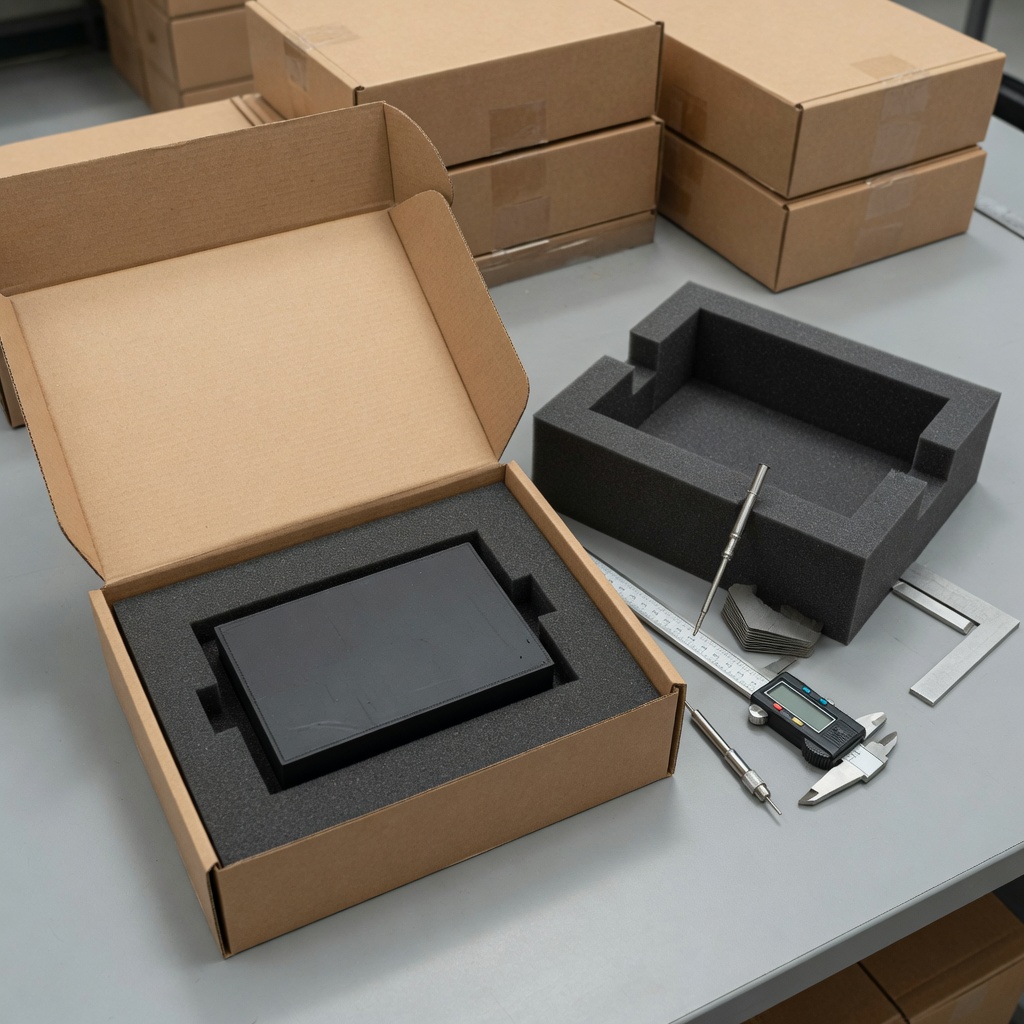
| Finished insert | Charcoal-grey closed-cell polyethylene foam with nominal outside dimensions of 280.0 mm length x 180.0 mm width x 45.0 mm thickness and an illustrative +/-1.0 mm tolerance at the specified external datums | Exact proposed material construction, instrument identity, calibration status, actual values and approved physical sample |
| Retention screen | Close the complete illustrative pack and perform 10 cycles. During each cycle, rotate the pack through 180 degrees, hold it inverted for 2 seconds, return it upright and hold it for 2 seconds. The product must not leave the cavity, the insert must remain within the approved position boundary and no buyer-defined damage may occur | Setup photographs, sampled-unit identities, observations and authorized pass, fail or concession disposition |
Using only these illustrative nominal assumptions, the centered long-axis clearance is 0.5 mm per side, derived from the 121.0 mm cavity length and 120.0 mm product length. The centered short-axis clearance is 0.5 mm per side, derived from the 81.0 mm cavity width and 80.0 mm product width. The nominal foam floor beneath the cavity is 9.5 mm, derived from the 45.0 mm insert thickness and 35.5 mm cavity depth. These are example calculations effective only as of the illustrative RFQ issue date and must be verified in the supplier quote and controlled drawing.
The calculations do not include product tolerance, foam compression, cavity taper, conversion variation, surface friction, accessory loading or movement inside the outer box. They therefore do not establish acceptable fit. Approve fit through a controlled physical trial using production-representative components at their named revisions.
The illustrative inversion screen is only a buyer-created retention check. It is not a transport-performance test because no distribution hazard, conditioning method or validated severity has been specified. Any drop, compression, vibration or handling test needs a separately approved procedure, complete pack configuration, conditioning basis, severity, orientation, failure criteria and responsible party.
Sampling and box insert defect decisions
The supplied QCADvisor page describes cartons being selected randomly from a production batch for packaging inspection (source). Convert that context into a purchase instruction requiring the inspector to select units from the completed, presented production lot. Supplier-prepared convenience samples should not replace inspector selection.
The same page discusses AQL-oriented inspection, but it is not the official text or sampling table for a buyer-selected framework. An instruction such as inspect to AQL is incomplete. Before issuing the purchase order, the buyer's quality owner should define:
- The inspection lot and whether output from different materials, colors, tools, cavities, lines or production periods may be pooled.
- The verified sampling framework and its applicable title, part, edition and inspection status where those fields are used.
- The inspection level, sample-size derivation and acceptance and rejection values taken from the buyer's controlled source.
- Buyer-defined defect classes and the decision criterion assigned to each class.
- Separate treatment for any characteristic classified as critical through the buyer's product-risk review.
- The response to rejection, including containment, sorting, rework, reinspection, concession authority and shipment hold.
If a sampling standard is selected, its requirements come from the verified official text and become a purchase control only through the buyer's applicable contract documents. The cited overview does not establish a standard requirement for this order, a supplier's company practice or certification held by any party.
| Buyer-defined class | Candidate box insert condition | RFQ treatment |
|---|---|---|
| Critical | A verified condition creating a buyer-documented safety or destination-compliance risk | State the expressly approved decision rule and require formal lot disposition |
| Major | Wrong revision, missing insert, wrong material, product does not fit, approved removal causes prohibited damage, retention screen fails or a functional dimension is outside tolerance | Count under the buyer's major criterion and hold affected output pending containment |
| Minor | Cosmetic, trim or finish variation outside the approved boundary that does not affect fit, protection, removal, packing or the buyer-defined presentation requirement | Count under the buyer's minor criterion and compare it with the approved boundary sample |
These classifications are candidate buyer controls, not classifications imposed by a cited source or standard. Confirm them against the actual product risk assessment and purchase documents.
Inspection evidence and shipment release
Use the controlled product, insert, outer box, accessories and packing sequence during sample approval and final inspection. This applies the fit-related context from the ZHY Packaging source without treating that source as proof of production conformity.
The shipment-release file should contain:
- Purchase order, SKU, production lot, presented quantity and all applicable product and packaging revisions.
- Inspection date and location, completed-lot status and any output unavailable for sample selection.
- Sampling instruction, sample-selection record, sampled-unit identities and defect-class results.
- Actual dimensional values with drawing characteristics, datums, tolerances, instruments and calibration status.
- Fit, insertion, removal, retention, workmanship and complete-pack results.
- Approved procedure, setup and results for any separately specified pack test.
- Photographs of the presented lot, selected units, packing method, measurements and each nonconformity.
- Defect totals, containment, corrective action and reinspection status where applicable.
- Authorized accept, reject, sort, rework, concession or shipment-hold decision.
A pass-or-fail mark without the underlying measurements does not provide the dimensional evidence requested by this buyer control. A concession should identify the affected lot and requirement, approving authority, rationale, containment and expiry condition; it should not silently change later-production criteria.
If a quotation includes a management-system, forestry, recycled-content, material or other certification claim, request the current document, holder, issuing body, covered site, scope, validity and applicability to the quoted insert. Do not imply certification without current, scope-matched evidence. Certification evidence does not replace the specified dimensional, fit, workmanship or pack-test records.
Normalize box insert supplier quotations
Use a mandatory commercial return schedule so that omissions and deviations remain visible before award.
| Quote component | Required supplier response |
|---|---|
| Recurring insert supply | Unit-price basis, quantity basis, exact construction, packing method, currency, delivery term, named European delivery location and exclusions |
| Tooling | Tool description, ownership, storage, maintenance, replacement conditions and change cost |
| Samples | Sample type, material and process equivalence, quantity basis, timing, charge and freight treatment |
| Quality control inspection support | Production-lot access, completed-lot presentation, document preparation, inspector waiting-time basis and staff support |
| Testing | Quoted procedure, sample source, complete packed configuration, responsible party, location, timing, report and retest charge |
| Production timing | Approval dependencies, material timing, production timing in calendar days, capacity in units per stated period and shipment-readiness basis |
| Nonconformity response | Sorting, rework, replacement, reinspection, disposal, freight and corrective-action responsibility |
| Documents and certifications | Document name, holder, issuing body, covered site, scope, validity, quoted-product applicability and charge |
| Deviations | Consolidated list of every difference from the RFQ, drawing, sample, inspection plan or requested evidence |
State whether a blank supplier response means not offered, not confirmed or buyer clarification required. Prohibit unapproved substitutions after sample approval and require written disposition before affected production begins.
Europe-specific box insert procurement controls
The cited packaging pages are not European legal sources. Use the following table only to route procurement evidence and obtain an applicability decision from the buyer's qualified legal or compliance owner for the actual insert, packed product and destination.
| Destination scope | Procurement control |
|---|---|
| EU destination | Name the destination Member State. Record buyer-confirmed EU-level requirements separately from any requirements specific to that country |
| EEA destination outside the EU | Maintain a separate applicability decision and evidence row rather than copying the EU file automatically |
| UK destination | Maintain a buyer-approved requirements and evidence row separate from the EU and EEA files |
| Other European destination | Obtain a country-specific review and request only evidence confirmed as applicable to that destination |
| Multiple European destinations | Use a destination matrix mapping every buyer-confirmed document, declaration, marking, waste control or other obligation to each release destination |
The supplier should confirm only the documents and controls it can support for the quoted material, production site and destination. Commercial acceptance, quality acceptance and destination-compliance review should have named owners so that approval in one area is not treated as approval in another.
Evidence method and source contexts
| Supplied source | Context used | What the source does not establish here |
|---|---|---|
| ZHY Packaging | Insert sample-approval variables, including product fit, removal, material, thickness, cavity, dieline and outer-box context | Supplier capability, production conformity, customer outcomes or European legal applicability |
| ONESILQ | Stage-based packaging controls and possible structural or mechanical checks | A mandatory test, applicable severity or supplier-specific control plan for this insert |
| QCADvisor | Production-batch sample selection and visual, dimensional, material, mechanical, labeling and AQL-oriented inspection context | Official sampling tables, purchase-specific decision values, legal compliance or certification |
The methodology was a structured comparison of the supplied source contexts. Explicit process statements were attributed to their pages and translated into buyer-controlled RFQ fields, decision gates and evidence records. Recommendations extending beyond those statements are identified as buyer controls. Numerical content is isolated as an illustrative assumption set rather than presented as measured production data.
Author scope: Vincent Xi is the Editorial Author. The article does not claim a factory visit, inspection, test, client outcome, certification or supplier-performance experience.
Limitations and what to verify
The supplied sources do not provide destination-specific European legal analysis, official standards text, purchase-specific sampling tables, product fragility data, material-specific tolerances, acceptable cavity clearance, transport hazards, validated test severity, supplier capability evidence or verified customer outcomes. They do not establish that a named sampling or test method is suitable for every box insert order.
Before order and production release, verify the actual product dimensional range and mass, controlled revisions, exact material construction, product-contact suitability, cavity tolerances, tolerance stack, measurement method, complete packing sequence, distribution risks, destination requirements, sampling plan, defect classifications, approved sample, test procedure, supplier deviations, document scope and release authority. Replace or expressly approve every illustrative assumption in the supplier quotation, drawings, purchase order and inspection booking.
Discuss Your Requirements
Review our manufacturing capabilities, then share your specifications for a supplier-fit review.