Box Insert Wholesale Supplier Sample Approval for United Arab Emirates Buyers
By Vincent Xi, Editorial Author, author profile. This byline names the editorial author of the page. It does not claim factory employment, a client project, a plant visit, or a personal trial of any insert.
United Arab Emirates buyers arranging box insert wholesale supplier sample approval should accept the insert only after a physical sample is checked against the real product and the result is written down. A photograph or a digital proof does not replace that check. The approval record should name the insert material, cavity depth, removal direction, fit inside the outer box, and whether the product shifts, rattles, or shows damage. The public pages cited below separate a structural fit sample from a pre-production sample meant to match production specifications, and they treat written approval as the operational freeze point that stops unrecorded changes.
This page addresses the procurement task of securing wholesale supply of a box insert. It does not rank suppliers, state a selling price, or report search demand metrics. Every exact number below is either tied to a cited source page, with the missing date context called out, or explicitly marked as an example calculation to recalculate on the live supplier quotation.
Why Written Sample Approval Controls Wholesale Supply
In wholesale supply, the box insert is a precision fit part. If cavity size, material thickness, or cavity position changes after the buyer assumes the design is closed, the bulk production lot can rattle, mark the product, or hold the carton lid open. A sourcing note published by Supplier Ally says an insert specification must cover product fit, structure, insert position, and materials, and that sample approval freezes the configuration. The same note instructs buyers to use a pre-production sample as the production reference and to require a written change request before any alteration is accepted (Supplier Ally).
For a United Arab Emirates order, that configuration freeze is also a schedule safeguard. An unrecorded revision can restart a cutting die or mold cycle while an inbound warehouse receiving date is already committed in the UAE. The approved sample, or a clearly marked duplicate held to the exact same revision, is the benchmark all production cartons must match. Supplier Ally separates structural samples—which evaluate size, fit, folding, closure, and insert stability—from printed samples. Physical fit must be accepted on an unprinted structural piece, while print, coating, and visual finish should remain on their own proofing workflow. One blanket signature line should not be used to accept both if only one aspect was physically reviewed.
The HS Packfactory box-insert page asks buyers to provide product dimensions, weight, photos, outer box style, and quantity when requesting a quotation and a sample (HS Packfactory). Those inputs establish the cavity geometry. Sending product dimensions without weight risks receiving an insert that compresses under a heavy item made from dense foam or molded pulp. Sending photos without the outer box style risks producing an insert that holds the item securely yet buckles inside the folding carton. Quantity dictates whether tooling is optimized for a short run or repeat wholesale releases. Buyers should submit dimensions in millimetres and weight in grams, as the cited source lists required parameters without prescribing a mandatory unit system.
Sample Types United Arab Emirates Buyers Should Name
The Gifts Pack custom packaging samples guide identifies four sample types and expressly includes box inserts within its classification. The count of four reflects the scope of that guide; it is not a market census, and the undated online excerpt represents a practical procurement framework rather than a formal industry standard (Gifts Pack).
Stock samples allow an initial inspection of a material grade or standard construction the supplier already produces. They demonstrate how a specific board weight, molded pulp recipe, or foam density presents in hand, but they do not verify that a custom cavity will hold a specific product. Structural samples test product fit and insert compatibility. This is the required stage while pocket dimensions, wall clearance, and product extraction paths remain open. Pre-production samples match full production specifications for a final verification of dimensions, materials, surface finishes, and EVA foam inserts. Digital proofs verify artwork alignment, colors, and dielines; they do not verify cavity depth, retention force, or ease of removal.
A disciplined sequence for wholesale ordering is clear: request a stock sample only if an unfamiliar substrate is under consideration. Request an unprinted structural sample to test with the physical product. Finally, request a pre-production sample and designate that exact physical unit as the production reference on the approval sheet. Approving a CAD dieline or digital render in place of a physical insert leaves fit unverified. Similarly, approving a structural piece cut from temporary substitute foam while expecting production-grade EVA foam to perform identically collapses the distinction Gifts Pack draws between an initial fit trial and a production-grade sample.
HS Packfactory states that its custom box inserts are manufactured in paperboard, corrugated board, molded pulp, EVA foam, and mixed materials (HS Packfactory). That list reflects that supplier's published manufacturing capabilities; it is not an exhaustive industry catalog, nor does it represent materials fabricated by this editorial page. The buyer must specify a distinct material grade on the RFQ. If a supplier identifies the substrate by board weight, pulp blend, or foam density rating, that code must be stamped on the sample identification tag and referenced in the purchase agreement. Any sample arriving in a substitute material should be rejected unless a formal deviation permit is authorized in writing.
Gifts Pack advises buyers to define insert type, material, and cutout style in their request. All three parameters must be incorporated as mandatory RFQ fields. The insert type designates the structural family (such as paperboard dividers, corrugated platforms, molded pulp trays, or routed EVA foam). The material specification must state the technical grade or density rating rather than subjective trade names. The cutout specification must define whether openings are through-cut apertures, blind routed pockets, finger access scoops, or friction retention ribs. When matching an existing outer container, provide the internal length, width, and depth in millimetres alongside lid closure mechanics. Because none of the cited sources establish universal tolerance standards, the allowable tolerance on cavity dimensions in millimetres must be defined by the supplier for both the sample and mass production.
Fit, Depth, and Removal Verification Before Sign-Off
The Gifts Pack verification guideline requires checking that an insert holds the product firmly without shifting, rattling, or damage (Gifts Pack). HS Packfactory defines sample approval as explicit confirmation of product fit, insert depth, removal direction, box matching, product movement, and packing stability prior to mass production (HS Packfactory). Together, these sources establish a practical bench verification routine, though neither cites an ASTM/ISTA test standard, specific drop height, or numeric movement threshold.
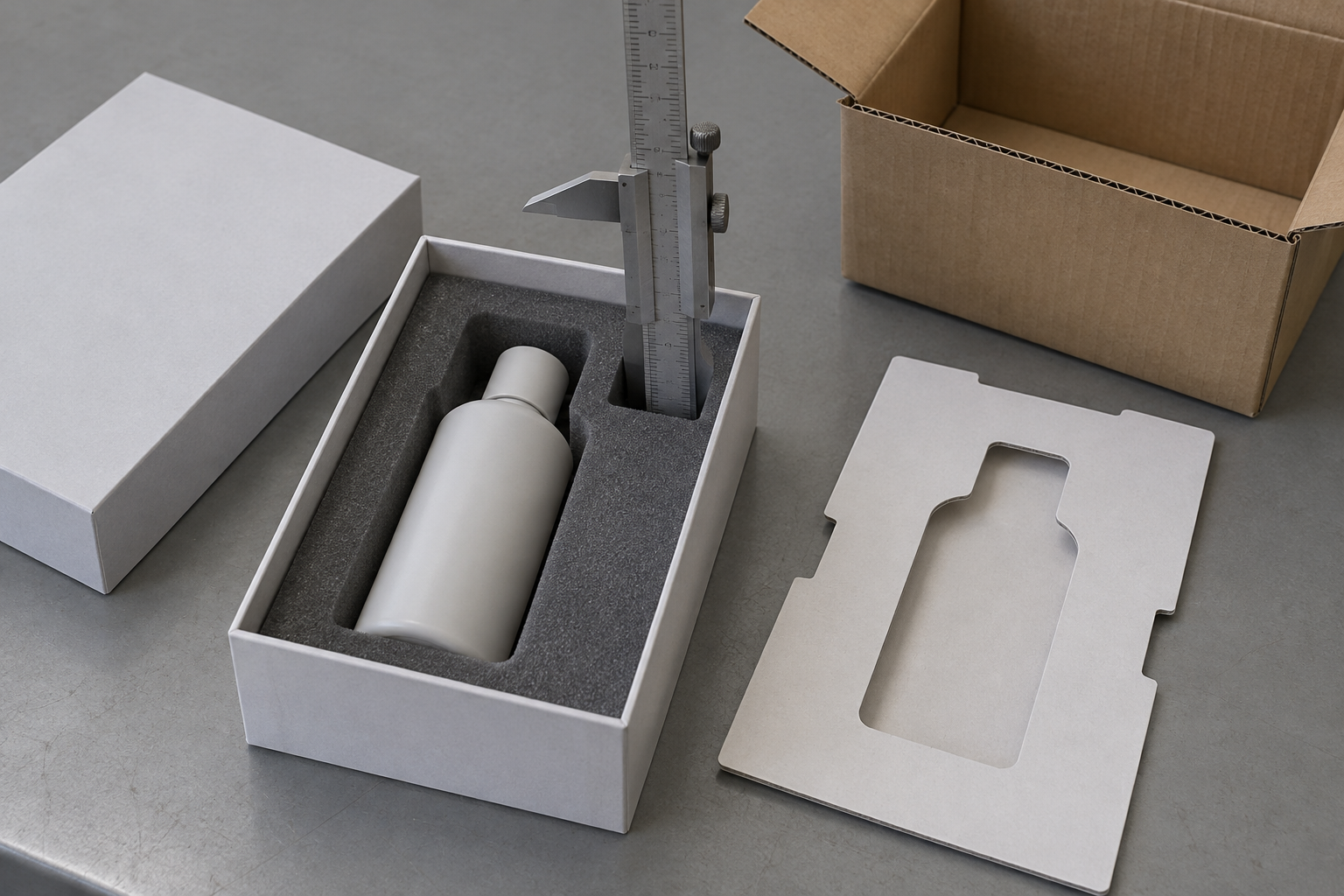
To conduct the bench check, insert the actual product in the exact orientation packers will use on the assembly line. Close the outer box, tilt it horizontally, and listen for internal rattling or movement. Extract the product along the intended removal path, confirming that cavity walls do not tear, surfaces do not scuff, and specialized tools are not needed. Check that the insert sits flush without bowing the carton walls or preventing lid closure. After initial insertion and removal cycles, examine the product surface for pressure marks, scuffs, or indentation. Supplier Ally confirms that the actual product must be evaluated inside the sample for protective performance and shipping carton packing, rather than evaluating the insert as an empty component (Supplier Ally).
Log each criterion on an inspection form with a clear pass or fail. If cavity depth deviates from expectations, record the specified depth versus measured depth in millimetres. Because the cited sources omit numeric displacement tolerances, buyers should establish an explicit internal benchmark on the purchase order. An example buyer-defined acceptance standard—developed for this checklist and not derived from the cited literature—is: zero visible shift when the packed container is rotated 90 degrees along all three axes, accompanied by zero surface scuffs after three extraction cycles. Buyers must label this standard as an internal requirement.
Carton packing stability requires similar verification. Determine whether the insert was evaluated as an isolated primary pack or within a packed corrugated master carton configured for wholesale freight. The literature advises testing packing stability but does not supply drop profiles or ISTA vibration parameters. If a standardized transit protocol is required for delivery into the UAE, specify the standard and edition in the RFQ and mandate that the supplier clarify whether certified laboratory testing is included, quoted as an optional service, or excluded.
Decisions to Close During Sample Approval
The following matrix outlines key procurement decisions, their technical definitions, the supporting source documentation, and the items buyers must verify on a quotation.
| Decision | What to specify | What the cited pages support | What to verify on the quote |
|---|---|---|---|
| Sample stage | Stock, structural, pre-production, or digital proof | Gifts Pack defines four sample categories; structural samples verify fit and compatibility; pre-production units match production specifications including EVA foam inserts | Which sample stages are covered in the baseline price, and which physical unit serves as the frozen production reference |
| Design inputs | Product dimensions, weight, photos, outer box style, and quantity | HS Packfactory identifies these data points as required RFQ and sampling inputs | Measurement units in millimetres and grams, outer carton dielines, and bulk volume tiers |
| Substrate & cavity | Insert structural type, material grade or density, and cutout style | Gifts Pack directs buyers to define all three; HS Packfactory lists paperboard, corrugated, molded pulp, EVA foam, and mixed substrates | Exact board weight or foam density codes, with written confirmation that sample materials match bulk runs |
| Acceptance criteria | Secure retention, zero shifting, zero rattle, zero product damage, correct cavity depth, extraction path, and carton fit | Gifts Pack requires verification of firm hold without shifting, rattle, or damage; HS Packfactory requires fit, depth, removal direction, box match, movement, and packing stability | Objective pass/fail criteria, measurement tools used, and confirmation that the physical product was tested |
| Configuration control | Formal written sign-off freezing the insert configuration | Supplier Ally notes approval freezes configuration, pre-production units serve as reference, and alterations require written change requests | Designated approval signatories, drawing revision control numbers, and disposal protocols for obsolete samples |
| Manufacturing schedule | Sampling timeline followed by bulk production lead time | HS Packfactory cites sampling at 3-7 days after artwork and structural confirmation, and bulk production at 15-20 days post-sample approval | Business days versus calendar days, trigger milestones, and export readiness dates |
Digital proofs must remain restricted to graphic placement, dielines, and print treatments. Never allow a digital proof signature to serve as physical cavity approval. Isolating these sign-offs prevents quality disputes where print sign-offs are misconstrued as dimensional approvals.
Lead Times to Recalculate Before a United Arab Emirates Delivery Promise
The lead-time figures published on the HS Packfactory box-insert page must be applied with their original scope. Sampling is quoted at 3-7 days following structural, material, and artwork confirmation. Mass production is quoted at 15-20 days following sample approval. The unit of measure is days. This scope represents an individual manufacturer's published schedule and is not an aggregated benchmark of box insert wholesale suppliers delivering to the United Arab Emirates. Furthermore, the undated excerpt lacks an as-of date. Both ranges must be reconfirmed on a live quotation prior to establishing delivery commitments (HS Packfactory).
Example lead-time calculation (for planning purposes; verify on supplier quotation): combining the upper published sampling limit of 7 days with the upper mass-production limit of 20 days yields 27 days. Combining the lower published limits of 3 days and 15 days yields 18 days. Both calculations assume seamless transitions between phases without artwork iterations, sample transit delays, or tooling adjustments. Neither figure includes international freight transit to a United Arab Emirates port or inland facility. These sums must not be entered into purchase orders without supplier validation. Furthermore, if artwork or structural drawings remain unfinalized, the sampling clock has not commenced under HS Packfactory's defined criteria.
None of the three cited publications state whether initial sampling fees are credited against bulk invoices. Commercial terms regarding sample charge deductions cannot be assumed from this evidence. Sample manufacturing costs, international courier charges for sample delivery, remake fees for non-conforming samples, and invoice credits must appear as itemized entries on the quotation.
Factory production time is separate from landed delivery time. The source materials discuss box insert fabrication within a manufacturing context in China; they do not publish air-freight transit times, ocean shipping schedules to UAE ports (such as Jebel Ali), local customs clearance durations, import duties, or UAE conformity labeling requirements. Buyers must instruct suppliers and freight forwarders to separate schedules into three milestones: sample delivery date, factory production completion date, and landed delivery date at the UAE receiving facility. Additionally, environmental performance under regional temperature and humidity extremes is not documented in the source texts. For sensitive goods, request substrate performance specifications from the supplier and test approved samples under expected storage and transport conditions in the UAE rather than relying solely on factory-floor evaluations.
RFQ Checklist
- Ask the supplier to confirm in writing which sample stage is produced first and which physical pre-production sample serves as the binding reference for bulk material, construction, and packing stability.
- Require the manufacturer to fabricate the sample strictly according to the product dimensions in millimetres, weight in grams, product photos, outer box dimensions, and order quantity provided by the buyer.
- Specify the insert structural family, material grade or foam density code, and cutout geometry as non-substitutable parameters on both the sample request and the bulk purchase agreement.
- Ask the supplier to define dimensional tolerances in millimetres for cavity length, width, and depth across both the initial sample and bulk manufacturing runs.
- Require an inspection sheet confirming that the actual product is held securely without shifting, rattling, or surface damage, and that cavity depth, removal direction, outer box fit, and packing stability meet pass/fail standards.
- Specify that written sample sign-off freezes the structural configuration and that any subsequent modification requires a numbered written change order before bulk production proceeds.
- Ask the supplier to quote sampling and mass-production lead times in days, identifying the exact milestone that triggers each timeline and confirming whether published 3-7 day sampling and 15-20 day production ranges apply.
- Require the quotation to itemize sample creation fees, international courier freight, remake costs for non-conforming samples, and any bulk order credits, confirming commercial terms in writing.
- Ask the supplier and freight forwarder to separate factory production schedules from international shipping transit times into the United Arab Emirates, clarifying physical sample delivery responsibilities.
- Specify physical sample retention terms, including revision labeling on approved units and mandatory comparison of incoming bulk shipments against the retained benchmark before receiving sign-off.
Evidence Method and Limits
This analysis relies on the comparative evaluation of three public technical packaging pages, rather than proprietary factory audits or physical laboratory testing conducted for this article. The classification of four sample types (stock, structural, pre-production, digital proof), the instruction to specify insert type, material, and cutout, and the physical criteria for shift, rattle, and damage derive from the Gifts Pack packaging samples guide. The listing of insert substrates, buyer input parameters (dimensions, weight, photos, outer box style, quantity), inspection criteria (fit, depth, removal direction, box matching, movement, packing stability), and the 3-7 day sampling and 15-20 day production ranges derive from the HS Packfactory custom box-inserts page. The instructions regarding structural specification completeness, separating structural from printed samples, testing physical products, using sample approval to freeze configuration, and enforcing change requests derive from the Supplier Ally sourcing guide. The 18-day and 27-day totals represent basic addition of published bounds, provided solely to illustrate schedule modeling.
Procurement teams must observe several limitations when applying this data. The source excerpts are undated web publications; live supplier quotes and updated commercial documentation supersede all published figures. The lead-time ranges represent one specific supplier's operational estimates and cannot be assumed across the broader wholesale packaging sector or interpreted as landed delivery dates in the United Arab Emirates. No compliance certifications, quality management registrations, factory audit ratings, or third-party test reports are claimed or implied. Furthermore, standards organizations (such as ISO or ISTA) are not cited because the underlying sources do not reference specific standard editions. Factory operating practices must not be conflated with accredited third-party certifications. Import clearance, UAE customs classifications, GCC conformity standards, and local value-added tax rules fall outside the scope of the analyzed source materials.
Vincent Xi holds the role of Editorial Author. The approved basis for this byline does not include proprietary manufacturing trials, on-site supplier audits, or custom packaging tests. Consequently, quality control remains the buyer's operational responsibility: establish the correct sample category, verify the physical product inside the cavity, document findings on a structured pass/fail inspection sheet, freeze the approved revision, and ensure quotations clearly separate factory production timelines from freight transit into the United Arab Emirates.
Discuss Your Requirements
Review our manufacturing capabilities, then share your specifications for a supplier-fit review.