Hang Tag Sourcing Minimum Order Quantity for United Arab Emirates Buyers
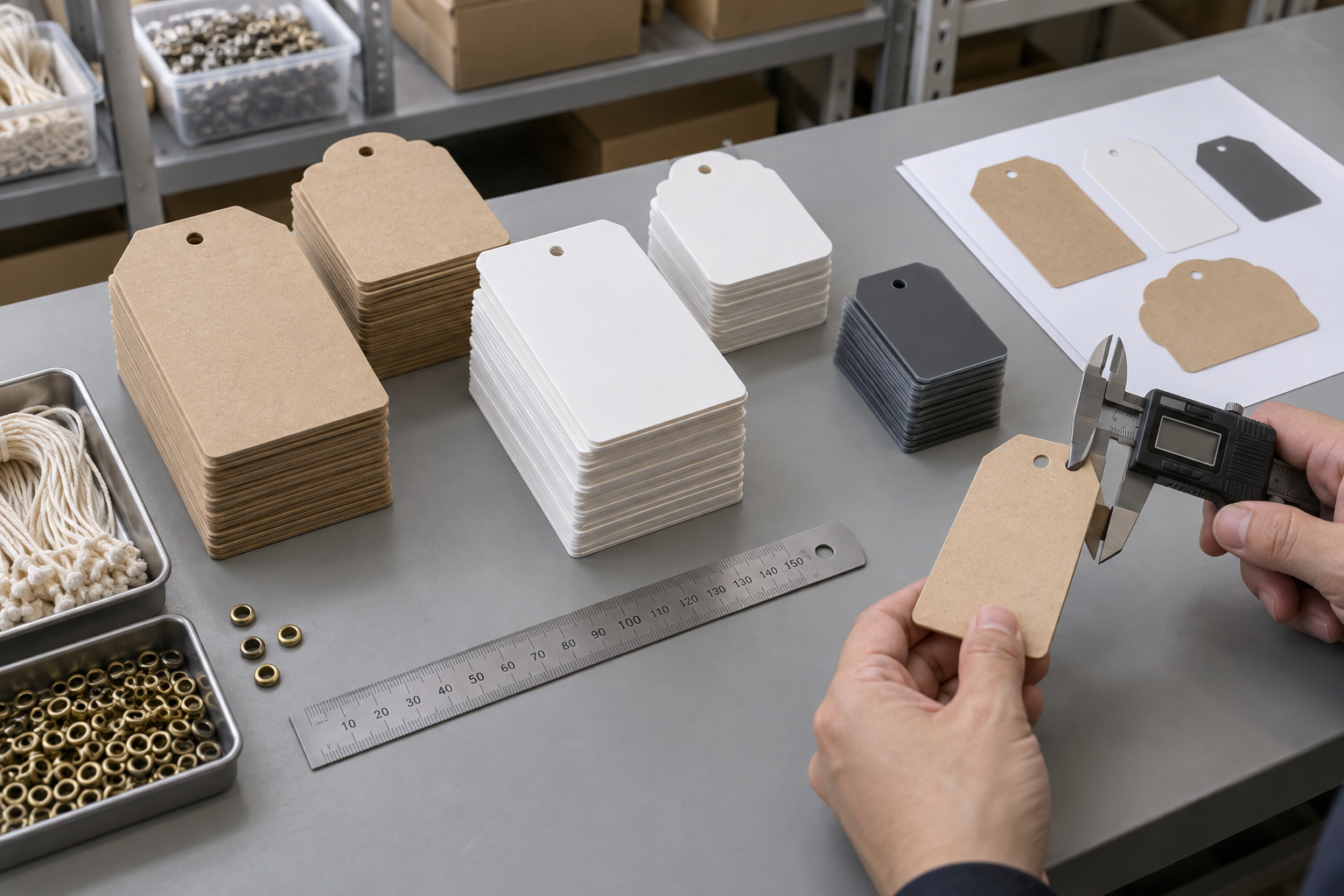
Editorial byline: Vincent Xi, Editorial Author, https://customlogothing.com/authors/vincent-xi/. This briefing does not claim a factory visit, a client program, or a first-hand production trial. It compiles and evaluates published supplier catalogs and procurement guides so a United Arab Emirates buyer can specify a hang tag production run and verify quoted minimum order quantity thresholds prior to issuing a commercial purchase order.
For United Arab Emirates apparel and retail brands, hang tag procurement does not operate under a single global minimum order quantity. Published commercial data reveals three distinct baselines: an entry-level floor of 100 units on a United States commercial printing portal, a manufacturing baseline starting from 500 pieces on a Shenzhen export factory catalog for general tag runs, and structured price-break tiers established at 250, 500, 1,000, 2,500, and 5,000+ units in a North American brand-tag ordering guide. None of these benchmarks constitutes a statutory standard for the United Arab Emirates market. Sourcing teams must establish the supplier's binding minimum order quantity on a formal quotation once dimensions, paper stock, ink coverage, and post-press embellishments are locked.
What the minimum order quantity covers in hang tag procurement
In custom hang tag procurement, the minimum order quantity (MOQ) defines the lowest volume of fully finished tags a converter will produce for an individual stock-keeping unit (SKU) or die-line. Suppliers quote this threshold strictly in finished units, rather than sheet counts or uncut master rolls. Securing the headline minimum does not grant volume pricing; an apparel buyer in the United Arab Emirates ordering 100 units will absorb setup amortization that results in a significantly higher unit rate than an order scaled to 2,500 units.
Scope and finishing dependencies dictate effective production minimums. The 100-unit minimum published by Hang Tags Co applies to its United States custom printing service, which advertises an entry price of USD 0.20 per unit on its bulk-order portal. That catalog outlines support for custom dimensions, contour die-cuts, PDF proofing, recycled kraft paper, coated card stock, waterproof PVC, offset lithography, foil stamping, embossing, and pre-strung attachments (Hang Tags Co bulk-order page). However, the listed USD 0.20 rate serves as an opening entry price rather than a flat rate across complex finishes or heavy card stocks, and it excludes customs tariffs, freight, or local handling within the United Arab Emirates.
HS Packfactory, an export manufacturer based in Shenzhen, lists an MOQ starting from 500 pieces for standard custom hang tag production. Its documentation covers custom die-cut geometries, various paper calipers, CMYK and Pantone color matching, hot foil stamping, blind embossing, metal eyelets, attachment cords, and scannable barcode panels, with stated turnaround times of 3–7 days for physical sampling and 15–20 days for mass production after artwork approval (HS Packfactory hang tags). The catalog condition "from 500 pcs for many projects" confirms that labor-intensive tooling, double-thick duplexing, or specialty foil configurations may command higher unit floors.
A manufacturing guide published by CBF Label indicates that commercial producers conventionally establish quantity price breaks at 250, 500, 1,000, 2,500, and 5,000+ units. Standard hang tag profiles span from 1.5 inches by 2.5 inches up to 3.5 inches by 5 inches, utilizing paperboards ranging from 100-pound cover stock through 18 pt caliper card stock. CBF Label outlines a workflow requiring vector artwork files and digital proof sign-off, leading into a 7–14 day manufacturing window for domestic United States production prior to dispatch (CBF Label ordering guide). While "most manufacturers" reflects broad industry practice, it remains an author generalization rather than an exhaustive census of converters shipping into the United Arab Emirates.
These three records form the factual basis of this analysis. Because public catalog pages rarely feature visible revision dates, buyers must treat web-published quantities as indicative references and secure firm, dated quotations from bidding vendors.
How quantity bands change the unit price you should compare
Procurement evaluations fail when buyers compare an entry-level 100-unit quote directly against a tiered 5,000-unit production quote. Unit rates in dirhams (AED) or US dollars (USD) must be benchmarked across identical volume thresholds to evaluate setup amortization.
Published benchmark parameters:
- 100 units: Entry minimum published by Hang Tags Co for US custom hang tag printing, accompanied by a starting price of USD 0.20 per unit on its bulk page. Scope: Entry-tier digital or offset runs. As-of context: Publicly listed catalog content without an explicit revision date.
- 500 pieces: Baseline minimum stated by HS Packfactory for general manufacturing projects. Scope: Factory-direct production covering sampling (3–7 days) and volume runs (15–20 days following final artwork approval).
- 250, 500, 1,000, 2,500, and 5,000+ units: Tiered volume breaks documented by CBF Label. Scope: Standard commercial sizing (1.5 x 2.5 inches to 3.5 x 5 inches) and stock ranges (100-pound cover to 18 pt card stock), reflecting 7–14 day factory production windows.
Example calculation (illustrative baseline, not a formal quote): Applying the Hang Tags Co entry rate of USD 0.20 per unit to its 100-unit baseline generates an initial print subtotal of USD 20. This arithmetic assumes baseline ink and card stock without accounting for premium die charges, stringing surcharges, proof iterations, international freight, cargo insurance, or United Arab Emirates customs clearance fees. Sourcing teams must verify this subtotal on a formal commercial quote.
Second example calculation (scaling illustration, not a quote): Multiplying USD 0.20 per unit across 500 units yields USD 100. This calculation merely demonstrates linear volume scaling; it does not imply that HS Packfactory quotes USD 0.20 per unit for its 500-piece baseline. In standard print economics, the price-break tiers outlined by CBF Label mean piece prices drop as order quantities expand. Assuming a flat per-unit rate overstates large-volume expenditure and obscures the cost penalties of ordering at minimum quantities.
For procurement across the United Arab Emirates, buyers should request pricing for at least two identical configurations: one at the supplier's strict minimum order quantity, and one at the subsequent volume tier (such as 1,000 or 2,500 units). This comparison illuminates the marginal cost per tag against physical warehousing overhead and the potential obsolescence risk of seasonal retail artwork.
Finishes, stocks, and size versus the minimum order quantity
Tooling investments and press changeovers are the primary variables that push actual production minimums beyond advertised minimum order quantity baselines. Suppliers rarely document individual minimums for every distinct finishing technique on their public portals. Buyers must not assume that advanced post-press embellishments remain accessible at 100 or 500 pieces.
Hang Tags Co includes offset printing, hot foil stamping, blind embossing, contour die-cutting, recycled kraft paper, coated board, and waterproof PVC in its broad capabilities menu, alongside its 100-unit minimum. However, the catalog does not state whether custom foil dies or specialty PVC substrates remain viable at that 100-unit threshold without supplemental setup surcharges. The procurement package must require the supplier to confirm whether requested finishes alter the minimum batch size.
HS Packfactory groups CMYK four-color process, spot Pantone inks, foil stamping, embossing, punched eyelets, stringing, and dedicated barcode areas under its "from 500 pcs" framework. Formulating spot Pantone inks or cutting stamping dies requires dedicated press makeready that is sensitive to order volume. Sourcing teams must state exact Pantone formulas or specify CMYK-only artwork, while confirming whether barcode white panels necessitate dimensional die adjustments.
The standard dimensions cited by CBF Label (1.5 x 2.5 inches to 3.5 x 5 inches) represent common rectangular trims. Custom geometries or complex perimeter silhouettes require dedicated steel-rule dies, which print houses may refuse to tool below 500 or 1,000 units. Furthermore, CBF Label conditions its 7–14 day production clock on vector artwork approvals and digital proof sign-off; supplying raster graphics delays plate imaging and invalidates scheduling.
Substrates cited across sources represent commercial trade designations rather than certified mill specifications: 100-pound cover and 18 pt board from CBF Label, versus recycled kraft, coated board, and waterproof PVC from Hang Tags Co. The sources provide no laboratory metrics on fiber composition or humidity resistance. For warehouse storage and logistics handling within the United Arab Emirates, the primary verified distinction is between waterproof PVC and conventional untreated cellulose paperboards. Sourcing managers must define required caliper and coating on the RFQ, as public sources do not provide certified moisture or temperature performance data.
Accessory specifications also influence delivered counts. Both Hang Tags Co (pre-fitted strings) and HS Packfactory (eyelets and cordage) list accessories as production options. The RFQ must establish whether the agreed minimum order quantity applies to fully assembled, strung units or flat, unstrung cards. Unstrung shipments represent a receiving non-compliance if the purchase order mandates ready-to-hang merchandise.
Buyer decision table for matching the order quantity
Evaluate each procurement factor against written vendor quotes prior to releasing a deposit. Sourcing origin fields identify global supply lines into the United Arab Emirates and do not represent secondary sales regions.
| Decision point | Parameter to lock | Source evidence | Buyer verification before approval |
|---|---|---|---|
| Headline minimum | Lowest finished-tag volume vendor will process | 100 units on Hang Tags Co US portal; from 500 pcs for standard HS Packfactory jobs | Require quote to specify count unit and state if complex tooling raises the floor |
| Base unit price | Price per unit at stated minimum | USD 0.20 entry price on Hang Tags Co portal | Restrict USD 0.20 baseline to standard specs; do not apply to foil, emboss, or PVC without confirmation |
| Volume tier ladder | Progressive quantity price breaks | 250, 500, 1,000, 2,500, and 5,000+ units documented by CBF Label | Instruct bidders to state per-unit pricing at each verified volume break |
| Geometry and die | Finished trim size and perimeter shape | Standard envelope: 1.5 x 2.5 in to 3.5 x 5 in (CBF Label) | Detail measurements in millimeters; identify non-rectangular profiles requiring tooling fees |
| Board stock | Commercial grade, caliper, and coating | Kraft, coated card, waterproof PVC (Hang Tags Co); 100-pound cover to 18 pt card stock (CBF Label) | Mandate a specific substrate trade name and weight rather than open selections |
| Inks and finishes | CMYK, Pantone, offset, foil, embossing, barcodes | Listed on factory portals; per-finish quantity floors not documented | Secure written confirmation that requested embellishments do not raise the base MOQ |
| Proofing protocol | Pre-press verification milestone | PDF proof (Hang Tags Co); 3–7 day physical sampling (HS Packfactory); digital proof (CBF Label) | Sign off on vector proofs and attach approved artwork directly to the contract |
| Factory turnaround | Net production timeline | 15–20 days bulk production (HS Packfactory); 7–14 days for US manufacturing (CBF Label) | Isolate plant production days from international logistics transit into the UAE |
| Landed cost scope | Non-print commercial expenses | Landed UAE logistics costs omitted from cited sources | Budget air/ocean freight, marine insurance, and UAE import customs separately |
United Arab Emirates delivery, documents, and cost boundaries
This sourcing guidance addresses B2B buyers procuring tags for destination delivery within the United Arab Emirates. The reference suppliers operate out of North America and Shenzhen. Their public portals do not publish UAE Federal Tax Authority (FTA) VAT treatments, customs duty classifications, CIF/DAP shipping rates, or local climatic warehouse guidelines. Sourcing specialists must manage these international trade elements independently.
Turnaround parameters must be kept separate from shipping transit times. CBF Label outlines a 7–14 day factory schedule for US-produced goods following vector art approval, while HS Packfactory allocates 3–7 days for pre-production samples and 15–20 days for mass production. Neither schedule accounts for air cargo, ocean container shipping to Jebel Ali or Khalifa Port, customs processing, or local inland transport within the United Arab Emirates. Buyers must require that quoted turnaround days reflect factory gate readiness only.
Commercial documentation must support standard import clearance. Ensure that the vendor provides an itemized commercial invoice describing the commodity accurately (e.g., printed paperboard hang tags or PVC merchandise labels, quantity, and unit value), an official packing list verifying carton counts and net/gross weights, and a copy of the finalized pre-press proof. The cited source literature contains no references to third-party sustainability or process certifications, such as FSC chain-of-custody or ISO quality systems. Recycled kraft represents a vendor material descriptor rather than an independently verified environmental standard; Custom Logo Things does not assert that referenced suppliers possess formal accreditations without audited documentation.
Currency and commercial terms require clear demarcation. The solitary pricing metric in the evidence base is USD 0.20 per unit at the 100-piece threshold on a US print catalog. Local purchase orders settled in UAE dirhams must secure fixed exchange terms, agreed Incoterms 2020 rules, and formal quote expiration windows. The USD 20 and USD 100 sample calculations detailed above serve purely as arithmetical examples and must not be interpreted as landed costs within the United Arab Emirates.
RFQ Checklist
- Specify the finished size in millimeters and inches, the contour or die-cut, the hole or eyelet position, and whether the count includes string attached.
- Ask the supplier to state the minimum order quantity in pieces for this exact specification, and to state whether foil, embossing, Pantone, PVC, or a new die raises that minimum.
- Require the manufacturer to price at least two quantities on one specification: the stated minimum and the next price break they will honor, in the same currency, with validity dates.
- Specify one named stock on the quote, such as recycled kraft, coated card, waterproof PVC, 100-pound cover, or 18 pt cardstock, rather than leaving an open material menu.
- Ask the supplier to confirm print method, Pantone codes or CMYK-only art, any barcode area, and that vector artwork plus a PDF or digital proof is the approval gate before production days start.
- Require the quote to separate unit price, setup or die cost, string and eyelet cost, and freight, and to name the Incoterm, so a United Arab Emirates landed cost can be built outside the tag price.
- Ask the supplier for sampling lead time and mass-production days after artwork approval, and require those days to be labeled as production only, not as delivery into the United Arab Emirates.
- Specify the receiving acceptance check: finished-piece count, string attachment if ordered, the trim tolerance the supplier will accept, and a hold on any lot that does not match the approved proof.
How the figures were derived, and what to verify
Methodology. Quantities, the USD 0.20 unit entry price, dimensions, board classifications, sampling turnarounds, and factory lead times were extracted directly from the three publicly accessible manufacturer and guide portals cited in this review. No predictive search volumes, traffic models, or commercial difficulty rankings were utilized. Mathematical projections (USD 0.20 multiplied by 100 units to reach USD 20, and by 500 units to reach USD 100) are explicitly labeled as illustrative calculations based on flat pricing assumptions; they do not represent binding offers or landed import totals.
Two distinct source contexts provide the operational evidence: Context one encompasses manufacturer self-reporting (Hang Tags Co establishing its domestic 100-unit minimum and USD 0.20 entry point, and HS Packfactory defining its 500-piece baseline, finishing options, and lead times). Context two comprises a secondary industry procurement guide (CBF Label) summarizing common commercial tiering (250 to 5,000+ units), standard sizing envelopes, and 7–14 day operational cycles. In commercial disputes, primary manufacturer quotes supersede generalized procurement guides.
Limitations and verification checkpoints. The underlying catalog data lacked publication or revision dates; buyers must re-verify all volume floors and unit pricing at the time of quotation. Portal marketing phrases such as "starting at" or "from" represent base-case scenarios that frequently escalate once specialty coatings or heavy dies are selected. The source material contains no specific data regarding United Arab Emirates port charges, regional freight tariffs, or warehouse humidity limits, and mentions no formal ISO or FSC accreditations. The Vincent Xi author citation functions solely as an editorial byline and does not represent an engineering test report or on-site facility audit.
Do not issue procurement deposits until the supplier confirms the final minimum order quantity, volume price breaks, substrate specifications, vector proof approvals, and distinct manufacturing lead times on a unified quotation document.
Discuss Your Requirements
Review our manufacturing capabilities, then share your specifications for a supplier-fit review.