Insert Card OEM Packing Requirements for United States Buyers
By Vincent Xi, Editorial Author
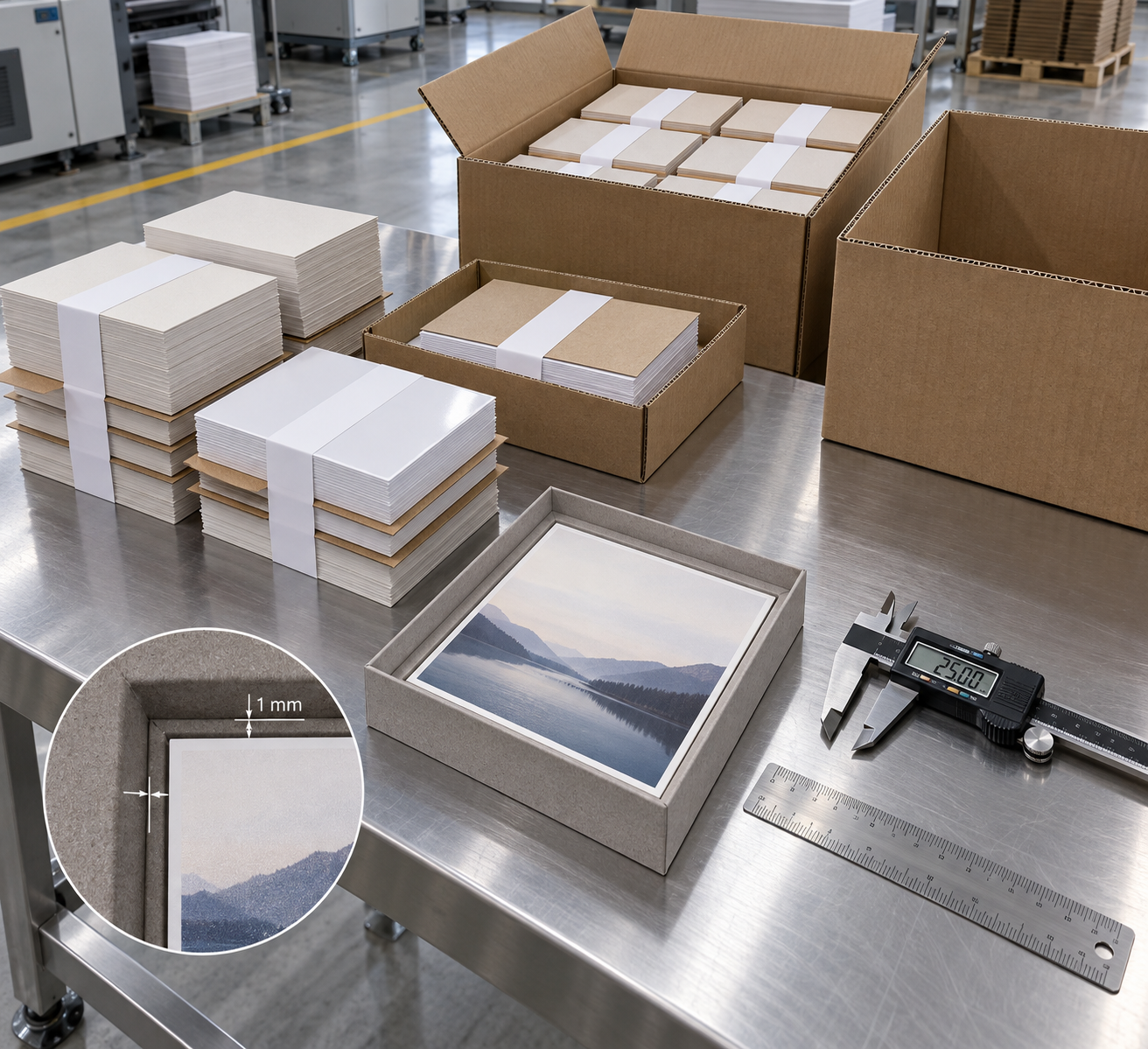
United States buyers placing an OEM order for printed insert cards should establish packing requirements before mass production begins rather than resolving them at receipt. A comprehensive purchase order packing instruction covers five mandatory release gates: finished count verification against the purchase order, card version and SKU segregation, cards per bundle, bundles and pieces per master carton, and the packing method (flat, nested, or placed at pack-out). Gentle Packing confirms finished piece quantities, card versions, SKU separation, bundle counts, carton quantities, and packing instructions against order requirements prior to dispatch, emphasizing that multi-SKU wholesale orders require clear identification by design or product reference so that different card versions remain segregated through packing and distribution (Gentle Packing). HS Packfactory indicates that pre-mass-production review covers insert structure, cavity layout, dielines, sample fit, packing method, and the export carton plan, with pack methods spanning flat-shipping units assembled at packing, nested units, or pre-assembled units; it advises B2B OEM buyers to confirm quantity per outer box, bundle method, labels, and export carton dimensions (HS Packfactory).
Author Experience Note: Per the author profile for Vincent Xi, Editorial Author at Custom Logo Things, no first-person factory trials, proprietary lab testing, or individual client outcomes are claimed for this analysis. All requirements and inspection checks are compiled directly from published manufacturer documentation and verified procurement formulas. Figures below cite supplier technical parameters or represent explicit example calculations to verify in supplier quotations.
United States Packing Requirements in Insert Card Manufacturing
For United States OEM programs, packing requirements serve as an integral technical manufacturing specification. They dictate whether a domestic receiving warehouse or third-party logistics (3PL) fulfillment center can feed the correct card to the matching assembly line without opening every carton for manual sorting. A brand story card, an instruction leaflet, a warranty slip, and a regional compliance card often share a common paper grade and print run, but mixing them in master cartons leads directly to line stoppages.
Procurement teams must specify the exact handling unit consumed at the United States assembly station. When manual packaging lines insert one card per retail package, supplier bundles should represent exact multiples of shift or batch quantities, and master cartons must represent an exact multiple of those bundles. When multiple artwork versions ship within a single consignment, each version requires designated inner and outer identification. Gentle Packing's documented release sequence—verifying order quantity, design version, SKU separation, bundle count, carton quantity, and packing instructions before shipment—provides a baseline verification framework (Gentle Packing). This reflects that supplier's published operational protocol rather than an ISO or industry-wide standard certification.
Landed cost and freight predictability depend directly on packing definitions. Quoted piece pricing ignores dimensional freight weight, pallet cube utilization, and sorting labor incurred when mixed SKUs arrive at domestic docks. Buyers must require quotations to specify cards per carton, external carton dimensions, and gross carton weight. Quotations that state vague terms such as "standard export packing" without dimensional commitments fail basic commercial controls.
SKU Separation, Bundle Counts, and Carton Quantities
Contract three distinct count tiers on the purchase order to prevent carton discrepancies:
- Order Quantity: Net accepted piece count per individual SKU and artwork revision.
- Bundle Count: Exact number of cards grouped before cartoning, including binding materials (kraft paper band, shrink film, or chipboard collar).
- Carton Quantity: Number of bundles and total card count per shipping carton, accompanied by clear carton markings.
Gentle Packing notes that multi-SKU production runs require distinct identification by design or product reference to preserve segregation through carton pack-out and dispatch (Gentle Packing). An internal artwork file name does not substitute for an external carton label. The physical exterior label must state the buyer SKU, artwork revision date, pack count, and purchase order reference.
Example calculation (verify in supplier quotation): Assume a United States buyer specifies 50 insert cards per paper-banded bundle and 20 bundles per export carton. Under this specification, carton capacity is calculated as:
$$\text{Carton Capacity} = 50\text{ cards/bundle} \times 20\text{ bundles} = 1,000\text{ cards/carton}$$
An order of 20,000 cards of a single SKU yields exactly 20 cartons (20,000 ÷ 1,000). If that order is divided across four SKUs of 5,000 cards each, the rule produces 5 dedicated cartons per SKU, totaling 20 cartons, provided that no cross-SKU mixing occurs. This 50-by-20 configuration serves strictly as an illustrative baseline; neither referenced manufacturer mandates 50, 20, 1,000, or 20,000 units as a standard threshold.
Define carton balance rules for short production runs. If an overrun or underrun produces a partial bundle, mandate that partial counts appear on the exterior carton label. Consolidating residual quantities of SKU A into a carton containing SKU B violates basic SKU segregation protocols (Gentle Packing).
Flat, Nested, or Pre-Assembled Pack Methods
HS Packfactory defines three baseline packing configurations evaluated during pre-production reviews: flat-shipping units assembled at packing, nested units, and pre-assembled components (HS Packfactory). While originally detailed for structural packaging inserts, these classifications apply to printed insert card procurement based on insertion workflow:
- Flat Pack: Finished cards are stacked horizontally or vertically, separated by slip sheets or paper bands, for assembly into retail cartons downstream. This configuration optimizes shipping cube and minimizes transit freight, retaining insertion labor at the domestic facility.
- Nested Pack: Cards are seated into pre-formed trays, chipboard sleeves, or partitioned cartons to prevent scuffing and edge damage. While nesting shields delicate matte or spot-UV varnishes, the supplementary trays increase exterior carton dimensions.
- Pre-Assembled Pack: The card is pre-inserted into a structural box insert, product envelope, or retail kit at the card manufacturing origin. This reduces labor at domestic lines but requires coordination across component vendors.
HS Packfactory confirms that B2B OEM buyers should verify quantity per outer box, bundling method, carton labeling, and export carton dimensions before manufacturing release (HS Packfactory). Bundling styles suitable for heavy corrugated board may crush or mark lightweight paper cards, while tight bands can cause edge curling or ink set-off on high-gloss stocks. Require an approved production-grade packaging sample matching the exact card stock, lamination, and bundle height prior to mass packing.
Clearance and Insertion Fit at Pack-Out
When printed cards must integrate into interior box cavities or structural board wells, dimensional fit is an essential packaging requirement. Sizing documentation from 4over4 outlines two specific structural board allowances: an interior clearance allowance of approximately 1/16 inch per side on board, and an overall box expansion of up to 1/4 inch resulting from two insert walls combined with two clearance gaps. The same documentation recommends sizing structural inserts before final box manufacture, verifying dimensions against interior box measurements, and placing inserts and cards by hand at final pack-out (4over4).
These published figures represent specific board-insert manufacturing guidelines without specified publication dates, revision numbers, or caliper constraints. They do not constitute standardized clearances for flexible paper insert cards and do not represent internal test data from Custom Logo Things.
Worked assumption (to verify via physical fit sample): Applying 4over4's board allowance of 1/16 inch (0.0625 inch) per side yields a cumulative dimensional expansion of 0.125 inch (1/8 inch) across width and length:
$$\text{Total Allowance} = 2 \times 0.0625\text{ in.} = 0.125\text{ in.}$$
If a United States buyer applies this allowance to a printed card measuring 5.000 inches wide by 7.000 inches long, the receiving cavity dimensions calculate to 5.125 inches by 7.125 inches. These card dimensions are working assumptions. Lightweight paper cards often require narrower clearances (such as 0.03125 inch per side) to prevent shift and rattling, whereas thick multi-ply duplex cards or embossed stocks may require larger tolerances. Final cavity dimensions must be validated against physical production samples rather than nominal calculations alone.
The 1/4-inch (0.25 inch) total box expansion documented by 4over4 accounts for structural wall buildup plus clearance (4over4). If the OEM is purchasing loose printed cards without structural inserts, this 0.25-inch expansion factor does not apply to master carton calculations. When purchasing both cards and rigid structural inserts, document the card bundle stack height and the structural cavity wall thicknesses as separate lines on the technical dieline.
For hand-placed inserts, specify component sequence and orientation. Hand insertion requires clear instructions indicating whether the card faces upward or downward, which margin aligns with the box hinge, and whether tissue paper sits above or beneath the card. Sizing guidance describes a sequence of structural insert first, followed by printed tissue, and topped with the thank-you card (4over4). Match this sequence strictly to the intended retail unboxing design.
Labels, Export Carton Plan, and United States Delivery
HS Packfactory's OEM checklist includes outer box quantities, bundle methods, labels, and export carton dimensions (HS Packfactory). Integrate these parameters with the SKU identification protocols outlined by Gentle Packing (Gentle Packing) to establish carton labeling specifications.
Mandatory carton label specifications include:
- Buyer SKU and manufacturer production code listed in adjacent fields.
- Card version or revision code corresponding to approved artwork files.
- Exact piece counts per bundle and total piece counts per carton.
- Purchase order number and progressive carton sequence (e.g., Box 04 of 20).
- Country of origin markings and applicable buyer compliance statements.
The master carton plan must define outer length, width, and height; corrugated fluting and test grade (e.g., 32 ECT or 44 ECT); maximum pallet stacking height; and carton SKU restrictions. Consolidating different SKUs into a single carton reduces master carton count for smaller lots but creates sorting overhead and inventory risks at United States distribution points. For initial manufacturing runs, mandate single-SKU master cartons.
Example freight input (verify with carrier quotes): Applying the baseline assumption of 1,000 cards per carton (20 cartons for a 20,000-piece order), assume each packed export carton weighs 12.0 pounds with outer dimensions of 18 × 12 × 10 inches:
$$\text{Total Gross Weight} = 20\text{ cartons} \times 12.0\text{ lbs} = 240\text{ lbs}$$
$$\text{Carton Volume} = 18\text{ in.} \times 12\text{ in.} \times 10\text{ in.} = 2,160\text{ in.}^3 = 1.25\text{ ft.}^3$$
$$\text{Total Consignment Volume} = 20 \times 1.25\text{ ft.}^3 = 25.0\text{ ft.}^3$$
These dimensional inputs (12.0 lbs, 18 × 12 × 10 inches) are illustrative planning figures and do not originate from supplier specifications. United States buyers should calculate actual dimensional weight ($$\text{L} \times \text{W} \times \text{H} \div 139$$ for standard domestic air or carrier-specific dimensional divisors) using actual supplier pack-out measurements. This document provides no freight tariffs, customs duties, or Incoterms.
Final delivery acceptance must verify piece counts and SKU separation. Receiving docks should match packing slips, carton labels, and barcode scans before releasing goods to assembly lines. Deliveries arriving on schedule but failing SKU separation criteria do not meet pre-shipment compliance standards (Gentle Packing).
Decision Table for Approving the Pack
| Decision | Purchase Order Specification | Risk If Unspecified | Pre-Approval Verification |
|---|---|---|---|
| SKU Separation | Dedicated single-SKU master cartons or explicit carton maps | Card versions cross-contaminate product lines | Audit artwork revision codes and exterior carton markings against PO (Gentle Packing) |
| Bundle Count | Exact pieces per bundle and approved banding material | Line operators break bundles manually, reducing throughput | Perform manual piece count on sample bundle; document thickness |
| Carton Quantity | Bundles per carton and total card count per carton | Inaccurate dock counts, incorrect freight classifications | Divide PO quantity by specified carton count; establish balance rule |
| Pack Method | Flat, nested, or pre-assembled workflow | Ink blocking, curled edges, or misplaced assembly labor | Inspect pre-production packed sample under mass-production conditions (HS Packfactory) |
| Insertion Clearance | Specified cavity opening dimensions with tolerances in inches | Cards bind in cavities or rattle during transit | Measure card and cavity samples against dieline tolerances (4over4) |
| Component Sequence | Card orientation and relative placement of tissue/product | Unboxing presentation does not match brand layout | Photograph and sign off on a physical pack-out golden sample |
| Master Carton Plan | Outer dimensions, gross weight, fluting, and label format | Underestimated freight costs and transit box crush | Replace planning assumptions with physical carton measurements |
| Release Verification | Certified packing list and pre-shipment inspection sign-off | Receiving dock accepts short-shipped or mixed inventory | Hold receipt until physical carton labels reconcile with packing list |
RFQ Checklist
- Ask the supplier to confirm, in writing and before shipment, finished quantity, card version, SKU separation, bundle count, carton quantity, and the packing instruction against the purchase order.
- Require the manufacturer to state pieces per bundle, bundles per carton, and pieces per carton for every SKU, including the rule for a short final bundle.
- Specify whether each SKU ships in its own cartons or in a mixed-SKU carton, and require the label fields that identify design or product reference on both the bundle and the carton.
- Ask the supplier to declare the pack method as flat, nested, or pre-assembled, and to include one packed sample of that method in the pre-production approval.
- Require the manufacturer to supply packed-carton outer dimensions and gross weight per carton so United States freight can be calculated from measured inputs rather than from an assumed 12-pound or 18 × 12 × 10 inch example.
- Specify card orientation, insertion sequence, and any tissue or product layer that must sit above or below the card when the card is placed at pack-out.
- Ask the supplier to measure cavity or box clearance on the fit sample and to state the gap in inches per side, instead of copying a sixteenth-inch board allowance without a check.
- Require the manufacturer to issue a packing list by SKU that matches carton labels before the shipment is tendered, and name that match as a delivery acceptance condition.
- Specify the art revision that is allowed in the packed lot, and require the supplier to hold any version change until the buyer approves a revised packing instruction.
- Ask the supplier to quote the packing labor separately when cards are pre-assembled or hand-placed, so the United States buyer can compare that cost with insertion at its own line.
How the Figures Were Derived, and What They Do Not Prove
This analysis draws upon three primary manufacturer reference sources. Gentle Packing provides source data regarding pre-shipment verification protocols, including validation of item quantities, artwork revisions, SKU separation, bundle counts, master carton counts, and packing instructions, along with SKU labeling practices (Gentle Packing). HS Packfactory outlines pre-production engineering review procedures encompassing dielines, insert cavities, structural fit, packing methodology (flat, nested, pre-assembled), and export packaging variables (HS Packfactory). Sizing specifications from 4over4 contribute documented physical packaging allowances: an approximate 1/16-inch (0.0625 inch) per-side clearance for board inserts and a cumulative 1/4-inch (0.25 inch) dimensional box expansion resulting from structural insert walls and clearances (4over4).
Methodology: Stated verification checks and board allowances were compiled directly from these public manufacturer sources without secondary transformation. No proprietary laboratory testing or factory-floor measuring was conducted by Custom Logo Things for this analysis. The 1,000-card carton capacity (50 cards × 20 bundles), 20,000-card production volume, 5.000 × 7.000 inch card dimensions, 0.125-inch cumulative cavity allowance, 12.0-pound carton weight, and 18 × 12 × 10 inch carton dimensions represent illustrative calculations designed to demonstrate volume and freight math. They do not constitute guaranteed supplier specifications.
Limitations and Verification Parameters: The underlying source documentation does not provide publication dates, revision numbers, specific ASTM/ISTA testing standards, commercial price quotes, import duties, or shipping transit times. Clearances documented for structural board inserts cannot be assumed directly valid for flexible paper cards without physical verification. The pack method taxonomy from HS Packfactory was established for structural box inserts; applying these classifications to printed insert cards requires physical pre-production sign-off. None of the referenced claims represent operational practices of Custom Logo Things, and no third-party quality certifications are claimed. Buyers must verify exact weight and dimension data from physical production samples, validate SKU labels against facility scanning equipment, and execute formal physical fit tests prior to mass production release.
Discuss Your Requirements
Review our manufacturing capabilities, then share your specifications for a supplier-fit review.