Insert Card Wholesale Supplier Customization Options for United States Buyers
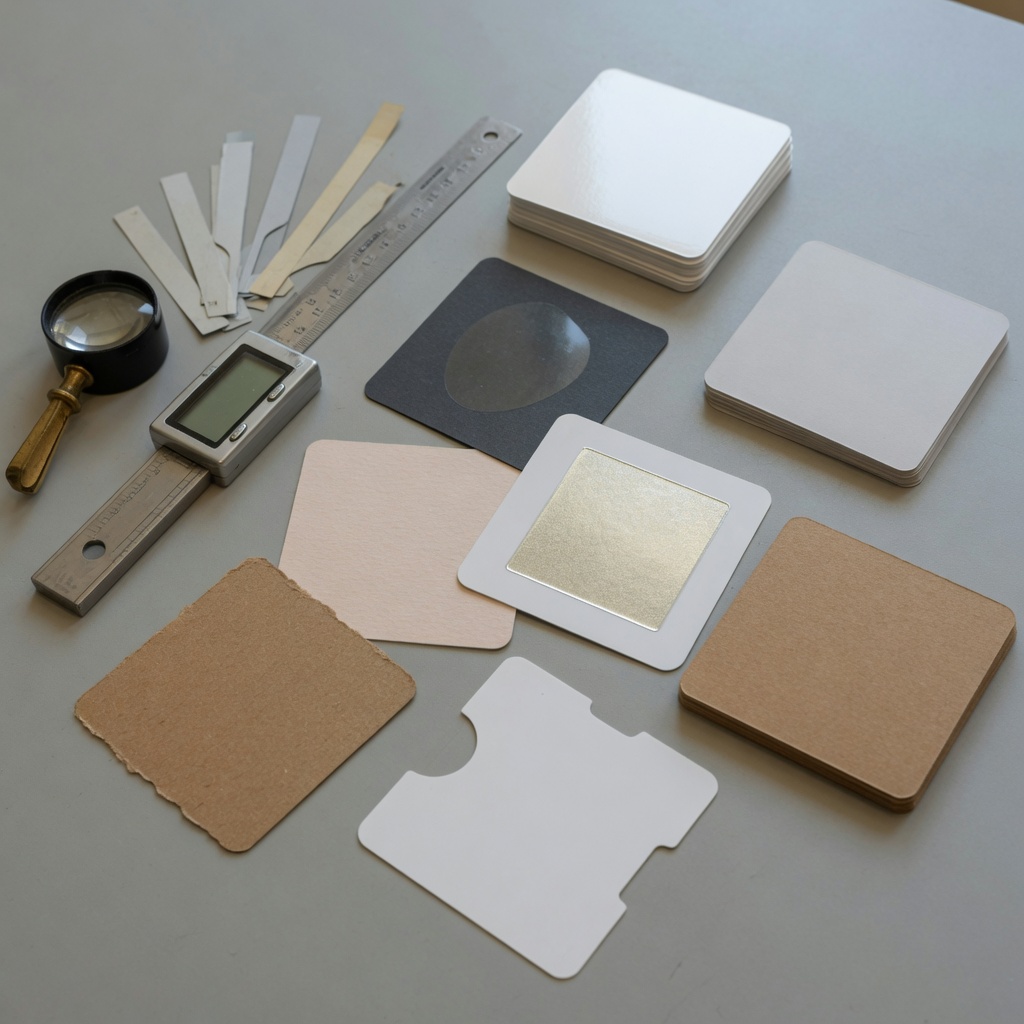
United States B2B buyers should treat insert card wholesale supplier customization options as one locked specification package, not as a unit-price contest. Finished trim, caliper, print sides, coating, embellishment, proof path, carton marks, and Incoterms have to be named before two quotes are comparable. A 14 pt matte card with a digital PDF is not the same wholesale SKU as a 16 pt soft-touch card with foil, a physical strike-off, and United States dock delivery.
Lock the package in this order:
- Cavity fit and finished size
- Caliper and fiber
- Print sides and ink method
- Coating and embellishment
- Proof and sample path
- Packing and receiving marks
- Origin, Incoterms, and dock date
- Dated quotes on that same package
A lower unit price is not a savings figure until those fields match.
Every exact number below is a published supplier-page example or a buyer assumption to reconfirm on a dated quote, a physical sample, and a United States landed-cost worksheet. This page covers only customization options for insert card wholesale supply. It is not a complete packaging guide, not a vendor ranking, and not a statement of Custom Logo Things production capacity, press equipment, or lead time.
Vincent Xi, Editorial Author, Custom Logo Things (author profile). This page does not describe factory visits, in-house press tests, named customer programs, or first-person handling of insert cards.
How to compare customization options without mixing quotes
Insert cards sit inside or against a product, mailer, or retail pack. In wholesale supply they are usually a printed, die-cut, or square-cut sheet of cover-weight paper, not a folding carton. Size, stock, ink, coating, and finish move stiffness, scuff risk, color match, unit cost, and lead time together. An RFQ that says “custom cards, best quality, rush” lets each plant fill gaps with house defaults that will not match the next bidder.
Three public commercial pages show how wide those defaults can be. Use them only as option maps for a United States RFQ, not as current bids.
- Gold Image Printing’s insert-card page lists sizes from 2.5 in × 2.5 in to 4.25 in × 5.5 in, plus custom quotes; 14 pt or 16 pt cover stocks; CMYK on one or both sides; coatings, foil stamping, velvet lamination, die-cutting, and rounded corners; and same-business-day to 2-day turnaround for orders of 100 pieces or more (Gold Image Printing insert cards). Scope: that page’s published insert-card offering. As-of: the cited excerpt does not state an effective date, press type, quantity break beyond the 100-piece turnaround claim, or freight term.
- Custom Box Makers’ packaging insert-card page lists 10–18 pt cardstock, kraft and recycled papers, custom sizes and shapes, CMYK or Pantone, gloss/matte/soft-touch coatings, foil, embossing, spot UV, and die-cutting, with no minimum order, digital proofs, and 8–10 business day turnaround (Custom Box Makers packaging insert cards). Scope: that page’s published insert-card offering. As-of: no effective date, lead-time start event, or Incoterm is stated in the excerpt used.
- Rush Custom Boxes’ insert-card page lists a starting figure of $0.05 per unit, 10 pt to 16 pt cardstock, matte/gloss/soft-touch/uncoated finishes, high-definition CMYK, 4 in × 6 in or custom die-cut, QR codes, foil, spot UV, soy-based inks, double-sided printing, and 8–10 day U.S. shipping (Rush Custom Boxes insert cards). Scope: that page’s published starting claim for insert cards. As-of: no quote date, quantity, finish combination, packing spec, duty, or dock ZIP is stated.
Those figures are source-page claims, not interchangeable United States landed costs. Until size, caliper, finish, proof type, and freight term are identical, treat any unit-price gap as unexplained, not as a win.
Size, shape, and structural choices
Start with the cavity the card must occupy. A card that is 1/16 in oversize will bulge a mailer; a card that is undersize will float and scuff. Those 1/16 in statements are pack-out planning notes to verify on the buyer’s jig, not published supplier tolerances. Gold Image’s listed window of 2.5 in × 2.5 in to 4.25 in × 5.5 in is a planning band on that page, not a limit on other plants (Gold Image Printing insert cards). Custom Box Makers and Rush Custom Boxes both publish custom sizes, shapes, and die-cutting; Rush also cites a 4 in × 6 in standard (Custom Box Makers packaging insert cards; Rush Custom Boxes insert cards).
Specify, in this order:
- Finished trim size in inches, width × height, after die-cut or guillotine.
- Corner treatment: square, radius in inches (for example 0.125 in as a buyer assumption to confirm), or custom contour.
- Hole, slot, or hang-tab geometry if the card will hang or lock to a tray.
- Grain direction relative to the long edge if the card will be scored or machine-inserted.
- Trim tolerance: an example RFQ assumption is ±0.03 in unless the pack-out jig is tighter; verify the plant’s stated tolerance on the quote.
Die-cutting adds a tool, make-ready, and often a minimum that may not apply to square-cut work. Ask whether an existing die can be reused, who owns it, whether storage is included, and how long it is retained for a United States reorder. If the piece folds, add score location, fold sequence, and flat blank size, and confirm a scored dummy on the quoted sheet rather than assuming a 14 pt flat card will fold without cracking.
Cardstock weight, fiber, and print surface
Caliper is the first cost and performance lever. Published wholesale ranges on the cited pages cluster around 10 pt to 18 pt. Custom Box Makers lists 10–18 pt plus kraft and recycled papers (Custom Box Makers packaging insert cards). Rush Custom Boxes lists 10 pt to 16 pt (Rush Custom Boxes insert cards). Gold Image Printing lists 14 pt or 16 pt cover stocks in semi-gloss, matte, or Fine Finch (Gold Image Printing insert cards). In U.S. paper-trade usage, 1 pt of caliper is a nominal 0.001 in thickness term (industry convention, not a mill certificate on the cited pages). Require the quote to state caliper (pt), basis weight if known, coated vs uncoated, C1S or C2S, and a gauge reading on the quoted sheet.
Planning trade-offs a United States buyer can check on samples (not lab results from this page):
- 10–12 pt: Lower material cost and postage mass; more show-through on double-sided work; higher curl risk in dry winter freight.
- 14–16 pt: Common premium-card hand-feel on the cited 14 pt / 16 pt listings.
- 18 pt: Board-like stiffness where Custom Box Makers’ 10–18 pt range is used; higher freight mass per thousand.
Fiber and sheet color change ink holdout. Kraft and recycled sheets listed by Custom Box Makers will shift CMYK and can mute foil. If marketing copy will claim “recycled,” “kraft,” or “soy-based inks,” that is a United States advertising claim under the FTC Green Guides, which are guidance on environmental marketing claims, not a product certification. Rush Custom Boxes lists soy-based inks on its insert-card page; verify with a current ink data sheet, not as a certified environmental attribute (Rush Custom Boxes insert cards). Uncoated stock takes writing and stamps but scuffs; coated stock holds finer type and QR codes. For any QR or barcode, specify quiet zone, minimum module size, and a press-side scan test on the actual coating.
Coatings, foil, spot UV, and related finishes
Coatings and embellishments are where two quotes that look identical on “full color cards” diverge. Across the three source pages, published finish options include gloss, matte, soft-touch, uncoated, velvet lamination, foil stamping, embossing, spot UV, and die-cutting (Gold Image Printing insert cards; Custom Box Makers packaging insert cards; Rush Custom Boxes insert cards).
Price the base printed card and each finish as separate lines:
- Aqueous or flood UV gloss: Rub resistance and color pop; glare; can crack on a tight score.
- Matte: Lower glare for instruction type; can scuff in bulk packs unless a carton liner is specified.
- Soft-touch / velvet lamination: Tactile cue; fingerprints; film can interfere with some glues if the card is later tipped on.
- Foil stamping: Metallic contrast; needs a die; poor for very small legal type; state registration to CMYK in inches or mm.
- Spot UV: Local gloss contrast; registration-critical.
- Embossing: Tactile without foil color; crush risk in high carton stacks.
A combined “premium finish” price hides which process is driving days and dollars. If both foil and spot UV are required, state sequence (plant-dependent) and whether a physical standard will govern acceptance. Double-sided printing is listed by Gold Image (one or both sides) and by Rush. If the back is a legal panel or bilingual instruction, specify minimum type size and contrast rather than “print the back too.”
Proofs, samples, and approval gates
An option list is incomplete until the approval path is complete. Custom Box Makers lists digital proofs (Custom Box Makers packaging insert cards). Digital PDFs catch spelling, trim, and QR placement. They do not prove caliper, soft-touch hand-feel, foil brightness, or show-through.
A practical United States wholesale sequence:
- Preflight PDF with bleed (an example house rule is 0.125 in, labeled as a buyer assumption to confirm), fonts outlined or embedded, and dieline on a separate spot color named and set to overprint.
- Contract-color proof if brand colors are critical; state calibrated digital proof vs press proof.
- Material dummy: unprinted or house-stock card in the quoted caliper and coating, cut to size.
- Finish strike-off: foil, spot UV, or lamination on the actual sheet. An example quantity to confirm in the quote is 10–20 pieces, not a source-page MOQ.
- First-article signed against the dummy, not a backlit monitor, and shipped to the United States receiving site before the balance packs.
Pantone vs CMYK is a separate decision. Custom Box Makers lists both (Custom Box Makers packaging insert cards). A brand red that must match a carton lid usually needs a spot ink or a measured ΔE target on a stated illuminant (for example D50 as a buyer-stated inspection condition). “HD CMYK” on a web page is not a tolerance. Keep a retained sample from the approved lot at the United States site that will receive goods.
United States labeling, delivery, and landed-cost controls
For United States programs, press-side choices still fail if cartons lack PO, SKU, quantity, and country-of-origin marks, or if the freight term leaves duty unsigned.
Labeling and claims. If the insert card itself makes fiber, recycled-content, compostable, or soy-ink claims, those statements require United States advertising substantiation. The FTC Green Guides address environmental marketing claims; they are not a certification of the card. If the insert accompanies a children’s product, the card is not automatically a CPSIA “children’s product,” but inks, coatings, and any plastic laminate should still be reviewed against the finished-goods compliance file. Do not print “compliant,” “certified,” or a standards logo unless a current document for that lot exists. Distinguish any named standard’s legal or guidance requirement from a printer’s website adjective.
Delivery. Published lead times are not equivalent clocks: Gold Image’s same-business-day to 2 days for 100-piece-or-more orders, Custom Box Makers’ 8–10 business days plus a free worldwide shipping offer, and Rush Custom Boxes’ 8–10 day U.S. shipping plus a free delivery offer are undated page claims (Gold Image Printing insert cards; Custom Box Makers packaging insert cards; Rush Custom Boxes insert cards). None of those excerpts defines whether lead time starts at artwork approval, payment, or material in house, or whether the term is origin ship date vs United States dock date. State ship-to ZIP, dock vs residential, pallet vs parcel, liftgate needs, and whether the need date is on-press, ex-works, or delivered. The “worldwide shipping” wording is a supplier commercial claim to interrogate; this page is written for United States receiving programs only.
Landed cost. Rush’s published starting figure of $0.05 per unit is not a United States landed cost and does not state quantity, finish, proofing, packing, duty, or freight (Rush Custom Boxes insert cards). Custom Box Makers’ free-shipping claim is a supplier commercial offer, not a duty-paid DDP term for every HTS classification (Custom Box Makers packaging insert cards). Paper-based printed matter can still incur origin-based duty, merchandise processing fees, and brokerage when imported. Require country of origin, HTS proposed by the supplier, Incoterms® 2020 rule, currency, validity date, and whether samples travel on the same clock as production.
Packing. Soft-touch and foil scuff in bulk. Specify inner wrap, max cards per carton, carton burst or ECT if relevant, and whether a moisture barrier is needed for kraft stock. Ask for a packed-carton photo of the first article. If wood pallets are used on an import move, ask whether the pallet meets the receiving site’s entry requirements; do not assume the insert-card quote includes compliant pallets.
Customization options versus RFQ controls
| Customization lever | Published example to verify on a dated quote | United States buyer impact | RFQ control |
|---|---|---|---|
| Finished size | Gold Image 2.5 in × 2.5 in to 4.25 in × 5.5 in plus custom; Rush 4 in × 6 in or custom die-cut (undated claims) | Cavity fit, waste, die cost | Trim, bleed, tolerance, dieline |
| Caliper / stock | 10–18 pt (Custom Box Makers); 14/16 pt (Gold Image); 10–16 pt (Rush) | Stiffness, show-through, freight mass | Caliper, C1S/C2S, grain, gauge reading |
| Fiber | Kraft and recycled listed by Custom Box Makers | Color shift, claim substantiation | Fiber %, recycled %, claim freeze |
| Print / inks | CMYK one or both sides; Pantone (Custom Box Makers); soy-based inks (Rush) | Cost, dry time, contrast | Sides, ink set, ΔE or Pantone, scan test |
| Flood coating | Gloss, matte, soft-touch, uncoated, velvet lamination | Scuff, glare, glue, fingerprints | Coating name, sides, rub test |
| Special finish | Foil, spot UV, embossing, rounded corners, die-cut | Make-ready, registration, crush | Location drawing, sequence, physical standard |
| Proof path | Digital proofs listed by Custom Box Makers | Color vs material risk | PDF, dummy, strike-off, retained sample, first article |
| Quantity / lead time | No MOQ (Custom Box Makers); 100+ pieces for 1–2 day claim (Gold Image); 8–10 business days (two pages) | Unit cost vs misship | MOQ, start event, ZIP, overrun/underrun |
| Commercial term | $0.05/unit starting (Rush); free-shipping claims on two pages | Not landed cost | Incoterms® 2020, origin, HTS, duty owner |
Every row is a specify-compare-verify item. Do not average the published numbers into a market price.
Practical RFQ checklist for insert card wholesale supply
Use this list as the body of a United States RFQ. Send the same package to every bidder.
- Item and end use: insert card; informational, branded, structural, or machine-inserted.
- Quantity breaks: at least three release quantities plus allowed overrun/underrun percent.
- Finished size in inches, grain, corner radius, and ± tolerance.
- Dieline: owner, units, cut vs crease, bleed (0.125 in only if it is the house rule, labeled as a buyer assumption to confirm).
- Artwork: PDF/X or stated equivalent; fonts; resolution; dieline on a named spot.
- Stock: caliper (pt), coated/uncoated, C1S or C2S, white/kraft/recycled, and any fiber claim that will print on the card.
- Print: 4/0, 4/4, or 4/1; CMYK and/or Pantone; coverage; QR/barcode spec and scan test.
- Coatings: front/back; gloss, matte, soft-touch, or none; flood vs spot.
- Embellishments: foil, spot UV, and emboss each as a separate priced line, plus die ownership and storage period.
- Color target: commercial match vs numeric ΔE on a named illuminant.
- Proofs: PDF, dummy, foil/UV strike-off, extra-proof charges, and sample ship-to in the United States.
- Approval: named approver, hours to approve; no silent-yes start.
- First article: samples shipped to the United States receiving site before the balance packs.
- Packing: pieces per bundle and carton, inner wrap, marks (PO, SKU, qty, origin, lot), pallet pattern.
- Lead time: approved-art-to-ship days; whether 8–10 business day page figures apply only after approval; dock vs ship date; ZIP; dock vs residential.
- Commercial: unit price, plate/die/proof charges, validity, currency, Incoterms® 2020, proposed HTS, origin, duty/broker owner, freight inclusion.
- Quality hold: reprint vs credit if caliper, coating, or foil is off; AQL only as the buyer’s incoming plan, not a claimed plant certification.
- Claims freeze: exact environmental or origin phrases allowed on the card; no extra badges.
- Reorder: plate/die retention period and whether a reprint needs a new proof.
A supplier that will not answer caliper, coating, proof type, and Incoterms is not quoting the same customization options.
Source context, method, and limits
Source contexts. This page uses three publicly listed insert-card commercial pages: Gold Image Printing (size band, 14/16 pt stocks, CMYK sides, coatings/foil/velvet/die-cut, and a 100-piece 1–2 day turnaround claim); Custom Box Makers (10–18 pt, kraft/recycled, Pantone, finish list, no MOQ, digital proofs, 8–10 business days, free-shipping claim); and Rush Custom Boxes (starting $0.05 per unit, 10–16 pt, soy-based inks, double-sided CMYK, foil/spot UV, 8–10 day U.S. shipping). Those pages are competitor or trade supplier listings, not Custom Logo Things factory records and not laboratory reports.
How the data was derived. Published numeric ranges and option lists were extracted from the supplied page excerpts and compared side by side as buyer-facing claims. No average price was calculated. Where a number could be misread as a current United States bid (especially $0.05 per unit and “free” shipping), it is labeled as an undated published starting claim. United States labeling and landed-cost notes apply general buyer-control practice (claim substantiation, origin, Incoterms, receiving marks); they are not a legal opinion and not a duty-rate table.
Limitations / what to verify. The excerpts used do not state effective dates, press type, sheet mill, or whether lead time includes finishing and U.S. transit. Caliper names (10 pt, 14 pt, 16 pt, 18 pt) are nominal; check thickness with a gauge on the quoted sheet. Environmental adjectives require current mill or ink documentation if they will appear in United States marketing. Tariff treatment is omitted because the source pages do not publish origin-based HTS rates. Example RFQ values (±0.03 in trim, 0.125 in bleed, 10–20 piece strike-off) are buyer assumptions to confirm. Confirm every specification on a dated quote, a physical sample, and the receiving site’s pack-out jig before purchase order.
Vincent Xi, Editorial Author, Custom Logo Things. Author profile.
Discuss Your Requirements
Review our manufacturing capabilities, then share your specifications for a supplier-fit review.