Poly Mailer Wholesale Supplier Quality Control Inspection for Australia
By Vincent Xi | Editorial Author
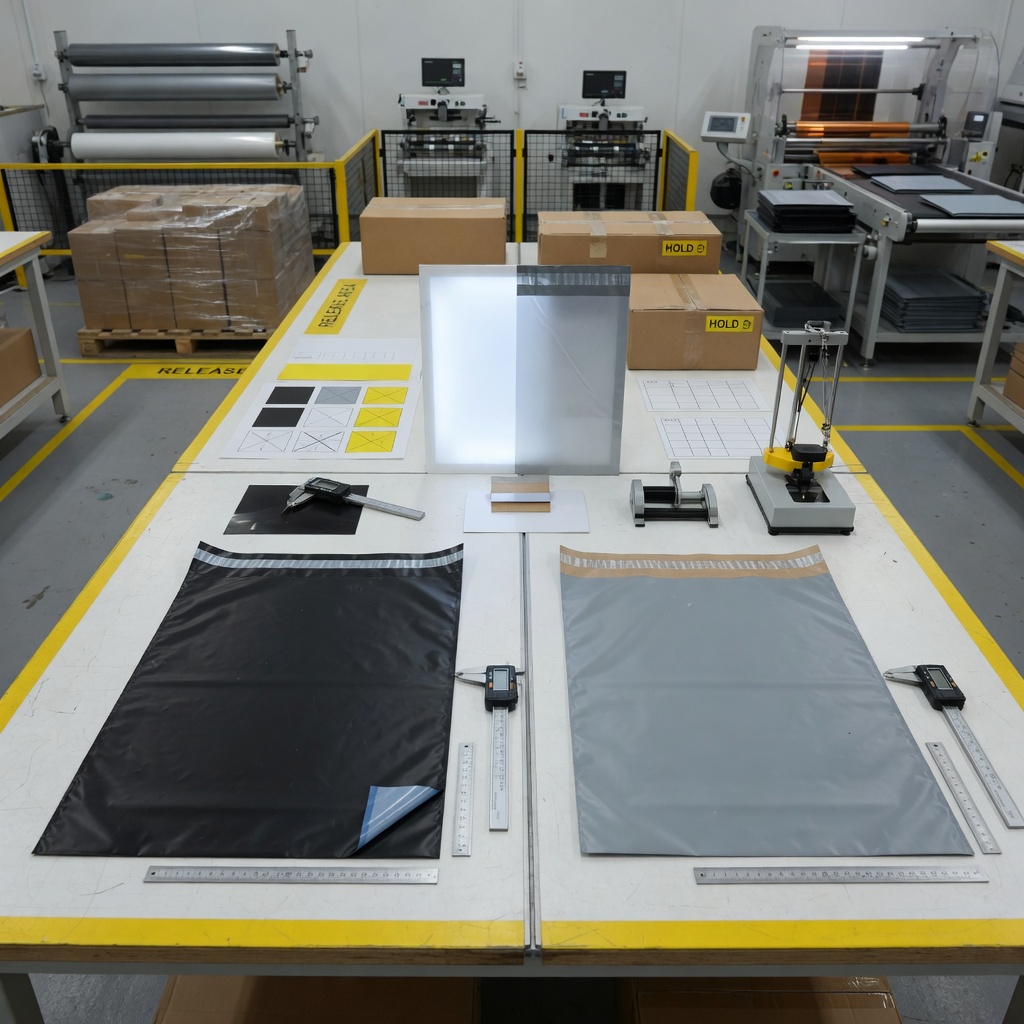
For an Australian B2B buyer, a poly mailer wholesale supplier quality control inspection should begin in the RFQ, before price comparison or production approval. Every bidder should receive the same finished-bag specification, inspection plan, acceptance rules and evidence requirements. Otherwise, quoted prices may cover materially different constructions or levels of inspection.
Supplier catalogue claims, appearance samples and general quality statements can inform qualification questions. They do not prove that a future production lot will meet the purchase order.
Recommended release rule: authorize dispatch only when the approved specification, inspection results, lot traceability, packing data and written deviation decisions agree with the purchase order. Hold the shipment if required evidence is missing, inconsistent or not linked to the inspected lot.
Australia quality control inspection gates for supplier release
These buyer-side gates are editorial recommendations, not claims about a supplier's current practices.
| Decision gate | Approve only when | Evidence to require | Hold trigger |
|---|---|---|---|
| Quote comparison | Every bidder has priced the same construction, dimensions, tolerances, print scope, packing format and inspection obligations | Completed specification response, declared assumptions, exclusions and separately priced alternatives | A requirement is omitted, substituted or left undefined |
| Production approval | The written specification, controlled drawing, artwork and inspection plan agree | Identified pre-production sample, approved artwork revision, agreed methods and lot-definition plan | The sample is untraceable or conflicts with the written specification |
| Production-lot acceptance | Results meet the buyer-approved acceptance rules | Individual readings where required, defect records, equipment references, lot links and disposition | A result fails, the inspected lot is unclear or an average replaces required raw readings |
| Dispatch release | Accepted product, quantity, cartons and deviations match the order | Release approval, packing record, shipment reference and written deviation decisions | Packing data conflict, evidence is incomplete or a deviation remains unresolved |
The RFQ should define the packed product, finished dimensions and measurement convention, film construction, nominal thickness and tolerance, opacity requirement, heat-sealed seams, adhesive closure, artwork revision, ordered quantity, packing format and Australian delivery destination. For every inspected characteristic, require the supplier to state the method, sample source, results, acceptance decision and production-lot reference.
Set document precedence in the purchase order. An appearance sample can show intended colour, print and construction, but it should not silently override measurable requirements in the drawing or specification.
Source evidence for the quality control inspection RFQ
The cited pages contain product-specific and supplier-specific figures. Use them to frame questions, not as universal poly mailer limits or evidence that an order has passed inspection.
| Cited data point | Unit, scope, date context and source | Appropriate RFQ use |
|---|---|---|
| More than 400 percent elongation | Unit: percent elongation. Product scope: black co-extruded LDPE/LLDPE mailers. Date context: the cited page is undated. Source: WH Packaging | Ask for the applicable method and edition, specimen direction, conditioning, individual results, production-lot link and buyer-approved limit. Do not copy the source claim into the specification automatically. |
| Adhesive checking from -20 degrees Celsius to 60 degrees Celsius | Unit: degrees Celsius. Product scope: adhesive checking described for the same black-mailer range. Date context: the cited page is undated. Source: WH Packaging | Ask the bidder to define exposure duration, closure preparation, conditioning procedure, failure classification and agreed acceptance rule. The cited range does not establish suitability for an Australian delivery route. |
| Offered thickness range of 35 micrometres to 120 micrometres | Unit: micrometres of film thickness. Product scope: grey shipping bags. Date context: the cited page is undated. Source: GoinPacks | Select an order-specific nominal thickness and tolerance. Require gauge locations, equipment details and individual lot readings rather than adopting the full catalogue range. |
| Minimum of 20,000 pieces per order | Unit: pieces per order. Product scope: the same grey shipping-bag listing. Date context: the cited page is undated. Source: GoinPacks | Treat this as a supplier-specific commercial figure, not a quality threshold or industry benchmark. Verify the current minimum, quoted quantity, quantity variance and packing counts in the live quote. |
| Publication date of 10 February 2023 | Date unit and scope: calendar publication date for a manufacturer-evaluation checklist. Source: PolyPak | Use the checklist to ask about custom sizes, bag types, equipment, quality-control protocols, delivery timing, bulk pricing and contract terms. Require order-specific answers and records. |
Do not average, combine or relabel these figures into a buyer threshold. Any value adopted for the order should appear in the controlled specification with its unit, tolerance, method and acceptance rule.
Write the wholesale supply RFQ as a controlled specification
A comparable bid requires each supplier to complete the same response schedule.
| RFQ section | Buyer fixes before quote | Supplier must return |
|---|---|---|
| Packed use | Contents, packed dimensions, packed mass, contact restrictions and relevant handling risks | Suitability assumptions, exclusions and any proposed packing trial |
| Finished geometry | Lay-flat width, usable length, flap length, seal locations, measurement reference points, units and tolerances | Controlled drawing, measurement method and sample results |
| Film construction | Required resin or multilayer construction, colour, nominal thickness, tolerance and substitution restrictions | Proposed construction, material declaration and batch-traceability method |
| Thickness and opacity | Gauge locations, equipment expectations, sample selection, opacity setup and objective acceptance rules | Individual thickness readings, reported minimum and maximum, instrument identification and controlled opacity evidence |
| Heat-sealed seams | Seams to inspect, specimen preparation, challenge method, prohibited failure modes and acceptance rule | Seam-specific results, defect classification and production-lot reference |
| Adhesive closure | Adhesive and release-liner requirements, closure preparation, conditioning, opening method and permitted failure mode | Results distinguishing clean peel, adhesive transfer, substrate separation and film tear |
| Print and appearance | Controlled artwork revision, film colour reference, print colours, registration tolerance, critical zones and defect boundaries | Approved setup sample and production inspection record |
| Packing and dispatch | Count method, carton protection, required carton data, permitted quantity variance and Australian destination | Packing proposal, carton data, quantity statement, dispatch basis and shipment reference |
| Inspection evidence | Lot definition, sampling rules, report fields, raw-data requirements and release authority | Completed inspection plan, example report format and responsibility matrix |
Where the buyer has not selected a requirement, keep a controlled placeholder in the RFQ. Do not fill it with a catalogue value merely to complete the form. Each alternative construction should have its own price, material description, drawing and inspection response, and it should require written buyer approval before substitution.
Build quality control inspection around the production lot
The undated GoinPacks page describes claimed controls for its grey shipping-bag scope across raw-material selection, blown-film production, printing and bag making. It also mentions tension, sealing, thickness, transparency and print checks. This is a description of that supplier's stated process, not evidence that another supplier uses the same controls or that a future lot has passed.
Translate each relevant production stage into a contract field:
| Control stage | Buyer requirement | Record to request |
|---|---|---|
| Incoming material | Identify the approved construction and the check used to confirm it | Material declaration, batch reference, receiving result and disposition |
| Film production | Define width, thickness, colour or opacity checks and sample locations | Individual readings, equipment identification, production-lot reference and acceptance decision |
| Printing | Confirm artwork revision, setup controls, registration requirement and critical visual zones | Setup approval, in-process results and agreed images |
| Bag conversion | Check finished dimensions, heat seals, flap geometry, adhesive application and release liner | Conversion inspection sheet, defect classifications and line or lot reference |
| Finished lot | Apply the accepted dimensional, visual, functional, quantity and packing checks | Consolidated report, raw measurements, defect totals and final disposition |
| Dispatch | Reconcile accepted quantity, cartons, deviations and shipment reference | Packing record, carton data, deviation approvals and signed release |
The inspection plan should also define:
- How a production lot is formed and linked to material batches, printing runs and bag-conversion runs.
- Where and when samples are selected across the defined production run.
- The specimen preparation, method, equipment and result unit for each characteristic.
- Poly mailer defect classes and buyer-approved acceptance and rejection rules.
- Sample size, acceptance count and rejection count for every applicable defect class.
- Segregation, additional inspection, rework, replacement and lot-rejection rules after a failure.
- Identification and retention rules for the approved pre-production sample and any production reference samples.
- The purchase order, item code, artwork revision, material batch, production lot, inspection date, carton reference and shipment reference required on the report.
Terms such as random inspection, seals checked or within tolerance are incomplete without the sample-selection basis, method, defect definition, acceptance rule, result and lot-linked record.
If a supplier proposes a recognized sampling standard, require its full title, applicable edition and exact plan. The sampling procedure does not establish the product specification, defect classifications, acceptance thresholds or commercial remedies unless the contract incorporates those terms separately.
Test methods and standards in quality control inspection
The undated WH Packaging page references ASTM D882 for tensile testing and ASTM D1922 for Elmendorf tear testing within its black-mailer scope. D882 and D1922 are alphanumeric method identifiers, not measured quantities, so no measurement unit applies to the identifiers themselves. The cited page does not establish the applicable edition, reproduce either standard's requirements or provide a report for a future production lot.
Naming a method does not create a purchase-order limit or prove that testing occurred. When tensile or tear performance addresses an identified packed-product risk, require the selected method edition, specimen dimensions, specimen direction, conditioning, result units, equipment identification, test date, individual results, buyer-approved limit and production-lot link.
Apply the same evidence structure to other checks:
- Thickness: equipment type, gauge locations, specimen handling, individual readings and acceptance rule.
- Opacity: backing, lighting or instrument mode, specimen condition and objective pass criterion.
- Heat seals: identified seam, specimen preparation, challenge method, prohibited failure modes and acceptance rule.
- Adhesive closure: closure preparation, conditioning, opening method, observed failure mode and result.
- Print: approved artwork, colour reference, registration method, critical zones, defect boundaries and lot-linked result.
A named standard's procedural requirements come from the applicable edition to the extent that edition specifies them. Sampling frequency, buyer acceptance limits, report format and shipment-release authority remain supplier practices or contractual controls unless the applicable standard or purchase order states otherwise.
Do not describe a supplier, site or product as certified without a current document supporting that exact statement. Where certification is relevant to the contract, verify the named holder, manufacturing site, issuing body, scope and validity status. A certificate does not replace the finished-product inspection records required for the actual lot.
Australia quality control inspection release package
For an Australia-bound wholesale order, make the following records conditions of buyer release before dispatch:
- Final signed specification and controlled dimension drawing.
- Approved artwork revision and identified pre-production sample record.
- Accepted inspection plan, production-lot definition and sampling rules.
- Material-batch and production-lot traceability references.
- Lot-level dimension, thickness, opacity, seam, closure and print results required by the purchase order.
- Raw readings wherever the specification requires them, rather than only an overall pass statement.
- Defect records, reinspection results and final disposition.
- Written approval for every accepted deviation.
- Finished quantity, packing counts, carton dimensions, carton mass and pallet configuration where applicable.
- Agreed dispatch point, Australian delivery destination, freight basis and shipment reference.
- Current certificates or declarations only where the purchase order makes them relevant.
Put responsibility for additional inspection, segregation, rework, replacement, delay and affected freight into the contract before production. The supplier should not decide unilaterally that an out-of-specification lot is commercially acceptable.
A copy-ready RFQ instruction can state:
> Quote only against the attached controlled specification, drawing, artwork and inspection schedule. Identify every assumption, exclusion and proposed substitution. For each inspected characteristic, state the method, sampling basis, acceptance rule, required record and production-lot link. Dispatch requires written buyer release after review of the agreed lot evidence and packing data.
The cited sources do not establish Australia-specific labelling, legal, freight or climate requirements for the buyer's packed goods. Do not infer such requirements from a general supplier page or from the cited adhesive-checking temperature range. Verify requirements separately for the actual contents, route and destination before adding them to the purchase order.
Evidence method, limitations and author basis
Methodology: Each cited page was assessed by source type, stated product scope, date status, quantitative claim and appropriate RFQ use. The WH Packaging page supplied black-mailer elongation, adhesive-checking and test-method claims. The GoinPacks product page supplied a grey shipping-bag thickness range, commercial minimum and claimed production-control context. The PolyPak checklist supplied manufacturer-qualification questions. Source values were retained in their stated units and were not converted, averaged or adopted as acceptance limits. The inspection gates were derived editorially by mapping each relevant characteristic to a specification field, method, acceptance owner, required record and production-lot link.
Limitations and points to verify: The cited material does not include a buyer-specific drawing, packed-product trial, agreed tolerances, complete lot-level test report, approved sampling plan, current supplier quote, current certificate file, applicable method editions or an Australia-specific legal determination. The WH Packaging and GoinPacks pages are undated. Before award, verify the proposed construction, legal supplier entity, manufacturing site, material declaration, method editions, testing capability, equipment calibration status, sample-selection rules, acceptance limits, packing data, freight assumptions and document validity. No cited page proves conformance for a particular order without evidence from that order's samples and production lot.
Author basis: The first-party profile identifies Vincent Xi as Editorial Author. The profile supports that identity and role only. It does not provide a first-hand basis for factory visits, laboratory testing, certification audits, purchasing outcomes or customer results, so no such experience claim is made here.
For supplier selection, compare completed specification responses and inspection obligations alongside price. For shipment release, rely on the agreed records for the identified production lot.
Discuss Your Requirements
Review our manufacturing capabilities, then share your specifications for a supplier-fit review.