Magnetic Box OEM Quality Control Inspection for Canada-Bound Rigid Box Orders
By Vincent Xi | Editorial Author
For Canadian B2B buyers, a magnetic box OEM quality control inspection for a Canada-bound rigid box order should verify the approved physical sample, finished dimensions and tolerances, magnet identity and placement, opening-force test method, lid and hinge function, insert fit, appearance, carton traceability, and lot-release records. Put each check's method, sample scope, acceptance limit, defect disposition, and required evidence in the RFQ before comparing quotations. Hold shipment when release-blocking results or required records remain open. Descriptions such as strong magnets, premium board, good alignment, or standard AQL do not establish a test method, tolerance, sample size, or acceptance rule.
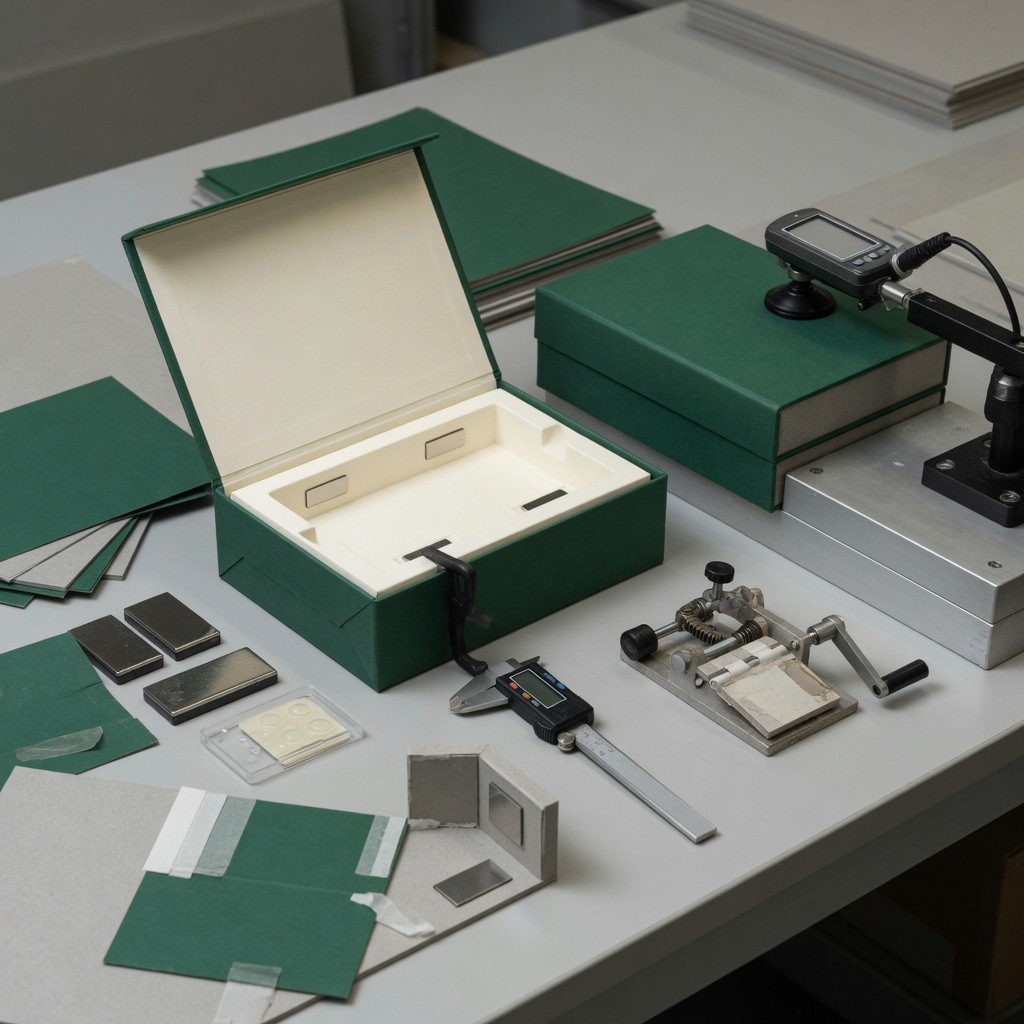
The supplied evidence supports treating the magnetic closure as an assembled system. Xactz identifies magnet specification, pull force, placement, board construction, lid geometry, and hinge behavior as closure variables. Qianxun Packaging identifies incoming material checks, inline magnet-placement and adhesive-cure controls, mechanical cycling, final inspection, and packing-list traceability. These controls become useful for procurement only after the buyer converts them into order-specific requirements, evidence, and release decisions.
Canada RFQ scope for magnetic box OEM quality control inspection
| Buyer decision | Required RFQ field | Evidence to request | Release rule |
|---|---|---|---|
| Finished construction | Internal and external dimensions in millimetres, measurement datums, tolerances, board and wrap specifications, insert design, and packed-product fit | Measured pre-production sample, material identification, and fit record | Do not release mass production until the sample meets the written specification |
| Magnet assembly | Magnet grade, dimensions, coating declaration, polarity, quantity, location, position tolerance, lot identity, and substitution restrictions | Component records and the placement measurement or fixture method | Hold affected production for an unapproved component, polarity error, or placement failure |
| Finished closure | Acceptable opening-force range, force unit, fixture, pull direction, measurement point, box condition, and reporting convention | Assembled-box readings linked to the SKU, production lot, and sampled unit | Reject readings that cannot be traced to the agreed method and sampled unit |
| Golden sample | SKU, dieline revision, bill of materials, artwork revision, finish, insert, product fit, closure result, approval date, and custody | Identified physical sample with matching approval record | Do not begin mass production before approval; review controlled changes before resuming work |
| Process controls | Incoming and inline characteristics, frequency, instruments, responsible role, records, and reaction plan | Lot-linked incoming records and production-stage inspection logs | Segregate failed material and stop affected work pending documented disposition |
| Final inspection | Lot definition, sampling procedure, defect classes, variable measurements, functional checks, and acceptance rules | Completed report with lot identity, sampled cartons, readings, photographs, rework, and disposition | Do not ship while release-blocking nonconformities or required evidence remain open |
| Packing and traceability | Unit protection, carton configuration, SKU and lot linkage, packing-list fields, and damage criteria | Carton records and packing list linked to the inspected lot | Release only quantities and lots covered by approved inspection records |
| Change control | Materials, magnets, adhesive, dieline, tooling, artwork, finish, insert, or process changes requiring review | Approved change record or confirmation that no controlled change occurred | Resample when a change can affect fit, closure, geometry, durability, or appearance |
A decision-ready quotation identifies the inspection method, scope, evidence, responsibility, acceptance rule, and remedy. A price without those fields does not represent a comparable quality-control scope.
Specify acceptance for the finished magnetic closure
A magnet-component result does not, by itself, establish whether the completed box will close correctly. The supplied Xactz guide describes closure performance in terms of the magnet and its placement together with intervening material, board construction, lid geometry, and hinge behavior. It does not provide a universal opening-force range or placement tolerance.
The RFQ should therefore separate three requirements:
- Component: State magnet grade, dimensions, coating declaration, polarity, quantity, lot identity, allowed substitutions, and the supplier's test method.
- Placement: Dimension each magnet location from a stated dieline or board datum and assign a position tolerance in millimetres.
- Finished box: Define opening force, closure engagement, lid-to-base clearance, squareness, edge alignment, bowing, hinge condition, and closed-position appearance.
For comparable opening-force measurements, define the instrument, fixture, pull direction, measurement point, operating procedure, conditioning, box state, and reporting convention. State whether the reported value is a peak reading or another agreed result. The buyer and supplier should establish order-specific limits through prototype and product-fit evaluation, then record them in the golden-sample approval, quotation, inspection plan, and purchase order.
Numerical baselines and RFQ assumptions
| Concrete data point | Evidence scope and date context | Controlled use in the RFQ |
|---|---|---|
| 500-1,000 open/close cycles per tested finished box | Source-reported mechanical-test range from the undated Qianxun Packaging checklist supplied for this article. Its publication date and test date were not provided. The page does not state the tested-box quantity, conditioning, cycle definition, or pass criterion. | Treat this as a candidate endurance range, not an automatic requirement. The supplier quote must define a complete cycle, tested quantity, conditioning, observations, and post-test acceptance criteria. |
| 100% of finished units in the production lot presented for pre-shipment inspection | Source-reported inspection scope from the same undated Qianxun Packaging checklist. It is supplier guidance, not a universal standard or Canada-specific requirement. | Define which characteristics receive full-unit screening. Do not assume that the source requires the same test, including cyclic testing, on every unit. |
| 2 signed physical golden-sample units per SKU | Example RFQ assumption for pre-production sample custody. It is not source-derived and must be verified in the supplier quote. | Confirm the custody split, sample identification, storage period, replacement procedure, and controlling written specifications. |
| 3 assembled opening-force readings per sampled finished unit | Example final-inspection assumption for a selected test unit. It is not source-derived and must be verified in the supplier quote. | Confirm whether repeated opening affects the result, then define the interval, reporting method, and acceptance calculation. |
The source-reported values do not prove a supplier's current process, capability, or production outcome. The example assumptions become contractual only when the buyer and supplier include them in approved purchase documents.
Rigid box manufacturing quality control inspection gates
Golden-sample approval
HarmonyPac recommends a physical pre-production sample for evaluating closure strength, print color, finish, and product fit. The Xactz guide also identifies closure strength, alignment, hinge integrity, and lid geometry as golden-sample considerations.
The approval record should identify the SKU, dieline revision, material specification, magnet construction, artwork revision, finish, insert, fit result, closure-test method, measured result, approval date, and approvers. Use the physical sample as the appearance and construction reference, while written tolerances and approved measurement methods control measurable characteristics.
The RFQ should also define resampling. Require written review when the supplier proposes a change to board, wrap, magnet, adhesive, dieline, tooling, artwork, finish, or insert. Require a replacement sample when an approved change can affect fit, closure, geometry, durability, or visible appearance.
Incoming and inline inspection
The Qianxun Packaging checklist lists paperboard, magnets, adhesives, and foils as incoming-control items. It gives GSM checks and dynamometer pull-strength testing as examples. For each contracted material, the RFQ should identify the required characteristic, received-lot evidence, sampling method, and disposition for failed material.
Inline controls should cover the source-supported issues of magnet placement, adhesive cure, and dieline accuracy. The production plan should state the datum or test method, inspection frequency, responsible role, record format, and reaction to an out-of-limit result. Records should connect each affected box batch to the magnet identity, polarity, measured position, and agreed adhesive-cure condition.
Final inspection and shipment hold
Final functional inspection should follow the approved RFQ and may include closure engagement, opening force, lid alignment, hinge integrity, repeated closure, product fit, insert fit, and loose-component checks. Appearance criteria may address wrap adhesion, corners, scuffing, print or foil position, residue, and visible deformation under agreed viewing conditions.
Keep full-unit screening separate from sample-based measurements and endurance tests. The Qianxun page reports full pre-shipment inspection alongside AQL sampling, but it does not define which characteristics receive each treatment. The quotation and inspection plan must make that distinction.
The final report should identify the SKU, purchase order, production lot, inspected quantity, sampled cartons, instrument identifiers, methods, measured results, defect photographs, rework status, and release authority. Packing-list traceability should connect released cartons and quantities to the inspected production lot.
Define sampling, defects, and remedies before production
An AQL reference alone does not identify the lot, sampling procedure, inspection level, sample size, defect classes, or acceptance and rejection rules. The supplied sources recommend AQL sampling but do not provide a universal AQL value or inspection level for magnetic rigid boxes.
If the parties select a published sampling standard, record its exact title and revision together with the chosen order-specific parameters. Naming a sampling standard defines a method; it does not certify the supplier, facility, or product.
Attribute inspection and variable measurement also need separate records. A missing component or visible surface defect can be classified as present or absent. Magnet position, finished dimensions, lid clearance, and opening force produce measured values and require units, instruments, methods, and tolerances.
| Issue to classify | Acceptance method to define | Contractual disposition to define |
|---|---|---|
| Missing, loose, incorrectly oriented, or exposed magnet | Visual and functional check plus the agreed position or retention method | Shipment hold, segregation, rework or replacement, and reinspection responsibility |
| Closure does not engage or falls outside the approved force range | Defined assembled-box force test and engagement check | Acceptance rule, permitted rework, and retest requirement |
| Lid is off-square, bowed, or outside clearance limits | Measurement from stated datums and comparison with the approved sample | Rejection rule and permitted corrective action |
| Hinge lifts, cracks, separates, or shows exposed adhesive | Visual inspection and the agreed cyclic test | Post-test pass criteria and disposition of affected production |
| Wrap, print, foil, or finish differs from approval | Golden-sample comparison under defined viewing conditions, plus measured registration where specified | Defect class, rework limit, and approval authority |
| Product or insert fit fails | Fit test using the approved product reference or controlled fit fixture | Production hold and responsibility for correcting the insert or box |
| Carton or lot cannot be linked to inspection records | Document and carton-identity check | Hold unidentified stock until traceability is restored |
Assign defect classes and remedies before production rather than leaving those commercial decisions to the final inspector. The supplied sources do not establish universal severity classes for these examples.
Canada-bound quotation and release evidence
For a Canada-bound SKU, the inspection report should match the purchase order, buyer-approved artwork or language revision, packing configuration, and shipment documents. The supplied sources do not establish Canadian bilingual-labeling or product-compliance requirements, so this article does not prescribe them. The responsible buyer-side reviewer should approve those requirements, while the inspection scope should verify production against the approved revision.
HarmonyPac identifies itemized quotations covering tooling and materials as a supplier-vetting consideration. For this RFQ, require the quotation to state whether pre-production samples, testing, final inspection, reinspection, rework, packing, and freight are included or excluded. Also record the quote currency, delivery term, and responsibility for each quoted logistics cost.
The supplied evidence contains no Canada-specific duty, tax, freight-rate, or delivery-time data. Those sources therefore cannot support a landed-cost calculation. Obtain current commercial figures from the responsible parties and keep them separate from the inspection evidence.
The shipment-release packet should contain the approved-sample identifier, controlled specification revisions, incoming and inline records, final inspection report, nonconformity dispositions, reinspection evidence, packing-list traceability, and written release authority. The purchase documents should also assign notification, rework, replacement, credit, reinspection, and logistics-cost responsibilities for rejected production.
Methodology and claim-to-source traceability
The editorial method maps each source-reported closure risk or manufacturing control to an RFQ field, an inspection record, and a production or shipment decision. Recommendations about tolerances, documentation, acceptance rules, and remedies are buyer-side controls derived from that mapping. They are not claims that a cited supplier currently follows those controls.
| Supplied source | Factual context retained | Boundary applied |
|---|---|---|
| Qianxun Packaging quality checklist | Incoming material checks, GSM and dynamometer examples, placement and adhesive-cure controls, mechanical cycling, pre-shipment inspection, AQL sampling, and packing-list traceability | Numerical guidance is identified as coming from an undated commercial page, not as a universal standard, Canadian rule, or verified supplier capability |
| HarmonyPac OEM selection article | Physical pre-production samples and itemized quotation context | Used only to support sample and quotation controls; it does not establish tolerances, Canadian compliance requirements, or current factory performance |
| Xactz magnetic closure guide | Magnet specification and placement, board construction, lid geometry, hinge behavior, and golden-sample considerations | Used to identify variables requiring order-specific limits; it does not supply a universal opening-force range or placement tolerance |
Where a source identifies a control but supplies no acceptance threshold, the value is left for prototype testing, fit evaluation, golden-sample approval, and confirmation in the supplier quote.
Limitations and items to verify
The supplied pages are commercial packaging guidance. The evidence does not establish them as independent standards, accredited laboratory reports, or Canadian legal advice. A verified publication date was not supplied for the Qianxun numerical guidance, so its data points are identified as coming from an undated page.
The sources do not establish a universal magnet grade, coating choice, opening-force range, placement tolerance, dimensional tolerance, AQL setting, inspection level, sample quantity, cycle-test sample size, cycle-test pass criterion, or Canada-specific labeling requirement. They also do not prove any supplier's current equipment, inspection practice, certification, or production outcome.
Before ordering, verify the current source pages, product and insert fit, supplier quotation, controlled manufacturing specification, measurement methods, sample results, lot-linked records, inspection scope, packing traceability, change-control process, and contractual remedies. Any certification or audit claim used for procurement should be supported by a current document identifying the legal entity, facility, scope, issuer, and validity. A website statement or displayed mark alone is not treated as certification evidence.
Discuss Your Requirements
Review our manufacturing capabilities, then share your specifications for a supplier-fit review.