Magnetic box wholesale supplier customization options for Canadian buyers
Vincent Xi, Editorial Author Profile: https://customlogothing.com/authors/vincent-xi/
Canadian buyers comparing magnetic box wholesale supplier customization options should freeze one physical construction before evaluating price. Direct RFQ comparisons fail when suppliers quote mismatched structural specifications. Order minimums, sample approval cycles, and production lead times only become actionable once finished dimensions, board weight, magnet specification, wrap paper, print method, surface finish, and interior insert are identical across every RFQ. Three primary published sources illustrate wide operational variance: Lipack states a 5,000-unit minimum order quantity and 20–25 days of production following sample approval. YPackaging states wholesale availability from 100 units with production in 4–7 business days. A Ruixing sourcing guide outlines a 500-unit minimum. These figures reflect claims published on the respective source pages without visible publication dates as of this editorial review. They do not represent Canadian market averages or Custom Logo Things production benchmarks.
This review is prepared for Canadian B2B buyers procuring rigid box wholesale supply, focusing directly on technical customization options for magnetic closure boxes. The byline author is Vincent Xi, Editorial Author, with author profile at https://customlogothing.com/authors/vincent-xi/. Editorial attribution is restricted to published research synthesis without proprietary testing claims.
Which customization options change a rigid box wholesale supply quote in Canada
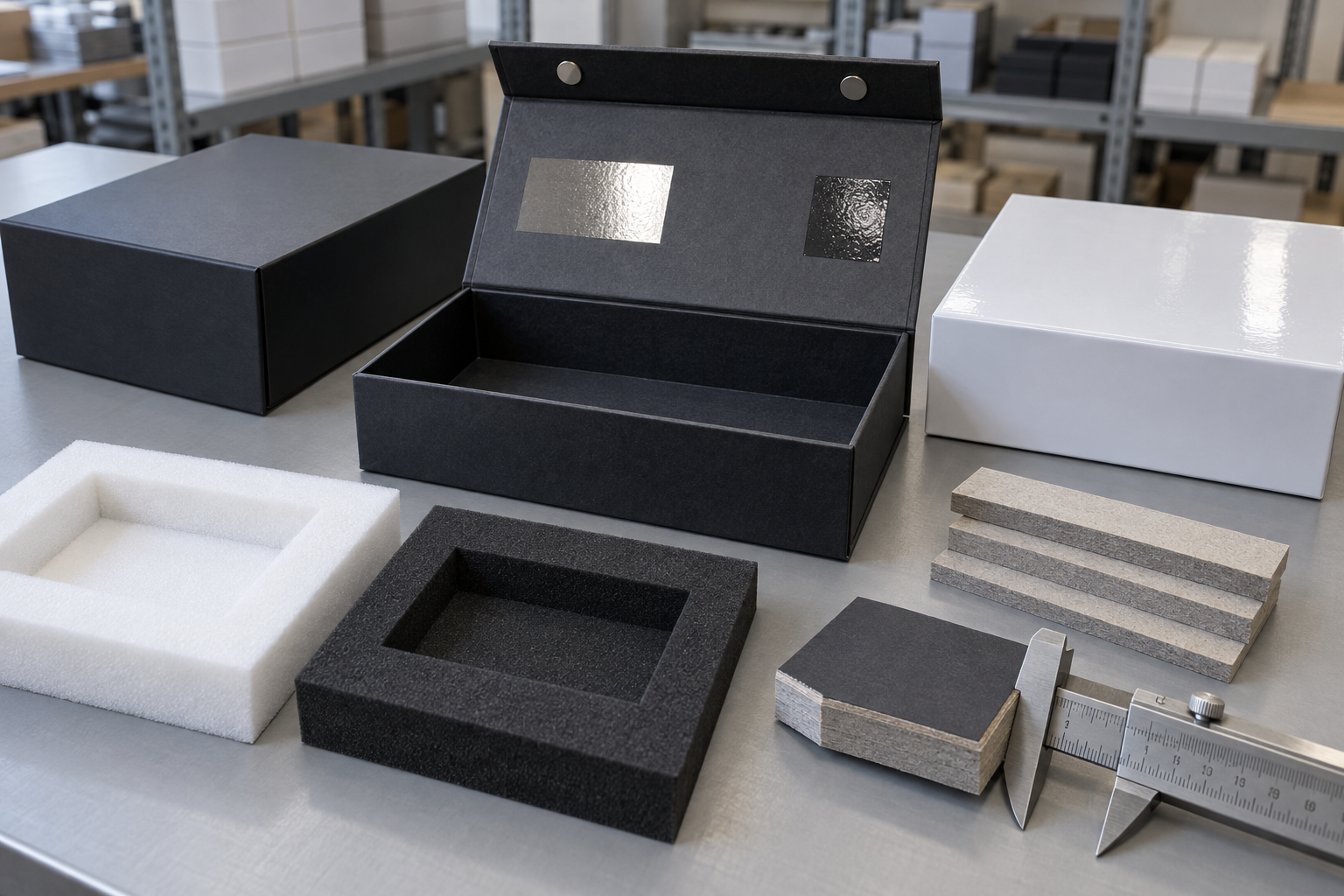
For custom magnetic rigid boxes, quote-altering variables fall into four technical tiers: structural core, magnetic closure, exterior graphics/embellishments, and interior containment. Core construction dictates outer length, width, depth, base board weight, and wrapping paper. Closure options dictate magnet count, physical dimensions, material grade, and placement. Graphics and surface treatments encompass print processes, ink color models, laminations, and foil or embossing dies. Interior containment covers custom-molded or routed insert materials and cavity sizing. While a Canadian delivery destination does not alter board conversion mechanics, it dictates that freight, production schedules, customs clearance, and terminal delivery terms must be separated on the final commercial quote.
Published supplier offerings show distinct technical parameters:
- Lipack’s factory page for custom magnetic rigid boxes states custom sizing, structural board weights ranging from 1,200 to 2,500 gsm, exterior paper wraps, foil stamping, spot UV, embossing, protective laminations, and interior foam inserts, with a stated minimum of 5,000 units and 20–25 production days tied to sample sign-off, published without a visible date (Lipack).
- YPackaging’s wholesale page offers custom dimensions and shapes, kraft or rigid board substrates, offset printing in CMYK or Pantone Matching System (PMS) spot colors, matte or gloss lamination, spot UV, foil stamping, and foam or EVA inserts, quoting wholesale quantities from 100 units, production in 4–7 business days, and an unrouted free-shipping statement, published without a visible date (YPackaging).
- Ruixing’s sourcing guide specifies greyboard densities between 1,200 and 1,800 GSM, N52 neodymium magnets, soft-touch lamination, metallic foil, custom EVA inserts, a 500-unit baseline minimum, and collapsible flat-pack configurations claiming up to 75% freight savings, published without a visible date (Ruixing).
Buyers must avoid treating these configurations as interchangeable. A 1,200 gsm board yields a lighter hand-feel and lower freight mass than a 2,500 gsm caliper. Similarly, an operational structure optimized for 100-unit pilot runs operates under different manufacturing overhead than a 5,000-unit high-speed production line. RFQ success requires fixing the bill of materials before evaluating vendor competitiveness.
Board weight, magnet grade, and insert fit
Structural board weight represents the foundational mechanical specification in rigid box manufacturing. Lipack cites 1,200–2,500 gsm for its magnetic rigid boxes, while Ruixing notes greyboard between 1,200–1,800 GSM. YPackaging lists kraft or rigid board without publishing an exact gsm range in the cited excerpt. None of these sources publishes edge crush test (ECT), puncture resistance, or drop-test ratings tied to these weights. Increasing board weight improves rigidity and tactile premium perception, but it proportionally elevates gross carton weight. For Canadian cross-border logistics, total shipment mass and container cubic volume directly determine destination freight charges, requiring suppliers to state carton dimensions and gross weight on the quotation.
Closure hardware specifications require precise mechanical definition. While Ruixing specifically identifies N52 neodymium magnets, the cited source does not document magnet diameter, thickness, quantity, surface plating, rated pull force, or temperature thresholds. N52 denotes magnetic material grade rather than closure assembly strength. Lids risk transit popping or weak closure feel if magnet diameter is undersized or if thick wrap paper dampens magnetic attraction. Procurement drawings must explicitly call out magnet grade, dimensions (diameter x thickness), total count per flap, and embedded coordinate positions.
Insert engineering directly controls internal product protection and perceived unboxing quality. Lipack lists interior foam, YPackaging references foam or EVA, and Ruixing specifies custom EVA. Polyurethane foam and closed-cell ethylene-vinyl acetate (EVA) possess distinct densities, surface hardness, and machining characteristics. Cavity tolerances, finger-access notches, and bonded versus drop-in assembly directly impact piece pricing and hand-assembly labor. RFQ specifications should define cavity dimensions based on the product’s maximum physical envelope, accounting for included accessories such as cables or literature, with clear acceptance criteria requiring zero rattle and smooth removal without substrate tearing.
Collapsible flat-pack constructions offer logistics advantages balanced against destination handling labor. Ruixing states that collapsible flat-pack rigid boxes save up to 75% on freight volume. This figure represents an upper structural potential rather than a guaranteed landed freight cost to Canadian distribution centers. Example calculation (assumption to verify on supplier quotation): if a baseline assembled rigid box shipment is quoted at CAD 2,000 in international freight, a flat-pack redesign achieving a verified 75% cubic reduction would yield an illustrative freight line of CAD 500. This CAD 2,000 baseline is an arithmetic example, not a quoted carrier tariff, customs duty, or supplier shipping guarantee. Buyers must assess destination labor costs required to erect folding boxes and confirm that corner adhesive tapes and magnetic flap alignments retain factory tolerances after final Canadian warehouse assembly.
Print and finishing lines that move the price
Decorative surface treatments drive substantial variance between competing quotations. Across the cited sources, available finishing options include matte, gloss, or soft-touch laminations, spot UV varnish, foil stamping, and multi-level embossing. YPackaging specifies offset printing with CMYK or PMS color matching, whereas Lipack lists foil, spot UV, embossing, and film laminations without defining color ink models in the reviewed text. Soft-touch coatings appear in Ruixing's guide as an upgraded tactile treatment.
Every post-press process requires an independent line item on the quotation. Spot UV over matte film involves multi-stage processing compared to single-pass aqueous or overall gloss lamination. Hot foil stamping and blind embossing require specialized metal stamping dies (magnesium, brass, or copper) and setup passes. Spot PMS ink matching delivers tighter color consistency than process CMYK builds across multi-lot reprints, though neither source documents numerical Delta E color tolerances. Color fidelity must be reviewed and locked on physical drawdown proofs or pre-production samples rather than digital screen proofs.
Ruixing’s sourcing guide mentions “FSC ISO compliance.” This marketing phrase does not substitute for accredited certification. Forest Stewardship Council (FSC) chain-of-custody claims require documented verification naming the certified entity, standard code, and valid license number. Similarly, ISO standards (such as ISO 9001 or ISO 14001) represent specific site management systems requiring documented certificate validation with active expiration dates. Custom Logo Things does not display FSC or ISO certificates on this page, and formal standards must not be conflated with commercial operating claims. Where certified sustainable paperboard or quality-managed facilities are required, Canadian buyers must mandate that the quoting supplier provide active certificates issued to the legal manufacturing entity.
None of the cited suppliers details bilingual English-French packaging requirements under Canadian federal regulations, provincial consumer packaging acts, or recycling labeling standards. Quoting vendors treat provided artwork as buyer-approved. Canadian B2B buyers must embed required bilingual consumer copy, origin designations, and recycling symbols directly into production dielines, maintaining legal and regulatory compliance review with internal Canadian counsel. Landed cost models must account for applicable Canadian customs tariffs, broker clearance fees, and federal/provincial taxes (GST/HST) calculated against commercial invoice values.
Minimums, samples, and production days
Published supplier operational minimums diverge widely across the competitive landscape: 100 units (YPackaging), 500 units (Ruixing), and 5,000 units (Lipack). These variations reflect underlying manufacturing specialization. Lipack targets volume runs with 20–25 production days commencing strictly after sample approval. YPackaging targets short-run on-demand production quoting 4–7 business days with unrouted free shipping. Ruixing targets intermediate production with a 500-unit minimum alongside tiered volume pricing.
Quoted factory production lead times must not be confused with delivered arrival dates at Canadian facilities. Standard manufacturing days exclude container ocean transit (typically 20–35 days to West Coast ports like Vancouver or Prince Rupert, plus transcontinental rail to Toronto or Montreal), air freight windows, customs processing, and local drayage. Unspecified “free shipping” claims require written clarification regarding delivery Incoterms (e.g., DDP vs CIF) and delivery eligibility to Canadian postal codes. A 5,000-unit minimum offers optimal unit economics for established enterprise replenishment but ties up working capital on initial product launches. Conversely, a 100-unit minimum minimizes inventory exposure while carrying significantly higher per-unit conversion overhead once custom dies and custom inserts are factored into the invoice.
Pre-production physical sampling serves as the primary risk-mitigation step. Lipack explicitly anchors its 20–25 day production clock to customer sample sign-off. The cited texts do not disclose standard sample fees, structural revision costs, or whether samples utilize final production board stock and calibrated magnet hardware. Digital PDF proofs confirm copy placement and dieline boundaries but cannot validate hinge tension, magnetic closure retention, wrap corner folding, or insert grip. Purchase agreements must mandate a fully converted physical sample manufactured from production-grade board, wraps, magnets, and cut inserts prior to volume material conversion.
Example calculation (assumption to verify on supplier quotation): a buyer requiring an initial seasonal run of 2,000 boxes who accepts a supplier’s rigid 5,000-unit minimum must purchase 3,000 surplus units beyond baseline demand—an inventory increase of 150%. While higher volume may reduce unit price, surplus holding costs, warehouse storage, and risk of graphic obsolescence must be weighed against short-run quotes before purchase order execution.
Buyer decision table
Evaluate prospective supplier quotations against the structured criteria below. An incomplete line indicates an unverified commercial risk.
| Decision point | What to put on the request | What the cited pages state | Action before approval |
|---|---|---|---|
| Size and style | Outer length, width, depth, and magnetic-lid or other named rigid form | Lipack: custom sizes. YPackaging: any size or shape. No shared standard size | Reject an “approximate” size |
| Board | Material name and weight in gsm, plus wrap | Lipack: 1,200–2,500 gsm. Ruixing guide: greyboard 1,200–1,800 GSM. YPackaging: kraft or rigid board | Match the sample to the quoted gsm |
| Magnet | Grade, size, count, and position | Ruixing guide names N52 neodymium only; size and pull force are not in the excerpt | Do not accept “magnetic” as a full spec |
| Process and CMYK and/or PMS codes | YPackaging: offset, CMYK or PMS. No page here gives a measured color tolerance | Approve color on a production-method sample | |
| Finish | Each process as its own line | Matte, gloss, or soft-touch lamination, spot UV, foil, and embossing appear across the sources, not as one bundle | Keep deletions visible in the price |
| Insert | Foam, EVA, or other; cavity; glue-in or drop-in | Foam on Lipack and YPackaging; EVA on YPackaging and Ruixing | Fit the real product and record pass or fail |
| Quantity | Units needed and quoted minimum | 100, 500, and 5,000 units are three different published statements | Compare need with the minimum before art is final |
| Schedule | Sample date, approval date, production days, and transit to the Canadian address | Lipack: 20–25 days after sample approval. YPackaging: 4–7 business days. Transit to Canada is not stated | Keep production and transit on separate lines |
| Pack-out | Assembled or flat-pack, carton size, weight, Incoterm, city | Ruixing: flat-pack saving up to 75% freight. YPackaging: free shipping with no destination in the excerpt | Price freight from the packing list; do not apply 75% automatically |
| Paperwork | Any FSC, ISO, or similar claim, with scope | Ruixing guide says “FSC ISO compliance.” No certificate file is in this source set | Match any certificate to the legal entity and the expiry, or drop the claim |
Evidence method and limits
Methodology: The specifications and commercial conditions reviewed above were extracted directly from published supplier documentation: Lipack's custom magnetic rigid box catalog, YPackaging's custom magnetic box portal, and Ruixing's rigid magnetic gift box sourcing brief. Technical data points (caliper ranges, closure hardware, embellishments, and interior materials) and commercial parameters (order minimums, production timeframes, and freight structure statements) were cross-compared. Metrics are presented as published ranges; no unit pricing or demand metrics were assumed or synthesized. The CAD 2,000 freight baseline and the 2,000-versus-5,000 unit inventory calculation represent explicit mathematical modeling designed to guide buyer quote verification.
Limitations: The underlying web sources omit publication and revision dates, specific Canadian tariff codes, customs brokerage schedules, provincial packaging compliance details, magnet pull-force test data, Delta E color tolerances, and formal FSC/ISO registration numbers. General statements regarding free shipping or 75% freight savings remain unverified commercial representations until substantiated by packing lists, carrier bills of lading, and formal commercial invoices. Quoted greyboard ranges represent distinct manufacturing tiers rather than uniform market options. This comparative editorial review does not represent Custom Logo Things manufacturing capabilities. The attribution basis for Vincent Xi is restricted strictly to the editorial byline without implied proprietary testing, auditing, or factory site inspections. Buyers must validate all mechanical specifications, certified credentials, landed tariffs, and delivery lead times through formal, dated supplier quotes and physical pre-production samples.
RFQ Checklist
- Specify finished outer dimensions, rigid-box style, board material, and board weight in gsm on every quote request.
- Ask the supplier to identify magnet grade, magnet size, magnet count, and magnet position on a drawing.
- Require the manufacturer to quote print method, CMYK or PMS codes, and each finish as a separate line.
- Specify foam, EVA, or another insert, including cavity size and whether the insert is glued in or drop-in.
- Ask the supplier to state the minimum order in units and to price the quantity planned for delivery.
- Require a production-method approval sample and a written pass rule for closure, color, and insert fit before bulk production.
- Ask the supplier to separate production days after approval from transit time to the named Canadian delivery address.
- Specify assembled or flat-pack shipment, and ask for the carton dimensions and gross weight used to price freight.
- Verify any FSC, ISO, or similar statement against a current certificate that names the same legal entity as the quote.
- Compare at least two complete quotes on the same size, board weight, finish list, insert, and quantity before approving spend.
- Require the purchase order to freeze the approved sample’s board weight, magnet callout, finish list, and insert drawing.
Discuss Your Requirements
Review our manufacturing capabilities, then share your specifications for a supplier-fit review.