Paper Bag OEM Sustainability Sourcing Criteria for Australian Buyers
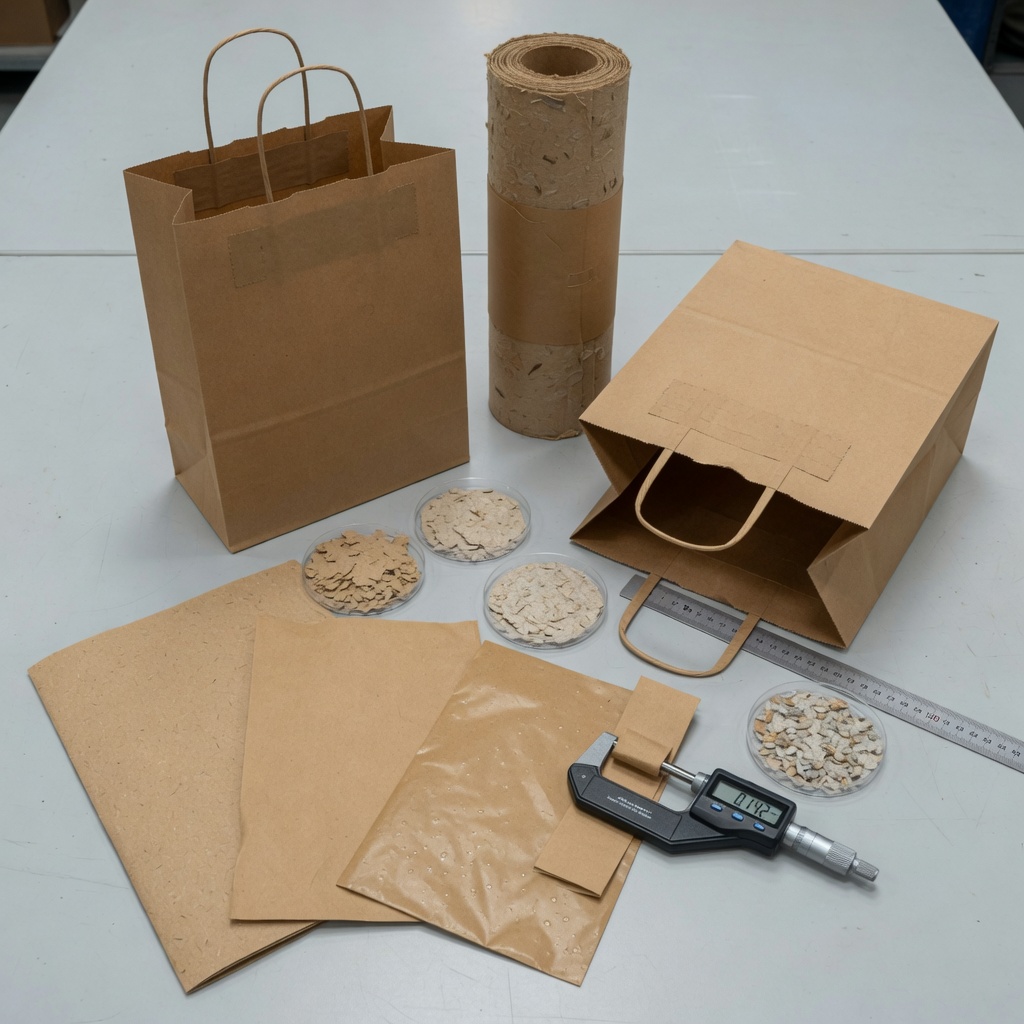
Australian B2B buyers should treat paper bag OEM sustainability sourcing criteria as a locked SKU specification and evidence pack, not as brochure language. Award shopping bag manufacturing only when fiber origin, paper grade, recycled-content percentage by mass, FSC or PEFC chain-of-custody coverage, and the effect of coatings, inks, adhesives, and handles on the finished bag are written into the RFQ and matched with documents for that exact article. Claims without matching proof are a greenwashing risk. Ask for grade specification sheets, mill recycled-content declarations, current FSC or PEFC chain-of-custody certificates, and a recyclability statement that names the assembled construction. Paper Bag Sustainability Specifications: What Buyers Can Ask Suppliers to Document
This page is for procurement, packaging, and brand teams buying shopping bag manufacturing as OEM or custom production for Australia. It does not claim factory visits, laboratory tests, named customers, or first-person production experience. Visible byline: Vincent Xi, Editorial Author, Custom Logo Things (author profile). Attribution is limited to that named author profile; no mill, converting, audit, or test experience is asserted here.
Freeze the bill of materials and mechanical spec first. Then name the sustainability evidence that must travel with that SKU, compare converters against the same document set, and freeze art, coating, and handle construction before mass production. Price is a later filter.
What Australian buyers should lock in first
Start with the bag as a specified article, not as a generic “eco” kraft tote. An RFQ that only says “eco paper bag” cannot be compared, verified, or defended. Load capacity, print quality, and handle comfort remain mechanical requirements; sustainability sourcing criteria sit on top of them and do not replace them.
Specify these fields before you score environmental statements:
- Bag style (SOS, pinch-bottom, euro tote, die-cut, or another construction) and finished dimensions in millimetres, including gusset and folded height.
- Body paper grade and basis weight in g/m² (example assumption to verify in the supplier quote, not a measured result: 90–140 g/m² for the body paper of a retail shopping-bag SKU, as of the quoted grade, against load, handle type, and puncture risk).
- Fiber mix: virgin kraft, mixed furnish, or recycled; and whether any recycled fraction is post-consumer or pre-consumer.
- Surface: uncoated, clay-coated, water-based barrier, or polymer film/laminate, with coating identity named.
- Ink system, varnish, and any foil or lamination.
- Handle type, material, attachment method, and adhesive.
- Claimed recyclability or compostability for the finished bag, not only the base paper.
If a converter cannot attach a SKU-specific pack—grade sheet, mill and converter chain-of-custody certificates, mill recycled-content declaration, full bill of materials, finished-bag recyclability statement, and a written change-control rule—treat the sustainability claim as unusable for award. Paper Bag Sustainability Specifications: What Buyers Can Ask Suppliers to Document
A heavier uncoated kraft body can improve tear and reuse cycles but uses more fiber per bag. A lighter bag with a barrier coating may survive wet takeaway use but can fail a recyclability claim. Put the mechanical test and the evidence request in the same RFQ so the two cannot drift apart during sampling.
RFQ checklist for paper bag OEM sustainability sourcing criteria
Paste the following lines into the RFQ. Each line should return a document, a number with a unit, or a pass/fail sample—not brand copy.
- Name the article as an OEM paper shopping bag, with style, dimensions (mm), and target load.
- State body paper grade, colour, and basis weight in g/m²; mark any figure that is still an assumption to confirm in the quote as of that grade and lot.
- State the required fiber mix and the post-consumer recycled (PCR) percentage by mass of the furnish, with pre-consumer listed separately.
- Require a mill recycled-content declaration tied to the grade and, at order stage, to the production lot.
- Require current FSC and/or PEFC CoC certificates for mill and converter, including certificate numbers, issuing body, product-group or paper-grade scope, and expiry date.
- State the CoC claim that will appear on invoices, cartons, and (if any) the bag itself, and require that claim to match the certificate scope.
- Request a written fiber-origin / deforestation-risk due-diligence statement for the ordered furnish.
- List every coating, barrier, film, or laminate by chemistry and coat weight; forbid unnamed “eco coatings.”
- List ink system, varnish, foil, and maximum coverage; require technical data sheets and, if food is packed, the relevant food-contact statement for that ink set only.
- List adhesives for seams, bottom, and handle patches by type; require them on the bill of materials.
- Specify handle material and attachment; state whether a mixed-material handle is allowed.
- Require a full bill of materials for the finished bag, including handle and adhesive mass if a bag-level recycled-content claim will be used (example calculation to verify in the quote: PCR share of finished bag ≠ PCR share of body paper).
- Require a recyclability statement for the assembled bag, with the construction explicitly named.
- Forbid customer-facing claims until the golden sample, BOM, and certificates match.
- Require that any mill, grade, coating, ink, adhesive, or handle change after sampling triggers new documents and re-approval.
- Ask for packing specification of the bags themselves (bundle wrap, carton grade, pallet sheet) so secondary packaging does not undo the bag-level story.
- Set sample quantities, print-proof substrate (must be the real grade), and mechanical tests before tooling or mass print.
- Set document retention: certificates and declarations must be valid at purchase-order date and still valid at ship date, or replaced with current versions; record the as-of date on each check.
- Name Australian delivery terms you will use (for example port or door) only as logistics fields; do not treat freight mode as a sustainability certificate.
- Require a single PDF pack: spec sheet, BOM, CoC certificates, recycled-content declaration, coating/ink data sheets, and finished-bag claim sheet.
Fiber origin, FSC or PEFC chain of custody, and deforestation-risk evidence
Fiber is the first sourcing criterion because later claims depend on it. In paper-packaging communications, FSC and PEFC are used to support wood from sustainably managed forests; they are chain-of-custody systems, not a substitute for a finished-bag recyclability test. GemPSI: The paper sack - sustainable from raw material extraction to end of life FSC certification is also cited, in OEM manufacturer-evaluation notes, as a way to show that paper used in bags comes from responsibly managed forests when the certificate actually covers that paper. OEM paper-bag manufacturer evaluation notes on verifiable certifications
Ask for documents, not logos on a quotation PDF:
- Current FSC and/or PEFC chain-of-custody certificates for the mill and for the converting plant that will make the bags.
- Certificate numbers, issuing body, product-group or paper-grade scope, and expiry date as printed on the certificate (certificates are time-bound; verify validity as of the RFQ date and again at mass-production release).
- Whether the ordered grade will be claimed as FSC 100%, FSC Mix, FSC Recycled, PEFC certified, or uncontrolled/unclaimed fiber.
- A written fiber origin statement for the SKU: species or furnish type if available, country/region of harvest or collection if the mill will disclose it, and any controlled-wood or due-diligence statement the mill uses for deforestation-risk screening.
- Confirmation that the CoC claim on cartons and invoices will match the claim you will print (or not print) on the bag.
Distinguish a standard’s requirement from a company’s own practice. FSC or PEFC CoC, when valid and in scope, supports a chain-of-custody claim for certified fiber. It does not automatically prove zero deforestation for every uncertified input, it does not prove the bag is recyclable after coating, and it is not a factory social-compliance audit. Do not imply a plant is “FSC certified” unless the current certificate names that legal entity and the product group you are buying. Never treat a website badge as the certificate.
Certified virgin kraft often gives higher tensile and tear for grocery loads than a high post-consumer recycled sheet of the same g/m². High recycled content can still be the right call if strength is proven on the actual handle construction. Specify mechanical tests (for example tensile, tear, or a filled-bag lift test) as pass/fail criteria alongside the CoC claim so “more certified” does not silently become “weaker bag.”
Industrial paper sacks are not identical to retail shopping bags, but the same raw-material logic applies: bio-based, recyclable packaging made largely from renewable fiber still needs documented forest-management and converting controls from extraction through end of life. GemPSI: The paper sack - sustainable from raw material extraction to end of life
Recycled content, paper grade, and documentation that survives an RFQ audit
Recycled content is a mass-percentage claim about the paper furnish, not a judgement about sheet colour. Brown kraft can be virgin; grey or speckled sheets can still be mostly virgin with a dye. Require the number, the definition, and the document.
Specify:
- Post-consumer recycled (PCR) content as a percentage by mass of the paper furnish for that SKU and production lot (example assumption to verify in the supplier quote and mill declaration, not a catalogue fact: 20% PCR or 40% PCR by mass of the named body-paper furnish, as of the production lot—do not treat a catalogue “eco” grade as the lot you will receive).
- Pre-consumer / broke / mill-converted scrap, stated separately so it is not blended into a PCR headline.
- Whether the recycled claim applies only to the body paper or also to handles, patches, and any inner sheet.
- Supporting documents: mill recycled-content declaration, grade specification sheet, and, where a percentage will be printed on the bag or used in a customer-facing claim, the test method or calculation basis the mill used.
Example calculation to verify in the quote, not a measured lot result (replace masses with the quoted SKU; as of the quoted construction): a bag body cut from 120 g/m² paper with a stated 30% PCR furnish means 30 g of post-consumer fiber per 100 g of that paper, before ink, adhesive, and handle mass. If handles are virgin twisted paper adding 8 g per bag and the body paper is 45 g, the PCR share of the finished bag is lower than the paper-furnish percentage. Ask the supplier to show both numbers if you will publish a bag-level claim.
Raising PCR can change shade, formation, and dusting, which then changes ink laydown and rub resistance. If you need tight brand colour, specify colour tolerance and a printed rub test on the recycled grade you actually approve—not on a virgin strike-off.
Evaluate OEM partners on documented criteria rather than price alone, including verifiable certifications such as FSC where they apply to the paper you buy, plus the converter’s ability to run a stable OEM specification. OEM paper-bag manufacturer evaluation notes on verifiable certifications Management-system certificates, where current, speak to process control; they are not fiber-origin certificates. Name each document’s job in the RFQ so they are not treated as interchangeable.
How coatings, inks, adhesives, and handles change recyclability claims
A recyclable paper grade can become a hard-to-recycle finished shopping bag. Coatings, inks, adhesives, and handles are where many OEM claims fail. Ask for a full bill of materials and for a recyclability statement that applies to the assembled bag, not the unprinted reel. Paper Bag Sustainability Specifications: What Buyers Can Ask Suppliers to Document
Work through each component:
- Coatings and barriers. Polyethylene or other polymer films, even as a thin layer, can change whether a bag is accepted as paper in a given recycling stream. Water-based barriers may be more compatible, but only if the chemistry and coat weight are declared and the finished bag is assessed. Specify coat identity, coat weight (example assumption to confirm on the specification sheet: dry coat weight in g/m² for the named barrier, as of the quoted construction), and whether the barrier is needed for grease, moisture, or both.
- Inks and varnishes. Ask whether inks are water-based, UV, or solvent; whether they are mineral-oil constrained; and whether a heavy solid print or metallic ink will be used. High ink coverage can affect repulpability even when the base paper is uncoated.
- Adhesives. Bottom-seam, side-seam, handle patch, and any window or liner adhesives should be named (for example starch, PVA, hot-melt). A handle patch that uses a non-repulpable hot-melt can contaminate an otherwise simple kraft bag.
- Handles. Twisted paper, flat paper, die-cut (same sheet), cotton, or polypropylene rope are different end-of-life articles. If the handle cannot stay with the paper stream, say whether it is designed to be removed and how that will be communicated. Die-cut handles avoid a second material but change tear-out risk; compensate in g/m² or reinforcement rather than ignoring the mechanical trade-off.
Do not print “100% recyclable” on a PE-laminated bag with PP rope handles unless you have evidence for that exact construction. Recyclability is construction-specific and collection-system-specific. This editorial does not map Australian kerbside or commercial MRF acceptance by council; that must be verified against the finished sample and the destinations where bags will be discarded.
A light water-based barrier may protect a takeaway bag in rain or refrigeration better than uncoated kraft, at the cost of extra chemistry to document. Uncoated kraft is usually the cleaner recyclability story if the use case is dry retail goods. Choose the barrier only when the use case requires it, then document it.
Buyer decision table for OEM shopping bag manufacturing
Use the table to compare OEM options against the same sustainability sourcing criteria. Every row is a specify / compare / verify action, not a slogan.
| Decision criterion | What to specify in the RFQ | Evidence to request (SKU-specific) | Trade-off or fail condition | Buyer action before award |
|---|---|---|---|---|
| Fiber origin and deforestation-risk screening | Virgin, mixed, or recycled furnish; any restricted origins | Mill origin or due-diligence statement plus CoC scope | Uncontrolled fiber with no due-diligence pack | Reject “responsibly sourced” wording without documents |
| FSC or PEFC chain of custody | Claim type (e.g. Mix, Recycled) on the ordered grade | Current certificate number, scope, expiry, mill and converter CoC | Certificate expired, wrong legal entity, or grade out of scope | Verify numbers with the issuing scheme before PO |
| Recycled content | PCR % by mass of paper furnish; pre-consumer stated separately | Mill declaration and grade sheet for the production lot | Catalogue % that cannot be tied to the lot | Freeze the % that may be printed or reported |
| Basis weight and grade | g/m² and kraft/white/testliner identity (example assumption to verify in the quote: 90–140 g/m² for body paper of the named shopping-bag SKU) | Spec sheet and incoming-paper test method | Strength failure at stated g/m² on recycled grade | Approve a filled-bag or tear test on the real grade |
| Coating / barrier | Chemistry, coat weight, coverage area | Technical data sheet and finished-bag recyclability note | Unnamed “water-resistant coating” | Ban unnamed polymer films if recyclability is required |
| Inks and varnish | System, coverage, any metallic/foil | Ink TDS and food-contact statement if used for food service | Rub-off or non-repulpable coverage | Approve print on the recycled/coated stock, not a dummy sheet |
| Adhesives | Seam, patch, and handle adhesive types | BOM line items and repulpability statement if claimed | Hidden hot-melt patch on an “all paper” bag | Require exploded BOM with adhesive grams per bag if claimed |
| Handles | Material, attachment, removable or integral | Handle component spec and end-of-life note | Mixed-material handle with an all-paper claim | Photograph and retain the approved handle construction |
| Finished-bag claim | Recyclable / compostable / recycled-content wording | Claim mapped to the approved construction | Claim written before BOM is frozen | Legal/brand sign-off only after golden sample |
| OEM change control | No substitution of mill, grade, coating, or handle | Written change-notice rule | Silent mill switch after sampling | State that substitutions need re-approval and new CoC |
Award rule: a lower unit price that omits CoC numbers, a lot-tied recycled-content declaration, or a BOM is not a complete offer. Hold the award until the table is green, or reject the quote.
How to compare quotes without rewarding the weakest evidence
Score each OEM quote against the table, not against adjectives. A higher price that includes a valid, in-scope certificate and a named uncoated kraft grade may be the only offer you can put in front of a retailer sustainability questionnaire.
- Put all quotes on the same g/m², handle, and print-coverage basis. A 90 g/m² bag is not comparable to a 140 g/m² bag on either strength or fiber mass (example basis weights to verify in the quote for the same shopping-bag style, as of the quoted grades).
- Reject mixed claims (“FSC paper” plus uncertified handles and unnamed lamination) unless the claim is rewritten to the certified component only.
- Prefer suppliers who can show OEM/ODM specification control—repeatable grades, documented substitutions, and supply-chain statements that are backed by certificates rather than a list of logos. OEM paper-bag manufacturer evaluation notes on verifiable certifications
- Treat energy-efficiency or mill recycling statements as mill-level context. They can support a broader packaging story for fiber-based packs made from renewable raw materials, but they do not replace SKU documents. GemPSI: The paper sack - sustainable from raw material extraction to end of life
If two converters quote the same certified grade from the same mill, the remaining differentiators are converting control (cut accuracy, handle attachment, print-to-grade), document discipline, and whether coatings or handles are being added that the mill never certified as a finished article.
Evidence method, limitations, and what to verify before production approval
Source contexts used. This article draws on three public industry texts: (1) buyer-facing guidance on paper-bag sustainability specifications and the documents to request; (2) a paper-sack industry communication on renewable fiber, FSC/PEFC, and resource-conserving production from raw-material extraction to end of life; and (3) an OEM manufacturer-evaluation list that names verifiable certifications and supply-chain documentation as selection criteria. Those texts describe documentation practice and selection criteria; they are not test reports for a Custom Logo Things SKU and they are not keyword-demand data.
How the data were derived. Buyer questions (certificate numbers, PCR percentage, coating/ink/adhesive/handle effects, and a full bill of materials) were mapped to the documentation steps those sources describe. Exact numbers in this article are either labeled as example assumptions or example calculations to verify in the supplier quote, or described as certificate fields (number, scope, expiry) that exist on real CoC documents and must be checked as of RFQ date and ship date. No mill audit, no laboratory recyclability test, and no production-lot measurement was performed for this editorial.
Limitations / what to verify. FSC and PEFC CoC claims are only as good as current scope and the physical paper on the machine. Recycled-content percentages are lot-specific. Coatings and mixed-material handles can void a paper-recyclability story even when fiber is certified. Local collection rules for Australian households and commercial sites are not mapped here and can differ by council and by contamination rules. Certificate expiry, mill switches, and ink/coating substitutions are common failure points between sample and mass production. Verify every certificate with the issuing scheme, re-test mechanical performance on the approved recycled or coated grade, and freeze the BOM before any on-bag claim is printed.
Prepared for Custom Logo Things (customlogothing.com) by Vincent Xi, Editorial Author (https://customlogothing.com/authors/vincent-xi/). No first-hand factory visit, lab test, award, or customer outcome is claimed.
Discuss Your Requirements
Review our manufacturing capabilities, then share your specifications for a supplier-fit review.