Paper Bag Sourcing Minimum Order Quantity for United States Buyers
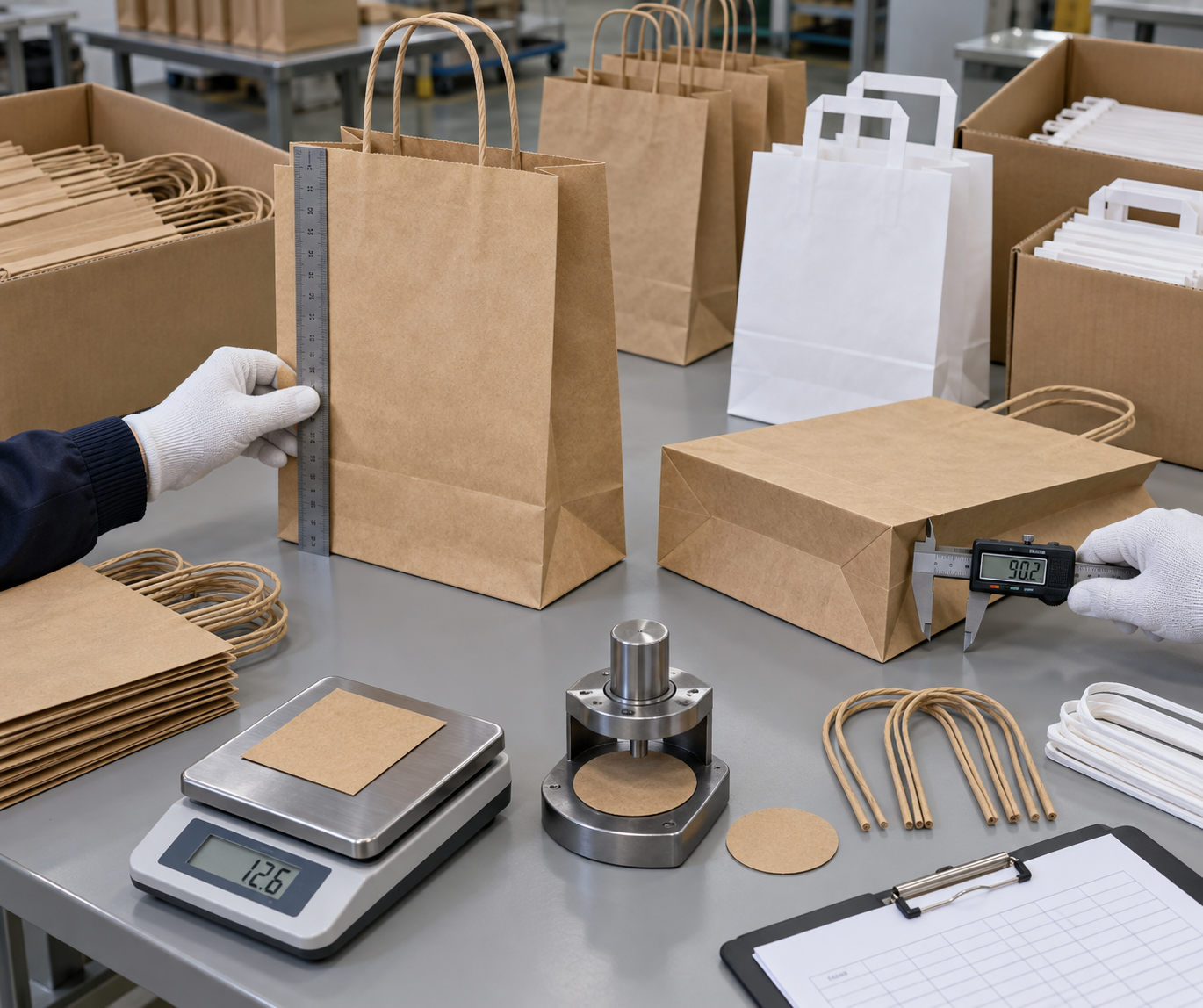
United States buyers establishing a paper bag sourcing minimum order quantity should freeze a single shopping bag specification before querying supplier thresholds. Published factory-direct ranges report digital printing floors near 300 pieces and offset printing near 1,000 pieces, with standard stock sizes frequently quoted around 500 pieces, according to Packzino's low-MOQ strategy documentation (no publication date is stated in the cited excerpt) (Packzino). A 2026 sourcing guide for paper bags from China identifies typical private-label minimums at 1,000 units or more, compared to 500 units or more for white-label programs, noting that setup fees dominate order economics below 1,000 units (SourcifyChina). These data points reflect third-party industry reports rather than Custom Logo Things manufacturing capacity, domestic mill quotes, or freight commitments.
Vincent Xi, Editorial Author, prepared this procurement brief. The author profile is documented at https://customlogothing.com/authors/vincent-xi/. The contributor role is strictly editorial; no factory audit, physical press run, client outcome, laboratory testing, or industry award is claimed or implied.
A key procurement decision is whether a vendor applies volume thresholds per bag size, per artwork file, per mill paper roll run, or across consolidated items sharing mechanical dimensions. A wholesale bag sourcing framework advises buyers to define structural specifications—including basis weight in grams per square meter (GSM) and burst factor—prior to issuing a request for quotation, evaluating vendor minimums directly against operational burn rates (PaperIndex).
What a United States Shopping Bag Minimum Order Quantity Covers
In retail shopping bag procurement, the minimum order quantity represents the smallest production run an operating converter will schedule for a single mechanical setup. A complete make-ready includes face width, gusset depth, bag height, paper grade or basis weight, handle attachment, ink station count, and printing process. Altering a gusset dimension or substrate specification requires a new machine setup, even if the graphic artwork remains unchanged.
United States purchasing teams must separate three operational thresholds on every quotation:
- The commercial minimum: the lowest quantity the converter will bill on an invoice.
- The packaging multiple: full carton or pallet quantities required to prevent broken-pack handling.
- The internal inventory ceiling: maximum carrying capacity based on store-level replenishment rates.
PaperIndex recommends that an order MOQ should not exceed 150 percent of projected monthly bag consumption to prevent carrying excess unallocated packaging (PaperIndex). That 150 percent figure functions as an inventory-risk planning benchmark rather than a regulatory or mill-certified ceiling.
A converter operating in the United States and an overseas manufacturing facility quote different minimum thresholds for identical kraft shopping bag specifications. While naming manufacturing origin clarifies ocean lead times, container optimization, and import tariffs, this guide addresses United States delivery, handling, and warehouse acceptance. Buyers should state destination zip codes, Incoterms, and required delivery dates on the initial RFQ to ensure ex-works base pricing is not confused with landed store delivery.
How Printing Method and Stock Size Change the Minimum Order Quantity
Packzino notes that retail brands can achieve custom paper bag orders between 300 and 500 pieces by selecting off-the-shelf standard sizes, utilizing digital presses, grouping artwork into combined production runs, and coordinating with existing factory paper schedules. The same source establishes baseline factory-direct minimums at 300 pieces for digital production, 1,000 pieces for offset printing, and approximately 500 pieces for standard stock conversions (Packzino). These metrics apply specifically to custom paper bag orders evaluated in that document; because the excerpt lacks an explicit publication date, these figures represent point-in-time reference benchmarks rather than a national market census.
SourcifyChina's 2026 sourcing guide states that private-label custom programs typically require 1,000 units or more, while white-label programs start around 500 units, with digital printing providing the lowest initial thresholds. The report emphasizes that fixed prepress and machine changeover expenses dominate unit economics below 1,000 units (SourcifyChina). White label indicates applying custom graphics to standardized bag blanks, whereas private label indicates custom-engineered bag dimensions and papers. The term "typically" reflects common supplier parameters rather than a guarantee that every manufacturing plant will accept 500 or 1,000 units on a given specification.
Stock dimensions reduce minimum requirements because converters utilize existing tooling, folding formers, and roll slit widths. Specifying non-standard heights or custom side gussets triggers new cutting dies or folding plates, raising piece minimums and fixed setup fees even on short-run digital presses. When bag geometry changes, buyers must require suppliers to re-verify the active minimum. Published references do not detail separate piece minimums for protective varnishes, film lamination, twisted paper cords, or internal flood-coat printing; those features must be quoted individually per supplier.
Per-Size, Per-Design, and Mixed-SKU Rules
United States retail operations frequently require multiple seasonal or regional designs across uniform bag dimensions. Packzino highlights SKU consolidation via gang runs as an operational method for securing 300–500 piece volumes (Packzino). This demonstrates that certain commercial converters accommodate combined runs, but it does not imply that every bidding vendor offers split-artwork production without added fees.
PaperIndex instructs procurement professionals to define SKU-level minimums and negotiate mixed-SKU allowances before shifting from spot-market buys to contract sourcing (PaperIndex). Buyers should structure the RFQ across three distinct operational layers:
- Dimensional make-ready: Uniform width, gusset, height, and GSM utilize identical converting plates and machine adjustments.
- Graphic changeover: Plate prepress, wash-ups, or digital indexing charges apply per individual artwork variation.
- Distribution packaging: Unique carton labeling or store-level pack counts represent warehouse requirements that should not arbitrarily increase factory master batch minimums.
To prevent mismatched commercial assumptions, state the consolidation rule clearly: one common mechanical specification (face width, gusset depth, bag height, paper GSM, handle construction) combined with multiple artwork designs within a single production release. Then require the vendor to specify any per-artwork minimum thresholds and gang-run change fees. If a vendor mandates the full base minimum for every individual graphic version, multi-design pooling provides no inventory relief.
Initial pilot programs require separate operational boundaries. PaperIndex recommends executing test runs of 5–10 percent of projected program volume to evaluate structural and print quality prior to large commitments (PaperIndex). This percentage is calculated against total buyer demand, not converter machine minimums. If a converter enforces a rigid 1,000-unit production floor, a 5 percent trial run on an 8,000-unit program (400 bags) cannot run unless the buyer pays for the 1,000-unit floor or switches to a digital stock-bag setup.
Landed Cost and Inventory Limits for United States Procurement
Published pricing benchmarks show significant unit-cost decreases as production runs expand beyond initial thresholds. SourcifyChina's 2026 sourcing guide reports landed unit costs ranging from $0.85 to $1.40 per bag at 500 units, dropping to $0.25 to $0.42 per bag at 5,000 units, based on verified sourcing quotations (SourcifyChina). These ranges represent U.S. dollars per bag for paper retail packaging under the specific sourcing conditions evaluated in that publication. These published figures are not independently audited here and should not be treated as uniform price schedules for United States domestic converting mills.
Example calculation (illustrative exercise to evaluate published range spread, not an active quote): Subtracting the lower bound at 5,000 units ($0.25) from the upper bound at 500 units ($1.40) yields a variance of $1.15 per bag. This calculation combines opposing ends of two separate volume brackets to highlight cost sensitivity at lower volumes. Buyers must replace these reference figures with itemized supplier quotes based on finalized specifications rather than calculating unweighted averages.
Because machine setup charges dominate lower production runs, a 500-unit shopping bag order can accumulate higher total costs in tooling, prepress, and plate preparation than in raw paper stock. Buyers should require vendors to itemize setup fees separately from unit pricing. Comparing comprehensive landed expenditure—combining setup charges, unit conversion, domestic or ocean freight, customs tariffs, and local drayage divided by verified delivered units—reveals the true cost of smaller production batches.
Example inventory calculation (planning assumption based on PaperIndex's 150 percent monthly usage threshold): At an operational burn rate of 800 shopping bags per month, a 150 percent inventory ceiling permits an order of up to 1,200 bags. A standard 1,000-unit offset production floor fits within this inventory parameter. Conversely, for a store consuming 400 bags per month, the 150 percent ceiling limits orders to 600 units; placing a 1,000-unit order represents 250 percent of monthly consumption, failing the carrying-cost threshold. These 400-bag and 800-bag scenarios represent illustrative planning figures to be adjusted against actual enterprise demand.
Total landed expense for United States delivery depends heavily on selected Incoterms (such as FOB, CIF, or DDP), port clearance, carton cubic volume, and customs entry management. RFQs must state who serves as the Importer of Record and whether quoted pricing covers customs brokerage and applicable Harmonized Tariff Schedule (HTS) duties. A low piece minimum does not yield procurement savings if customs delays or oversized freight charges disrupt scheduled retail rollouts.
Regulatory and compliance parameters must be verified prior to awarding production contracts. If retail bags encounter direct or indirect food contact, require written declarations detailing whether the substrate, adhesives, inks, and handle attachments meet applicable FDA food-contact standards, accompanied by supporting supplier documentation. For goods distributed in California, confirm whether materials require warnings under California Proposition 65. For imported packaging, require clear country-of-origin labeling on bags or shipping master cartons in accordance with U.S. Customs regulations. Structural integrity requirements must be documented using objective parameters: paper grammage (GSM) and burst factor, referenced via standard testing protocols such as TAPPI test methods noted on mill data sheets. Citing industry test methods establishes verification criteria but does not constitute formal mill certification by Custom Logo Things.
Buyer Decision Table for Paper Bag Sourcing Minimum Order Quantity
The following matrix outlines production minimum scenarios, published benchmarks, and direct procurement verification actions:
| MOQ Structure | Published Anchor Benchmark | Applicability for United States Sourcing | Mandatory Verification Action |
|---|---|---|---|
| Digital Production | 300 pieces (Packzino; publication date unstated) | Short-run campaigns, localized tests, low inventory ceiling | Confirm whether quoted floor requires standard stock dies or covers custom dimensions. |
| Stock Dimension Converting | ~500 pieces (Packzino) | Core retail programs matching standard former tooling | Validate vendor stock die drawing against internal merchandise dimensions. |
| Offset Production | 1,000 pieces (Packzino) | High-volume rollouts requiring precise brand color matching | Specify spot colors and confirm how ink station count impacts plate setup fees. |
| White-Label Program | 500+ units (SourcifyChina 2026 Guide) | Overprinting graphics on standardized pre-manufactured blanks | Require physical paper samples and dimension sheets before releasing artwork. |
| Private-Label Program | 1,000+ units (SourcifyChina 2026 Guide) | Custom-engineered dimensions, custom handles, structural specifications | Specify paper GSM, burst strength, and handle style; ensure all fit within quoted base minimum. |
| Gang-Run Consolidation | 300–500 pieces consolidated (Packzino) | Multiple graphic variations sharing identical physical dimensions | Require written confirmation of per-design minimums and gang-run change fees. |
| Inventory Ceiling Policy | ≤150% of monthly projected demand (PaperIndex) | Enterprise inventory control across all order sizes | Compare quote against consumption forecast; mandate formal override for overages. |
| Operational Pilot | 5–10% of total program volume (PaperIndex) | Verifying new substrate grades, handles, or production partners | Verify whether trial volume satisfies factory minimum or requires digital substitution. |
| Landed Cost Reference | $0.85–$1.40 (500 units) / $0.25–$0.42 (5,000 units) (SourcifyChina 2026) | Initial budget modeling prior to formal RFQ issuance | Require itemized quote lines for setup, freight, duty, and drayage to destination facility. |
RFQ Checklist
- Specify face width, gusset depth, bag height, paper GSM or basis weight, burst factor and test method, handle type, and print method as one revision-controlled specification.
- Ask the supplier to restate the minimum order quantity for that revision, in pieces and in cartons, split by size, by artwork, and by paper lot.
- Ask whether same-size, same-material artworks may be combined, and require any per-design minimum or gang-run charge to be stated as a number.
- Require setup, unit price, freight, duty, and brokerage as separate quote lines for the United States ship-to address, with the Incoterm named.
- Compare the quoted piece count with projected monthly usage, and approve a quantity above 150 percent of that usage only with a signed inventory override.
- Require a pre-production sample, including paper and handle, to be approved against the specification before the production quantity is released.
- Verify incoming count, dimensions, paper weight, and handle construction against the approved sample, and state the reject path for a short count or a missed spec.
- Specify country-of-origin marking on the bag or the export carton for imported goods, and ask for the food-contact or California material declarations the buyer's distribution actually requires.
Methodology, Source Context, and Limits
The volume and pricing metrics cited in this report derive directly from the three referenced industry guides, rather than internal Custom Logo Things production databases. Packzino's sourcing report provides the 300-piece digital printing baseline, the 1,000-piece offset printing threshold, the 500-piece stock-size reference, and the 300–500 piece SKU consolidation framework; the source document does not provide a formal publication date. SourcifyChina's 2026 report serves as the source for the 1,000-unit private-label baseline, the 500-unit white-label threshold, the observation regarding setup charges below 1,000 units, and the landed cost ranges of $0.85–$1.40 per bag at 500 units and $0.25–$0.42 per bag at 5,000 units (reported as verified supplier quotes). PaperIndex's wholesale sourcing documentation provides the framework for standardizing GSM and burst factor prior to RFQ release, auditing SKU-level minimums, structuring 5–10 percent volume pilots, and capping order sizes at 150 percent of monthly consumption.
Data synthesis methodology: Each numerical figure maintains its original unit of measure and defined operational context. The calculated $1.15 cost range differential and the 400-bag versus 800-bag replenishment analyses represent explicit arithmetic models designed to assist buyers in testing supplier proposals. These volume figures represent illustrative planning assumptions rather than empirical market-demand statistics. No search volume, cost-per-click, keyword difficulty, search intent scores, or search traffic metrics are included or estimated.
Verification constraints: Commercial production minimums are subject to change over time; cost benchmarks from overseas sourcing reports have not been independently audited against domestic converters, specific Incoterms, or fluctuating freight indices. Duty rates, shipping tariffs, and raw kraft paper pulp pricing vary independently. Multi-artwork consolidation terms must be confirmed directly with bidding suppliers in written proposals. Material regulatory statements, including FDA compliance and California Proposition 65 disclosures, must be obtained directly from manufacturers. Mention of technical testing procedures (such as TAPPI standards) outlines verification methodology and does not represent an active product certification by Custom Logo Things.
Vincent Xi, Editorial Author (https://customlogothing.com/authors/vincent-xi/), compiled these operational parameters to assist United States packaging buyers in defining clear contractual controls for commercial paper bag procurement.
Discuss Your Requirements
Review our manufacturing capabilities, then share your specifications for a supplier-fit review.