Tissue Paper Sourcing Minimum Order Quantity for European Buyers
Vincent Xi, Editorial Author https://customlogothing.com/authors/vincent-xi/
European buyers do not face a uniform statutory or commercial minimum order quantity when sourcing tissue paper. For European procurement teams, the operative quantity is strictly what a manufacturer will produce and release for a defined SKU, in a specific physical format, along an identified shipping route into Europe. Published supplier baselines vary considerably. One commercial hygiene sourcing reference indicates that private-label toilet paper runs frequently start at 10,000 rolls, that custom OEM manufacturing typically requires a 40GP container of approximately 50,000 rolls, and that a 40HQ container is the standard unit used to minimize landed unit freight on low-density converted paper (Top Source Hygiene). Meanwhile, a jumbo-roll converting FAQ cites an approximate standard minimum of 20 metric tons per item for toilet paper and napkin parent reels, noting that a standard 40ft container typically accommodates 26 reels of 1850 mm toilet paper jumbo rolls totaling 12–13 metric tons (Huaxing). Manufacturer purchasing guidance further emphasizes requesting quantity thresholds per individual SKU, because customized packaging, custom sheet dimensions, embossing patterns, and virgin versus recycled raw furnishes alter production minimums (Donsea Paper).
Treat these figures strictly as supplier-published reference points rather than universal benchmarks. Every parameter must be reconfirmed on a live quote for the specific EU member state, EEA non-EU market, or UK port of destination. This article provides editorial procurement analysis and does not report on proprietary mill trials, commercial transactions, or first-hand manufacturing operations.
Why tissue paper sourcing minimum order quantity is not one number
Tissue paper procurement encompasses two distinct product classes: finished consumer or away-from-home (AFH) rolled goods, and parent or jumbo rolls destined for local converting. Facial tissue, folded napkins, hand towels, kitchen rolls, and toilet tissue each possess distinct basis weights, converting speeds, and packaging lines. Consequently, an aggregated supplier "MOQ" that fails to differentiate product form and SKU classification cannot be used for cross-vendor comparisons.
Guidance from Donsea Paper highlights the primary commercial pitfall: failing to establish the minimum order quantity on a per-SKU basis. Packaging customization, non-standard core dimensions, custom embossing patterns, and raw furnish selections frequently drive up line-setup requirements. The source notes that private-label tissue production minimums vary according to product format and customization depth; buyers must therefore evaluate per-SKU volume thresholds alongside pricing, production lead times, quality assurance gates, actual supplier-held certifications, and OEM manufacturing scope prior to purchase-order commitment (Donsea Paper).
None of the cited industry references establishes an EU, EEA, or UK legal threshold for purchase volume. A paper mill's technical run minimum and an importer's freight-optimized container load represent two distinct constraints. An importer clearing freight through an EU member state, an EEA buyer operating outside the EU customs union, and a UK business managing post-Brexit import requirements encounter different customs formalities, VAT timing, and packaging waste reporting rules on the exact same SKU. These national and regional regulatory differences are absent from overseas supplier portals, yet they dictate whether a quoted production volume can be cost-effectively received, warehoused, and distributed. Buyers should explicitly specify the delivery destination in the request for quote (RFQ) and never assume that quantity terms accepted for one European jurisdiction apply across others.
Before initiating commercial evaluations, categorize any quoted quantity along three lines:
- Whether it reflects a finished roll count, metric tonnage of parent reels, or a mandatory ocean container booking.
- Whether it applies to a single SKU, an individual item code, or an aggregated product assortment.
- Whether it reflects a customized production run requiring tooling or standard stock continuous production.
Without explicit written clarification on these three elements, supplier quotes cannot be normalized.
Container loads versus a per-SKU minimum order quantity
Due to their high volume and low density, tissue paper products incur steep freight penalties when ocean containers are underfilled. Top Source Hygiene observes that B2B tissue sourcing typically relies on a 40HQ (high-cube) container volume to minimize landed unit costs. The same source notes that private-label toilet paper production frequently starts at 10,000 rolls, whereas a fully customized OEM production run typically requires a 40GP (general-purpose) container holding approximately 50,000 rolls. The author notes that lower volume runs can sometimes be negotiated by bundling multi-ply variants (such as 2-ply and 3-ply) or by absorbing plate and tooling setup costs through an elevated unit price (Top Source Hygiene).
Equipment types must not be conflated during load planning. A 40HQ container provides roughly 76 cubic metres of volume, whereas a standard 40GP offers approximately 67 cubic metres. The cited literature identifies the 40HQ as the landed-cost benchmark and the 40GP as the physical envelope for a 50,000-roll custom OEM run. Importers must not treat 10,000 rolls as an operational fraction of a standard container load; it represents a commercial entry threshold for branded converting, not a shipping profile.
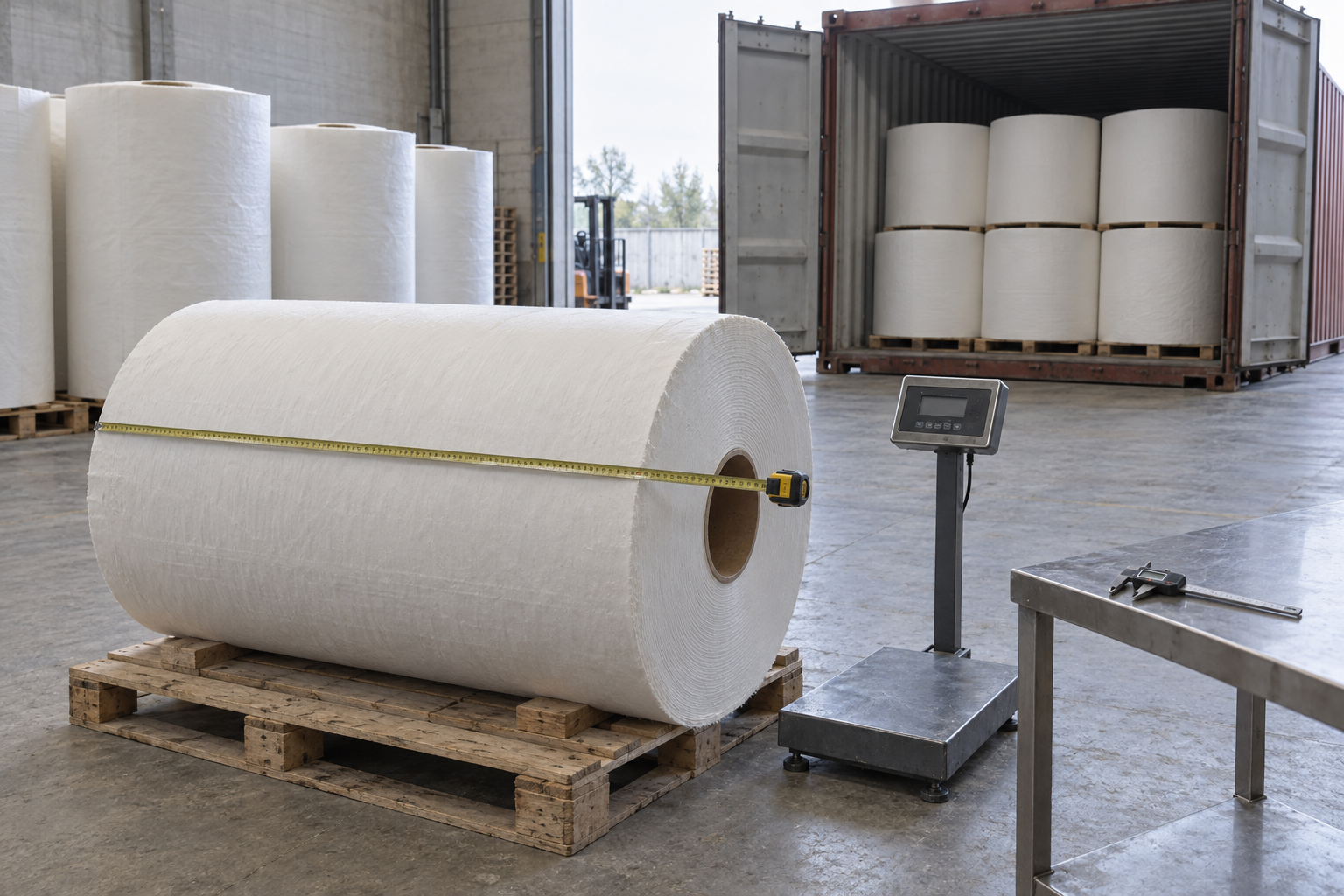
For converters sourcing parent rolls, Huaxing's documentation frames order minimums through roll mass and reel dimensions. It states that standard minimum order volumes for toilet paper and napkin jumbo rolls average around 20 metric tons per item. For logistics planning, Huaxing notes that a standard 40ft container typically accommodates 26 parent reels of 1850 mm width toilet-paper tissue, yielding a net payload of 12–13 metric tons. Sourcing flexibility can reportedly be achieved by mixing item categories—including toilet paper, facial tissue, napkin stock, hand towel stock, and kitchen roll tissue (Huaxing). However, terms such as "around" and "typically" represent non-binding operational estimates rather than contractual commitments.
Example calculation to verify in supplier quotes (not a binding loading plan): Huaxing's per-item baseline of approximately 20 metric tons exceeds the 12–13 metric tons accommodated by 26 reels of 1850 mm jumbo rolls in a single 40ft container. A European converter requiring only one 40ft container of this specification would fall roughly 7–8 metric tons short of the single-item minimum. Importers must explicitly confirm whether the balance must consist of the identical reel specification, a second container, or an approved mix of alternative tissue grades.
Comparative gap illustration: Comparing Top Source Hygiene's published private-label starting point (10,000 rolls) against its OEM container scale (approximately 50,000 rolls) yields a variance of 40,000 rolls. This arithmetic indicates the commercial gap between an initial trial order and a full-scale OEM manufacturing run. It does not reflect market demand or price parity. It serves as an analytical basis to ask whether SKU bundling or dedicated tooling amortizations are available for shipments to specified European ports.
Finished private-label rolls and jumbo rolls
Selecting between finished retail packaging and jumbo parent reels fundamentally shifts RFQ specifications. Retailers and distributors purchasing finished private-label units must specify ply count, sheet dimensions, perforation tensile strength, core diameter, inner wrap, outer master carton or bundle packaging, and print graphic layouts. In contrast, converters acquiring parent reels must detail deckle width, target basis weight (gsm), roll diameter, core inner diameter, moisture content, tensile strength, and furnish compatibility with their converting machinery.
Supplier claims must remain strictly within their original product scope. The 10,000-roll baseline and the 50,000-roll 40GP reference in the cited text apply exclusively to finished toilet tissue; they provide no baseline data for boxed facial tissues, interfolded napkins, or industrial parent rolls. Conversely, the 20-metric-ton parameter applies solely to parent reels of toilet and napkin tissue, not finished retail cartons. Furthermore, the 26-reel, 1850 mm specification yielding 12–13 metric tons illustrates a specific loading scenario for a 40ft container; it cannot be applied universally to other parent roll diameters or trim widths.
Warehouse intake limitations across European facilities must be audited alongside overseas freight minimums. A full 40HQ container may optimize ocean shipping rates yet strain regional pallet storage capacities or exceed European trailer payload allowances (typically limited to 24 metric tons gross road freight). These logistical factors require regional verification; neither overseas source provides domestic distribution guarantees within Europe.
Sample availability represents a separate transactional step. Huaxing notes that evaluation samples are supplied free of charge provided the buyer covers international courier expenses. This provision does not define specimen sample size, transit timelines, or technical tolerances relative to commercial production runs. For European converters, the freight cost of air-freighting parent reel hand sheets versus finished roll samples must be budgeted accordingly. Sample acceptance does not supersede production run minimums.
Buyer decision table for European tissue paper procurement
Use this comparative matrix to evaluate supplier responses against published benchmarks. Every parameter is derived directly from the cited sources, which lack original publication dates. Terms must be validated during formal bidding. This table does not constitute a supplier audit or vendor ranking.
| Decision point | Published signal | Unit, scope, and source context | What it does not establish | Procurement action |
|---|---|---|---|---|
| Private-label finished rolls starting point | Often starting at 10,000 rolls | Rolls; private-label finished toilet paper; Top Source Hygiene excerpt; undated | Maximum capacity; container fraction; applicability to non-toilet tissue SKUs | Ask whether 10,000 rolls is applicable to your specific ply, roll diameter, and destination port |
| Custom OEM dedicated production | Approximately 50,000 rolls per 40GP container | Rolls per 40GP container; custom OEM manufacturing; Top Source Hygiene; undated | 40HQ capacity; unit pricing; standard manufacturing lead time | Require quotes to separate machine-run setup thresholds from logistics loading calculations |
| Freight landed-cost optimization | 40HQ container cited as standard to control landed cost | Volumetric 40HQ container load; converted B2B tissue; Top Source Hygiene; undated | European statutory minimum; prohibition against smaller ocean bookings | Compare total landed unit cost between a full 40HQ and smaller LCL/FCL shipments |
| Parent reel production minimum | Around 20 metric tons per item | Metric tons per item; toilet and napkin parent reels; Huaxing FAQ; undated | Finished retail carton minimums; legally binding manufacturing tolerance | Specify tissue grade and request written minimum tonnage required per item code |
| Parent roll container loading profile | 26 rolls, 1850 mm width, 12–13 metric tons | Rolls, mm width, net metric tons, 40ft container; toilet parent reels; Huaxing FAQ; undated | 40HQ volumetric capacity; loading profile for alternate reel widths or basis weights | Verify trim width, reel count, and net weight against converting line unwind stands |
| Grade mixing flexibility | Combining toilet, napkin, facial, hand towel, and kitchen tissue | Assortment mixing; parent rolls; Huaxing FAQ; undated; no formula provided | Authority to import SKUs not suited to commercial market demands | Approve only grade assortments that match active European converting capacity |
| Lower-volume commercial levers | Bundling 2-ply and 3-ply, or amortizing tooling across piece prices | Commercial negotiations; finished rolls; Top Source Hygiene; undated; no pricing schedule | Fixed plate costs; guaranteed acceptance of lower volumes | Ask for printing plate and tooling charges as transparent, unbundled line items |
| Per-SKU volume governance | Packaging, dimensions, embossing, and raw materials increase MOQ | Operational principle; private-label tissue; Donsea Paper; undated; non-numeric | Technical compliance; verification of supplier-held certifications | Require a formal per-SKU quantity schedule prior to tender evaluation |
What customization changes in the quantity
Customization requirements directly impact factory minimum order volumes. Donsea Paper notes that custom secondary packaging, non-standard product dimensions, decorative embossing tooling, and furnish specifications frequently increase supplier run requirements. Top Source Hygiene observes that printing plate costs represent a fixed setup expense that must either be amortized across larger production runs or absorbed via higher unit prices on smaller orders. Neither source publishes fixed costs for gravure or flexographic printing plates, steel embossing cylinders, or pulp grade premiums.
For European private-label programs or converting operations, isolate four technical variables within the RFQ to control order minimums:
- Ply count and lamination: A 2-ply and a 3-ply tissue SKU represent distinct product lines. While literature suggests bundling plies to meet factory minimums, converters must confirm whether ply alterations require machine recalibration, knife changes, or packaging line stoppages that factories treat as discrete setups.
- Trim and roll geometry: Huaxing's literature cites an 1850 mm width for parent reels. If a European converting machine operates on an 1800 mm or 2100 mm unwind stand, that 1850 mm reel cannot be used. Buyers must define trim width down to the millimetre and request the minimum order tonnage calibrated to that specific deckle.
- Embossing cylinders and print plates: Machine tooling requires substantial capital expenditure. Unless tooling is quoted as an explicit, separate charge, low-volume orders will carry inflated unit costs. Procure printing plates and embossing tooling as discrete capital assets to ensure repeat replenishment orders do not repeat tooling fees.
- Furnish and technical tolerances: Virgin wood pulp, recycled de-inked pulp (DIP), and mixed furnish run at different speeds and yield varying bulk density. None of the cited literature details tensile strength, sheet brightness, or chemical compliance. Donsea Paper recommends auditing factory quality management protocols before placing bulk commitments. Buyers must incorporate measurable acceptance criteria—including dry/wet tensile strength, basis weight tolerances (gsm), sheet count verification, core crush resistance, and approved reference samples—into purchase agreements tied to final European destination clearance.
Production lead time represents an integral element of supply-chain risk. The cited literature omits manufacturing schedules. An order of 20 metric tons of parent reels or a 50,000-roll OEM container that misses a scheduled retail distribution window creates severe operational disruption. Solicit binding production timelines and transit schedules per SKU. Do not rely on sample parcel transit times to forecast production scheduling.
Europe checks that sit beside the order quantity
Commercial terms derived from overseas supplier websites must be aligned with European regulatory frameworks. The cited manufacturing sources do not track EU single-market directives, EEA agreements, or UK import standards.
Importers must avoid treating Europe as a unified commercial jurisdiction. Regulatory mandates differ across jurisdictions:
- EU Member States: Commercial imports are subject to harmonized EU customs tariffs, EU-wide product safety standards, and country-specific Extended Producer Responsibility (EPR) packaging waste registrations.
- EEA Non-EU States (e.g., Norway, Iceland): While aligned with many internal market product rules, these destinations require independent customs declarations and distinct import VAT accounting.
- The United Kingdom: Post-Brexit importations require distinct UK customs clearances, separate UK EPR packaging reporting, and independent chemical regulatory tracking.
Overseas supplier portals do not provide guidance on these jurisdictional distinctions. Importers must define whether order quantities are consolidated for a single central European distribution center or split across multiple delivery points. Dividing a single production run across EU, EEA, and UK locations can invalidate quoted volume economics due to separate customs clearances and national labeling mandates.
Chain-of-custody claims, recycled fiber content assertions, and environmental labeling must be independently documented. While supplier portals advise buyers to inquire about certifications, a website mention does not verify that a vendor holds current ISO 9001, ISO 14001, FSC, or PEFC accreditations. If a vendor claims compliance with an environmental standard, require an unredacted copy of the certificate showing the exact corporate entity, certification scope, issuing registrar, and expiry date. Mill standard operating practices must never be confused with accredited third-party certification. Neither the citing supplier sources nor Custom Logo Things provides third-party certification for the cited products.
Commercial price terms must be rigorously defined. Quoted adjustments that cover tooling within unit rates remain incomplete until the applicable Incoterm (e.g., FOB, CIF, or DDP), the port of origin, and the specific European port of discharge are contractually established.
How these figures were derived, and what to verify
Methodology: The quantitative thresholds cited in this article are drawn directly from public information published on three industrial supplier portals and preserved within their original contextual scope. Volume and weight metrics were not mathematically averaged or converted between container models. A 40HQ container profile was not transposed onto a 40GP or standard 40ft footprint. No search-engine metrics, keyword tracking figures, or search-demand statistics were utilized in compiling this guidance. Analytical calculations are explicitly labeled as illustrative comparisons for procurement verification: specifically, contrasting Huaxing's 20-metric-ton per-item parent roll baseline against its 12–13 metric ton (26-reel) 40ft loading scenario, and illustrating the 40,000-roll numerical spread between Top Source Hygiene's 10,000-roll starting threshold and its 50,000-roll 40GP OEM run. Importers must recompute these metrics against live supplier tenders.
Limitations: Commercial supplier portals serve promotional purposes and are subject to unannounced revisions. The source materials lack publication dates, verifiable pricing sheets, mechanical loading diagrams, and standard contractual clauses. Modifiers such as "often," "typically," and "around" represent supplier estimates rather than binding performance tolerances. The cited references do not imply that Custom Logo Things operates paper mills or primary converting machinery, nor do they guarantee that European importers can access lower volume minimums through SKU bundling. EU, EEA, and UK regulatory frameworks are omitted from the source texts and must be verified independently with certified trade compliance counsel. Evaluation samples provided on a courier-collect basis do not substantiate production lot conformity.
Editorial Attribution: This analysis was authored by Vincent Xi, Editorial Author (https://customlogothing.com/authors/vincent-xi/). The approved editorial profile contains no claims of mill audits, factory trials, proprietary client accounts, or direct purchasing outcomes. No unverified first-hand manufacturing claims are made or implied. Factual statements unsupported by the referenced source documentation have been excluded.
RFQ Checklist
- Ask the supplier to quote the minimum order quantity per SKU in exact roll counts or metric tons, stating whether the figure represents a manufacturing batch minimum, a container loading requirement, or a commercial billing constraint.
- Require the manufacturer to identify container specifications separately across 40GP, 40HQ, and 40ft configurations, itemizing roll width in millimetres, gross and net reel counts, and total payload weight in metric tons.
- Specify ply construction, sheet perforations, finished roll diameter, core dimensions, embossing patterns, packaging styles, and raw furnish grades for each individual SKU prior to accepting unit rates.
- Compare the quoted parent roll minimum (evaluating the standard ~20-ton baseline) against proposed grade-mixing options across toilet, napkin, facial, hand towel, and kitchen tissue rolls to confirm alignment with European converting schedules.
- Verify in writing whether entry-level volumes (such as 10,000 finished rolls) and OEM production volumes (such as ~50,000 rolls per 40GP) are available for your selected European discharge port.
- Ask the supplier to separate tooling, plate engraving, and machine setup costs as discrete line items to evaluate the landed economics of smaller production volumes against full container loads.
- Specify whether the final delivery point is an EU member state, an EEA non-EU country, or the UK, and require the quote to identify the specific customs, tariff, and shipping responsibilities assigned to each party under the agreed Incoterm.
- Require the manufacturer to supply current, unredacted certificate documentation for every claimed environmental or quality standard, verifying scope, entity name, registrar, and expiration dates.
- Specify delivery quality acceptance tests covering basis weight, sheet count, core crush strength, tensile strength, and sample matching, explicitly designating who holds final inspection and rejection authority at the European warehouse.
- Ask the supplier to define pre-production sample availability, sample preparation costs, courier billing arrangements, and whether sample materials reflect final production-line tolerances.
Evaluate tender submissions against these verified parameters before issuing purchase authorizations. Informal or verbal minimums do not constitute contractual terms. Secure the per-SKU schedule, container loading plan, tooling invoice terms, and customs declarations alongside the formal purchase order so receiving warehouses can audit incoming deliveries against approved technical baselines.
Discuss Your Requirements
Review our manufacturing capabilities, then share your specifications for a supplier-fit review.