Tissue Paper Sourcing Sample Approval for United States Procurement Teams
By Vincent Xi, Editorial Author Author profile
Do not issue a United States bulk purchase order until tissue paper sourcing sample approval is complete: a physical inspection against named methods, a written pass/fail record, and a signed golden sample. For United States procurement teams, that gate freezes the SKU. It is not a catalog browse. Measure the arriving lot for grammage, unit mass, sheet count, embossing, moisture, and pack-out.
Visual-only review is an operational risk in tissue procurement. An academy briefing on toilet-tissue raw materials and parent rolls states that visual samples miss GSM, bulk, and moisture—the variables that cause converting-line jams—and recommends named ISO or TAPPI methods so quotes stay comparable (PaperIndex academy). Use that briefing as process evidence for a United States-bound tissue paper SKU. It is not a wrapping-grade default, not a United States statute, and not an editorial laboratory result.
Write test methods and tolerances into the RFQ before samples are made so competing quotes stay comparable. Inspect the physical lot. Approve, reject, or request a custom resample. Sign the golden sample, then order. A qualified mill is not an approved SKU.
This page covers one buyer task: how a United States B2B procurement team specifies, inspects, approves, and freezes tissue paper samples before ordering. It is not a country shopping guide and not a complete product encyclopedia.
How these figures were derived. Numeric statements below are transcribed from three published supplier or academy pages cited inline. Each figure is scoped to that page's stated practice. It is not a United States import measurement, not a mill certificate, and not an in-house test. Editorial review is by Vincent Xi, Editorial Author. This article does not claim factory inspections, mill tests, named customers, awards, or personal production experience.
Separate sample approval from supplier qualification
Supplier qualification answers whether a mill belongs on the approved-vendor list: export capacity, quality-system documents, social-compliance files, and whether it can ship to the United States with a complete commercial invoice and packing list. Sample approval answers whether this SKU—this GSM, sheet size, emboss, print, and pack-out—meets the written specification.
A qualified mill can still ship a non-conforming first lot if the sample was only looked at. An attractive sample from an unqualified mill can still fail on moisture, basis-weight variation, or carton strength in a full container.
Keep two files:
- Vendor file: capability, audit status, sample-lead-time policy, and Incoterms offered for United States delivery (name FOB, CIF, or DDP in the quote; do not infer terms from a sample airway bill).
- SKU file: the signed specification, the sample inspection record, retain photographs, lab tickets, and the golden-sample ID that production must match.
Issue the bulk PO from the SKU file, not from vendor qualification alone. A hand-picked courier parcel is not statistical evidence that a production lot will match; require the sample path (stock versus production-intent custom) in the RFQ.
Specify sample approval in the RFQ before the mill ships
Request samples only after the RFQ names attributes, methods, and pass/fail rules. Missing fields mean competing mills are not quoting the same SKU.
Do not request a sample until the RFQ writes product identity and intended United States use; target GSM with a named TAPPI or ISO grammage method; sheet size, fold, declared count, and the short-count rule; emboss, perforation, brightness/OBA, moisture, and bulk or caliper if converting or storing; a print rule with artwork version ID; bulk pack-out rather than a presentation box; saleable-unit mass and the variance rule; stock versus custom path and a mill ship calendar (not a United States door date); golden-sample retain quantity at the mill and in the United States; and inspection-record fields, Incoterms, sample-freight payer, country-of-origin marking, and claim language.
The same PaperIndex academy briefing recommends locking a tolerance such as 18 GSM ±3% and naming ISO or TAPPI methods so quotes are comparable (PaperIndex academy). Treat 18 GSM ±3% as an example calculation to verify in the supplier quote, not as a universal grade: unit is grams per square metre, with ±3 percent of target; scope is that academy page's stated example for tissue/parent-roll procurement; publication date is not stated in the excerpt used here—verify the live page and the mill's current method IDs. Do not copy 18 GSM onto a wrapping-sheet RFQ unless that is the agreed target. Stock samples cannot approve custom print, registration, or color.
Objective criteria for sample approval: weight, sheet count, embossing, and packaging
A supplier sampling note associated with Canton Fair 2026 tells buyers to evaluate arrivals against objective checks: weigh the roll (over 5% variance requires explanation), count sheets manually, confirm clean perforation and symmetric embossing, and inspect packaging for tight shrink wrap plus carton board of at least 200 g/m² (Canton Fair 2026 sampling note). Scope: that publisher's stated inspection practice as of the 2026 Canton Fair page, not a United States import rule and not an in-house QC protocol. Units: percent variance versus the quoted unit weight (confirm whether nominal, invoice, or conditioned mass); grams per square metre for carton board.
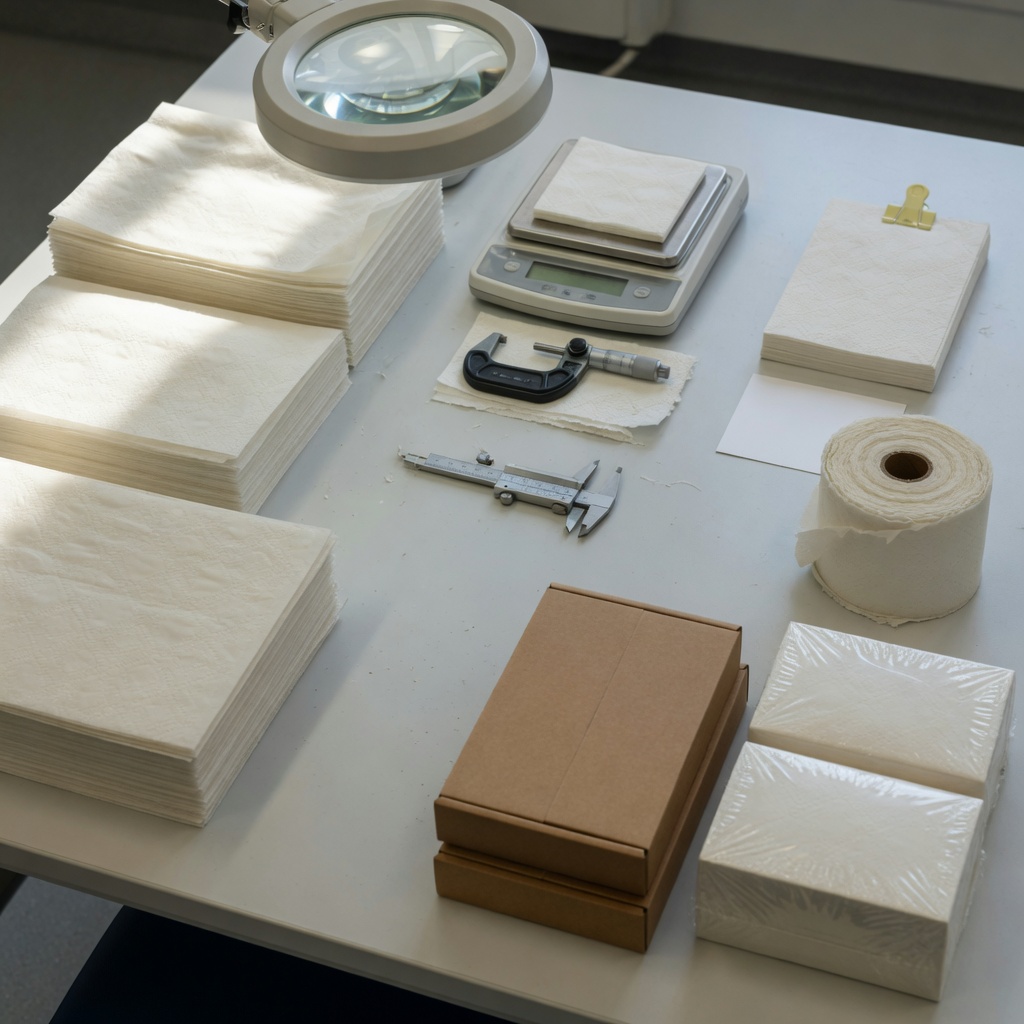
Use this sequence on every United States-bound sample lot:
- Identity. Match SKU, ply or sheet format, color, and any logo proof to the RFQ. Unprinted stock does not approve custom print.
- Basis weight (GSM). Cut a defined area, condition if required, and weigh. Record actual GSM versus target. Require the quoted TAPPI or ISO method ID on the test report. Hand feel is not a substitute (PaperIndex academy).
- Roll or ream mass. Weigh the saleable unit. Variance greater than 5% versus the quoted unit weight should trigger a written explanation before approval, per the 2026 sampling note (unit: percent; as-of: that page). Confirm whether the 5% is versus nominal, invoice, or conditioned mass.
- Sheet count. Count a full pack or a defined subsample by hand. Short count is a landed-cost leak: United States retailers and 3PLs claim against the PO, not against a mill photo.
- Embossing and converting. Check pattern symmetry, depth consistency, and perforation cleanliness. Asymmetric emboss or torn perfs are process signals on the 2026 sampling note.
- Moisture and bulk. If the tissue will be converted or stored in United States warehouses, require moisture and bulk on the sample report. Visual samples do not capture these (PaperIndex academy).
- Packaging. Confirm shrink tightness and carton board of at least 200 g/m² when that is the specified shipper (unit: g/m²; source and as-of: 2026 sampling note). Photograph crush, scuff, and label placement.
- Representativeness. Record whether the parcel is a stock showroom sample or a production-intent lot. A presentation-box sample does not approve export cartons.
Approve only when identity, method-backed GSM, count, pack-out, and (if custom) print all pass, and a golden sample can be signed. Resample when custom print, size, or emboss was never on the parcel, or when mass variance needs a production-intent lot. Reject when methods are visual-only, count is short, pack-out is not the bulk export pack, or the mill cannot substantiate on-pack claims. A 40HQ is a freight unit named on the supplier sampling pages cited here, not a quality system and not a United States entry type.
Standard versus custom sample timelines
On the same Canton Fair 2026 supplier page, standard samples are stated to ship within 3–5 business days while custom samples take 10–15 days (Canton Fair 2026 sampling note). Units are business days to mill shipment, not door-to-door United States delivery, not customs clearance, and not a contract. Scope is that site's stated window as of the 2026 page. Verify the calendar in the quote for this SKU.
A separate hygiene-industry workflow describes a 14-day prototyping and sampling lifecycle in which physical samples verify GSM, texture, and chemical purity before production (Topsource Hygiene sampling workflow). Unit is calendar days for that publisher's described cycle. Publication date is not stated in the excerpt used here. "Chemical purity" on that page is that publisher's sampling step, not a United States agency clearance and not a mill certificate.
For United States buyers, add gates those pages do not freeze: international courier time after the mill ships; lab time if TAPPI or ISO tickets are required; brand and QA sign-off; and revision loops. Custom print sits on the 10–15 day or 14-day path, not the 3–5 day stock path. Stock samples can check construction but cannot approve custom print, size, or emboss. Approval is a dated inspection record plus a physical retain, not a tracking number.
Why a golden sample is required before bulk orders
A golden sample is the signed physical benchmark that production, incoming inspection, and dispute resolution all use. One sampling-workflow page states that the golden sample locks ply density of 13–22 g/m², 85–92% OBA-free brightness, and CNC embossing so every 40HQ container matches the approved standard (Topsource Hygiene sampling workflow). Units are grams per square metre for ply density and percent for brightness. Scope is that page's described benchmark band, not a United States regulatory range, not a wrapping-tissue default, and not a certification. Use those bands only if they match the grade being bought; put the agreed numbers on the RFQ and the retain tag.
Print proofs do not hold caliper, hand feel, or emboss depth. Lots described as similar to last year drift in shade and moisture. United States chargebacks need a retain that shows the agreed product. Sign and date the golden sample. Keep one retain at the mill and one in the United States (buyer QA or 3PL). Photograph shade under controlled lighting. Record GSM, sheet count, pack-out, and any print standard. State that production lots must match the golden sample within written tolerances, not a numberless "commercially acceptable" clause.
United States labeling, landed cost, and delivery controls after sample approval
Sample approval is incomplete if the approved pack cannot clear and sell in the United States. Tie the golden sample to import and labeling controls in the same SKU file.
Country of origin and marks. United States import rules generally require country-of-origin marking on imported articles unless an exception applies. Confirm marking on the sample carton and inner pack with counsel or a licensed customs broker. Use 19 CFR Part 134 as the framework to verify; it is a marking regulation, not a mill certificate and not a classification opinion. The sample's label layout should be the production layout; a mark on a sample is not a broker's entry advice.
On-pack claims. Recycled-content, eco, and chlorine-free statements on tissue wraps are advertising claims. Align them with the Federal Trade Commission Green Guides and with chain-of-custody documents the mill can supply on the bulk invoice. Do not approve claims from a sample the mill cannot substantiate.
Food, cosmetic, or children's use. If tissue will contact food, pack cosmetics, or form part of a children's product, sample approval must include the relevant United States safety path and current documents. This article does not certify any mill for those uses and does not treat a white sheet as proof of compliance.
Landed cost. Freeze GSM, sheet size, count, and carton spec before modeling cost. A 5% mass shortfall (unit: percent versus quoted unit weight; source: 2026 sampling note) or a thinner carton changes product value and damage rate—re-cost before the PO. For United States entry, have a broker confirm HTS classification, duty, Merchandise Processing Fee, and Harbor Maintenance Fee on ocean freight. Do not publish or assume a duty rate here. Sample parcels usually move by air courier; bulk often moves as a container (including 40HQ in the supplier notes). Do not use a sample courier invoice as the bulk freight rate.
Delivery terms. State Incoterms, United States port or door, and whether sample freight is prepaid. Require the same pack-out on the golden sample that will ship in bulk. If the sample arrived in a presentation box and bulk will be export cartons, bulk packaging has not been approved. DDP simplifies the United States handoff but buries duty in the unit price; FOB plus buyer-controlled freight is more transparent but requires the buyer to own ISF, entry, and drayage. Neither term replaces sample approval.
Buyer decision table: specify, compare, verify, approve, or reject
Every row is an action on a live sample. Treat supplier-page values as quote inputs until the mill confirms in writing.
| Decision point | Specify in the RFQ | Verify on the sample | Approve or reject rule | Order implication |
|---|---|---|---|---|
| Basis weight (GSM) | Target GSM, ±% tolerance, named TAPPI or ISO method | Cut-and-weigh or mill lab ticket matching the named method | Example lock: 18 GSM ±3% only if that is the grade; unit g/m²; academy example only (PaperIndex academy) | No bulk PO if the method is visual or the method ID is missing |
| Unit mass | Nominal roll, ream, or pack weight and variance rule | Calibrated scale on the saleable unit | Greater than 5% variance requires written explanation before pass; unit: percent; as-of 2026 page (Canton Fair 2026 sampling note) | Recalculate United States unit cost and sheet yield before PO |
| Sheet count | Declared count per pack and short-count rule | Manual count of pack or defined subsample | Fail if below declared count unless a documented allowance exists | Short count is a United States chargeback risk |
| Embossing, moisture, bulk | Pattern ID, depth, symmetry; moisture % and caliper with method | Raking light; lab ticket, not a photo | Fail asymmetric emboss, unclean perfs, or untested moisture on converting grades (Canton Fair 2026 sampling note; PaperIndex academy) | Custom emboss needs a custom sample; visual samples miss moisture |
| Brightness, OBA, ply | Brightness target, OBA-free yes or no, ply or 13–22 g/m² band if that matches the grade | Instrument reading and construction check versus golden sample | Use 85–92% OBA-free brightness and 13–22 g/m² only if agreed; units: percent and g/m² (Topsource Hygiene sampling workflow) | Wrong ply or shade drift changes brand and landed cost |
| Carton and shrink | Carton board at least 200 g/m² if specified; shrink standard | Board GSM check; shrink tightness; crush photos | Fail crushed corners or board below specified GSM; unit: g/m²; as-of 2026 page (Canton Fair 2026 sampling note) | Sample must use the bulk export pack, not a presentation box |
| Print (custom only) | Artwork version ID, ink, registration, strike-off | Custom sample versus signed proof | Fail any stock-only sample used as a print approval | Custom mill-stated ship window is 10–15 days, not 3–5; unit: business days to mill ship (Canton Fair 2026 sampling note) |
| Golden sample | Retain quantity; mill plus United States storage | Signed, dated physical piece plus photographs | No bulk and no 40HQ release without a signed golden sample (Topsource Hygiene sampling workflow) | Production must match the retain within written tolerances |
| United States marks and timeline | Country-of-origin marking, claim language, stock versus custom path | Sample labels versus broker checklist; mill ship date versus inspection date | Conditional approve if product passes but marks fail; confirm stock 3–5 or custom 10–15 business days to mill ship (2026 page), or a 14-day prototype cycle, in writing | Do not schedule a United States launch from unpublished lead times |
RFQ checklist for tissue paper sourcing sample approval
Use this list in the RFQ and again at inspection.
- Product identity: wrapping sheet, folded pack, roll, or parent-roll format; intended United States use.
- Target GSM and tolerance with a named TAPPI or ISO grammage method. Treat 18 GSM ±3% as an academy example to verify in the mill quote (unit: g/m² and percent of target).
- Ply or construction, including whether the 13–22 g/m² ply-density band applies (unit: g/m²; workflow example only).
- Sheet size, fold, declared sheet count, sample quantity, and the short-count rule.
- Color, brightness, and OBA policy, including whether 85–92% OBA-free brightness is in scope (unit: percent; workflow example only).
- Emboss, perforation, moisture, and bulk with named methods, because visual samples miss moisture and caliper.
- Print controls: artwork version ID and a rule that stock samples cannot approve custom print.
- Restricted-substance documents relevant to United States use. Do not infer compliance from a white sheet.
- Unit pack: inner wrap, tight shrink, and carton board of at least 200 g/m² if that is the export shipper (unit: g/m²; as-of the 2026 sampling note); require the bulk pack-out on the sample.
- Mass variance rule: weigh the saleable unit; greater than 5% variance needs explanation before approval (unit: percent; as-of the 2026 sampling note); state whether the base is nominal, invoice, or conditioned mass.
- Sample type and lead time: stock versus custom; mill-stated 3–5 business days versus 10–15 days, or the mill's 14-day prototype calendar (units: business days to mill ship, or calendar days for the workflow cycle)—not United States door times.
- Golden sample: retain quantity, mill plus United States storage, photo protocol, and no 40HQ or bulk without a signed retain.
- United States trade and landed-cost freeze: Incoterms, port or door, HTS confirmed by the buyer's broker, country-of-origin marking, commercial invoice matching the golden-sample description; recost if GSM, count, or carton board changes after sampling.
- Inspection, change control, and disputes: scale identity, GSM cut size, sheet-count method, photographs, inspector, date, pass or fail; any post-approval change voids the golden sample; production lots compared to the golden sample and written tolerances. Ship specification sheet, method IDs, lot ID, and the bulk packing-list format with the sample. Keep vendor-qualification documents separate from SKU sample approval.
Evidence basis, method, and what to verify before you order
Source contexts. The figures below come from three published pages: a Canton Fair 2026 supplier sampling note on mill-stated sample ship windows and physical inspection checks (Canton Fair 2026 sampling note); a PaperIndex academy briefing on visual-sample risk and named ISO or TAPPI methods (PaperIndex academy); and a hygiene sampling-workflow page on a 14-day prototype cycle and golden-sample construction locks (Topsource Hygiene sampling workflow).
Concrete data points (unit, scope, as-of, source). (1) 18 GSM ±3%: unit grams per square metre and percent of target; scope is an academy example for tissue/parent-roll procurement, not a wrapping default; as-of date not stated in the excerpt; source PaperIndex academy; verify in the mill quote. (2) Over 5% unit-mass variance requires explanation, and carton board of at least 200 g/m²: units percent and g/m²; scope is that publisher's inspection practice; as-of the 2026 Canton Fair page; source tissuepapersupplier.com sampling note. (3) Standard sample ship 3–5 business days and custom 10–15 days: unit business days to mill shipment, not United States door; as-of the 2026 page; same sampling note. (4) 14-day prototyping cycle, 13–22 g/m² ply density, 85–92% OBA-free brightness: units calendar days, g/m², and percent; scope is that workflow's described band; publication date not stated in the excerpt; source Topsource Hygiene sampling workflow. Use each figure only if the mill writes the same number for this SKU.
Method. Figures are transcribed from those pages as published in the excerpts supplied for this article. They are not mill certificates, not United States agency measurements, and not in-house laboratory results. Editorial authorship is Vincent Xi, Editorial Author (author profile). No mill visit, customer outcome, or in-house test is claimed.
Limitations / what to verify. Lead times are mill-stated ship windows on marketing or workflow pages; obtain a written sample calendar for the SKU. 18 GSM ±3%, 13–22 g/m², 85–92% brightness, 5% mass variance, and 200 g/m² board are not automatically the specification—put agreed numbers on the RFQ and the golden-sample tag. Naming ISO or TAPPI methods is not the same as holding a current mill certificate; request the current test report with method IDs. A courier sample may be hand-picked and is not a production-lot capability study. United States duty, HTS, Merchandise Processing Fee, Harbor Maintenance Fee, and marking depend on the exact tissue; use a licensed broker. Food-contact, recycled-content, and children's-product claims need current documents. A 40HQ is a freight unit, not a quality system.
Approve the sample, sign the golden retain, then order. Anything earlier is a quote, not a specification.
Discuss Your Requirements
Review our manufacturing capabilities, then share your specifications for a supplier-fit review.