Tissue Paper Wholesale Supplier Customization Options for Malaysian Buyers
By Vincent Xi, Editorial Author, https://customlogothing.com/authors/vincent-xi/
Author Note: Vincent Xi is an Editorial Author at Custom Logo Things (Vincent Xi Profile). In accordance with strict editorial publication standards, no personal factory trials, proprietary client outcomes, or first-person testing claims are asserted. This assessment provides an objective, desk-researched synthesis based entirely on public supplier documentation and published procurement records.
For commercial procurement teams in Malaysia, evaluating tissue paper wholesale supplier customization options requires locking the physical product structure, branding methods, and commercial order gates before approving a supplier quote. Customization must be treated as a documented technical specification rather than an aesthetic add-on. Buyers must isolate three distinct operational decisions: the substrate itself (basis weight, ply, and dimensions), the print and packaging execution (spot-color, full-color, UV, repeating logos, core treatments, and outer cartons), and the commercial verification milestones (digital mockups, pre-production physical samples, and minimum order quantities). Published supplier documentation reveals that suppliers do not operate from a single standardized menu. For example, branded packaging records list 17 GSM and 28 GSM sheets across sizes from 10x10 to 30x42 inches, one-color or full-color print, repeating marks, and minimums starting from 50 sheets (Packaging in Practice). Conversely, OEM mill pages outline roll and packaging programs featuring 13 to 45 g/m² basis weights, 1–3 ply builds, custom core colors, 4-color or UV printing, and container-level minimums of one 40HQ (Top Source Paper; Hewbonn). These figures reflect standalone published marketing and technical claims without audit dates and must be verified directly on incoming Malaysian import quotes.
How the customization evidence was compiled
This editorial analysis synthesizes data from three public, verifiable B2B documentation sources. The first source is an academic and vocational packaging chapter examining branded packaging tissue options, detailing GSM options, dimensions, print methods, and design interfaces. The second source is Hewbonn Paper’s OEM guide detailing custom branding parameters, including 4-color and UV logo printing, custom packaging boxes, core colors, ply, fragrance, and label specifications. The third source is Top Source Paper’s OEM and private-label specification guide, which documents manufacturing ranges for GSM, ply, embossing, inner-bag printing, digital mockup turnarounds, sample timing, plate-fee terms, and container order minimums.
Every numeric data point cited in this guide retains its exact published unit, source scope, and the explicit notation that original publication dates were unstated on the host pages. Where metric conversions or weight ratios are provided (such as converting imperial sheet sizes to millimetres or calculating mass ratios between basis weights), they are explicitly identified as example calculations to verify in the supplier quote rather than pre-negotiated mill commitments.
Methodology: Technical parameters were extracted by cross-referencing published manufacturing capabilities against standard procurement line items required for international B2B contracting. Commercial freight rates to Malaysian ports (such as Port Klang or Penang), specific transit moisture-barrier thresholds, proprietary customer agreements, and ISO/ASTM test certificates were not detailed in the source texts and are therefore omitted from this guide. Supplier assertions reflect company-specific practices and do not constitute industry-wide standards or verified regulatory certifications.
Limitations to verify: Branded sheet converters and integrated OEM paper mills serve fundamentally different packaging formats. Small-run sheet dimensions and low minimums (from 50 sheets) apply exclusively to specialized flat-sheet wrapping programs. Roll specifications, ply lamination, core coloration, and containerload commitments (40HQ) belong to high-volume mill lines. Mixing these distinct scopes risks unworkable contracts and unfulfilled quality inspections upon container arrival in Malaysia.
Customization options to lock for Malaysia wholesale supply
For wholesale supply into Malaysia, Malaysian commercial buyers must establish the exact baseline product form before issuing an RFQ. Flat packaging tissue, folded retail paper, and cored rolls present mutually exclusive manufacturing workflows. Once the base format is defined, procurement teams can isolate the specific branding and finishing options applicable to that format.
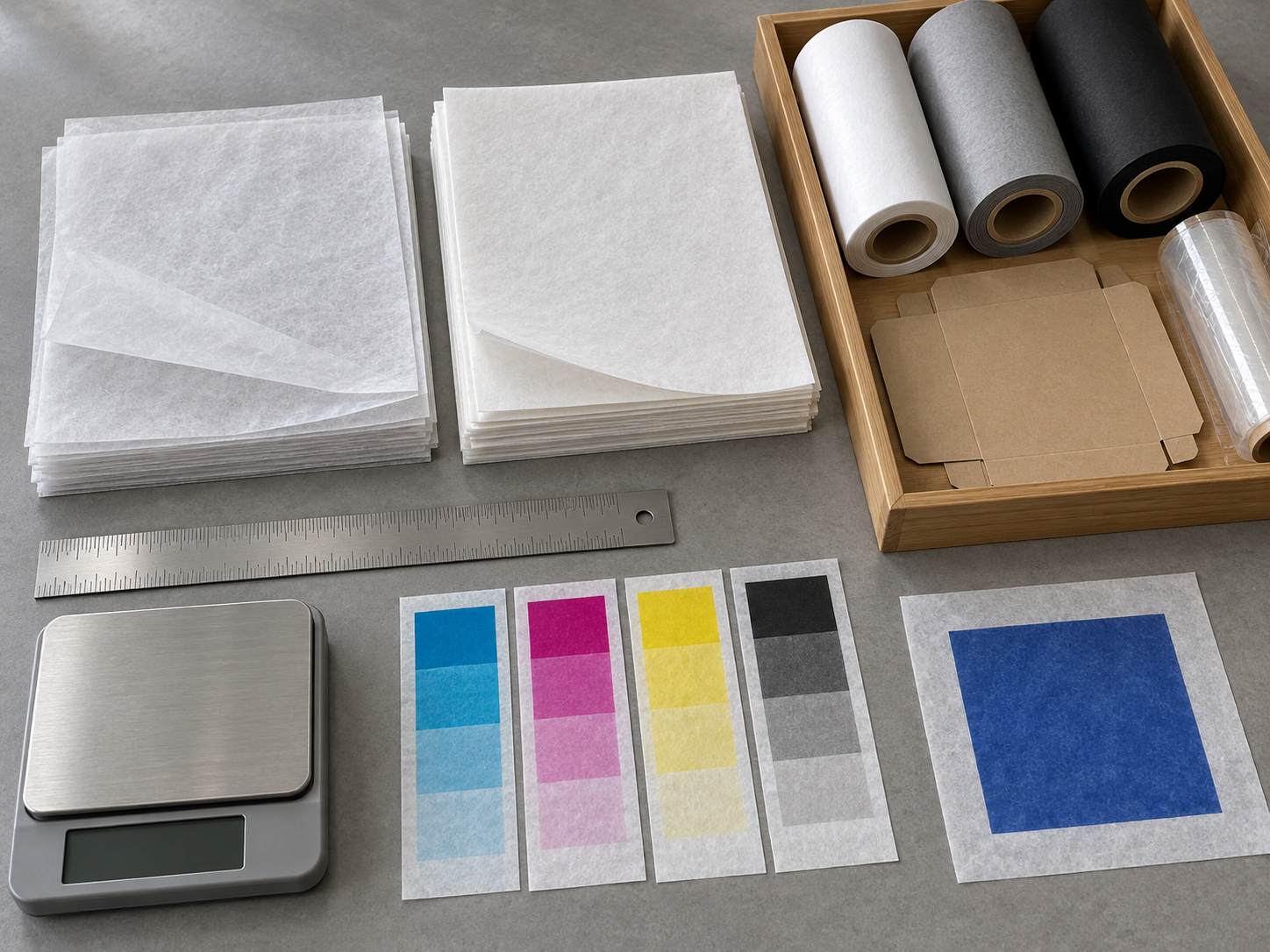
Published branded packaging benchmarks emphasize sheet basis weight, finished sheet dimensions, low-run minimums, single- or full-color printing, and web-based artwork preview systems (Packaging in Practice). In contrast, industrial OEM programs define customization across multiple distinct manufacturing layers: base roll attributes (13–45 g/m², 1–3 ply), core construction (white, grey, or black cores), primary packaging (CMYK-printed inner poly bags, color retail boxes, or shrink wrap), and logo printing using 4-color or UV systems (Top Source Paper; Hewbonn).
A custom flat packaging sheet can feature custom trim dimensions, step-and-repeat logo printing, and moisture-resistant wrapping, but attributes such as inner core color or multi-ply winding do not apply. Conversely, a roll-stock private-label contract requires tight controls on core diameter, ply count, perforation pitch, and inner-bag artwork, while flat inch measurements are irrelevant unless the supplier operates an in-line sheeter. Marking non-applicable fields as "N/A" prevents overseas vendors from substituting default industrial specifications into Malaysian commercial orders.
Basis weight, ply, and cut size
Basis weight (grammage) represents the fundamental cost and performance driver in tissue procurement. The public documentation shows two distinct manufacturing tiers rather than a single continuous grade scale.
In branded flat-sheet packaging, documented industry baselines cite 17 GSM and 28 GSM options (unit: grams per square metre; scope: branded sheet comparison chapter; context: undated published benchmark) (Packaging in Practice). As an example calculation to verify against physical samples: 28 GSM divided by 17 GSM equals approximately 1.65, indicating that a 28 GSM sheet provides 65% more dry fibre mass per unit area than a 17 GSM sheet. While higher basis weight typically improves burst strength and opacity, this mathematical ratio does not guarantee puncture resistance, wet strength, or print clarity; physical testing remains mandatory.
In OEM paper mill programs, published capabilities indicate an adjustable basis weight span of 13 to 45 g/m² and multi-ply options spanning 1 to 3 ply (unit: g/m² and physical layer count; scope: integrated mill OEM operations; context: undated published capability guide) (Top Source Paper). Hewbonn similarly affirms that GSM, ply, and dimensions are fully adjustable, though without publishing boundary figures (Hewbonn). A buyer must not request a 13–45 g/m² specification from a packaging tissue converter unless the vendor confirms access to parent jumbo reels and dedicated converting machinery.
Flat sheet sizes in published branded guides range from 10x10 inches to 30x42 inches (unit: inches; scope: branded packaging sheets; context: undated catalog excerpts) (Packaging in Practice). For Malaysian warehouses operating on the metric system, these imperial dimensions convert as follows (calculated using the exact conversion factor of 25.4 mm per inch; labeled as example conversions for quotation verification):
- A 10x10 inch sheet converts to 254.0 mm by 254.0 mm.
- A 30x42 inch sheet converts to 762.0 mm by 1,066.8 mm.
Contractual clarity regarding ply structure is critical. On OEM technical datasheets, "ply" denotes individual paper webs laminated or combined during converting (1, 2, or 3 ply). However, ambiguities frequently arise: a specification written as "28 GSM, 2-ply" could signify two 14 GSM plies combined to achieve a 28 GSM finished sheet, or two 28 GSM plies yielding a 56 GSM composite structure. Malaysian buyers must mandate that suppliers explicitly state both individual ply grammage and total finished grammage in the formal quote.
Print, color, pack format, and design control
Branding language across supplier documentation varies widely and must be converted into explicit printing engineering terms on the RFQ.
Published packaging programs reference single-color or full-color print capabilities with step-and-repeat pattern layouts supported by digital preview platforms (Packaging in Practice). Commercial OEM mill documentation specifies 4-color process printing or UV printing for brand graphics, alongside CMYK flexographic or gravure printing on primary packaging and cores (Hewbonn; Top Source Paper). Top Source Paper notes that printing plates and formulations can be archived to eliminate repeat plate charges on subsequent production runs (Top Source Paper). Malaysian procurement teams must verify whether initial cylinder or photopolymer plate fees apply on the preliminary order, as plate waivers on reorders do not imply free initial tooling.
Color matching requires explicit quality boundaries. None of the cited source documents specifies numeric color-match tolerances (such as Delta E thresholds under ISO or CIE standards) or standardized lighting environments (such as D65 or D50). Descriptors like "full-color," "CMYK," or "UV" define the ink transfer process, not visual accuracy or ink-rub resistance. If brand reproduction is critical, buyers must require physical ink drawdowns or wet press proofs on the exact target paper stock prior to commercial execution.
Packaging customization extends beyond the tissue substrate. Primary, secondary, and tertiary packaging must each be itemized on separate contract lines:
- Base tissue substrate: printed flat wrapping sheet or perforated cored roll.
- Primary wrap: shrink wrap film or heat-sealed printed poly bag (CMYK-capable).
- Core options: unprinted kraft, or dedicated white, grey, or black paperboard cores.
- Secondary outer casing: corrugated master carton or high-graphic color retail box.
- Functional additives: fragrance integration is cited as an optional OEM capability (Hewbonn). If items contact apparel, food, or sensitive cosmetics, buyers should explicitly stipulate "zero added fragrance" unless a specific formulation with documented safety data is approved.
Samples, mockups, and minimums that do not compare
Commercial lead times and production thresholds documented across public supplier records reflect entirely separate manufacturing setups and logistics realities.
Top Source Paper documents digital 3D mockups generated within 48 hours, rapid physical sample production within 1 to 3 days, and a full private-label order threshold of one 40HQ container (unit: calendar or business days and one 40-foot high-cube sea freight container; scope: mill OEM production; context: undated published capability) (Top Source Paper). Packaging in Practice documents low-run packaging tissue thresholds starting "from 50 sheets" (unit: flat sheets; scope: custom branded wrapping paper; context: undated vocational guide) (Packaging in Practice). Hewbonn promotes flexible order thresholds for B2B distributors and brand owners but cites no specific numeric sheet, roll, or carton baseline (Hewbonn).
A 50-sheet floor represents a boutique converting service suited for initial brand presentation or proof-of-concept verification. A 40HQ container commitment represents an industrial manufacturing run filling roughly 68 to 76 cubic metres of cargo space. These two metrics cannot be directly compared on a unit-price basis. Furthermore, published sample timeframes of 1 to 3 days cover factory bench assembly only; they exclude international courier transit, customs clearance, and local inland delivery to Malaysian corporate facilities.
Tooling reuse terms also demand contractual documentation. Archiving printing plates to waive repeat fees is an individual supplier policy, not an industry entitlement. Malaysian buyers must demand written terms detailing tooling ownership, plate storage lifespans, and maintenance responsibilities before remitting tooling deposits.
Decision table for wholesale supply customization
Use this comparative matrix to evaluate incoming supplier proposals. Verify that each quoted specification matches the operational scope of the intended product.
| Procurement Decision | Published Evidence & Scope | Buyer Action on Supplier Quote | Technical Verification Requirement |
|---|---|---|---|
| Sheet Grammage | 17 GSM and 28 GSM options in branded sheet literature; grams per square metre; date unstated (Packaging in Practice) | Specify target finished GSM and require written tolerance limits (e.g., ±5%) | Calibrate on a precision balance; do not rely on the 1.65 mass ratio (28/17 example calculation) to predict physical tensile strength |
| OEM Grammage & Ply | 13 to 45 g/m² span and 1–3 ply configurations on OEM mill records (Top Source Paper) | Mandate exact GSM per ply and total combined finished grammage on contract | Reject this manufacturing range if quoted by a sheet converter lacking paper mill access |
| Cut Sheet Format | Illustrative ranges from 10x10 to 30x42 inches in branded packaging guide (Packaging in Practice) | Stipulate length and width in millimetres with allowable dimensional cutting tolerances | Verify converted metric dimensions (e.g., 10x10 in = 254x254 mm; 30x42 in = 762x1066.8 mm) against die-cut drawings |
| Print Reproduction | 1-color, full-color, 4-color process, UV printing, or CMYK bag/core printing across cited guides | Specify the exact printing process, ink count, and exact substrate component receiving ink | Require a physical signed ink drawdown; published sources state no numeric Delta E color tolerances |
| Core & Pack Structure | White, grey, and black core options; color boxes, shrink film, and printed poly bags documented | List each packaging element as an explicit line item or formally mark as "Not Applicable" | Inspect physical packing lists against approved bill of materials upon container destuffing |
| Sampling & Lead Time | 48-hour 3D mockups; 1–3 day sample dispatch on OEM mill records (Top Source Paper) | Separate factory sample tooling time from ocean/air transit timelines to Malaysia | Confirm whether stated turnaround times represent working business days or calendar days |
| Order Thresholds (MOQ) | From 50 sheets for custom gift wrapping; one 40HQ container for private-label OEM mill orders | Require quotes to define MOQ in explicit units: pieces, master cartons, or containerloads | Never evaluate a 50-sheet retail pack against a 40HQ sea freight container program on simple piece price |
| Cylinder & Plate Terms | Repeat plate fees waived with archived formulas on select OEM pages only (Top Source Paper) | Mandate explicit contractual terms covering initial plate costs, ownership, and reorder fees | Refuse assumptions of free tooling unless verified in writing by the designated manufacturer |
RFQ Checklist
- Specify the exact product format as flat wrapping tissue sheets, folded retail tissue, or cored rolled tissue, and formally designate core, ply, fragrance, and secondary wrap lines as active or not applicable.
- Ask the supplier to quote a single target basis weight in grams per square metre (GSM), state whether the figure represents individual ply or combined finished mass, and define the grammage test method.
- Specify finished sheet or roll dimensions in millimetres with explicit manufacturing tolerances (e.g., ±2 mm), requiring verification against technical cutting drawings if imperial benchmarks (10x10 or 30x42 inches) are referenced.
- Ask the supplier to state the printing technology—designated as flexographic spot-color, 4-color process, UV print, or CMYK bag print—along with graphic repeat spacing and cylinder step dimensions.
- Require the manufacturer to provide physical ink drawdowns or pre-production press proofs on the contracted tissue substrate for visual sign-off, given the absence of published numeric color tolerances.
- Specify all packaging components line by line—including raw sheet wrap, poly shrink film, corrugated shipper, printed retail box, or white, grey, or black core—marking unselected lines as not applicable.
- Ask the supplier to confirm minimum order quantities in clear units (total sheet count, master cartons, or full containerloads) and establish whether a 50-sheet low-run or 40HQ container threshold applies.
- Require the manufacturer to separate artwork preparation, physical sampling production, factory lead time, and shipping transit duration to Malaysian receiving ports into distinct schedule commitments.
- Ask the supplier to provide a binding tooling schedule itemizing initial plate/cylinder fees, plate ownership rights, storage lifespans, and reorder fee policies in writing.
- Specify the digital artwork master by strict revision date and secure file hash, requiring written approval of the physical counter-sample before commercial production commences.
- Require the manufacturer to mirror all contractual product parameters—specifically basis weight, dimensions, ply count, and package unit counts—on commercial invoices, packing lists, and bill of lading documentation for Malaysian customs verification.
- Verify any regulatory claims, fragrance additions, or "compliant label" assertions against current, verifiable documentation provided directly by the manufacturer before contract signature.
Acceptance checks on the specified customization
Receiving teams at Malaysian warehousing and fulfillment hubs must inspect incoming tissue shipments against the parameters established in the executed purchase contract. Physical receiving protocols must verify:
- Unit counts: Tally cartons, rolls, or sheet packs against the commercial invoice and bill of lading.
- Grammage verification: Condition paper samples and weigh a calibrated die-cut area (e.g., 100 cm²) on an analytical balance. Confirm whether measured mass conforms to single-ply or multi-ply contractual grammage.
- Dimensional inspection: Measure sheet lengths, widths, core inner diameters, and roll widths using calibrated steel rules, verifying conformance against agreed metric tolerances.
- Print fidelity: Inspect step-and-repeat spacing, registration, and color ink laydown against the signed physical counter-sample under controlled lighting.
- Packaging integrity: Check that primary poly wraps, carton corner strengths, and core colors match the approved bill of materials.
Procurement officers must refrain from inventing unverified tropical-climate performance metrics, customs classifications, or moisture-barrier claims. None of the three analyzed source documents specifies tropical humidity thresholds, mold-growth tolerances, or Malaysian regulatory standards. If goods are intended for direct food contact, cosmetic wrapping, or medical packaging, Malaysian buyers must independently request, review, and validate relevant statutory compliance certificates from the supplier. Published supplier marketing claims do not constitute third-party legal certifications.
Reorder controls represent a vital operational safeguard. Maintain the approved technical specification, master artwork files, physical golden samples, and written tooling agreements under the original contract file. Where suppliers advertise archived formulations and waived reprint plate fees, mandate that these terms be reconfirmed in writing on every subsequent purchase order.
Discuss Your Requirements
Review our manufacturing capabilities, then share your specifications for a supplier-fit review.