Custom asset labels look small enough to ignore. That is a mistake. In apparel programs, the label is often the least expensive part of the garment and one of the most failure-prone. If it peels after a few wash cycles, jams a scanner, or becomes unreadable in storage, the real cost shows up later in labor, returns, and inventory errors.
For uniforms, workwear, retail basics, and bundled apparel kits, these labels do more than identify a product. They connect the garment to a size, a SKU, a lot number, care information, and sometimes a serial or tracking code. That link matters because apparel moves through more hands than most buyers expect: cutting, sewing, finishing, folding, packing, warehouse receiving, retail display, and customer use. A label that survives only the first step is not useful.
There is also a presentation effect that buyers underestimate. A clean, well-placed label makes a garment feel organized and intentional. A cheap one, even if the print is neat, can make the whole item feel improvised. The difference is subtle in a mockup and obvious in a carton.
A label is part of the handling system. If the system breaks, the label failed even if the garment itself is fine.
For teams building a broader apparel program, custom asset labels usually sit inside a larger set of Custom Labels & Tags that support packaging, identification, and compliance. They may be small, but they influence a long chain of decisions.
What Custom Asset Labels Really Do for Apparel
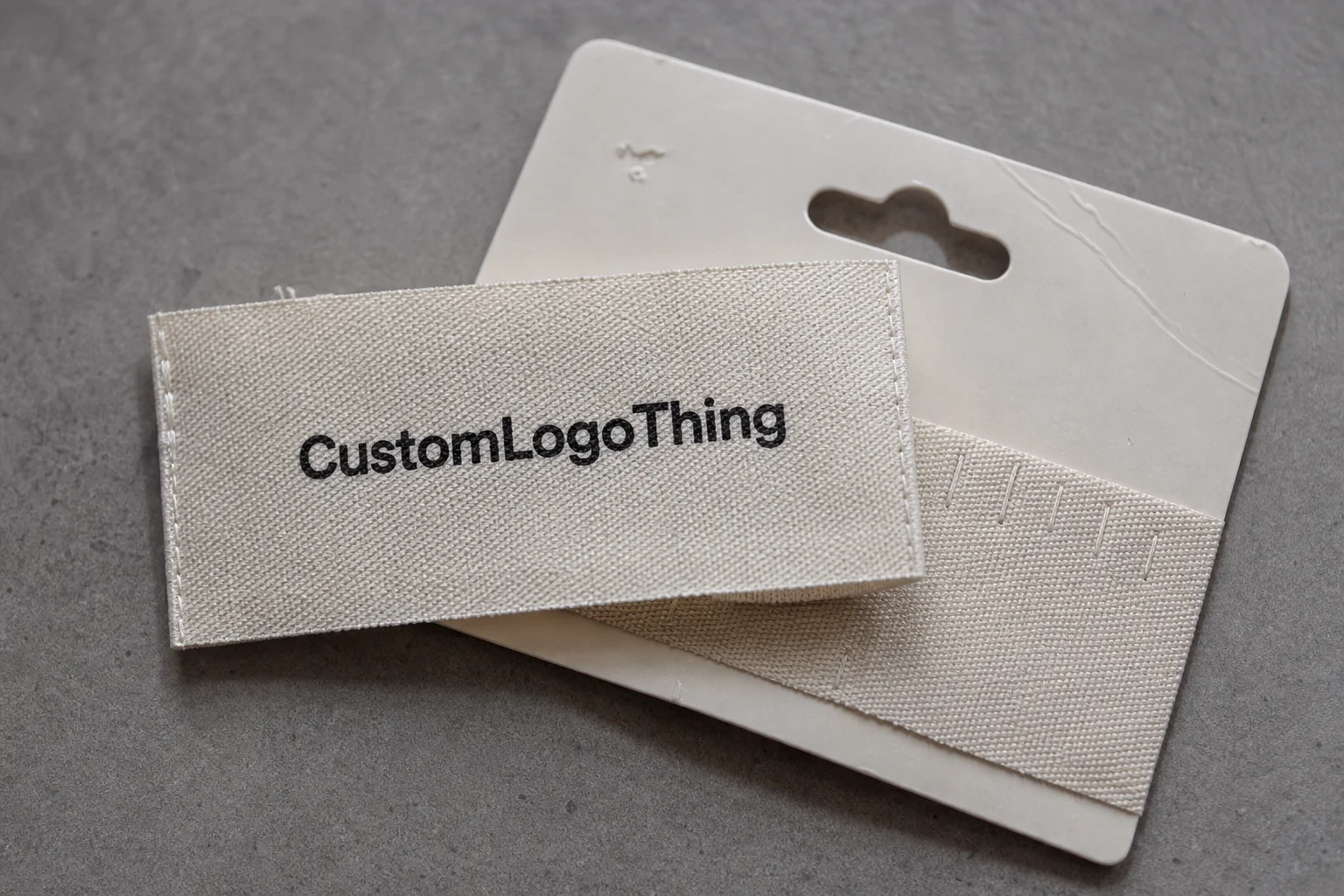
In apparel, an asset label is an identification tool first and a branding surface second. It can carry a barcode, QR code, serial number, SKU, size, fiber content, care instructions, or an internal reference used by warehouse and retail teams. That information has to remain readable after printing, folding, shipping, and in some cases laundering. If the code fails on day one, the label did not do its job.
Placement matters as much as print quality. You see these labels inside neck areas, at side seams, on hangtag systems, and on packaging for multipacks or uniform sets. Some programs use them as permanent identification. Others need them only until the garment reaches the right department or customer. The application method should match that purpose. A short-term inventory label should not be built like a permanent sewn-in identifier, and a retail-facing label should not look like a warehouse ticket.
Operationally, the best labels reduce friction. A receiving team should be able to sort a medium black crewneck from a medium charcoal one without opening every bag. A distribution team should be able to scan and match units without second-guessing the data. Those sound like small wins, but they save real labor when quantities rise.
Custom asset labels also support traceability. In programs with multiple styles, colorways, or replenishment cycles, labels help teams verify what arrived, what was packed, and where a garment belongs. That is particularly useful in uniform programs, hospitality apparel, and branded kits where one wrong item can trigger a return or a replacement shipment.
Presentation still matters. Buyers in retail and B2B settings often judge quality from the first carton opening. A label that is centered, legible, and consistent with the rest of the package tells a buyer the program was built with discipline. A sloppy one creates doubt quickly.
How the Label Construction and Application Works
The label starts with the substrate, and everything else follows from that choice. Material affects print quality, hand feel, durability, and cost. Then come the print method, adhesive or backing, shape, and finish. If those pieces do not line up with the garment’s use, the label may look acceptable at shipment and fail under actual handling.
Common application methods include sew-in, heat-applied, pressure-sensitive adhesive, and removable formats. Sew-in labels are usually the most durable for long-life garments. Heat-applied labels can be efficient for textile applications, but only if the fabric tolerates the required temperature, pressure, and dwell time. Pressure-sensitive adhesive works well for temporary identification, bundle control, and carton-to-garment workflows. Removable formats are useful when the label only needs to survive a limited window.
Artwork preparation is where many orders go wrong. Small text, barcodes, QR codes, and sequential numbers need enough size and contrast to remain readable after printing and folding. A code that looks sharp on a screen can fail in a scanner if the quiet zone is too tight, the bars are too thin, or the background contrast is weak. Proofing should check layout, orientation, numbering logic, and scanability, not just appearance.
There is also a fabric reality that a spec sheet cannot fully capture. Cotton jersey stretches differently from brushed fleece. Coated outerwear behaves differently from open-knit basics. A label that sits flat on one fabric may curl, lift, or distort on another. The safest route is to test on the actual garment or on a close production equivalent before committing to the full run.
- Substrate: woven, film, coated paper, satin, or synthetic stock
- Print method: thermal transfer, digital, flexographic, or screen depending on run size and detail
- Backing: sew-in, heat-applied, adhesive, or removable
- Finish: matte, gloss, soft hand, or protective coating
Production teams tend to think in terms of systems, not single components. That matters here. A label that survives packing but fails during warehousing is still a weak label. A label that scans well but irritates the wearer is also a problem. Good construction balances handling, readability, and comfort.
The same logic applies to broader Custom Packaging Products. Whether the item is a carton insert, hangtag, or apparel label, the right answer is usually the one that matches the actual workflow instead of the prettiest sample.
Material and Finish Choices That Affect Performance
Material selection decides how the label behaves under abrasion, moisture, heat, and repeated touch. For apparel, the most common options are woven constructions, printed satin, polyester film, coated paper, and synthetic stocks designed for durability. Each behaves differently. Some feel better against skin. Some hold variable data more reliably. Some are cheap enough for short-term use but poor for wash resistance.
Woven labels are used when a softer textile look and sewn-in appearance matter. They usually suit premium garments and applications where the label should feel like part of the garment rather than an add-on. Polyester film is a strong fit for asset tracking, barcodes, and uniform programs because it resists abrasion and handles small data fields well. Printed satin gives a smoother, more brand-forward finish, though it is not always the best choice for hard wear. Coated paper can be fine for short-term identification, but it should not be treated as a wash-safe option.
Finish changes performance more than many buyers expect. Matte reduces glare and often improves readability. Gloss can make color blocks look richer, but it may introduce reflection that makes quick scanning harder. Soft-hand treatments improve comfort, though the underlying structure still has to survive the use case. If tamper evidence matters, that can be built into the construction, but most apparel programs do not need it.
Use case should drive the spec. Hospitality uniforms want clean presentation and moderate durability. Industrial workwear needs resistance to heat, friction, and detergent. Retail basics need visual consistency and strong brand alignment. Promotional garments can sometimes accept a lighter spec if the lifecycle is short. One material cannot do all of those jobs well.
Barcode readability deserves direct attention. Good contrast, enough quiet space, and the correct symbol size matter more than decorative effects. In receiving, a scan that works on the first pass can save more time than a slightly lower unit price ever will. That is especially true in apparel programs with high SKU counts or frequent replenishment.
| Label Type | Best Use | Typical Strength | Typical Limit |
|---|---|---|---|
| Woven | Premium sewn-in apparel | Comfort, textile look, good wear resistance | Less suited to tiny variable data |
| Polyester film | Asset tracking, barcode labels, uniforms | High durability, strong scan performance | Can feel less textile-like |
| Coated paper | Short-term identification | Low cost, easy printability | Poor wash resistance |
| Satin printed | Brand-forward apparel labels | Soft feel, attractive finish | Not always ideal for harsh handling |
For buyers who care about sourcing and material stewardship, adjacent packaging choices can be informed by standards from groups such as FSC for paper-based inputs and ISTA for transport and handling testing. Those references do not replace application testing, but they help buyers compare options with more discipline.
There is a practical caveat here: the most durable label is not always the right label. If the item has a short life, the spec should not be overbuilt. If the item is washed weekly, underbuilding is expensive. The right answer sits between those extremes.
Process and Lead Time: From Artwork to Delivery
The ordering process is usually straightforward if the input is complete. It starts with specs, then artwork review, proof approval, production, and shipment. The moment data gets vague, delays begin. Missing files, uncertain size data, mismatched barcode formats, and unclear application methods slow a job down faster than almost anything else.
Proofing should verify more than color and layout. Check dimensions, placement, orientation, numbering sequence, barcode content, and any handling instructions for roll direction or pack-out. If the job uses variable data, the buyer should verify the data file itself. One wrong column can ruin a full production run, and that kind of error is expensive to fix after the fact.
Sampling is worth the time when the label must scan, survive washing, or adhere to a difficult fabric. A preproduction sample can reveal edge curl, adhesive failure, print smearing, or discomfort against skin. Those are not theoretical issues. They are the problems that appear after a garment has already been packed.
Lead time depends on complexity, quantity, and finishing. Standard jobs with simple construction can sometimes move in about 12 to 15 business days after proof approval. More complex runs with custom finishing, special materials, or sequential numbering often need longer. Those timing windows are planning ranges, not guarantees. A rush order can compress them, but that usually raises cost and raises risk at the same time.
Buyers should align label timing with garment timing. If the apparel will reach a distribution center in two weeks, the labels should not be treated as a last-minute accessory. They are part of the release schedule. When the label slips, the garment program slips with it.
- Send garment use case, quantity, and size data.
- Confirm the application method and durability requirements.
- Review proofs for layout, scanability, and material fit.
- Approve samples or preproduction tests if needed.
- Move into production and pack-out.
That sequence is ordinary on paper and highly consequential in practice. The most reliable programs are usually the ones with the fewest assumptions.
Cost, MOQ, and What Shapes Your Quote
Pricing for custom asset labels is driven mostly by quantity, material, print complexity, finishing, and variable data. Small runs carry higher per-piece cost because setup gets spread across fewer units. Larger runs reduce unit price, but only if the spec stays stable. If the design changes after proofing, the savings can disappear quickly.
Minimum order quantity affects both cost and process. A simple label may be economical at volume, while a custom short run can carry a setup premium. That is normal. The surprise usually comes from comparing quotes that are not actually equal. One quote may include a protective coating, sequence numbering, or a custom shape that the other omitted.
A realistic cost range is broad because the use cases are broad. At higher volumes, simple identification labels can land in the low cents per piece. More specialized sewn-in, heat-applied, or variable-data labels can move into the mid-cents to several tenths of a dollar per piece, especially in smaller quantities. Custom shapes, premium materials, and extra testing can push that higher. The point is not the exact number. The point is that the spec, not the label name, determines the price.
These factors move the quote more than most buyers expect:
- Die shape: standard rectangle vs. custom contour
- Print complexity: one-color ID label vs. multi-color branding and variable data
- Adhesive or backing: permanent, removable, heat-applied, or sew-in
- Coatings: abrasion protection, moisture resistance, or surface finish
- Pack-out: rolls, sheets, folded pieces, or custom grouping
The cleanest way to compare quotes is line by line. Match size, material, finish, quantity, data handling, and sample expectations. A quote that is slightly higher can be the better buy if it reduces rework, scanning errors, or label failure after launch. Cheap labels become expensive very quickly once labor enters the picture.
For apparel brands balancing labeling against packaging and fulfillment budgets, the label is often a small share of total spend but a large share of operational control. That makes quote review less about chasing the lowest number and more about choosing the spec that fits the product lifecycle.
Common Mistakes That Cause Failures in the Field
The most common failure starts with appearance. A buyer likes the mockup, approves the price, and discovers later that the label peels, frays, fades, or rubs off under real use. A good-looking proof does not prove durability. The garment will only respond to the actual build.
Undersized text and low-contrast barcodes are another repeat problem. They can look acceptable on a monitor and still scan badly once printed small or folded into packaging. If the label supports inventory control, that failure does more than create inconvenience. It can throw off receiving, picking, and stock reconciliation.
Skipping fabric testing is risky, especially on stretch knits, coated textiles, or garments meant to go through repeated laundering. A label that sits flat on a test swatch may curl on a seam or distort on a flexible panel. The cost of testing is usually low compared with the cost of rework.
Data structure causes trouble too. If one team uses a style code, another uses an internal SKU, and a third changes serial formats monthly, the label workflow becomes hard to manage. Custom asset labels work best when the naming logic is stable and easy for multiple teams to follow. Complexity in the file often becomes complexity on the factory floor.
Over-specifying is less visible but just as wasteful. Some buyers add premium features that do not improve the actual use case. A short-run promo item does not need the same durability as a hospital uniform. A work shirt does. The right spec should reflect the lifecycle, not the desire to add every available feature.
Material waste deserves attention too. Labels that are oversized, overpacked, or printed with unnecessary extras create scrap downstream. The EPA sustainable materials guidance offers a useful framework for thinking about waste and material handling across packaging-related programs. In larger apparel operations, small efficiency gains add up.
Expert Tips and Next Steps for Ordering
Start with the garment’s real use case and work backward into the label spec. That order matters. Industrial apparel should be spec’d for durability first. Retail packaging should be spec’d for clarity and presentation first. Long-term inventory tracking should prioritize scan reliability and data accuracy first. If the order is reversed, the result usually costs more than it should.
Ask for a sample or proof whenever the label needs to scan, wash, or hold to a difficult fabric. A short test run can expose adhesive issues, print contrast problems, or placement mistakes before the full order starts. That checkpoint is small compared with a replacement run.
Prepare artwork, size specs, barcode data, quantity target, and application method before requesting pricing. The more complete the brief, the better the quote. It also reduces back-and-forth, which matters when labels must align with folded garments, cartons, inserts, or a larger product packaging schedule.
A simple internal approval list helps. Check placement, legibility, quantity, pack-out, and any special handling requirements. If those five items are signed off before release, the production path is usually cleaner and the result is more consistent.
For a clothing line, uniform program, or inventory-managed apparel rollout, custom asset labels should be treated as part of the garment system rather than a finishing touch. Define the garment, the environment, and the lifecycle first. Then choose the label that can handle the job without creating extra work for the teams that touch it later.
How durable are custom asset labels on clothing after washing?
Durability depends on the substrate, the backing or stitch method, and the fabric they are applied to. For washable apparel, synthetic materials and tested application methods usually outperform basic paper or light-duty stocks. The safest approach is to validate the label on the actual garment before full production.
What materials are best for custom asset labels on apparel?
Polyester, woven constructions, and other synthetic materials are common when the label needs abrasion and wash resistance. The best choice depends on whether the label is sewn in, heat applied, or used only for inventory identification. Match the material to the lifecycle of the garment, not just the visual style.
What affects the price of custom asset labels the most?
Quantity, material, print complexity, finishing, and variable data are the biggest drivers. Smaller runs usually cost more per label because setup is spread across fewer units. Custom shapes, special adhesives, and testing can also raise the quote.
What is a normal lead time for custom asset labels?
Lead time depends on proof approval, material availability, quantity, and print complexity. Simpler orders can move in roughly 12 to 15 business days after approval, while jobs with samples or variable data usually take longer. Build time into the apparel schedule so labels do not become the bottleneck.
Can custom asset labels include barcodes or serial numbers?
Yes. Many asset labels are built specifically for barcodes, QR codes, and sequential numbering. The layout must preserve contrast and scanability after printing and application, so the final data file should be checked before production starts.


