Custom coffee pouches do more than hold beans. They affect shelf life, shape the first impression, and determine whether packing runs smoothly or turns into a sequence of small problems that add up. If the pouch feels flimsy, looks generic, or seals inconsistently, buyers notice that long before they notice tasting notes.
Why coffee buyers notice the pouch before the beans
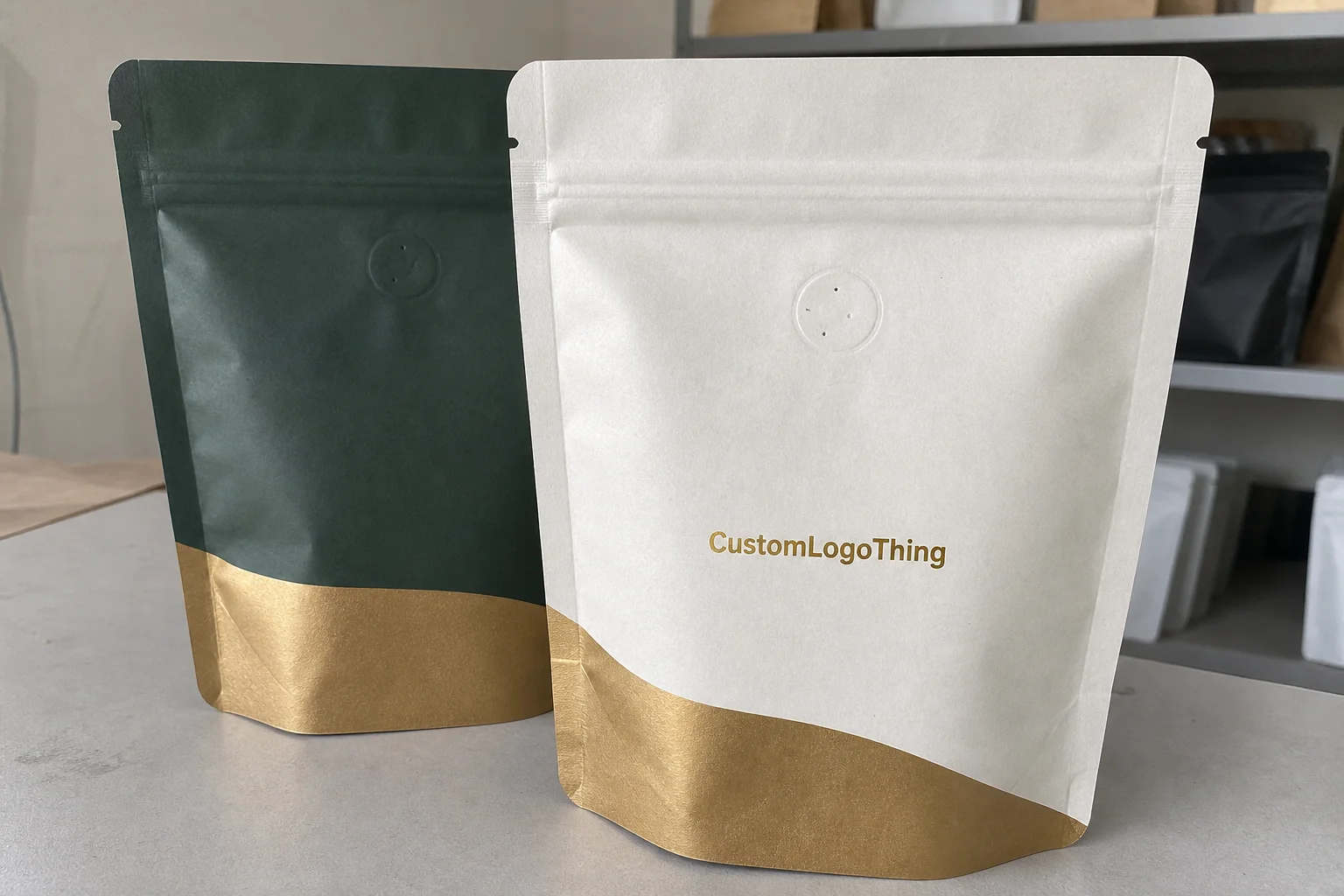
The package is often the first signal a shopper gets. On a shelf, it has to stand straight, keep its shape, and read clearly from a few feet away. Online, the same bag has to photograph well, which is why packaging design matters as much as roast notes or origin copy. A clean pouch suggests care. A sloppy one raises doubts about the product inside.
That matters because coffee is fragile once it leaves the roaster. Aroma fades quickly when oxygen, moisture, heat, and light get time to work on it. In practical terms, custom coffee pouches are doing two jobs at once: preserving freshness and carrying package branding. Specialty roasters, subscription brands, and private-label sellers all depend on that balance. A pouch that protects the coffee but looks like stock packaging leaves money on the table. A pouch that looks polished but leaks aroma creates a return problem.
A coffee pouch should feel like part of the product, not a wrapper built around it as an afterthought.
From a buyer’s point of view, the real question is not “Does it look premium?” It is “Does it fill cleanly, seal consistently, and survive shipping?” That is where a packaging spec becomes real. The difference between branded packaging that supports repeat orders and packaging that creates complaints usually comes down to practical details: barrier level, closure style, film stiffness, and how the pouch behaves on the line.
If you are comparing formats for a launch, a line extension, or a multi-SKU program, start with the broader Custom Packaging Products range and compare pouch structures against other product packaging options before you commit.
How multilayer films, valves, and zippers keep coffee stable
Most coffee pouches use multilayer film because one layer cannot do every job well. An outer layer handles printability and stiffness, while inner layers manage sealability and barrier performance. The barrier layer slows oxygen transmission and helps preserve the compounds that make fresh coffee smell alive instead of flat. Depending on the build, that barrier can come from metallized film, foil, or a high-barrier clear structure. The right choice depends on shelf-life targets, roast level, and the distribution channel.
One-way degassing valves matter for freshly roasted coffee because beans keep releasing carbon dioxide after roasting. Without a valve, that gas can swell the pouch or stress the seals. With a valve, the pouch can vent outward without letting ambient air rush back in. That is useful for fresh-roasted bags packed soon after roasting. If the coffee is fully degassed, a valve may still help presentation, but it is not always required. Product behavior should decide that, not habit.
Zippers and heat seals do different work. The heat seal is the primary closure and the real barrier lock. The zipper is convenience for the customer, and convenience matters if the pouch will be opened more than once. A solid zipper is useful for 12 oz and 1 lb retail packaging. A single-use sampler may not need one at all. Tear notches matter too because they control how the first opening happens. If the tear point is awkward, the customer may damage the seal zone on first use.
The right feature set depends on the use case. A subscription pouch for whole beans may need a matte finish, valve, and resealable zipper. A grocery shelf pack may need stronger scuff resistance and more visual blocking. A sampler or a smaller run of custom coffee pouches might prioritize cost and speed over premium features. There is no universal spec that wins every time.
A useful way to think about the pouch is as a system:
- Barrier preserves freshness.
- Valve manages post-roast gas.
- Zipper supports repeat use.
- Seal construction protects the fill through shipping and handling.
For broader flexible packaging basics, the Flexible Packaging Association at packaging.org is useful background on film structures and barrier properties. If the product will ship Direct To Consumer, the testing guidance from ISTA helps explain why drop and vibration damage can turn a decent pouch spec into a bad customer experience.
Material, size, finish, and graphic choices that change the spec
Size starts with fill weight, but it should not stop there. Bean density changes by origin and roast level, so an 8 oz pouch that works for one coffee may feel tight for another. Headspace matters too, especially if the pouch includes a zipper and top seal. A bag that is too snug can push product into the seal area. A bag that is too loose can look underfilled and sit poorly on shelf. For many brands, practical sizes land around 4 oz, 8 oz, 12 oz, 1 lb, 2 lb, and 5 lb, but the right shape still depends on the filling line and the retail plan.
Finish changes the personality of the pack. Matte reads quieter and more premium. Gloss brings brighter color and stronger contrast. Soft-touch feels tactile, but it can show scuffs more easily in transit. A kraft look can suit artisan branding, though buyers should confirm whether the structure is truly paper-based or simply printed to look that way. A paper appearance does not mean paper performance. If the product needs high barrier, the film stack underneath matters more than the surface graphic.
Clear windows are useful only when they support the sale. Some roasters want a small window because the beans become part of the branding. Others avoid them because any clear area can weaken barrier performance and make the layout busy. Opaque structures usually give more control over design and print coverage, while clear or partially clear structures create a lighter look. The right choice depends on whether the coffee is meant to feel craft-driven, retail-polished, or built for wholesale and e-commerce.
Good artwork has to respect the pouch structure. Valve placement, zipper location, lot code zones, and barcode space all have to be planned before print files are finalized. Seal widths need enough room to protect the printed image and keep the seam strong, often around 6 to 10 mm depending on the build. Gusset style matters too. A flat-bottom pouch sits differently from a standard stand-up pouch, and the wrong choice can change the whole feel of the product line.
That is why custom coffee pouches should be specified like an engineered product, not just a surface for graphics. Strong retail packaging is rarely accidental.
| Option | Typical use | What you get | Common tradeoff |
|---|---|---|---|
| Stock stand-up pouch | Short runs, sampling, internal launches | Lower setup cost, faster sourcing | Less control over dimensions and branding |
| Custom printed pouch | Main retail line, subscription coffee, private label | Better brand fit, exact sizing, stronger shelf presence | Higher setup and longer lead time |
| High-barrier pouch with valve and zipper | Fresh-roasted coffee and repeated openings | Better freshness protection plus consumer convenience | Higher unit cost and more spec decisions |
| Kraft-look printed pouch | Natural or artisan branding | Warm visual identity with custom graphics | Appearance still needs to be checked against barrier and scuff resistance |
If the brand story depends on fiber-based components, check whether the materials are FSC-aligned where applicable. The certification rules at FSC are useful if you are comparing paper content or trying to support sourcing claims in package branding.
What drives pricing, MOQ, and unit cost on a pouch quote
Pouch pricing comes down to a few large variables. Film construction is one of the biggest. Size is another. Print complexity, special finishes, valves, zippers, and die-cut shapes all add cost. Whether the job uses stock components or a full custom build changes the economics too. A simple matte pouch with basic graphics can land in one price band, while a full high-barrier build with a valve, zipper, and heavy ink coverage sits much higher.
MOQ matters because setup cost gets spread across the run. Higher quantities usually lower the unit cost. Lower quantities make plates, changeovers, and material waste a larger part of the landed price. As a rough working range, custom coffee pouches at 5,000 to 10,000 units might land around $0.18 to $0.45 per pouch depending on size, print coverage, and feature set. Larger runs can come in lower. Very short runs can be much higher. That is not a quote. It is how flexible packaging cost behaves.
Add-ons are easy to underestimate. A one-way valve may add only a small amount per piece, but across a large run it matters. A zipper adds both material and processing cost. Specialty inks, matte or soft-touch finishes, custom windows, and unusual bag geometry all increase complexity. None of these features are bad. They just need a business reason. A premium finish only makes sense if it improves conversion, supports the coffee brand, or solves a handling issue.
The wrong way to compare quotes is by piece price alone. The better comparison is total value. A slightly higher-priced pouch that runs cleanly on the line, seals well, and protects roast quality often costs less overall than a cheaper pouch that slows packing or drives returns. Buyers usually find out too late that the cheapest pouch was expensive in another way.
For a purchasing team, three questions matter most:
- Does the pouch match the product’s shelf-life needs?
- Will it run at the required line speed without seal problems?
- Does the branding justify the added cost?
That is the right frame for evaluating custom coffee pouches, not just the lowest sticker number.
Production steps and timeline from artwork to cartons
The cleanest projects start with a spec review. Before artwork gets polished, the supplier should confirm pouch style, dimensions, fill weight, closure type, valve need, and target quantity. Then comes the dieline, the working map for the print file. If the dieline is wrong, the design team can end up building around the wrong seal area or barcode zone. That creates avoidable revisions and slows the schedule.
After artwork approval, the manufacturing sequence starts. Printing comes first, followed by lamination if the structure uses multiple films. The laminate may need curing time so the layers bond properly before slitting and pouch forming. Once the web is cut and formed, the pouches are sealed, inspected, counted, and packed into cartons. Every step affects quality. Print registration affects brand appearance. Lamination affects barrier integrity. Seal pressure affects shelf life. Carton packing affects how the units arrive.
Lead times depend on complexity. A simpler stock-based order can move quickly. A full custom run with new artwork, specialty finishes, or custom dimensions usually takes longer. A common production window after proof approval is around 12 to 20 business days, though that can stretch if the order needs sample approval, color matching, or a revised dieline. Delays usually come from small things stacking up: a missing barcode file, late copy changes, or a spec that was not locked early enough.
That is why coffee brands doing branded packaging should think ahead about the whole workflow, not only the final look. If you already know the fill weight, roast level, closure style, and machine constraints, you save time at every step. You also make it easier for the supplier to recommend the right build instead of guessing. Good product packaging usually comes from good inputs.
Common packaging mistakes that waste shelf life or slow packing
The most common mistake is choosing the pouch for appearance first and performance second. A polished mockup can hide weak barrier protection, poor sealability, or a finish that scuffs badly in transit. That is a fast way to lose the shelf advantage you were trying to build. Coffee is especially unforgiving because freshness loss is not always obvious the day it happens. It shows up later as flatter aroma, shorter retail life, and more customer complaints.
Another mistake is ignoring the filling equipment. A pouch that looks perfect on paper can run badly if machine jaw timing, seal temperature, or headspace are off. The result may be wrinkled seals, misaligned zippers, or pouches that do not stand properly after filling. That is not a packaging sales problem. It is a production problem, and it gets expensive quickly. This is where a sample run matters more than a polished render.
Over-specifying is just as risky. Some buyers add a window because it looks premium, even though barrier performance matters more for the product. Others add a zipper to a pack that is meant for single use, which increases cost without improving the customer experience. There is also the habit of treating every feature as a badge of quality. In reality, the best pouch is the one that fits the product and the channel.
Testing with real coffee is the simplest way to avoid expensive guesswork. Bean density, roast level, gas release, and fill temperature can all change how the pouch sits and seals. A bag that works with one origin may behave differently with another. That is normal. It is also why the better suppliers ask for real product details before recommending a structure.
Honestly, the most reliable custom coffee pouches are the ones specified with enough discipline to survive production, shipping, and repeated use. A pretty pouch that fails those tests is not premium. It is just expensive.
Next steps for ordering the right pouch specification
Start with the product facts. Gather the fill weight, roast level, whether the coffee is fresh-roasted or fully degassed, and whether the pouch needs a valve, zipper, window, or single-use closure. Then decide what the pouch must do on the shelf and in the customer’s hands. That list becomes the brief. Without it, quotes are little more than rough guesses.
Ask for pricing with full details: pouch style, finished dimensions, print coverage, quantity, timeline, and machine requirements. If you already have artwork, send it. If you do not, ask for a dieline first. That lets the design team work around the actual structure instead of improvising around a generic size. For brands comparing options, the broader Custom Packaging Products page is a good place to review related structures before narrowing the spec.
Request a sample or a similar production example if the program matters. You want to check the feel, sealability, print clarity, and barrier level before committing to the full run. If the supplier can show a comparable pouch, that is better than relying on a screenshot. A physical sample reveals things a rendering never will: stiffness, zipper action, surface scuffing, and how the pouch stands after filling.
The best buying path is simple. Confirm the product needs. Compare the material options. Review the quote tiers. Then choose the structure that gives the best mix of freshness, shelf appeal, and line efficiency. That is how custom coffee pouches stop being a packaging expense and start acting like part of the product itself.
Frequently asked questions
Do custom coffee pouches need a one-way valve?
Use a valve when the coffee is still releasing carbon dioxide after roasting, because it prevents swelling while keeping outside air from entering the pouch. If the coffee is fully degassed or the pack is meant for short-term use, a valve may not be necessary, but the decision should still be based on product behavior and shelf-life goals.
How do I choose the right size for custom coffee pouches?
Start with the target fill weight, then account for bean density, headspace, closure style, and whether the pouch needs enough room for a zipper and top seal. Ask for a dieline or sample in the intended size so you can verify fit on the filling line and confirm that the final pack stands and seals correctly.
What affects custom coffee pouch pricing the most?
The biggest cost drivers are pouch size, barrier construction, print complexity, special features like valves or zippers, and the quantity you order. Setup, plates, samples, and freight can change the landed cost, so compare total project cost rather than focusing only on the per-piece quote.
Can I get a kraft look without giving up barrier protection?
Yes, many printed film structures can create a kraft-style appearance while still using a high-barrier construction underneath. The key is to confirm the actual film specification, seal performance, and scuff resistance instead of relying on the look of the surface alone.
What should I send for an accurate quote on custom coffee pouches?
Send the fill weight, pouch style, dimensions if known, print coverage, quantity, target timeline, and whether the pouch needs a valve, zipper, or window. Include artwork files and any filling machine requirements, because line constraints can affect material choice, seal format, and overall production approach. For most brands, the fastest path to a clean quote on custom coffee pouches is a complete spec sheet plus a real sample goal.

