Buyer Fit Snapshot
| Best fit | Custom Eco Mailer Boxes Factory projects where brand print, material claims, artwork control, MOQ, and repeat-order consistency need to be specified before quoting. |
|---|---|
| Quote inputs | Share finished size, material target, print colors, finish, packing count, annual reorder estimate, ship-to region, and any compliance wording. |
| Proofing check | Approve dieline scale, logo placement, barcode or warning zones, color tolerance, closure strength, and carton packing before bulk production. |
| Main risk | Vague material claims, crowded artwork, missing packing details, or unclear freight terms can make a low unit price expensive after revisions. |
Fast answer: Custom Eco Mailer Boxes Factory: How It Actually Works should be specified like a repeatable production item. The safest quote records material, print method, finish, artwork proof, packing count, and reorder notes in one written spec.
Production checks before approval
Compare the actual filled-product size with the drawing, then confirm tolerance on folds, seals, hang holes, label areas, and retail display edges. Reserve space for logos, QR codes, warning copy, and material claims before decorative graphics fill the panel.
Quote comparison points
Review material grade, print process, finish, sampling route, tooling charges, carton quantity, and freight assumptions side by side. A quote is only useful when the supplier can repeat the same color, closure quality, and packing count on the next order.
A custom eco mailer boxes factory is not just a place that prints a logo on kraft board and sends cartons out the door. It is the part of the supply chain where packaging either starts making economic sense or quietly turns into a nuisance. I have seen orders that looked fine on paper end up costing more because the box was a hair too large, the board was too light, or the structure needed one more round of revision. That kind of problem does not always show up in a mockup, but it absolutely shows up in freight bills and damaged returns.
Packaging buyers care about the factory because it controls structure, material selection, print setup, and the checks that keep the run consistent from the first box to the last. That matters for product packaging that has to protect the contents and still present the brand with some discipline at the door. If the box is part of the customer experience, the factory is where function and appearance have to get along.
Sustainability only means something once it is tied to real materials and real production choices. A serious custom eco mailer boxes factory uses responsibly sourced board, efficient dielines, tight cutting layouts, and inks or finishes that do not create unnecessary waste. The best result is a carton that feels considered, ships safely, and avoids the kind of excess material that makes opening a package feel like a small excavation. Nobody needs that.
What a custom eco mailer boxes factory actually does
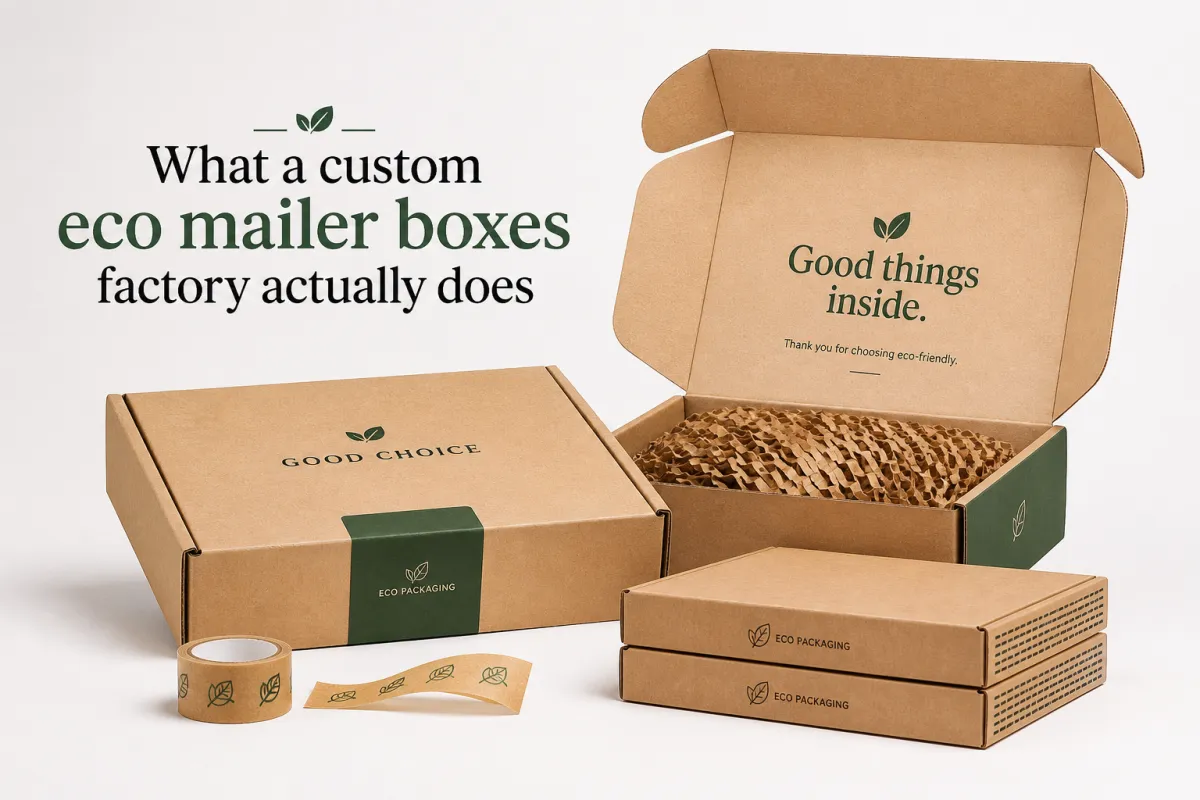
A custom eco mailer boxes factory takes your product dimensions, shipping method, brand style, and sustainability requirements and turns them into a carton that can survive parcel handling in the real world. That sounds straightforward until you see how a quarter-inch of extra space can increase movement inside the box, waste board, and bump up dimensional weight. The packaging may still look perfect on a screen, but carriers do not care about the render.
The work begins with structure. The factory maps inside measurements, flap lock behavior, closure strength, and the right style of tuck or lock so the box serves the product instead of fighting it. Delicate items may need a reinforced corrugated mailer, a fitted insert, or a closure that stays secure under pressure. Lighter products often allow a simpler build, which leaves more room for the print and finish to do their job without making the package feel overworked.
What makes the box eco in practical terms is not a slogan on the outside panel. It is usually a mix of recycled or responsibly sourced board, clean die-cut layouts, efficient use of the sheet, and low-impact printing choices where possible. A custom eco mailer boxes factory also looks for ways to reduce waste during production by avoiding extra lamination, unnecessary decorative layers, and oversized die lines that create scrap without improving performance.
The difference between a factory and a reseller shows up quickly once a project needs a change. A reseller may return a quick quote, but the real production details often sit with another shop, which slows down revisions and makes simple adjustments feel heavier than they should. A true custom eco mailer boxes factory handles the dieline, print registration, cutting, creasing, and finishing in-house or through a tightly controlled production line, which gives the buyer more visibility into timing, quality, and cost.
That difference matters most when packaging is part of the brand experience. A mailer is not only a shipping container. It is also retail packaging in transit, package branding at the moment of delivery, and a small but important signal about how carefully the brand handles details. If the factory misses on structure or finish, the product may still arrive, but the experience stops feeling intentional.
Here is the clearest way to separate the options:
- Factory: manages structure, materials, print, and quality control.
- Broker: handles quoting and usually adds markup before the order reaches production.
- Result: the factory route usually gives tighter control over custom printed boxes and fewer surprises later.
How a custom eco mailer boxes factory turns your brief into production
A capable custom eco mailer boxes factory does not start by tossing out a price. It starts by asking for the details that shape the box: dimensions, weight, shipping method, pack-out style, print coverage, quantity, destination, and any sustainability requirements that need to be met. If a supplier skips those questions, the quote may look fast, but it is usually based on guesswork rather than a real production plan.
Intake and dieline setup
The first serious step is intake. The factory collects the product size, the clearance needed for a snug fit, whether the item ships alone or with inserts, and whether the closure should be self-locking or glued. From there, the dieline is adjusted so the box fits the product instead of leaving the product to rattle around inside it. A well-built dieline trims waste, keeps the pack-out cleaner, and avoids oversized panels that use more board than they should.
A custom eco mailer boxes factory also needs to understand how the box will be packed in practice. Tissue paper, instruction cards, accessory kits, and secondary wraps all affect interior space. A common error is measuring the product and ignoring everything that sits around it once the order is packed. The box may look right in a digital file and still fail the minute someone tries to close it with the real contents inside.
Sampling and proofing
Before production starts, the factory should make a sample or prototype. That sample checks fit, closure strength, print placement, and the feel of the board surface. A kraft mailer behaves differently from a white-lined one, and a low-coverage design can look elegant where a dense flood of dark ink may appear muddy if the material and print method are not matched well.
Physical sampling catches things a PDF never will. Does the flap bow when folded? Does the lock hold during handling? Does the product shift inside the box? Does the logo sit where the customer actually sees it after the package is opened? A custom eco mailer boxes factory that rushes or skips this stage is asking the buyer to approve problems that show up later on a warehouse floor.
Prepress to final QC
Once the sample is approved, production moves through prepress, printing, cutting, creasing, locking or gluing, finishing, and quality control. Each stage has its own failure points. Artwork with weak bleed or poor resolution slows prepress. Board that does not match the agreed spec creates cutting issues. Creases that are too soft make assembly sloppy. QC is supposed to catch the odd cartons before they leave the line, not after they are already packed and palletized.
A realistic timeline often looks like this: sample development can take 5-10 business days, production commonly runs 2-4 weeks depending on quantity and print complexity, and freight may add another week or more. A custom eco mailer boxes factory can move faster for simple work, but the schedule gets tighter when the order is rushed, and rushed jobs usually cost more while leaving less room for corrections.
A good box should disappear into the shipping process and reappear as a clean customer experience. If the packaging demands attention for the wrong reasons, it has already failed.
Key factors that decide performance, sustainability, and shelf appeal
Material choice is the first major decision in any custom eco mailer boxes factory project. Recycled kraft, virgin board, corrugated flute type, and caliper thickness all change how the box performs and how it feels in hand. A 32 ECT corrugated mailer behaves differently from a 44 ECT version, and a 24pt paperboard mailer has a very different surface and stiffness than an E-flute structure. Those choices affect shipping, presentation, and the way the box holds up after repeated handling.
There is always a tradeoff between sustainability and durability, and pretending that tradeoff does not exist usually ends with crushed corners and unhappy customers. Lighter board uses less material, which is good. Fragile products still need enough structure to survive carrier handling. The smartest custom eco mailer boxes factory choice is usually the one that right-sizes the board instead of chasing the thinnest option on the sheet. Less material is efficient. Too little material is just a problem with a smaller footprint.
Printing and finishing deserve the same level of attention. Heavy ink coverage, soft-touch lamination, foil, and gloss coatings can look sharp, but they can also complicate recycling and push cost higher than it needs to be. If the box is meant to go back into the recycling stream, every finish should earn its place. A low-ink kraft mailer with one clean logo often does more for package branding than a crowded surface with too many effects and too little restraint.
Documentation matters just as much as the material itself. If you are making FSC claims, ask for the paperwork. If you are talking about recycled content, get the percentage in writing. If someone wants to describe a package as compostable or biodegradable, ask for the test basis and the conditions behind the claim. The language may sound persuasive on a sales sheet, but the paperwork is what protects the brand when questions come back later.
For structural testing, many buyers use ISTA test protocols to pressure-check the pack before scaling up. That is practical, not overbuilt. On the material side, FSC certification remains a useful reference point when sourcing responsibly managed fiber. A serious custom eco mailer boxes factory should be able to explain both without hiding behind a logo and hoping no one asks about the details.
The opening experience still matters, even for shipping-first packaging. Tear tabs, self-locking closures, inserts, and clean interior printing can improve the feel of the box without turning it into a heavier or more wasteful package. Smart product packaging does more with less. That is the point of a well-run custom eco mailer boxes factory: every feature should justify its material use, not merely decorate the carton.
- Structural strength: enough board and flute to resist crush damage in transit.
- Print clarity: crisp logos and readable copy without flooding the sheet.
- Recyclability: fewer coatings and fewer mixed materials where possible.
- Usability: easy opening, dependable closure, and predictable pack-out.
Custom eco mailer boxes factory pricing: what actually drives cost
Pricing from a custom eco mailer boxes factory comes down to a handful of concrete variables, not a mystery formula. Quantity, board grade, print colors, ink coverage, finishing, insert complexity, tooling, and freight all affect the number. If a quote looks unusually low, one of those inputs has probably been trimmed so the price reads better than the job actually is.
Low quantities always cost more per unit because setup labor gets spread across fewer boxes. That is normal. A 500-unit order can look surprisingly expensive, while a 5,000-unit order may fall sharply once setup and tooling are spread out. The better comparison is not only the unit price, but the full project cost, including freight, handling, and the risk of damage if the box is underspecified.
Hidden costs appear in the same places again and again. Rush production adds fees. Multiple proof rounds add time and labor. Special coatings can change the recycling profile and push the price higher. Oversized boxes cost more to ship. If the freight lane is awkward, the landed cost can rise even when the factory price looks fine. A custom eco mailer boxes factory should be able to explain those cost drivers before approval, not after the invoice lands on your desk.
Ask for price breaks at 500, 1,000, and 5,000 units. That gives you a clean view of the pricing curve. If the jump from 1,000 to 5,000 units is tiny, the supplier may be padding the lower tiers. If the quote drops sharply at scale, you can decide whether the inventory risk is worth the savings. Either way, you get an actual pricing pattern instead of a polished sales pitch.
| Order size | Typical unit price | Typical setup profile | Best fit |
|---|---|---|---|
| 500 units | $0.85-$1.35 | Higher setup share, limited customization | Testing a new SKU or short seasonal run |
| 1,000 units | $0.55-$0.90 | Better balance of setup and unit cost | Small ecommerce brand with steady demand |
| 5,000 units | $0.22-$0.42 | Lower unit cost, more storage commitment | Established product lines with repeat orders |
Those numbers shift with board grade, print coverage, and inserts, but they offer a useful starting point. A plain kraft mailer with a single-color print will usually sit below a fully printed box with specialty finishes. A custom eco mailer boxes factory that explains the pricing curve honestly keeps you from choosing the false bargain that becomes expensive after shipping and storage are added.
Land cost matters more than factory price. Compare the total delivered cost rather than only the production line item. Freight, duties, storage, and damage risk can erase a small unit-price advantage in a hurry. That is especially true for custom printed boxes that travel a long distance before the customer ever sees them.
Step-by-step ordering plan for a custom eco mailer boxes factory
A smooth order starts with measurements that are actually useful. List the product length, width, height, weight, and whether it ships alone or with inserts, tissue, or accessory packs. A custom eco mailer boxes factory can only quote accurately if the brief includes the full shipping load, not just the object that looks neat on a desk.
- Measure the product correctly. Include wrap, sleeves, and accessory pieces that affect the internal fit.
- Choose the structure first. Decide on a simple mailer, reinforced corrugated mailer, or insert-based system before artwork starts.
- Send a clean brief. Include dieline notes, brand colors, quantity, target budget, sustainability requirements, and the destination zip or port.
- Review a sample. Close it, shake it, stack it, and inspect the closure and print alignment.
- Lock the logistics plan. Confirm lead time, carton count, palletization, freight terms, and the receiving process.
That order matters. If the process starts with artwork and ignores structure, the box usually needs a redesign later anyway. It is cleaner to make the structural choice early, then fit the design to the package shape. For brands building a wider packaging system, it also helps to compare the mailer with other Custom Packaging Products so the box fits the rest of the branded packaging lineup. For lighter secondary packaging, Custom Poly Mailers can be the right companion for certain SKUs.
Sample testing should be practical, not ceremonial. Put the actual product inside. Close the flap. Check whether the box springs back open. Drop it from a short height onto a hard surface. Stack it under a few cartons. If the product moves around or the closure feels weak, fix it now. A custom eco mailer boxes factory can correct that far more easily before production than after 3,000 cartons have already been packed.
If a supplier cannot explain the sample, the board, the lead time, and the freight terms in plain language, keep looking. Packaging is technical, but buying it should not feel like decoding a ransom note.
Receiving details should be settled before the shipment leaves the dock. How many cartons per pallet? What is the pallet height limit? Do you want overage built in? Who checks the first cartons on arrival? Clear answers keep the first delivery from turning into a warehouse argument. A good custom eco mailer boxes factory should help shape those details, not dodge them.
Common mistakes brands make with custom eco mailer boxes
The classic mistake is choosing the wrong board weight. Too light, and the box fails in transit. Too heavy, and the brand pays for material, freight, and storage that were never needed. A custom eco mailer boxes factory should recommend a board grade based on product weight, the carrier path, and the crush risk, not on whatever happens to be cheapest at the moment.
Overdesigning the print is another trap. Full-coverage ink, extra coatings, and decorative layers can make a package less recyclable and more expensive without improving conversion in any meaningful way. Most brands do not need a loud box. They need a controlled one. A single strong mark, a clean interior message, or a restrained line drawing often does more for package branding than a busy surface trying too hard to impress.
Shipping thresholds cause trouble quietly. A box that is only slightly too large can trigger higher dimensional weight charges and chip away at margin on every order. That problem compounds fast. If the brand sends thousands of units, even a small footprint mistake becomes real money. A careful custom eco mailer boxes factory checks the dimensions against carrier realities, not just against the render on a laptop screen.
Skipping the sample stage is another expensive habit. Digital mockups do not show closure strength, board feel, or how the mailer behaves when the product is actually inside it. A buyer who signs off from a PDF alone is often inviting a correction round that could have been avoided with one physical prototype and a few minutes of testing.
Sustainability claims can cause even bigger headaches. If the factory cannot document recycled content, sourcing, or coating type, do not print a claim you cannot defend. That is not brand storytelling; it is paperwork waiting to become a problem. A custom eco mailer boxes factory that understands compliance helps keep claims tied to evidence, which is how solid packaging decisions should be made.
- Wrong board weight: either too fragile or unnecessarily heavy.
- Too much print: attractive on screen, wasteful in practice.
- Bad sizing: more freight cost and more movement inside the box.
- No sample: the fastest route to regret.
- Loose claims: sustainability language without documentation.
Expert tips before you choose a custom eco mailer boxes factory
Ask for a material spec sheet, not only a quote. You want the board type, thickness, print method, coating details, and certification notes in writing. A custom eco mailer boxes factory that can provide those details is usually the kind of supplier that understands production at the level that matters, not just the level that sounds confident in a sales call.
Request a real sample or at least a production-grade photo set. Mockups are fine during early design, but they do not show seam quality or print control. If the factory hides behind polished renders, treat that as a warning sign. The box should be judged by the box, not by the rendering software having a nice afternoon.
Compare factories on clarity and response time, not only on price. The supplier that answers cleanly about MOQ, lead time, freight, and file prep is usually easier to work with when something changes. Something usually does. An artwork correction, a spec revision, or a freight delay is ordinary business, not a rare event.
Use one strong box size instead of five nearly identical ones. Simplifying your SKU count lowers setup waste, improves storage, and makes reorders easier to manage. It also tightens the whole product packaging system, which helps both operations and brand consistency. A custom eco mailer boxes factory can build around that kind of discipline more effectively than around a cluttered size library.
For brands comparing suppliers, send the same brief to each one and compare landed cost, sample quality, and timeline side by side. That is the clearest way to see who actually solves problems. A supplier can be cheap, fast, or helpful. The rare one gives you two out of three. The strongest custom eco mailer boxes factory gets as close to all three as possible without excuses.
It also helps to think about the box as part of the wider line, not as a lone object. If your brand uses inserts, shipping cartons, sleeves, or outer wraps, the mailer should sit naturally beside those pieces. Good packaging design is not one polished carton. It is a family of choices that makes the brand feel coherent from warehouse to doorstep. That is what separates average custom printed boxes from packaging that genuinely earns its keep.
For most ecommerce brands, the right custom eco mailer boxes factory is the one that respects both the math and the customer experience. If the supplier can keep the structure efficient, the print clean, the claims honest, and the freight under control, the relationship is on solid ground. That kind of factory partnership saves money, reduces waste, and makes the package look like it belongs to the brand rather than another carton in the stack.
FAQ
How do I know if a custom eco mailer boxes factory is truly sustainable?
Ask for recycled-content or FSC documentation instead of vague marketing language. Check whether the factory uses right-sized dielines, flat-pack shipping, and low-impact inks or coatings. If the supplier cannot back up compostable or biodegradable claims with test data, treat the claim as marketing, not fact. A real custom eco mailer boxes factory should be able to explain the materials and the process without getting slippery.
What is the usual MOQ for custom eco mailer boxes from a factory?
MOQ depends on structure, board type, and print complexity, but small runs usually cost more per unit because setup is spread across fewer boxes. Ask for price breaks at 500, 1,000, and 5,000 units so you can see the real economics. If you are testing a new product, start with the smallest run that still gives you usable freight and production pricing from the custom eco mailer boxes factory.
How long does a custom eco mailer boxes factory need to produce an order?
A sample often takes about 5-10 business days if the dieline is straightforward. Full production commonly takes 2-4 weeks depending on quantity, print complexity, and current factory load. Add extra time for shipping, artwork revisions, and any approval delays so the schedule does not slip. A dependable custom eco mailer boxes factory should tell you the schedule in plain language, not vague promises.
What should I send a custom eco mailer boxes factory for an accurate quote?
Send product dimensions, weight, packaging contents, desired box style, and estimated order quantity. Include print coverage, brand colors, sustainability requirements, and delivery location. If possible, share photos of the product and current packaging so the factory can avoid guesswork. The better the brief, the less likely the custom eco mailer boxes factory is to quote the wrong structure.
Are recycled custom eco mailer boxes strong enough for ecommerce shipping?
Yes, if the board grade matches the product weight and the structure is designed correctly. Test for crush resistance, closure strength, and movement inside the box before scaling up. Use inserts or a stronger flute when the product is fragile, heavy, or likely to bounce around in transit. A good custom eco mailer boxes factory will size the board around the shipping risk instead of guessing.
If you want packaging that genuinely earns its place in the shipping chain, start with the structure, the board, and the freight math, then shape the visual finish around those decisions. That is the honest way to buy from a custom eco mailer boxes factory. Get those basics right, and the box does its work quietly: it protects the product, supports the brand, and keeps waste down where it belongs.

