Custom Engraved Wooden Box: What Buyers Should Know Before Ordering
A custom engraved wooden box changes the value signal before the product inside is even touched. That sounds like marketing language until you watch how people handle it: the weight registers first, then the finish, then the engraved mark, and only after that do they get to the item. Compared with a printed carton, wood does more of the selling in silence.
That is why these boxes keep showing up in jewelry, watches, spirits, awards, collectibles, artisan goods, and corporate gifting. They do not just hold a product. They frame it. The difference is practical, not poetic. A disposable mailer says one thing; a wooden presentation box says something else entirely.
Still, wood is not a default upgrade. It is a specific tool with specific tradeoffs. If the product is low margin, if shipping weight matters more than presentation, or if the item will move through high-volume fulfillment, the numbers can stop making sense quickly. Buyers who understand that tend to make better packaging decisions than buyers chasing a mood board.
What an engraved wood box adds to the product
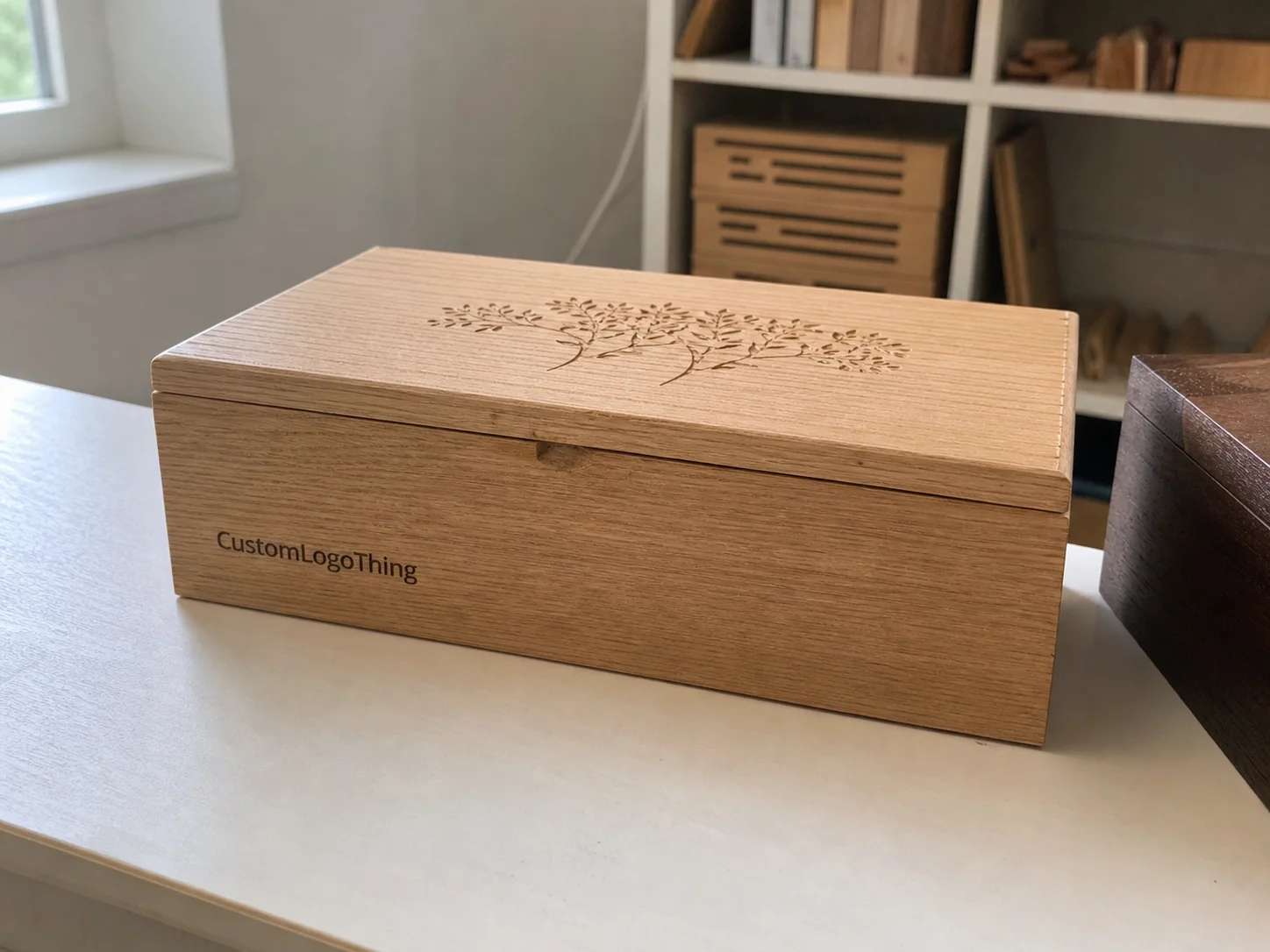
A custom engraved wooden box does three jobs at once. It protects the item, it raises the perceived value, and it extends the life of the branding. The first job is functional. The second is commercial. The third is the one people underestimate.
Printed packaging often gets discarded. Wood is different. It is kept on desks, shelves, and dressers because it feels durable enough to reuse. That matters for brands that want repeated exposure after the purchase moment. A box that stays in the room keeps the logo in view longer than a carton ever will.
There is also a sensory effect that buyers notice even when they do not describe it well. Wood has a temperature, a texture, and a density that paperboard lacks. An engraved mark adds contrast without needing ink coverage, and the result usually feels more permanent. In packaging terms, permanence is a value cue.
The catch is that wood also exposes weak decisions. An oversized logo, a thin font, a poor stain choice, or a sloppy insert fit will show faster here than on a printed sleeve. The material is premium, but it is not forgiving. If the spec is weak, the box looks expensive and unfinished at the same time.
For buyers comparing package formats, the question is simple: does the box contribute to the product story, or is it just carrying the product? If the answer is the former, wood has a strong case. If the answer is the latter, a lighter structure is usually the smarter buy.
How the process works from file to finished box
The production flow is usually straightforward: artwork prep, material selection, proofing, engraving setup, sample approval if needed, production, finishing, inspection, and packing. The steps are predictable. The failure points are also predictable.
Artwork is where many orders start to drift. Vector files are the safest choice because they scale cleanly and preserve edge quality. A raster image might look fine on a screen and still fail in production once the engraving hits grain. Thin lines, small text, and detailed gradients are the usual suspects. They look precise in a PDF and vague on wood.
The engraving method changes the result too. Laser engraving is common because it gives consistent detail and works well on flat lids. Rotary carving creates more depth and can read as more tactile, but it is slower and usually better suited to specific design styles. Some jobs add paint or fill to the engraved area for contrast, though that adds labor and another inspection point.
Wood itself introduces variation. Grain pattern, tone, and burn response are not identical from one panel to the next. Buyers sometimes expect every unit to match like injection-molded plastic. That is not how wood behaves. A reasonable run will be consistent enough for brand use, but there will be natural variation. If the sourcing spec does not allow for that, the order will disappoint someone.
Sampling is where the practical decisions happen. A digital proof can confirm placement and scale, but it cannot tell you whether the engraving reads cleanly at the actual size or whether the finish darkens the mark too much. A physical sample answers those questions. If the project is sensitive to presentation, skipping this step is expensive.
A vague proof is not a harmless shortcut. It is a deferred mistake, and in wood packaging the mistake usually gets more visible after production begins.
For buyers who care about transit performance, it is worth asking how the box will be packed for shipping and whether the outer carton is being tested or at least specified in a way that reflects the route. ISTA testing methods are a useful reference point for rough handling expectations. If sustainability is part of the brief, ask for FSC-certified material rather than relying on a verbal claim.
What drives cost, pricing, and MOQ
The price of a custom engraved wooden box is shaped by a handful of variables that matter more than most mood boards do. Size, wood species, finish, engraving area, insert complexity, lid style, and quantity all change the quote. Buyers often ask for a “premium gift box” and then wonder why the estimate is broad. Specificity is what tightens the number.
MOQ changes the math because setup costs do not scale politely. The machine still needs to be programmed. The fixture still needs to be set. The artwork still needs to be checked. At 25 units, that burden lands on very few boxes. At 250 units, the same burden spreads out and the price usually drops noticeably. That is not a markup trick. It is production reality.
| Tier | Typical build | Common use | Rough unit cost at 100 units |
|---|---|---|---|
| Budget-friendly | Pine or bamboo, simple lid, shallow laser mark, basic foam insert | Small gift sets, event giveaways, starter retail packaging | $8-$14 |
| Mid-range | Stained finish, cleaner closure, deeper engraving, fitted insert | Corporate gifts, artisan sets, premium product packaging | $14-$24 |
| Premium | Walnut or hardwood look, refined finish, engraved lid and interior, custom compartments | Collector editions, heirloom gifts, high-end retail packaging | $24-$45+ |
These ranges move with quantity. A 500-unit order can reduce unit cost sharply because tooling and setup are spread across more pieces. A 25-unit order can feel surprisingly expensive even when the design is simple. For buying decisions, it helps to request pricing at 50, 100, and 250 units. That shows the break points instead of leaving the buyer to guess.
There are also hidden cost drivers that deserve attention. Interior compartments, hand-applied fill, special stains, inside-lid engraving, and rush timing can all add money fast. Shipping does the same if the box is bulky or if the item requires protective packing. A quote that ignores pack-out is not complete. It is a partial estimate with a nice layout.
For broader packaging comparisons, it helps to compare the box as part of a system rather than as a standalone object. The right structure needs to fit the product, the margin, and the shipping method. If you are comparing presentation formats, the Custom Packaging Products catalog is a useful starting point.
Lead time and production: what happens after approval
Once the artwork is approved, the schedule usually follows a fairly clean sequence: final proof, sample if needed, production scheduling, engraving, finishing, assembly, quality checks, and shipping. A simple run can move quickly. A complicated one with multiple engraving areas, custom compartments, or special coatings will move slower because each extra variable creates another delay point.
Artwork revisions are the most common source of slippage. Low-resolution files need cleanup. Font issues need correction. Spacing changes need another proof. Special finishes often need drying or cure time. Custom inserts may require their own tooling or cutting setup. The engraving itself is often not the slowest part of the job.
Lead time should be planned backward from the actual use date, not from the day the order is placed. If the boxes are for an event, a product launch, or a retail campaign, the approval cycle, freight time, and inspection time all need room. A tight calendar leaves no margin for rework, and wood packaging is not the category where you want to discover a problem late.
Bulkier packaging also carries a handling risk. Boxes can arrive scratched, dented, or shifted if the outer cartons are too weak or the internal packing is loose. That is not an edge case. It is a normal logistics issue if the pack-out spec is weak. The safer approach is to specify the transport package with the same seriousness as the box itself.
For simple jobs, the lead time can be short once the design is locked. For more complex jobs, the timeline tends to stretch for reasons that are easy to predict and hard to skip. Buyers who account for those steps early usually avoid the worst delays.
Design choices that affect durability and brand feel
Material choice sets the tone. Bamboo reads clean and contemporary. Pine tends to be the value option. Walnut or a walnut-stained finish carries more perceived weight. A custom engraved wooden box can work in all of those categories, but the material should match the product story rather than pretending to be something else.
Finish matters just as much. A matte natural finish feels restrained and craft-oriented. Satin stain adds warmth and visual depth. Clear coat can protect the surface and improve wipeability. Oil finish creates a softer feel but may show wear differently. The finish also changes engraving contrast, which means the same logo can look crisp on one surface and muddy on another.
Closure style is not a minor detail. Hinges, magnetic clasps, and sliding lids all change how the box opens and how durable it feels over repeated use. A lid that comes loose too easily reads as cheap, even if the wood is decent. The opposite problem is also common: a closure that is too stiff can make the box awkward to handle and shorten the life of the hinge.
The interior is where presentation either holds together or falls apart. Foam works for fragile items. Velvet or fabric lining signals luxury more clearly. Paperboard inserts are efficient and practical for lighter products. Carved or routed compartments are best when the set contains several distinct pieces. The right insert prevents movement, protects the product, and keeps the first impression intact.
There is a useful rule here: the outside and the inside should agree with each other. A refined engraved lid paired with a loose insert sends mixed signals. A durable box with a flimsy tray does the same. Buyers notice the mismatch, even if they do not describe it that way.
For repeated use or resale packaging, consistency matters more than most people expect. If the box becomes part of the customer experience, every small detail starts to matter: hinge tension, surface smoothness, logo contrast, and the feel of the interior fit. Those are not decorative concerns. They are part of the product.
Quality control points buyers should ask about
Good quality control for wood packaging is not glamorous, but it is where expensive mistakes get caught. Buyers should ask how the supplier checks engraving depth, surface finish, edge smoothness, closure alignment, and insert fit. If the answer is vague, the process is probably vague too.
One of the most important checks is contrast. If the engraving is too shallow, the logo disappears into the grain. If it is too deep or burned too dark, it can look harsh and uneven. Both problems are avoidable with a sample and a proper inspection process. The same is true for finish consistency. A stain that looks good on one panel can look blotchy on another if the wood was not prepared correctly.
Fit testing deserves more attention than it usually gets. The product should not rattle. It should not have to be forced in. If the box is meant for repeated opening and closing, the fit should allow that without damage. Too many packaging issues are actually fit issues wearing packaging clothes.
There is also a tolerance conversation that should happen early. Wood is not perfect, and most buyers do not need it to be. They do need a clear understanding of acceptable variance, especially on engraving placement and insert dimensions. If the design includes multiple compartments, the tolerance stack can become the hidden source of inconsistency.
When a job is being evaluated for premium use, ask about the inspection standard, not just whether an inspection exists. That distinction matters. A visual glance is not the same thing as a structured check against a spec sheet.
Common ordering mistakes that raise cost or lower quality
- Using a logo with tiny details that lose clarity once engraved into grain.
- Choosing a wood tone that makes the mark too close in value to the background.
- Skipping a sample and discovering too late that the finish is darker, lighter, or glossier than expected.
- Underestimating product dimensions and ending up with an insert that is too tight or too loose.
- Ordering a premium box for a product that cannot support the added packaging cost.
Those errors sound minor on a screen. They are not minor once production starts. A weak logo makes the box feel cheaper. A loose insert lets the product shift. A finish mismatch changes the whole brand impression. The cost of fixing one of those problems after approval is usually much higher than the cost of preventing it.
The most common failure is probably also the easiest to avoid: buyers fall in love with a render and never test the physical material. Wood grain, burn depth, stain response, and hinge feel are hard to judge from a flat mockup. A sample removes guesswork. For this category, that is not a luxury. It is basic risk control.
Another recurring mistake is applying paperboard logic to wood. Printed boxes and engraved boxes are not interchangeable simply because both are packaging. The processes, tolerances, and cost structures are different. Treating them as the same thing usually leads to a weak spec and a noisier approval cycle.
How to spec a better box on the first round
Start with the dimensions of the actual product, not the approximate shape in your head. Then add the target quantity and the presentation level you actually need. Those three inputs give the supplier enough information to quote a custom engraved wooden box without guessing. If the product is fragile, include weight. If the box is for retail display or gifting, say so directly.
Keep the artwork simple when possible. Strong marks with clear spacing usually outperform crowded logos that depend on fine detail. Wood can handle precision, but only to a point. The cleaner the mark, the more reliable the result across different batches of grain and finish.
Ask for a proof that shows exact placement and size. If the job is sensitive to appearance, ask for a sample or at least a material reference. This matters more than it sounds because a mark that looks balanced on a screen can land too high, too low, or too small in the real box.
Specify the insert plainly. The product should sit securely without stressing corners or crushing surfaces. If the product is removed often, leave enough room for easy handling. If it is fragile, tighten the fit and let the insert absorb movement instead of the product itself.
Keep the spec stable if you expect reorders. Once the dimensions, engraving file, finish, and insert layout are locked, repeat runs are easier to match. That matters for brands that want packaging to stay consistent over multiple launches.
One practical habit helps more than most people realize: define the box from the customer’s point of view. How heavy should it feel? How often will it be opened? Will it sit on a shelf? Will it be shipped individually or packed in sets? The right answers guide the spec faster than abstract branding language does.
Clean approvals save more money than fast approvals. Precision on the proof prevents most of the rework that turns a straightforward packaging run into a frustrating one.
Final checklist before you place the order
Before ordering a custom engraved wooden box, confirm the product dimensions, quantity, finish, engraving file, insert style, closure type, and delivery date. That sounds basic because it is basic. The projects that go smoothly usually have those details settled before production starts.
Then ask the supplier for a tiered quote. If the price drops materially at 100, 250, or 500 units, that may change the buying decision. It is better to know that up front than to discover it after the first estimate comes in. If timing is tight, ask what part of the schedule is most likely to slip. That question reveals whether the lead time is actually realistic.
If the box is part of a launch, a gift program, or a retail rollout, treat packaging as a dependency rather than a final accessory. The box affects the product story, the schedule, and the budget. Ignoring any one of those usually costs more than the packaging itself.
A well-made wooden box can make the product feel finished, deliberate, and worth keeping. A poorly specified one does the opposite. The difference is often not dramatic on paper. It becomes obvious in hand.
FAQs
How much does a custom engraved wooden box usually cost per unit?
Pricing depends on wood type, box size, engraving area, finish, insert complexity, and order quantity. Small orders usually cost more per unit because setup and machine time are spread across fewer boxes. At 100 units, rough ranges often land around $8-$14 for basic builds, $14-$24 for mid-range builds, and $24-$45+ for premium specs.
What file format works best for engraving?
Vector artwork is the safest format because it keeps edges sharp and scales cleanly. Thin fonts, tiny detail, and busy gradients are risky on wood. If the only file available is low resolution, expect cleanup work before the job is approved.
How long is the lead time for a custom engraved wooden box order?
Lead time depends on proof approval, sampling, box complexity, and quantity. Simple runs move faster than jobs with custom inserts, multiple engraving positions, or special coatings. Build extra time into the schedule for revisions and freight, especially if the boxes are tied to a launch date.
Which wood or finish is best for premium presentation?
Bamboo works well for a clean, contemporary look. Walnut or a walnut-stained finish usually reads as more upscale and can support a stronger luxury signal. The best choice depends on the product story, the engraving contrast, and the kind of handling the box will see.
Can I order a small quantity of engraved wooden boxes?
Yes. Small runs are common for samples, limited editions, gifting, and pilot launches. The tradeoff is higher unit cost because setup is spread over fewer boxes. If cost matters, compare the small-run price against the savings at a larger quantity before deciding.

