Flat stickers are cheap until they make a premium product look cheap. Custom epoxy stickers solve that problem by adding a clear raised dome over the printed design, turning a regular label into something closer to a badge.
That raised, glossy finish changes how the sticker looks, feels, and survives handling. It catches light. It adds thickness. It makes a small logo feel more intentional on electronics, bottles, retail displays, packaging, and promotional gear.
Not magic. Just better materials, tighter production control, and specs that need to be decided before the order hits the press.
What Custom Epoxy Stickers Are and Where They Actually Work
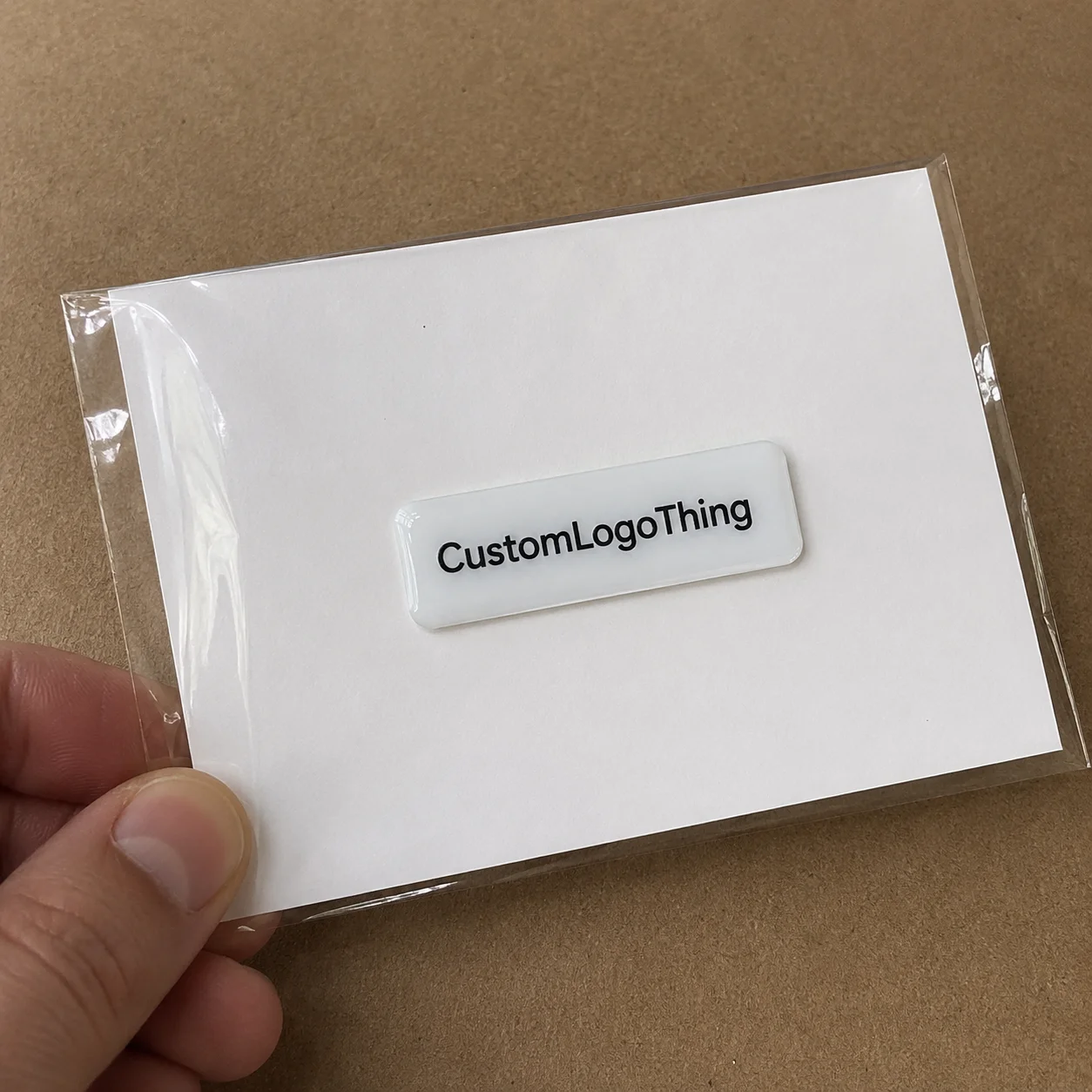
Custom epoxy stickers are printed decals made from vinyl, polyester, or a similar film, then covered with a clear polyurethane or epoxy-style resin dome. The resin cures into a rounded surface that protects the print underneath and creates the dimensional “gel” feel buyers often associate with premium branding.
You may see these called domed stickers, resin stickers, 3D stickers, raised decals, gel labels, or epoxy labels. Same basic family. Different suppliers use different names because apparently packaging needed more ways to confuse buyers.
The big difference is tactile. A standard paper label is flat and usually thin, often around 60-100 microns before adhesive. A domed decal can feel several times thicker once the resin is added, commonly landing around 1.5-2.5 mm depending on size, resin flow, and the production spec. That thickness makes the logo feel like a physical component instead of a printed afterthought.
Strong applications include:
- Product branding on electronics, tools, phone accessories, cosmetics, outdoor gear, and small appliances.
- Retail packaging accents, bottle caps, gift boxes, rigid boxes, and high-margin product kits.
- Promotional decals for events, clubs, limited drops, memberships, and brand campaigns.
- Machinery tags and equipment labels where the surface needs more scuff resistance than a basic sticker.
- Packaging seals where the goal is premium shelf appeal more than tamper evidence.
They are not ideal for tight folds, heavily textured surfaces, fabric, raw kraft board, ultra-thin mailer inserts, or anything that must stay perfectly flat in transit. If your packaging design depends on a crisp fold line, do not slap a raised resin dome across it and hope physics takes the day off.
From a buyer’s point of view, these stickers make the most sense when they improve perceived value, durability, or brand feel. If the only goal is the lowest possible label cost, use a flat paper or BOPP label and move on.
How the Domed Sticker Process and Timeline Works
The production process is simple on paper and fussy in real life. A typical order moves through artwork review, material selection, printing, cutting, resin doming, curing, inspection, packing, and shipping. Each step affects the next one, so a bad cut line or rushed proof can create expensive little problems later.
The clear dome is usually applied after printing and die cutting. That means the shape, size, bleed, edge margin, and artwork position need to be finalized before resin is added. Once the dome is on, changes are not “quick edits.” They are rework. Nobody enjoys paying for rework.
Curing is the boring-but-critical step buyers often underestimate. Uncured resin can dent, cloud, shift, trap bubbles, or pick up dust. Lovely way to ruin a premium sticker. Depending on resin type, dome thickness, humidity, and production setup, curing may take a day or more before the stickers are safe to stack, pack, or ship.
For standard repeat orders, production may run about 7-12 business days after proof approval. Custom shapes, large quantities, metallic materials, special adhesives, or detailed inspection requirements can push that closer to 12-20 business days. Shipping is separate. Factory turnaround is not the same thing as delivery date, no matter how badly the sales team wants the calendar to behave.
Practical rule: if a launch, trade show, seasonal promotion, or retail deadline matters, build in at least one extra week beyond the quoted production time. That buffer saves budgets, blood pressure, and awkward calls.
Proof approval speed matters more than many buyers think. A supplier may quote 10 business days after approval, but if the proof sits in an inbox for four days, the production clock has not started. For urgent orders, keep the spec clean: one or two shapes, readable art, standard adhesive, no last-minute metallic stock experiments, and no ten-version design circus.
Inspection should cover more than whether the logo printed correctly. Good QC checks look for bubbles, dust specks, off-center doming, edge overflow, inconsistent height, adhesive contamination, curling, color shifts, and pieces stuck together during packing. Raised stickers are small, but the defects are not subtle once they land on a finished product.
Material, Shape, and Finish Specs That Change the Result
The base material does more than hold ink. It changes color density, durability, adhesive performance, and how premium the finished decal feels. White vinyl is the workhorse for bold logo color and opaque graphics. Clear film is useful for window-style effects or labels that need the product color to show through. Metallic film gives a badge-like finish for premium product packaging. Polyester usually costs more, but it can offer better dimensional stability and durability for equipment or outdoor use.
Adhesive choice matters too. Standard permanent adhesive works for most smooth packaging, coated paperboard, glass, plastic, and metal. Stronger adhesive may be needed for textured or outdoor surfaces. Removable adhesive should only be used when the sticker truly needs to come off cleanly. Buyers sometimes ask for “strong but removable,” which is adorable. Adhesives involve tradeoffs.
Shape is another major factor. Rounded corners and smooth curves dome better than sharp points, needle-thin tails, or highly detailed cut shapes. Resin naturally wants to flow and settle. A simple circle, oval, rounded rectangle, or soft custom logo outline usually produces a cleaner dome than a spiky shape with tiny extensions.
| Spec Choice | Best For | Watch Out For | Typical Cost Impact |
|---|---|---|---|
| White vinyl | Bold color logos, retail packaging, general product labels | Less dramatic than metallic or clear effects | Lowest to moderate |
| Clear film | Window effects, transparent backgrounds, glass or plastic products | Requires white ink for opaque areas | Moderate |
| Metallic film | Premium badges, cosmetics, tech accessories, gift packaging | Can reduce readability if contrast is weak | Moderate to high |
| Polyester film | Outdoor gear, equipment tags, durable branding | May need stronger adhesive depending on surface | Moderate to high |
Dome height is a balance between premium feel and practical use. A higher dome feels more substantial, but too much height can interfere with stacking, carton packing, automated application, or tight retail displays. For small decals under 1.5 inches wide, a moderate dome usually looks better than a heavy bubble. Bigger is not automatically better. Packaging has enough overbuilt nonsense already.
High-gloss doming is standard. The print underneath can still use metallic effects, white ink, transparent areas, or opaque color blocks. Tiny text is the danger zone. Under a curved dome, small type can distort near the edges, especially below 5-6 pt depending on font and print method. If the sticker needs compliance copy, serial numbers, ingredients, warnings, or detailed instructions, consider a flat label instead.
Surface compatibility should be tested when the substrate is unusual. Smooth plastic, coated paperboard, glass, metal, and sealed wood are usually friendly. Fabric, raw cardboard, rough kraft, silicone, dusty surfaces, oily surfaces, and deep texture are not. If the raised decal is part of broader Custom Labels & Tags, treat it as a physical component with adhesive, thickness, handling, and storage requirements — not just artwork with a shiny bubble on top.
Pricing, MOQ, and Unit Cost Drivers
Pricing for custom epoxy stickers depends on size, shape complexity, material, print method, dome area, quantity, adhesive, packaging format, inspection requirements, and delivery speed. That is why “How much for stickers?” is how bad quotes are born. A 1-inch round logo and a 4-inch metallic equipment badge are not remotely the same job.
Small batches carry higher unit costs because setup, proofing, cutting, resin application, curing space, and inspection do not disappear at low quantity. Many orders start around 100-500 pieces. Better unit pricing usually appears at 1,000+ pieces, especially when the shape is simple and the same setup can run efficiently.
As a rough buying range, small 1-inch domed logo decals might land around $0.35-$1.25 each depending on quantity and spec. Larger 2-3 inch raised decals may run $0.80-$2.50 each. Specialty materials, individual bagging, barcode labels, rush production, split shipments, color matching, or unusually strict tolerances can push the cost higher. These are planning ranges, not a universal price list. Resin coverage, labor, and reject rate change the math quickly.
Size has an outsized effect because resin coverage and curing space increase fast. A 4-inch equipment badge uses far more material and rack space than a 1-inch logo dome. Shape complexity also matters. A clean rounded rectangle is cheaper to cut and dome than a detailed crest with sharp corners and narrow gaps.
Multiple designs may share some setup only if the size, shape, material, adhesive, and production specs match. If every version has a different outline and finish, each one may price like its own job. That surprise shows up often in branded packaging programs with ten SKUs and ten slightly different logo lockups.
Quote requests should include exact dimensions, quantity breaks, artwork, application surface, expected exposure, packing preference, and delivery deadline. Ask for 250, 500, and 1,000 pieces if you are unsure. The unit cost curve will usually tell you whether a small test run makes sense or whether bumping the order saves enough to justify extra inventory.
Compare the sticker cost against the product margin. A $1 raised decal on a $12 low-margin item may be hard to justify. A $1 raised decal on a $90 electronics kit, premium cosmetic set, or gift box may be cheap package branding. The math depends on the product, not just the sticker.
Step-by-Step Ordering Guide From Artwork to Delivery
Start by defining the use case. Is the sticker a product label, decorative logo, equipment tag, packaging seal, promotional giveaway, or retail badge? That answer changes material, adhesive, thickness, finish, and how hard the supplier should push durability testing.
- Measure the application area. Note whether the surface is flat, curved, smooth, textured, flexible, or exposed to moisture and sunlight. A 40 mm decal on a flat box behaves differently from the same decal on a small curved jar.
- Prepare artwork properly. Vector files such as AI, EPS, or PDF are best. Fonts should be outlined, cut lines should be clean, bleed should be included where needed, and fine details should be checked at actual size.
- Choose quantity based on real usage. Include launch stock, replacements, samples, sales kits, and reorder timing. Do not guess the smallest number that feels emotionally safe.
- Request a digital proof. The proof should show size, cut shape, print placement, edge margin, and any special effects such as metallic film, clear areas, or white ink.
- Ask for a physical sample if needed. Color, adhesive, surface compatibility, and dome feel are easier to judge in hand than on a screen.
- Approve only after checking the boring stuff. Spelling, logo placement, trim margin, scale, color callouts, and version numbers matter. Zooming in on a monitor is not quality control.
- Confirm packing format. Stickers may ship on sheets, rolls, as individual pieces, or bulk packed. The right format depends on whether they are hand-applied, kitted, sold, or sent to a co-packer.
If the stickers are part of a broader packaging run, coordinate them with your Custom Packaging Products. A raised decal can look excellent on custom printed boxes, rigid gift packaging, or branded inserts, but the dimensions must match the print layout and packing method. A beautiful decal placed 3 mm too close to a fold line is still a production mistake.
Application planning deserves its own line item. Hand-applied domed labels need enough space around the placement area for fingers or a simple jig. Machine application may require roll format, consistent liner spacing, and a dome height that does not jam the equipment. If a co-packer is applying them, confirm the format before production, not after cartons arrive.
For structural transit risk, especially if stickers are applied to finished goods before shipping, look at packaging test expectations from groups such as ISTA. You do not need a lab test for every sticker order, but you should understand how rubbing, stacking pressure, temperature, and vibration can affect the finished package.
Common Mistakes That Make Raised Decals Look Cheap
The fastest way to make raised decals look cheap is to use artwork that was never designed for a dome. Fine lines, tiny type, low contrast, and delicate gradients become harder to read once the glossy surface adds reflection. A dome amplifies good design. It also amplifies messy design. Rude, but useful.
Sharp corners and overly complex die cuts cause problems too. Resin flows better across smooth curves and rounded corners. Thin tails, sharp points, deep notches, and tiny cutouts can create uneven doming or weak edges. If the design must include detail, simplify the cut path and keep the complexity inside the print area.
Ignoring the application surface is another classic mistake. Rough kraft paper, powder-coated metal, silicone, fabric, dusty plastic, and curved containers can all create adhesion problems. For curved bottles or jars, smaller stickers usually perform better than large rigid domes because the decal does not have to fight the curve as much.
Gloss also deserves respect. It can make cosmetics, tech accessories, and retail badges feel more polished. It can also make text-heavy compliance labels annoying to read under bright light. If the label must communicate safety information, serial data, ingredients, or instructions, consider a flat matte label and keep the dome for the logo.
Timing mistakes are just as expensive. Ordering too close to a launch date and then trying to rush curing, inspection, or shipping is a bad plan. Physics remains rude and undefeated. If samples are needed, build them into the calendar before final production, not after the purchase order has already caught fire.
Overbuilding is the quieter budget killer. Metallic stock, transparent windows, complex shapes, special packing, tight color matching, and rush production may all be useful — just not always together. Sometimes a white vinyl dome with strong color contrast does the job better, costs less, and applies faster.
Storage matters after delivery. Keep domed labels flat, clean, and away from extreme heat before application. Avoid crushing cartons under heavy inventory. A premium sticker that arrives perfect can still get damaged in a warehouse if it is treated like scrap paper.
Next Steps Before You Request Samples or a Quote
Before asking for pricing, create a simple spec sheet. It should include size, shape, quantity, material preference, adhesive needs, artwork files, application surface, expected exposure, packing format, and delivery date. A one-page spec prevents the supplier from guessing. Guessing is not sourcing. It is gambling with nicer fonts.
Quote two or three quantity breaks, such as 250, 500, and 1,000 pieces. If your budget is tight, this is the fastest way to see where the unit cost actually improves. Sometimes 500 pieces cost only slightly more than 250 because setup is already covered. Other times the jump does not save enough to matter. Get the numbers.
Photograph or describe the surface where the sticker will be applied. Mention if it is curved, textured, coated, refrigerated, exposed to sunlight, handled outdoors, wiped with cleaners, or shipped on finished goods. Water-resistant and waterproof are not the same promise. For environmental guidance around packaging materials and disposal claims, resources from the EPA can help keep sustainability language grounded instead of fluffy.
Decide what the sticker needs to accomplish. Does it need to sell the product visually, survive handling, support brand authentication, or do all three? A decorative package branding sticker can use different specs than an equipment label exposed to oil, UV, and abrasion.
Ask the supplier what they would change to improve durability or reduce cost. Good production teams usually spot one or two easy wins: rounding a corner, increasing text size, switching material, quoting a better quantity break, or simplifying the packing format. Honestly, this is where good buying beats fancy artwork.
Request samples in the closest material and size range before placing a large order if fit, feel, adhesive strength, or color matters. Digital proofs are useful, but they cannot tell you how the dome feels on a jar cap or whether the edge lifts after two days on coated plastic.
Custom epoxy stickers work best when the design, material, adhesive, and timeline are decided together instead of patched together after the quote. Treat them like a small branded component, not a commodity label, and they can add real perceived value without turning your packaging budget into confetti.
FAQ
Are custom epoxy stickers waterproof?
They are generally water-resistant and can handle splashes, wiping, and moderate outdoor exposure when made with suitable film and adhesive. They are not automatically rated for long-term submersion, dishwashers, solvents, or extreme UV unless those requirements are specified before quoting. For bottles, outdoor gear, or equipment, ask for material and adhesive recommendations based on the exact exposure.
What is the minimum order quantity for domed epoxy labels?
Typical MOQs often start around 100-500 pieces, depending on size, shape, material, and factory setup. Orders under the MOQ may be possible, but unit cost usually jumps because setup, proofing, cutting, and doming still take time. If budget matters, quote at least three quantity breaks to find the practical price point.
How long do custom domed stickers take to produce?
A standard order often takes about 7-12 business days after proof approval, while larger or more complex jobs may take 12-20 business days. Curing time is a real production step, not decorative waiting around. Shipping, artwork revisions, sample approval, and rush capacity can all change the final delivery date.
Can epoxy stickers be used on curved bottles or jars?
Yes, but the sticker size, dome thickness, adhesive, and curve radius matter. Small domed labels usually perform better on curved surfaces than large rigid shapes. For tight curves, test samples first because edge lift can happen if the sticker is too large or too thick.
What artwork files are best for custom resin stickers?
Vector files such as AI, EPS, or PDF are best because they keep logos, cut lines, and text clean. Outlined fonts, clear bleed, defined cut paths, and actual-size layout reduce proofing delays. High-resolution PNG or PSD files may work for simple art, but low-resolution screenshots are where good sticker projects go to suffer.


