Most firehouse stickers do more than decorate a cooler. Good Custom Firefighter Stickers identify gear, support fundraisers, mark academy classes, honor memorial events, and make station pride visible without ordering another stack of shirts in six sizes.
That last part matters. Shirts need storage, reorders, size guessing, and someone debating whether “athletic fit” means anything useful. Stickers are lighter. They move through a department, a community event, or a swap table with almost no friction.
They are also less forgiving than they look. A tiny badge, a weak adhesive, or the wrong material can turn a sharp idea into a peeling red-and-gold blur. The best orders usually start with boring questions: where will the sticker go, how long should it last, who has to read it, and what surface is it going on?
What Custom Firefighter Stickers Are Really Used For
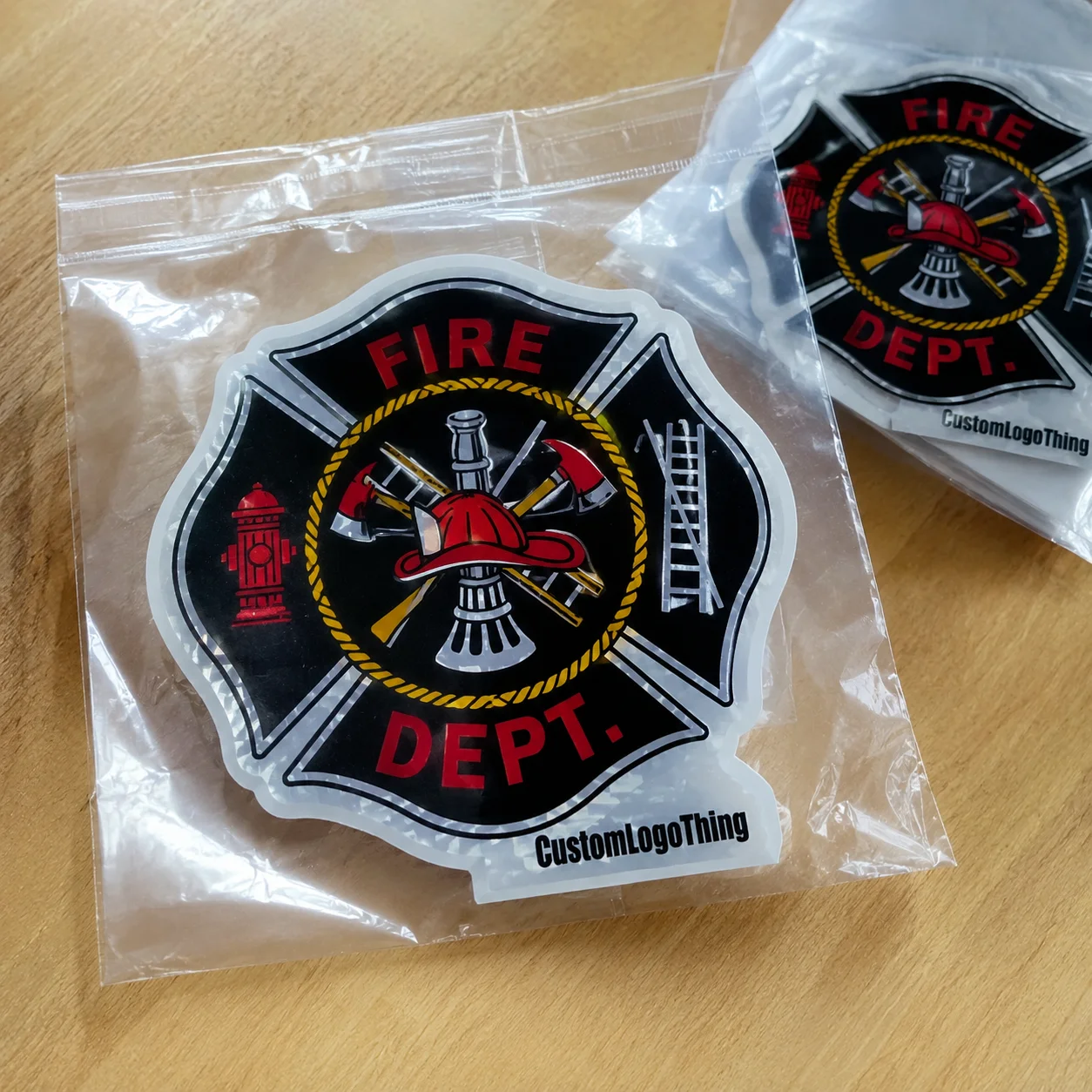
Custom firefighter stickers are printed adhesive decals made for fire departments, volunteer companies, firefighter unions, memorial events, academy classes, apparatus teams, recruiting campaigns, and community programs. They can be functional, promotional, commemorative, or some mix of all three if the design stays under control.
The practical uses come first: helmet locker labels, turnout gear bin IDs, water bottle decals, laptop stickers, car window decals, event giveaways, sponsor appreciation packs, fundraiser merchandise, and station swap stickers. A 3-inch decal can travel farther than a flyer because people keep it. Strange, but true. Paper goes in the trash. A decent sticker ends up on a bottle, toolbox, rear window, or cooler.
There is a real difference between a cheap indoor paper sticker and a durable fire department decal. Paper stickers are fine for envelopes, thank-you cards, short-term packaging inserts, or event handouts that do not need to survive much. They are not built for sun, rain, smoke residue, cleaning, rough handling, or the daily abuse around a station.
For bottles, coolers, lockers, windows, outdoor swaps, and department merch, outdoor-rated vinyl with UV-resistant ink and a protective laminate is usually the safer choice. That combination costs more than paper. It also prevents the awkward outcome where the fundraiser sticker starts fading before the fundraiser is over.
Design styles tend to fall into familiar categories: Maltese cross, department badge, apparatus illustration, mascot, memorial ribbon, shift logo, union local number, recruiting message, anniversary mark, or limited-run trading decal. Familiar is not a weakness. Familiar helps people read the sticker in two seconds, which is the point.
The best sticker is not always the flashiest one. It is the one people can read quickly, peel cleanly, apply without fighting the backing, and reorder six months later without restarting a committee meeting from hell.
How Fire Department Decal Materials and Finishes Work
Material choice drives durability, appearance, and price. Standard white vinyl is the workhorse. It gives strong opacity, clean color, and predictable results on most designs. If the artwork uses red, black, gold, navy, white, or badge-style color blocking, white vinyl usually prints cleanly and keeps the quote sane.
Clear vinyl works well for glass, helmets, and designs where the surface color should show through. It needs more planning. Light colors may disappear unless white ink is printed behind them, and not every shop prices white ink the same way. If a clear decal needs to be readable on tinted glass, dark bottles, or colored helmets, ask for a proof that shows how the white layer will be handled.
Holographic, chrome-style, and reflective-look films can make premium trading stickers feel collectible. They also raise unit cost and can hurt readability if the design is already busy. Specialty film looks best when the artwork has bold shapes and open space. Put a detailed apparatus drawing, three slogans, a flag, flames, and tiny dates on holographic film and the eye has nowhere to land.
Adhesive matters as much as face stock. Removable adhesive is useful for temporary campaigns, event signage, short-term recruiting decals, or stickers that should come off without a long cleanup job. Permanent adhesive is better for lockers, bins, coolers, bottles, and long-term use. Stronger adhesive helps on some tougher surfaces, but stronger is not automatically smarter.
If the decal needs to come off later, aggressive adhesive can leave residue or pull finish from painted surfaces. Nice little surprise for whoever gets cleanup duty.
Finish choices are more straightforward. Gloss makes colors pop and often feels brighter. Matte reduces glare and photographs better under harsh light. Soft-touch can feel premium, though it is usually overkill for rugged station use unless the sticker is sold as higher-end merch or paired with other branded materials.
Lamination is the quiet hero. A clear protective laminate helps prevent scratching, fading, moisture damage, and ink wear from handling and cleaning. If the sticker will be used outdoors or handled often, ask whether laminate is included. Do not assume. Assumptions are how buyers end up comparing one real outdoor decal quote against one cheaper quote for unlaminated indoor stickers.
Shape options include circles, shields, rectangles, Maltese crosses, die-cut silhouettes, and kiss-cut sheets. Kiss-cut sheets are useful for event tables because people can peel stickers quickly without wrestling the backing. Die-cut shapes look more custom, but complex cuts can slow production and increase cost, especially if the outline has tight points or thin protruding shapes.
Buyer callout: Outdoor-rated does not mean magic. Vinyl can handle rain and sun, but it will fail faster if applied to a dirty, wet, oily, dusty, textured, or hot surface.
Curved helmets, textured coolers, powder-coated bottles, car windows, and painted metal all behave differently. Testing one sample beats guessing on a full order. For broader packaging durability language, organizations such as ISTA are useful references for how products and materials are evaluated under transit and handling stress, even though sticker performance depends heavily on surface prep, adhesive chemistry, temperature, and exposure.
Artwork Specs That Make Firefighter Sticker Designs Print Cleanly
Vector files are preferred. AI, EPS, SVG, or a clean print-ready PDF gives the printer scalable lines and sharp edges. High-resolution PNG files can work if the art is already sized correctly, usually 300 dpi at final print size. Screenshots from a group chat are not artwork. Painful truth, but someone has to say it.
Small details are where fire department sticker designs often fall apart. Thin helmet lines, tiny station numbers, long department names, and detailed apparatus art can disappear when reduced to a 2-inch or 3-inch sticker. A badge that looks great on a patch may turn into a red-and-gold blur on vinyl if nobody simplifies it.
Use size with intent. A 2-inch sticker works for helmet lockers, compact gear labels, or small giveaways. A 3-inch sticker is the safest all-around size for swaps, bottles, laptops, and public handouts. A 4-inch sticker feels more premium for fundraising or sponsor packs. A 5-inch or larger decal is better for windows, apparatus-related displays, and designs with more badge detail.
High-contrast color palettes print best. Red, black, white, gold, navy, and reflective-inspired combinations are common for a reason. Subtle gradients may look sharp on a backlit screen and muddy in print. Metallic effects shown on a monitor are not the same as actual chrome or holographic film, so be clear about whether the shine is printed artwork or specialty material.
Bleed, cut lines, and safe zones are not glamorous. They prevent ugly edges. Bleed extends the artwork slightly beyond the cut line. The cut line tells the blade where to trim. The safe zone keeps important text and badge details away from the edge. The blade needs breathing room. It is not a surgeon with infinite patience and a tiny spotlight.
Before proof approval, confirm official badge colors, station number formatting, union identifiers, memorial dates, apparatus numbers, and department spelling. If the official crest has too much detail, create a sticker-friendly version instead of shrinking the entire encyclopedia onto vinyl.
One useful test costs almost nothing: print the proof at 100% scale on office paper, set it on a table, and step back three feet. If the name, number, or central icon cannot be read, the printed sticker will not magically fix it. Screens flatter small details. Real life does not.
Cost, Pricing, and MOQ for Firefighter Decal Orders
Pricing depends on size, quantity, material, finish, number of designs, die-cut complexity, packaging, proofing time, and rush production. Small custom vinyl sticker runs often cost more per unit because setup, proofing, printing, cutting, and quality checks still happen whether the order is 50 pieces or 5,000 pieces.
Many orders start around 50 to 100 pieces. Better unit pricing usually appears around 250, 500, or 1,000 pieces, depending on specs. A single 500-piece design is almost always cheaper than five 100-piece designs because each artwork file needs separate setup and proofing. Printers do not wave a wand over five files and call it one job. Sad, but true.
| Order Type | Typical Specs | Common Quantity | Rough Unit Range | Best Use |
|---|---|---|---|---|
| Budget vinyl decal | 3-inch white vinyl, gloss laminate, simple shape | 250-500 pieces | $0.45-$1.10 each | Giveaways, swaps, bottles |
| Premium fundraiser sticker | 4-inch vinyl, matte laminate, custom die cut | 500-1,000 pieces | $0.55-$1.35 each | Merch tables, station events |
| Specialty film decal | Holographic or chrome-style film, laminate | 100-500 pieces | $0.90-$2.50 each | Trading stickers, limited runs |
| Temporary campaign sticker | Removable adhesive, standard shape | 250-1,000 pieces | $0.40-$1.20 each | Recruiting, awareness campaigns |
Those ranges are not universal quotes. They depend on print coverage, exact size, finishing, proofing needs, and delivery timeline. Still, they give a realistic starting point. If a quote is far lower, check whether laminate, outdoor rating, die cutting, and shipping are included. If it is far higher, ask what spec is driving the cost.
Standard white vinyl with gloss laminate is usually the best value for fire department giveaways and public-facing decals. Holographic film, chrome-style material, custom backing cards, individually packed stickers, or retail packaging add cost fast. Those extras can make sense if the stickers are sold as merch or bundled with Custom Labels & Tags, but they are not necessary for every station giveaway.
Fundraiser math is simple. If a department sells stickers for $3 to $5 each, the best margin often comes from mid-size runs where the unit cost drops without creating boxes of leftovers. Selling 500 stickers at $4 each creates $2,000 in gross sales. If the landed cost is $0.85 each, the sticker cost is $425 before payment fees, table supplies, or event costs. That leaves room to raise funds without gambling on 2,000 pieces nobody has a plan to sell.
For a clean quote, provide size, quantity, material, finish, shape, number of designs, delivery date, and whether the stickers need to be outdoor-rated. If you are comparing quotes, compare the same specs. Otherwise, you are just comparing confusion with different letterheads.
Production Steps, Timeline, and Turnaround Expectations
The normal ordering process has seven steps: Request a Quote, submit artwork, review the proof, approve specs, move into production, complete quality check, then ship. Simple enough. The problems usually start when proofing gets treated like a formality.
The proofing stage confirms size, cut line, spelling, color direction, and placement. Read it slowly. Check every letter, date, station number, apparatus number, union local, and memorial detail. Skipping careful proof review is how typos become 1,000 tiny regrets.
Typical timing varies. A simple standard-vinyl sticker order may need about 5-8 business days in production after proof approval, plus transit. Custom shapes, specialty films, multiple designs, or large quantities can push production closer to 8-15 business days. Rush orders may be possible, but they reduce flexibility, limit material choices, and often cost more because production schedules are not made of elastic.
The clock usually starts after proof approval, not after someone emails a blurry logo and says, “Can you make this cool?” Cute, but no. Artwork cleanup, missing details, slow feedback, and committee review all add time before production even begins.
Shipping variables matter too. Fundraiser dates, department open houses, academy graduations, memorial events, pancake breakfasts, and parade weekends should be shared upfront. A supplier can plan production and transit better if the real deadline is known from the start, not discovered after the order is already boxed.
Build in buffer time. Order earlier than the event date because proof edits, weather delays, and carrier issues do not care about your pancake breakfast. A practical target is to start the quote and artwork process 3-4 weeks before an event for standard stickers, and 4-6 weeks for specialty materials or multiple designs.
Quality Checks Before Stickers Leave Production
Sticker quality control is not dramatic. It is a series of small checks that catch the problems buyers notice immediately: bad cuts, weak color, scuffed laminate, off-center borders, missing pieces, and backing that refuses to peel.
A good production check should confirm the printed size, cut alignment, color consistency, laminate coverage, surface scratches, and quantity count. For kiss-cut sheets, the cut should go through the sticker layer without slicing through the backing. For die-cut singles, edges should be clean enough that the sticker does not look chewed.
Peel testing matters. If a sticker is difficult to lift from the liner, people at an event table will bend the decal, crease the edge, or give up. If the backing splits, the complaint will not be poetic. It will be immediate.
Color should be judged under reasonable lighting, not just a glowing monitor. Fire department reds and golds can shift depending on material and laminate. Exact color matching may require a formal color target or press proof, which adds time and cost. For most decal orders, the practical goal is consistent, approved color direction across the run.
Quantity checks also deserve attention. Short counts are irritating on any order, but they are especially painful before a fundraiser, academy ceremony, or memorial event. If the stickers are being separated into sponsor packs or merch bundles, ask whether they arrive bulk packed, sheeted, individually cut, or banded in smaller counts.
Common Mistakes That Make Firefighter Stickers Look Cheap
Overcrowding is the big one. Badges, axes, flames, slogans, dates, names, trucks, smoke, flags, and three fonts on one 3-inch sticker create visual soup. Nobody wants soup on a helmet.
Unreadable text is next. Long department names, tiny station numbers, thin script fonts, and low-contrast outlines can vanish when printed small or viewed from a few feet away. If people have to squint, the design is doing too much. Cut words, increase size, or simplify the badge.
Poor material matching causes problems that look like print failure but start with the wrong spec. Indoor paper stickers may be fine for envelopes, mailers, or packaging inserts. They are the wrong choice for bottles, coolers, apparatus windows, and outdoor swaps. If the sticker will face weather, handling, or cleaning, use vinyl and laminate.
Weak contrast is sneaky. Red on black, dark gray on navy, or gold gradients on white can look premium on screen and flat in real life. Ask for a proof at actual size. Better yet, print the proof at 100% scale and stand back. Low-tech? Yes. Useful? Also yes.
Ignoring the application surface is another classic. Stickers placed on dusty helmets, wet coolers, oily tools, textured plastic, or hot metal will fail faster, then everyone blames the sticker. Naturally. Clean the surface with the recommended method, let it dry, and apply with firm pressure. Some adhesives need 24-72 hours to build full bond strength.
Copyright and trademark issues can create real headaches. Manufacturer logos, cartoon characters, sports marks, and borrowed artwork should not be used without permission, especially for public fundraisers. If the design is being sold, keep the artwork original or properly licensed.
Ordering too few is the quiet budget killer. Tiny runs feel safe, but if the sticker is for a fundraiser, parade, academy class, mutual aid swap, or sponsor pack, running out early kills momentum and raises reorder costs. If the design is evergreen, order enough to cover the event plus future internal use.
What to Confirm Before You Order Firefighter Stickers
Before asking for pricing, decide the sticker purpose, target surface, preferred size, quantity, material, finish, budget range, and deadline. A supplier can quote faster when the job is defined. “We need some stickers” is not a spec. It is a starting pistol for ten follow-up emails.
Pick one primary use first: fundraiser merch, event giveaway, gear labeling, department branding, or swap sticker. Trying to make one design serve every job usually makes it worse at all of them. A gear label needs clarity. A fundraiser decal needs shelf appeal. A swap sticker needs personality. Those goals overlap, but they are not identical.
Prepare the artwork properly. Gather vector logos, badge references, official colors, spelling approvals, station numbers, union local details, apparatus numbers, and memorial dates before production starts. If the sticker will be paired with custom printed boxes, sponsor kits, or other Custom Packaging Products, keep the package branding consistent so the whole set looks intentional.
Request a digital proof and read it slowly. Check the cut line, size, spelling, small text, color direction, and edge spacing. “Approved” means the printer is about to make exactly what you signed off on. That is not the moment for vibes.
Plan quantity with a little math. Estimate internal use, public sales, swap demand, sponsor packs, and leftovers for future events. If 80 members each want two stickers, that is 160 gone before the first public sale. Add event sales, donor packets, and replacements, then choose the run size. For many departments, 250-500 pieces is the practical starting range for a public-facing design.
Ask targeted supplier questions: Is the sticker outdoor-rated? Is laminate included? What is the MOQ? What file format is preferred? When does production time start? What happens if the proof needs revision? Can the adhesive handle the intended surface? For sustainability questions around paper-based backers or related materials, the Forest Stewardship Council is a useful reference when buyers care about responsible sourcing across print and packaging materials.
Ordering custom firefighter stickers gets easier when the design, material, quantity, surface, and deadline are decided before the quote request. Do that work upfront and the order becomes cleaner, faster, and far less annoying for everyone involved.
FAQ
What size should custom fire department stickers be?
For most giveaway and swap stickers, 3 inches is the safest all-around size. Use 2 inches for small gear labels, helmets, or tight surfaces. Use 4 inches or larger for fundraising stickers, window decals, or designs with more badge detail. If the design has small text, size up or simplify the artwork before printing.
Are firefighter helmet stickers the same as regular vinyl stickers?
Not always. Helmet use needs careful material and adhesive selection because curved surfaces, heat exposure, cleaning chemicals, and department rules can affect performance. Ask for outdoor-rated vinyl with laminate if the sticker needs durability. Confirm whether your department allows decorative helmet decals before ordering, and test one sticker on the intended surface before buying a large run.
How much do custom firefighter decals usually cost?
Pricing depends on size, quantity, material, finish, shape, and number of designs. Smaller runs have a higher unit cost because setup and proofing are spread across fewer stickers. Standard vinyl with gloss or matte laminate is usually the best value. Specialty films, custom packaging, rush production, and multiple designs increase the quote.
How long does it take to make fire station stickers?
The timeline usually includes quoting, artwork review, proof approval, production, quality check, and shipping. Production time typically starts after the proof is approved, not when the first email is sent. Simple standard-vinyl orders move faster than specialty finishes or complex die-cut shapes. Share event dates upfront so the supplier can flag rush options or timeline risks.
What artwork file is best for custom firefighter stickers?
Vector files such as AI, EPS, SVG, or print-ready PDF are best for clean edges and scalable logos. High-resolution PNG files can work if the design is already the right size and quality. Low-resolution screenshots, social media images, and photos of patches usually need cleanup. Always review the proof closely for spelling, colors, cut lines, and small text readability.


