Small packaging choices have a habit of showing up everywhere else. A 1 mil change in film thickness affects puncture resistance, pack-out speed, and cost. A wider seal can reduce failures. Cleaner print can make a product look finished instead of improvised. That is why custom flat poly bags are more than basic commodity packaging. They influence protection, presentation, and labor in the same move.
Buyers usually compare them with stock bags, paper alternatives, or loosely specified flexible packaging. That comparison is useful, but the real question is simpler: does the bag fit the product, the line, and the brand without creating extra handling? If it does, it earns its place. If it does not, it becomes a very ordinary source of waste.
What custom flat poly bags are—and why they outperform loose packaging
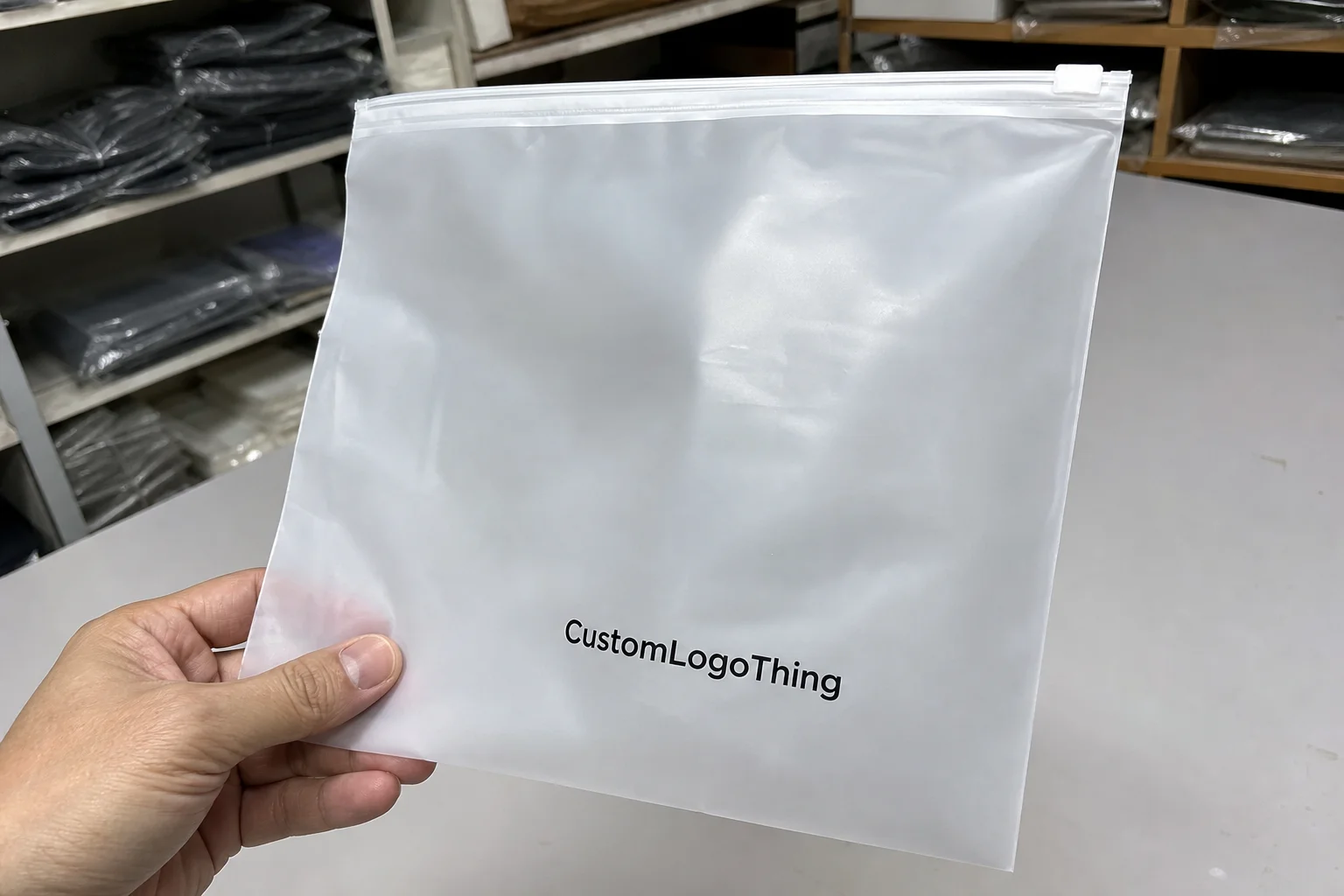
Flat poly bags are polyethylene bags with no side gussets. They are flat, heat-sealable sleeves used to protect products from dust, moisture, scuffing, and casual handling damage. A stock bag is made in fixed sizes and thicknesses. A custom bag is made around product dimensions, print needs, handling conditions, and often a specific shipping method. That difference sounds small. It usually is not.
Loose packaging tends to create small inefficiencies that stack up. Operators fold, tape, stuff, or rework. Products with sharp corners fight the packaging. Oversized bags look sloppy and can shift during transit. Undersized bags slow the line and put stress on seals. Well-specified custom flat poly bags reduce that friction. They are especially useful for apparel, printed inserts, hardware, samples, and e-commerce kits where the package needs to look tidy without adding much weight.
They also fit into broader Custom Packaging Products programs when a brand wants a consistent visual system across multiple SKUs. Flat bags are often the quiet part of the packaging mix, but they still affect how the product lands with the customer.
In retail settings, clarity and fit matter more than people expect. A clean bag can make an item look deliberate. A bad one makes even a good product feel second-tier. That is not dramatic. It is just how packaging works.
One practical advantage is control. With custom spec bags, you can define size, thickness, print, seal strength, and special properties such as anti-static or venting. That gives buyers tighter product packaging control than grabbing stock sizes and hoping for the best. It also helps with package branding, because the bag can support the look of the product instead of interrupting it.
How the manufacturing process works
Most production starts with polyethylene resin selection. The film may be made from low-density polyethylene, linear low-density polyethylene, or a blend, depending on clarity, flexibility, and puncture requirements. After extrusion, the film is formed into flat sheet or tube stock, then cut to length, sealed, printed if required, and packed for shipment. The process is straightforward on paper. Quality depends on the details.
Film structure matters. A clearer film can improve retail visibility. A tougher blend can resist puncture better. A softer film may open more easily on the packing line. None of those choices is free. Better clarity can reduce opacity. Higher toughness can change the hand feel. Every spec changes something else.
Seal design is one of the most overlooked variables. Narrow seals save a little material, but they can be less forgiving on sharp-edged contents or during compression in transit. Wider seals generally provide more durability and better leak resistance. For products that will be packed tightly in cartons or handled repeatedly, that extra seal width often pays for itself.
Printing method also affects the result. Flexographic printing is common for recurring runs and straightforward artwork. It is efficient once the setup is locked in. Rotogravure is usually reserved for high-volume jobs where cylinder cost can be justified by long production cycles and consistent image quality. Digital printing has a place in short runs, prototypes, and changing artwork, but unit cost tends to be higher. The method should match the order profile, not the other way around.
Artwork approval can make or break the schedule. Clean files, exact dimensions, and defined color expectations reduce revision loops. Vague instructions create delays. If the bag needs a vent pattern, anti-static treatment, specific opacity, or a matte versus gloss finish, that should be stated early. Those choices can affect film selection, print setup, and testing.
“The least painful production runs usually share the same trait: final specs, final artwork, and one person who actually owns the approval.”
Display applications usually lean toward clarity and gloss. Privacy-oriented or industrial applications may call for tinted or opaque film. Some electronics packaging needs anti-static properties. Some contents need venting to release air or moisture. These are functional choices, not decorative extras.
That same logic applies across flexible packaging categories, including Custom Poly Mailers. Start with the use case. Then specify the package.
Key specs that change performance, appearance, and cost
Film thickness is one of the biggest cost and performance drivers. Gauge, often described in mils for flexible packaging, affects puncture resistance, flexibility, and resin usage. Thin film lowers material cost and can be easier to handle. Thicker film resists damage better, but it also increases price and can make the bag stiffer. More thickness is not automatically better. It just costs more unless the product actually needs it.
Size matters just as much. A bag should allow easy insertion without creating a lot of empty space. Too much slack looks sloppy and lets the product shift. Too little room makes packing slower and puts stress on the seal. The better sizing approach is usually simple: measure the product at its widest and thickest points, then add enough margin for insertion, seal area, and any corners, folds, or hardware. Rigid items need more allowance than soft goods.
Clarity, gloss, and slip are easier to ignore than they should be. High clarity improves visibility for retail packaging. Gloss can sharpen print contrast. Slip affects how the bag opens and runs through the line. If workers have to fight the opening, throughput slows down. That labor cost can exceed the packaging savings very quickly.
Closure style matters too. Heat seal is standard for most flat poly bags. Some applications call for resealability, perforation, or a specific seal configuration. If the bag is meant to be opened once and discarded, simplicity usually wins. If it must be reopened or stored after opening, the closure spec needs to support that use.
Compliance becomes more relevant for food-adjacent products, regulated items, and anything that carries environmental claims. If the bag touches food-contact items, verify the material suitability and documentation. If recycled content or sustainability claims are part of the pitch, ask for the exact basis of the claim. “Eco-friendly” is not a specification. It is usually marketing wearing a fake mustache.
For shipping and distribution testing, many buyers reference guidance from the International Safe Transit Association. For recycling and waste context, the EPA’s guidance remains a useful reference point: EPA recycling guidance.
| Specification | What it changes | Buyer impact |
|---|---|---|
| Film thickness | Durability, puncture resistance, resin usage | Higher gauge usually costs more but may reduce damage |
| Dimensions | Fit, pack-out speed, visual appearance | Incorrect sizing can slow packing and create waste |
| Print coverage | Brand visibility, ink usage, setup complexity | More print often means higher cost and longer proofing |
| Seal type | Ease of use, security, leak resistance | Must match the product’s handling and storage needs |
| Add-on features | Anti-static, vented, recycled content, special inks | Useful only if the use case justifies the added cost |
Custom flat poly bags pricing, MOQ, and unit cost
Pricing comes down to a handful of variables: bag size, film thickness, resin type, print colors, order quantity, and any special processing. Larger bags use more material. Thicker films use more resin. More print colors add setup time and proofing. Double-sided printing usually adds more complexity than a one-side job. Nothing mysterious there. Just packaging math.
For rough planning, lower-volume custom runs often carry a noticeable setup premium. A small order can land somewhere around $0.20 to $0.45 per unit depending on dimensions, thickness, and print coverage. Larger repeat runs can come down materially once setup is spread across more pieces. That range is not a quote. It is a reality check. A run of 2,500 units and a run of 25,000 units do not live in the same cost world.
Minimum order quantity exists because converting and printing are process-heavy. Machines must be set up, film staged, artwork checked, and output inspected. If the order is too small, setup costs dominate the economics. For buyers, the smarter approach is to estimate annual consumption, reorder cadence, and storage space before asking for numbers. Otherwise the budget looks fine on paper and then rush freight shows up with a bill.
Some costs are obvious. Others creep in. Rush timing, premium resin, extra proof rounds, special inks, venting, anti-static treatment, and custom slitting can all move the price. A calm lead time is almost always cheaper than an emergency one. Packaging vendors did not invent this. Production schedules did.
A simple order-profile comparison helps frame the tradeoff:
| Order profile | Typical cost behavior | Best use |
|---|---|---|
| Short run | Higher unit cost due to setup and proofing | Launches, seasonal products, testing demand |
| Mid-volume run | Balanced cost and flexibility | Growing SKUs, recurring promotional packs |
| High-volume run | Lower unit cost, more planning required | Established packaging programs with stable demand |
If the budget is tight, start with minimal print coverage. A clean one-color logo on a clear bag can look intentional and professional. Many brands do not need full-surface print immediately. They need enough branding to support recognition and enough performance to protect the product.
Process, timeline, and turnaround: from quote to delivery
The usual path runs through seven steps: spec gathering, quote, artwork proof, approval, production, inspection, and shipping. Each step can move quickly or drag depending on how complete the information is at the start. A quote built from exact dimensions, film requirements, print detail, and quantity is usually faster and more accurate than one based on a product photo and hope.
Lead time depends on whether the job is a repeat, whether custom converting is needed, and how complex the print is. Straightforward jobs with final artwork can move faster. New sizes, premium films, or multi-color print usually take longer. For many custom orders, 12 to 20 business days from proof approval to shipment is a realistic planning window, though that varies with factory load and shipping method. Transit time is separate. Plenty of buyers forget that until the dock starts asking questions.
Speed also depends on the customer side. Prompt approval, clean files, and final dimensions can shave days off the schedule. Delays usually come from open questions, not the pressroom. If a launch date matters, ask for a written schedule that includes proof timing, production window, and transit assumptions. “We’ll try” is not a plan.
Inventory planning makes a bigger difference than most people admit. A small safety stock can reduce emergency freight, protect seasonal launches, and keep the packing line moving. It is not glamorous. It is cheaper than a missed ship date. The same discipline applies to custom printed boxes and other packaging components: the lowest unit cost does not matter if the package arrives too late to use.
If your packaging system includes cartons, inserts, mailers, and flat bags, keep the timing aligned across all components. Packaging is not finished when the bag is approved. It is finished when every piece lands on time and the line can actually pack.
Common specification mistakes that create waste
Undersizing is the most common mistake. It sounds efficient until the pack-out starts. A bag that is too tight slows insertion and increases seal stress. A bag that is too loose looks careless and can let the product shift in transit. Either way, the package works harder than it should.
Overbuilding is the next trap. Some buyers specify thicker film because thicker sounds safer. Sometimes that is the right call. Often it just increases cost without addressing the real risk. If a product has sharp corners, fix the sizing and geometry first. Then decide whether the film needs to be heavier.
Artwork problems are another predictable source of waste. A logo that looks fine on a screen can print too faintly on film. A barcode can land across a fold or seal. Small text can disappear. Proofs should be checked for dimensions, contrast, and machine readability, not just whether the layout looks decent at a glance.
Bag opening behavior deserves more attention than it gets. If workers have to pry the bag open, line speed drops and labor cost climbs. That is not a packaging issue in isolation. It is an operations issue caused by packaging. The bag should support the process, not force the process to work around the bag.
Then there is the internal mismatch problem. Marketing wants visual impact. Operations wants speed. Procurement wants a lower number. If those groups do not agree before the order is placed, the first run will expose the gap. That happens more often than anyone wants to admit, especially with branded packaging where appearance and function have to coexist.
Expert buying tips and next steps for better results
The fastest way to get better quotes is to build a spec sheet before talking to suppliers. Include dimensions, film thickness, color count, print area, quantity, product type, closure preference, and any special requirement such as anti-static or venting. Vendors can only compare apples to apples if the apples are described clearly. Vague requests invite vague pricing.
When the bag is facing retail display, moisture exposure, or shipping stress, ask for samples or a pre-production proof. A paper proof helps with layout, but it does not show how the film opens or how the print looks after handling. For a package that has to protect the product and support retail packaging, a real sample is usually worth the extra step.
If budget is tight, keep print coverage lean until demand is proven. A clean logo, the right bag size, and a sensible film choice can carry a brand further than many buyers expect. Then scale up. That is usually smarter than over-designing the package before the product has stable volume.
Storage matters too. A larger run lowers unit cost only if the bags can be stored safely and used before the design changes. This is where buyers of custom flat poly bags can borrow a lesson from corrugated and mailer programs: cheap inventory is not cheap if it sits, warps, or goes obsolete.
For sustainability-minded teams, ask for documentation instead of assuming every claim means the same thing. If a supplier mentions FSC, recycled content, or a similar certification, verify what applies to the actual material and format. FSC is relevant for paper-based packaging, while flexible poly materials need their own documentation and claim boundaries. For reference, FSC maintains a certification overview at fsc.org.
Next steps: measure the product, define the packaging goal, gather artwork, and request quotes from at least two suppliers. Compare price, lead time, proof process, and the quality of the spec sheet you receive back. That is the difference between buying packaging and buying a problem.
Done well, custom flat poly bags support cleaner pack-outs, better presentation, and fewer shipping headaches. Done loosely, they turn into another quiet line item that creates waste. The spec decides which version you get.
What are custom flat poly bags best used for?
They work well for flat or low-profile products that need dust protection, moisture resistance, and a clean branded presentation. Common uses include apparel, printed materials, small parts, and e-commerce packing inserts.
How do I choose the right size for custom flat poly bags?
Measure the product at its widest and thickest points, then add enough tolerance for easy insertion and sealing. If the item is rigid or has sharp corners, allow extra room to reduce stress on the seal and film.
What affects the price of custom flat poly bags the most?
Size, film thickness, print colors, order volume, and special features usually have the biggest impact. Setup and proofing can raise the first-order cost, while larger runs typically lower the unit cost.
How long does the process usually take for custom flat poly bags?
Timing depends on whether artwork is ready, how complex the print is, and whether the order requires custom converting. Prompt proof approval and final specs usually shorten lead time the most.
Can custom flat poly bags be printed on both sides?
Yes, many buyers choose one-side or two-side printing depending on branding needs and budget. Double-sided print increases setup complexity and often raises the unit cost, so it should be tied to a clear display goal.

