Custom jute tote bags look uncomplicated until you specify one. Then the details appear fast: weave density, handle reinforcement, print method, lining, gusset depth, and how much variation you can tolerate before the bag stops feeling premium. The logo matters, but it is only one line item in a longer buying decision. The real question is whether the bag carries weight, looks intentional, and survives the trip from factory to shelf.
Jute has a specific visual language. It reads natural, textured, and slightly rustic, which is useful for retail packaging, gift programs, food brands, boutique merch, and event kits that need more presence than a disposable promo bag. It also has limits. Fine text can disappear into the weave. Soft gradients can look muddy. If the artwork depends on photography or micro-detail, the material will punish the design rather than support it.
That is why custom jute tote bags should be treated as packaging with a second life, not as a printed surface with handles. They need to work at handoff, in transit, on a shelf, and again when the customer carries them a week later.
What Custom Jute Tote Bags Are Really For
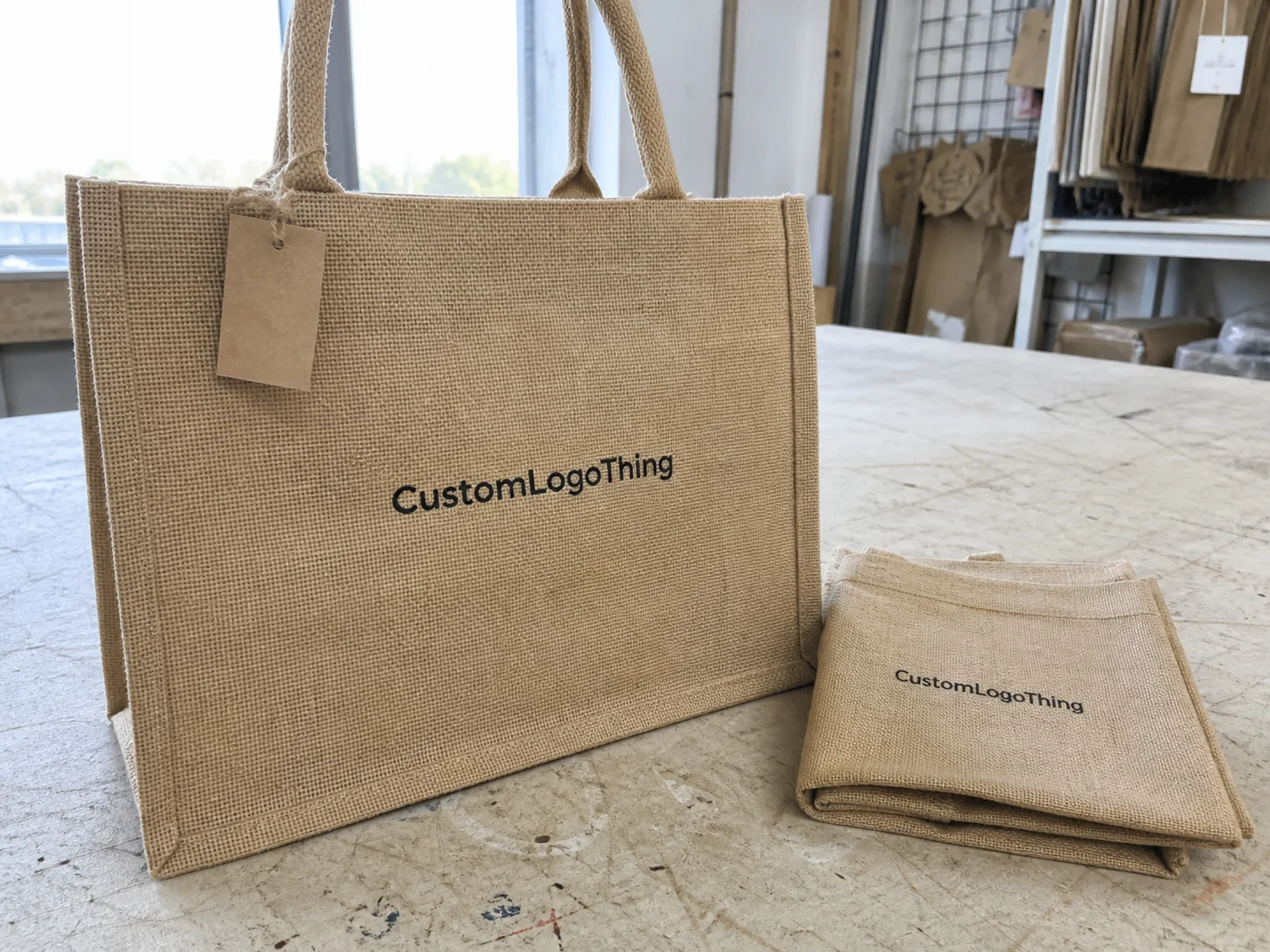
Jute is a coarse natural fiber spun into yarn and woven into fabric with a visible grid and a firm hand feel. That structure is doing most of the visual work. It is what gives the bag body, helps it stand upright, and makes it feel more substantial than a soft cotton tote or a thin nonwoven giveaway bag.
For buyers, the best use cases are usually practical. Retail packaging for apparel, candles, and home goods. Gift bags for higher-value purchases. Trade show bags that people keep instead of discarding. Food brands that want a farm-direct or artisan tone. Small merch runs where the bag itself carries part of the brand story.
Jute is less forgiving than smoother substrates. The weave can blur tiny typography. It can also make dense artwork look overcrowded, especially if the design uses too many colors or relies on subtle tonal shifts. If the bag is expected to look crisp from two feet away, the design should be simplified before production starts. That is not a stylistic preference; it is a material constraint.
There is one more point worth stating clearly. Jute brings visual value, but not every order needs the same level of finish. Some brands should keep the look raw and direct. Others need lining, reinforcement, or a cleaner interior because the bag is part of a premium retail experience. The right spec depends on channel, price point, and what the customer will actually do with the bag after purchase.
- Best for: retail packaging, gifts, event bags, premium handouts, and branded carry solutions.
- Not ideal for: photo-heavy artwork, tiny text, ultra-low-cost giveaways, and designs that rely on smooth color blends.
- Typical feel: structured, textured, durable, and visibly natural.
Compared with custom printed boxes, jute bags do a different job. Boxes protect and present. Jute bags present, travel, and keep being seen. That repeat visibility is part of the value, which is why the build quality matters more than buyers sometimes expect.
Production Steps and Timeline for a Jute Tote Order
A tote order is not complex, but it does have a sequence. Quote, spec confirmation, artwork setup, proof approval, sampling if needed, bulk production, inspection, packing, and shipping. Every delay usually comes from one of those steps being vague or under-specified. The factory can only move as quickly as the brief allows.
Lead times vary by supplier, country of origin, print method, and whether the bag is a standard build or a custom configuration. A straightforward quote may take 1 to 3 business days if the dimensions, artwork, and quantity are clear. Sampling often runs 5 to 10 business days for a basic bag, longer if the order includes lining, zippers, special closures, or unusual finishing. Bulk production commonly falls in the 15 to 30 business day range after proof approval. Shipping adds its own variable, and international freight can extend the total timeline by weeks rather than days.
The slowdowns are predictable. Missing artwork files. Changes after proof approval. Requests for color matching that were never defined. Added pockets, zippers, or lining after the quote. Peak season congestion. None of these are mysterious. They just cost time.
There is a useful rule for buyers working toward a launch date: add a buffer of at least 10 to 14 days beyond the factory promise. That is not pessimism. It is scheduling with real shipping in mind.
- Request the quote with complete specs.
- Send vector artwork and color references if color accuracy matters.
- Review the proof or sample carefully.
- Freeze the spec before production starts.
- Confirm packing method, carton count, and shipping terms.
- Check inspection and dispatch timing before final shipment.
If the bags are tied to a store opening, a seasonal launch, or a trade show, treat them like product packaging rather than an accessory. People judge the bag as part of the brand experience, not as an isolated object. That is especially true when the tote is the last thing they receive at checkout or in a gift bundle.
Pricing, MOQ, and What Drives Unit Cost
Pricing for custom jute tote bags moves with size, material weight, construction, and decoration. A plain medium tote with one-color printing sits at a very different price point than a lined, laminated bag with embroidery, a zipper closure, and a custom inner pocket. Those differences sound obvious in theory, but buyers still compare quotes as if every tote starts from the same template.
The biggest cost drivers are usually fabric weight, bag size, gusset depth, handle type, print area, number of colors, lining, and finishing details. Heavier material uses more fiber. Reinforced stitching adds labor. A base board helps the bag stand upright, but it also adds components. Laminated interiors and custom closures change the production process and slow throughput. Even packing format can matter if the order includes individual polybags, inserts, or branded sleeves.
MOQ changes the unit rate because setup costs do not shrink just because the order is small. Screen preparation, pattern cutting, proofing, and machine setup all have to be paid for somewhere. A 300-piece order will almost always cost more per unit than a 5,000-piece order, even if the bag looks nearly identical from a distance.
A quoted unit price is not the full price until freight, duties, carton packing, and final delivery are included. Compare landed cost, not just the factory rate.
| Spec Choice | Typical Unit Cost Impact | What You Get | Best For |
|---|---|---|---|
| Simple jute tote, one-color print | $1.10-$1.80 at 5,000 pcs | Basic structure, clean branding, lower setup burden | Retail handouts, events, budget-conscious launches |
| Lined tote with gusset and reinforced handles | $1.70-$2.70 at 3,000 pcs | Better shape, better carry comfort, more premium look | Gift retail, lifestyle brands, repeat-use bags |
| Embroidery or patch detail | $2.50-$4.50 at 2,000 pcs | Higher perceived value and stronger tactile branding | Boutique merch, premium gifting, small collections |
| Small MOQ order | $3.50-$7.00 at 100-300 pcs | More flexibility, less commitment, higher per-unit cost | Testing a design, pilot launch, short seasonal run |
Those ranges only make sense if the spec is truly identical. A lighter fabric, simpler handle, smaller print area, or bulk packing can make a quote look cheaper without making it comparable. Buyers get burned when they compare number to number instead of spec to spec.
For sustainability-related programs, ask for documentation on the components, not just the bag. Inserts, hang tags, sleeves, and cartons can often be specified with FSC-certified paper stock. If the order will move through retail distribution, transit durability matters too. Testing standards from organizations such as ISTA are useful when the packaging has to survive compression, stacking, and rough handling before the tote ever reaches the customer.
The same logic applies to timing and cost. A low quote can become expensive once rework, freight upgrades, and damaged cartons enter the picture. That is usually where first-time buyers lose budget. The bag itself was not the problem. The spec was incomplete.
Choosing Size, Handles, Construction, and Print
Size should follow use. A compact tote works for event kits and light purchases. A medium tote is the safest default for retail because it handles apparel, books, candles, and bundled gifts without looking oversized. Larger gusseted bags make sense for grocery-style use, bulkier products, or orders where the contents are boxy and need more room. If the tote must carry a box, measure the box first and leave room for seam allowance and handle drop.
Handles affect both comfort and perceived quality. Short handles can feel neat, but they are less versatile when the bag is full. Longer webbing handles distribute weight better and tend to feel more useful in daily carry. Jute handles keep the material story consistent, although cotton webbing often feels softer in hand and reduces friction. Reinforced anchor stitching is worth paying for if the bag will be used more than once.
Construction changes the bag’s behavior. A gusset improves capacity and keeps the profile cleaner. A base board helps the bag stand up on a counter. Lining reduces loose fibers and gives the interior a more finished appearance. Lamination can improve surface consistency, but it also changes the tactile character of the bag. If the brief is meant to feel organic, overfinishing it can erase the appeal that made jute attractive in the first place.
Printing is where most bags either succeed or become awkward. Screen printing is the safest option for bold logos, flat colors, and strong contrast. Heat transfer works when the design needs more detail, though it can feel less integrated on rough fabric. Embroidery delivers a premium tactile effect, but it is not suitable for tiny logos or oversized filled areas. Sewn patches can be strong when the brand wants a more crafted look and can accept a slightly more complex build.
- Bold logo: screen printing.
- More detail: heat transfer or a sewn patch.
- Premium tactile effect: embroidery, if the logo is large enough.
- Natural look: simple graphics, restrained ink coverage, and enough contrast to survive the weave.
The weave will not hide a weak design. It exposes one. On jute, clean lines and moderate text size usually outperform clever artwork with too many moving parts. That is a material truth, not a design preference.
Step-by-Step Checklist for Ordering Without Delays
Begin with the facts before asking for pricing. Quantity. Intended use. Target size. Delivery deadline. Ship-to location. Budget range. If you can answer those six points, the supplier can usually quote something meaningful instead of guessing and revising later.
Artwork should be prepared for production, not just presentation. Vector files are the cleanest option. If color matters, include Pantone references or an equally specific color target. Mark no-print zones such as seams, zippers, and handle anchors before proofing begins. If placement matters, say it in measurements. “Centered on front panel, 40 mm below top seam” is a specification. “Make it look good” is not.
Sampling deserves attention when the bag is part of retail packaging or a premium bundle. A photo can show proportions, but it cannot tell you how the weave feels, whether the handle sits comfortably under load, or whether the seam line is straight across both panels. Physical samples catch problems that screens miss.
Once the proof is correct, stop changing the spec. No casual edits to size, handle length, print color, packing style, or closure type. Each change forces a new check and adds risk. Small changes on paper can become meaningful disruptions in production.
- Write a one-page spec sheet.
- Attach artwork files and color references.
- Ask for two quote tiers: lean spec and premium spec.
- Confirm lead time in writing.
- Review the final proof line by line.
- Lock carton count, pack format, and ship marks.
Ask how the bags will be packed if they are being stored, distributed, or sold alongside other items. Individual polybags can preserve cleanliness and print quality, but they add cost and plastic. Bulk packing reduces packaging waste and freight volume, but it may not suit retail presentation. The right answer depends on the channel, not on a generic best practice.
If the tote is part of a larger launch kit, align it with the rest of the packaging system so the presentation feels deliberate. That is where Custom Packaging Products can sit alongside the bag without creating visual noise. A good kit reads as a system. A poor one looks assembled in a hurry.
Common Mistakes That Make Tote Orders Cost More
The first mistake is overcomplicated artwork. Tiny text, hairline rules, and soft gradients are a poor match for coarse natural fabric. They either print badly or force the supplier into a more expensive process. If the artwork only works on a high-resolution screen, it probably will not work on jute.
The second mistake is spec drift. A buyer requests a quote for one size, then changes the handle, then adds a gusset, then asks for a zipper, then questions the revised price. That is not a minor adjustment. It is a different product.
The third mistake is comparing quotes without checking what the price includes. Does it cover sampling? Freight? Duties? Individual packing? Color limits? Lining? Sometimes the cheapest quote is only cheap because half the project is missing from the line item.
The fourth mistake is expecting natural fiber to behave like synthetic fabric. Jute has normal variation in color and texture. Slight differences are part of the material. If a buyer wants every panel to match perfectly, the spec needs to acknowledge the limitation instead of pretending it does not exist. The correct control points are size, stitch quality, print placement, and overall construction consistency.
If the bag must feel premium, protect the details customers can see and touch: print clarity, seam quality, handle comfort, and consistent sizing.
One more issue is often ignored until the shipment arrives: outer carton quality. A good tote can still arrive flattened, dirty, or creased if the packing plan is weak. The bag is part of the experience, but the transit plan protects the experience. That is why shipping tests and carton specifications belong in the conversation early, not after a claim has to be filed.
There is also a hidden cost in unclear expectations. If the buyer wants a rustic finish, then a few natural irregularities are acceptable. If the buyer wants a polished retail product, then the supplier needs stricter checks on trim, stitching, and alignment. Those are different standards. Mixing them creates frustration on both sides.
Expert Tips and Next Steps Before You Request a Quote
If the tote will be sold, merchandised, or handed out as a premium item, order a physical sample. Not a mockup. Not a render. A real sample. Texture, stitch quality, print density, and handle feel are only obvious in hand. That is the difference between a bag that looks acceptable online and one that actually feels worth keeping.
When comparing suppliers, compare identical specs only. Same size. Same fabric weight. Same handle style. Same print method. Same packing. If one quote comes in dramatically lower, there is usually a reason: thinner fabric, weaker handles, simpler finishing, or a less demanding production standard. Cheap is easy. Comparable is harder.
Rank your priorities before sending the request. Lowest unit cost. Fastest delivery. Strongest construction. Best print quality. Pick the top two. If all four are treated as equally important, the brief loses precision and the quotes will reflect that. Buyers often want every benefit at once; suppliers usually need a hierarchy.
For procurement teams, the broader packaging decision matters too. Sometimes custom jute tote bags are the right choice. Sometimes a cotton bag is better. Sometimes a rigid box with branded inserts does a stronger job for the margin and the channel. The correct packaging format is the one that fits the customer journey, not the one that sounds best in a meeting.
For a quote that can actually be used, send the essentials in one note:
- Quantity: target run size and any backup quantity.
- Specs: size, handle length, gusset depth, lining, closure, and print side.
- Artwork: vector file, colors, and placement notes.
- Timing: delivery date and destination.
- Budget: preferred range or ceiling.
Then ask for one proof, one revised quote if needed, and a clear lead time commitment. That is enough to move the order without turning it into endless back-and-forth. Keep the spec tight, and custom jute tote bags are straightforward to source, durable in use, and capable of carrying a brand without looking disposable.
What size custom jute tote bags should I order for retail?
Choose the size based on the tallest product you need to fit, not the average item. Medium bags are the safest default for most retail uses because they handle apparel, gifts, and bundled purchases without looking oversized. Leave room for handle drop and gusset depth so the bag carries well instead of bulging at the seams.
Are custom jute tote bags strong enough for groceries?
Yes, if you specify a heavier weave and reinforced handles. They work best for dry goods, produce, bread, and lighter household items rather than very heavy liquids or sharp-edged products. Ask the supplier for stitch and load guidance instead of judging only from a photo.
What print looks best on custom jute tote bags?
Bold logos and clean shapes usually look best because the weave is naturally textured. Screen printing is the safest choice for simple branding, while embroidery or a patch can look more premium. Very fine text and soft gradients are risky unless the supplier has already proven the result on similar material.
How long does a custom jute tote bag order usually take?
The timeline depends on proofing, sampling, production volume, and shipping method. Simple orders move faster when the artwork is clean and approvals are quick. International freight and peak-season factory schedules can add meaningful time, so a buffer is wise.
What should I send to get an accurate quote for custom jute tote bags?
Send target quantity, size, handle style, print method, artwork files, and delivery deadline. Include the destination country or ZIP code because freight changes the real cost materially. If you already know your budget ceiling, include that too; it prevents vague pricing and wasted rounds of revision.

