A custom leather box is not just a container with a nicer surface. It is rigid presentation packaging with a leather or leather-look wrap, a built structure underneath, and enough finishing work to make the whole thing feel deliberate. That usually means board, wrap, lining, insert, closure, and logo treatment all have to work together. If one part is off, the box looks expensive in the quote and cheap in the hand.
Buyers usually discover that the hard way. They compare two samples that look similar in photos, then wonder why one costs twice as much. The answer is usually not mysterious. One box has a basic shell and a simple insert. The other has tighter board tolerances, better corner wrapping, a cleaner closure, and finishing that does not fall apart after a few test cycles.
The box matters because it does three jobs at once. It protects the product. It creates the unboxing experience. It signals value before the lid opens. That is why the best quote is the one that separates structure, material, and branding instead of hiding everything behind one neat number.
“The cheapest quote is usually the one that left out half the box.”
What a Custom Leather Box Really Is
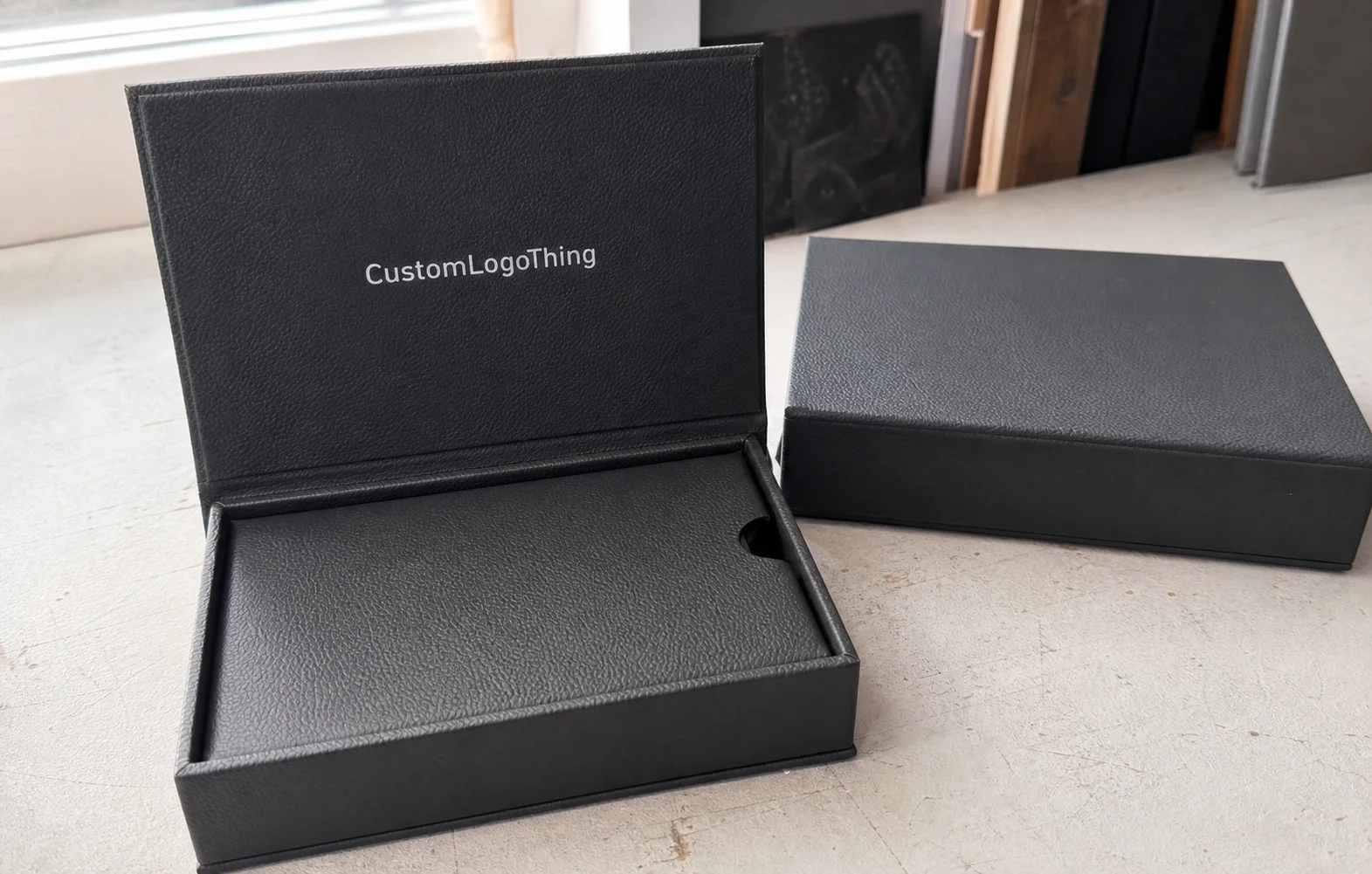
A custom leather box is typically a rigid lid-and-base, magnetic closure, or hinged presentation box wrapped in leather, bonded leather, PU, or another leather-like material. The outer wrap gets attention, but the substrate does the heavy lifting. Most builds use greyboard or chipboard in the 1.5 mm to 3 mm range, depending on size, weight, and how much crush resistance the package needs.
That core matters more than most buyers expect. Thin board can feel light and neat, but it also dents faster and gives the box a softer edge profile. Thicker board adds stiffness and a more substantial feel, although it can make corners harder to wrap cleanly if the design is tight. There is always a tradeoff. Nothing is free, especially not premium packaging.
These boxes show up in luxury gifting, jewelry, watches, cosmetics, executive sets, and branded presentation programs where the package is part of the product story. They also show up in retail packaging programs that need a more permanent feel than a folding carton can offer. A rigid leather-style box sits closer to presentation packaging than ordinary shipping packaging. If the box is expected to live on a desk or shelf after opening, the structure has to justify that role.
The visible wrap can be real leather, bonded leather, PU leather, or a textured synthetic surface designed to mimic leather grain. Those materials do not behave the same way in production. Real leather gives natural variation and a distinct hand-feel. PU and similar synthetics are easier to color-match, easier to scale, and usually more predictable across a run. Bonded leather can look good on paper, but the wear profile and edge behavior may not match what the buyer expects from a premium keepsake piece.
For teams sourcing broader packaging programs, a Custom Packaging Products range can help compare leather-style presentation boxes against other rigid formats without forcing one structure to do every job.
Structure, Insert, and Closure Details
The structure usually starts with a rigid board shell, then moves to wrap application, corner turning, and assembly. That sounds simple. It is not. Clean corners depend on wrap thickness, glue behavior, board edge precision, and how much tension the operator can hold without pulling the material out of alignment. On a narrow box or a small lid, this gets harder fast.
Inserts are where function either gets solved or ignored. A product can sit loose in a box and still look acceptable in a mockup. Once shipping starts, loose products move, scuff, and eventually complain through damage claims. Foam, EVA, flocked trays, die-cut board inserts, and formed paperboard each serve different needs. EVA is better for heavier items and more exact cutouts. Flocked trays feel softer and more giftable. Paperboard is usually lighter and cheaper, but it can wear faster if the item is removed often.
A few practical points matter here:
- Clearance: the cavity needs room for lining thickness and product removal, not just the product dimensions.
- Retention: the item should not rattle, slide, or sink too deeply into the insert.
- Wear: repeated opening should not shave foam, crease the lining, or loosen the fit.
- Shipping: if the box ships with product inside, compression and vibration need to be part of the design, not an afterthought.
Closure style changes both the customer experience and the manufacturing burden. Magnetic lids are popular because they feel controlled and clean. They are also unforgiving if magnet placement is off by even a small amount. Lift-off lids are straightforward and dependable, but they can feel less refined unless the fit is precise. Hinged boxes read as more gift-like and more permanent, though they need tighter alignment and usually more hand assembly. Ribbon ties are visually soft and good for lighter presentation sets, but they are not the first choice for transport-heavy programs.
None of those options is universally best. A good packaging spec starts with the product, then picks the closure based on use case. If the box is for repeated opening on a vanity or desk, a hinge may make sense. If the box is going to move through fulfillment and retail channels, a simpler closure often wins because it tolerates more abuse.
If the box needs to survive distribution, ask whether the structure has been checked against general transport expectations such as drop, vibration, and compression resistance. Formal ISTA testing is not required for every program, but the box should still be treated like something that will be handled badly at least once.
Material, Finish, and Branding Options
Material choice is where quotes start drifting apart. A genuine leather wrap, a bonded leather surface, a PU leather-look finish, and a textured synthetic wrap can all appear similar in a photo. They do not behave similarly in production. Cost, odor, grain consistency, edge wrap quality, scratch resistance, and long-term wear all vary.
Real leather gives a natural surface and a premium tactile feel, but it comes with variation. That variation is part of the appeal, and part of the headache. Color matching across lots is harder. Grain consistency is never perfect. Edge turning can expose natural differences. If the buyer wants absolute repeatability, real leather may be the wrong answer even if it looks best on a sample.
PU and other synthetic wraps are usually easier to control. They can be specified with a finer grain, a matte finish, or a more pronounced texture depending on the brand direction. They also tend to hold printed branding more predictably. Bonded leather sits somewhere in the middle on cost, but it is not a shortcut to genuine leather performance. It is a separate material with its own limits.
Finish detail changes perceived quality more than many buyers want to admit. A clean matte surface feels more restrained. A deeper grain feels more tactile. Edge wrapping needs to be tight enough that the board shape disappears, not just hidden enough to pass a quick glance. If the corner folds are sloppy, the whole box reads cheap. The logo cannot rescue that. Neither can a nice product photo.
Branding methods should be chosen for the surface, not just the artwork file. Blind deboss is subtle and works well when the goal is restraint. Foil stamping creates contrast and catches light, but it needs the material to accept the detail cleanly. Screen print can work on flatter panels with simpler graphics. A metal emblem raises the perceived value, although it adds tooling, attachment steps, and another possible failure point if the adhesive or rivet placement is weak.
Text placement matters more than buyers usually expect. A logo that is centered on screen may sit awkwardly once the hinge, closure line, or wrap seam is accounted for. On leather-look materials, very fine lines can blur or fill in during embossing. On rough surfaces, foil can break up and look inconsistent. Good artwork for a custom leather box is not just good artwork. It is artwork that can survive the material.
The inside matters too. A microfiber or suede-style lining feels softer and more premium than exposed board. If the insert is visible on opening, its color and texture are part of the brand presentation. Lid lining, base lining, and insert finish should be specified together. Leaving the interior as a vague “match the outside” note is how packaging specs drift into excuses.
If sustainability documentation matters, ask early about paper-based components and whether FSC-backed board is available. That is relevant for corporate reporting, procurement reviews, and programs that need traceability on non-product materials. The better time to ask is before sampling, not after the quote has already been approved.
Cost, MOQ, and What Drives Price
Pricing a custom leather box is mostly about operations. How many times does the box need to be cut, wrapped, aligned, pressed, decorated, and inspected before it is ready to ship? Each extra step adds labor or tooling. The outer look matters, but the build path matters more.
Size is the first variable. Larger boxes use more board and more wrap, but a small box with multiple inserts, tight wrapping, and a detailed logo can still cost more than a larger but simpler build. Board thickness, insert type, closure style, lining material, and branding method all push price in different directions. Sometimes the expensive part is not the material. It is the labor required to make the material behave.
MOQ is where fixed costs show up. Dies, emboss plates, insert tooling, color matching, and sample setup all need to be absorbed by the run. If the order is small, the unit price rises because those fixed costs have fewer pieces to land on. At higher volumes, the unit cost can drop sharply if the spec stays stable and the finish is not unusually hand-heavy.
A useful quote should show dimensions, quantity tiers, wrap material, insert requirements, branding method, shipping term, and sample treatment. If the quote only gives a unit number, it is not a serious comparison. It is a teaser. And teasers do not ship boxes.
| Build Type | Typical Use | Approx. Unit Cost at 5,000 pcs | Notes |
|---|---|---|---|
| Basic rigid lid-and-base with synthetic wrap | Gift sets, light presentation packaging | $1.40-$2.20 | Lower finishing load, simpler insert or none |
| Magnetic closure with printed or debossed logo | Premium retail packaging, corporate sets | $2.10-$3.60 | Moderate assembly time, better unboxing feel |
| Foam or EVA insert with stitched-look wrap | Jewelry, watches, accessories | $3.20-$5.50 | Insert fit and surface finish raise labor cost |
| Real leather wrap with metal emblem | High-end presentation and keepsake boxes | $5.50-$10.00+ | Higher material cost, more manual finishing, tighter QA |
Those are working ranges, not guarantees. A smaller run, a custom color match, a specialty lining, or a more precise insert can push price higher. Freight can do the same. Air shipment raises landed cost quickly. Ocean freight lowers the per-unit transport cost at scale, but it demands better carton planning and more time. Packaging buyers who only look at factory pricing usually miss the part that actually hits the budget.
The cleanest comparison is like for like. Same size. Same board thickness. Same closure. Same wrap. Same insert. Same logo method. Same destination. If one quote is cheaper because it quietly removed the magnet, downgraded the lining, or used thinner board, that is not savings. That is a spec change.
Production Timeline and Quality Control
The process usually starts with inquiry, then moves to clarification, quote, sampling, approval, production, inspection, and shipment. The friction usually starts at the first step. “Around this size” is not a spec. It is a guess with a billing address.
A serious sample should verify more than appearance. It should check closure feel, product fit, logo placement, wrap tension, and the way the corners behave after the box is opened and closed a few times. If a sample looks good but the hinge binds or the magnet snaps too hard, the design is not done. It is just photographed well.
Typical timing depends on complexity. A straightforward build can move from sample approval to shipment in roughly 12 to 18 business days after sampling, assuming artwork is ready and there is no insert tooling delay. More complex builds take longer. Add time for custom dies, exact color matching, multiple decoration methods, or repeated approval rounds. The calendar gets longer fast once revisions begin. Packaging always costs more when people rush their decisions.
Quality control should be specific. The useful checks are not abstract. They are practical:
- Dimension check: internal cavity matches the product with enough clearance for lining and removal.
- Color match: wrap shade is consistent across sample and bulk run.
- Corner inspection: no glue bleed, open seams, wrinkles, or exposed board.
- Closure test: magnets align cleanly, hinges sit square, lids do not warp.
- Logo inspection: deboss depth, foil coverage, or print sharpness is even.
- Compression check: stacked cartons do not deform the box shape in storage or transit.
One more detail that gets ignored too often: odor. Some wraps and adhesives have a stronger smell than buyers expect, especially on enclosed Boxes with Foam Inserts. That can matter for cosmetics, gifts, or premium retail sets that get opened in close quarters. If the product is sensitive to scent, mention it early and ask about adhesive selection and airing time.
Good packaging suppliers will ask for the things that actually affect the build. Product weight. Opening frequency. Retail display use. Shipping method. Storage conditions. They are not being difficult. They are trying to keep the box from becoming a revision cycle with a logo on it.
Mistakes That Cause Requotes
The biggest mistake is vague sizing. Buyers often send the product dimensions and stop there. The box also needs space for lining, insert thickness, product removal, and closure movement. If the internal cavity is drawn too tight, the product binds or the lid refuses to close cleanly. If it is too loose, the product shifts and the whole premium effect disappears.
Another common error is confusing material appearance with material performance. A leather-look surface may satisfy the visual brief at a lower cost and with better consistency. Real leather may satisfy the emotional brief but require a different budget, longer lead time, and more tolerance for variation. If that choice is not made early, the quote changes later. Usually not in your favor.
Artwork creates its own problems. A logo that looks crisp on a screen may not emboss cleanly if the lines are too fine or the material grain is too rough. Foil stamping can break up on textured wraps. Metal emblems need placement room and a clean attachment method. If the artwork is approved before the supplier confirms the process limit, the result can look weak even if the vector file looked perfect.
Logistics errors are just as common. Carton count, gross weight, pallet configuration, and shipping method all affect landed cost. A low factory number can become a bad deal once freight is added. Buyers who focus only on the unit price often miss that the shipping term can move the total more than the box spec ever will.
- Dimension error: no allowance for lining, insert, or closure tolerance.
- Material mismatch: expecting genuine leather performance on a synthetic budget.
- Logo issue: approving artwork before testing emboss or foil limits.
- Logistics issue: ignoring carton count, weight, and freight method.
None of that is unusual. It is just what happens when a premium packaging project is treated like a generic box order.
How to Spec a Better Box
Start with the product that goes inside the box. Not the box style. The product decides the cavity, the insert, and the amount of protection needed. Once the item dimensions and weight are fixed, the packaging can be designed around actual use instead of a mood board.
A strong spec sheet usually gets a better quote than a long email thread. Include the external dimensions, internal cavity target, wrap material, closure style, insert type, logo method, quantity, destination, and deadline. If color matters, include a reference standard or physical sample. If odor, sustainability, or retail display requirements matter, say so now. Not after the sample arrives.
Ask for a sample or a close mockup when texture, closure feel, or color accuracy matters. Photos do not tell you how the magnet pulls, how the lid sits after repeated use, or whether the lining feels too slick. Those details are hard to judge remotely, and they are often the things the end customer notices first.
The best suppliers will ask questions back. How will the box be packed? Is it single-use gifting or repeated storage? Does the priority sit on display value or shipping durability? Those answers change the build. A box optimized for shelf presence is not the same as a box designed to survive rough fulfillment. Pretending otherwise is how budgets get burned.
For a buyer, the next move is simple. Lock the product dimensions, choose the interior format, decide the branding method, and request quotes on the same specification from each supplier. Once the quotes are aligned, compare sample quality, lead time, and production consistency. Do not chase the lowest headline number. It is usually the easiest number to fake.
For teams managing broader packaging systems, it helps to review your existing custom printed boxes and presentation packaging together. A custom leather box should fit the brand system, not fight it.
FAQ
How much does a custom leather box usually cost?
Cost depends on size, material, insert complexity, closure style, and branding method. Small runs cost more per unit because setup and finishing are spread over fewer pieces. For volume runs, a simple synthetic-wrap box may land in the low single digits per unit, while real leather and metal details push the price much higher.
What materials are used in a custom leather box?
Most use a rigid board core wrapped in real leather, bonded leather, PU, or another leather-look material. Interiors may use microfiber, suede-style lining, paper wrap, or a formed insert. The right choice depends on budget, product weight, durability, and the feel you want at opening.
How long does production take?
Production time depends on sample approval, artwork readiness, tooling, and shipping method. Simple builds can move quickly after approval. Custom inserts, embossing, exact color matching, and more complex closures add time. A clear spec and fast approval cycle shorten the schedule more than anything else.
Can I add embossing or foil stamping?
Yes. Blind deboss, embossing, foil stamping, and metal emblems are all common options. The surface texture and artwork detail need to fit the method. Fine lines or thin fonts may not survive rough wraps well, so the logo should be checked against the actual material, not just the art file.
What should I send before requesting a quote?
Send product dimensions, desired box style, quantity, logo file, insert needs, color or finish reference, and shipping destination. If you have carton, retail display, or sustainability requirements, include those too. The more exact the brief, the less time gets wasted on revisions and the cleaner the quote will be.
A good custom leather box does not rely on one expensive detail. It works because structure, material, branding, and fit all support the same result. If those pieces are aligned, the box feels deliberate. If they are not, it just feels like packaging that tried too hard.

