Custom Military Stickers have a straightforward purpose that is harder to execute than it looks: survive heat, rain, abrasion, handling, and long periods of use on gear that gets moved, stacked, wiped down, and occasionally treated roughly. On ammo cans, toolboxes, vehicle panels, hard cases, and morale items, the best versions do not rely on novelty. They stay legible, stay attached, and keep doing their job after the first week of use has already passed.
That is the real divide between a decorative decal and custom military stickers built for practical use. Materials matter. Adhesives matter. Finish matters. Cut quality matters too, because a clean edge and a clean release can be the difference between a sticker that applies well and one that starts lifting at the corners after a few temperature swings. From a buyer’s point of view, the goal is not simply a good-looking proof. It is a sticker that still looks acceptable after it has been rubbed against other gear, exposed to weather, and handled with gloves or wet hands.
The most reliable military-style stickers are often the least dramatic once they are in service. No edge lift. No fuzzy print. No cracking when peeled from the liner. That quiet reliability is usually the standard worth paying for, especially when the sticker is part of equipment identification or repeated distribution.
“A durable sticker is a small engineered label. If the substrate, adhesive, and finish are mismatched, the artwork never gets a fair chance.”
Below is a practical look at how these orders are made, what really affects pricing, how to compare quotes without getting lost in jargon, and which mistakes cause the most regret. If you already manage broader Custom Packaging Products, the same discipline applies here: define the use case first, then specify the build.
Why custom military stickers hold up better in hard use
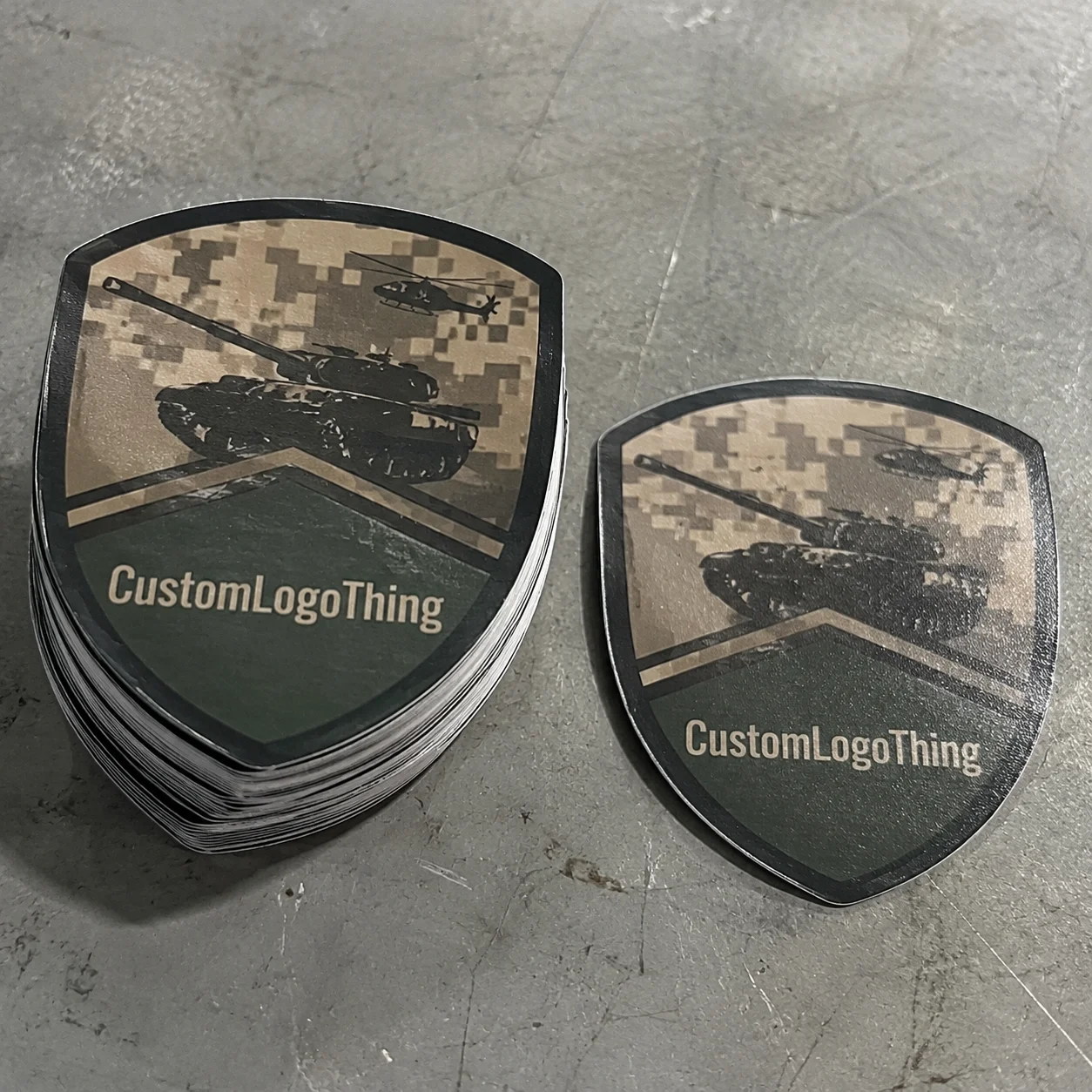
Think about the normal conditions these stickers face. A hard case gets scraped against other cases in transit. A label on a metal box gets wiped with cleaner or solvent. A decal on a vehicle panel sees UV exposure and heat cycles long before anyone thinks to replace it. That is why custom military stickers are not judged only by how they look on day one. They are judged by how long they stay readable under actual use.
Standard promotional stickers are usually designed for short-term visibility. Military-style stickers need a different approach. They often use stronger adhesive systems, tougher facestock, and artwork that favors clean identification over ornament. In practice, that means bold contrast, fewer tiny elements, and enough margin for the cut to be accurate without clipping important details.
Most buyers do not need exotic specs to get solid results. They need a sensible combination: a weather-resistant vinyl or polyester construction, a finish that does not scuff too easily, and art that can still be recognized at the intended size. The same logic applies to durable product packaging and dependable branding packaging—the message has to survive the environment, not just the mockup.
Professional buyers often compare sticker builds the same way they compare packaging design decisions for retail packaging or Custom Printed Boxes: by use case first, then by material. If the application is outdoor equipment, the priority should be endurance, not novelty.
There is also a practical reason these stickers can fail faster than expected: the surface itself. Powder-coated metal, textured plastic, and slightly curved containers all create different bonding conditions. A sticker that looks fine on a smooth sample panel may behave differently on the actual item. That is why a material choice should always be tied to the substrate, not to a generic product description.
How the production process and timeline work
Most custom military stickers follow a familiar workflow. Artwork comes in, a proof is created, corrections are made if needed, then the job moves into print, finishing, inspection, and packing. The order may look simple from the outside, but the schedule is usually shaped by what happens before the first sheet is printed.
Artwork issues are the most common delay. Low-resolution files force cleanup. Missing vector files slow down die-line setup. Unapproved color changes can trigger another proof cycle. If more than one person needs to sign off, approval time can matter more than machine time.
Turnaround also depends on the spec. A straight reprint on a common vinyl stock may move faster than a job that needs specialty adhesive, white ink, heavy lamination, or custom packaging for distribution. Order volume matters too: a few hundred pieces may be quick to produce, while a larger run can require more time for print setup, cutting, and quality checks.
For planning purposes, many sticker orders land in a 7-15 business day window after proof approval, though material availability and current workload can move that in either direction. Rush jobs are possible in some cases, but the buyer still has to account for shipping time. If the stickers are needed for training dates, team swaps, deployment prep, or a scheduled distribution run, leave extra room. Two buffer days can prevent a lot of last-minute stress.
One detail that gets overlooked is packing. If the stickers need to arrive in separate sets for different teams, ask how they will be bundled before approving the order. Carton counts, labeled bundles, and sorted packets sound minor until someone has to divide 5,000 pieces by hand after delivery.
Material, adhesive, and finish factors that affect durability
Material choice is where durability starts. For many custom military stickers, vinyl is the most common option because it balances cost, print quality, and environmental resistance. Polypropylene can work for certain shorter-term applications, especially where flexibility and lower cost matter. Polyester-style films are often stronger and more dimensionally stable, which helps in harder-use environments or where heat and chemical exposure are part of the picture.
Adhesive selection matters just as much. A sticker that bonds well to smooth painted metal may behave differently on powder-coated surfaces, textured plastics, or curved containers. Surface energy, cleanliness, and application temperature all affect the final bond. If the sticker will be applied to gear that gets handled often, ask whether the adhesive is intended for high-tack application or for general-purpose use.
Finish affects more than appearance. Gloss finishes usually make colors stand out and can add a bit of scuff resistance. Matte finishes reduce glare, which improves readability on equipment used outdoors or under bright light. Lamination is often worth the added cost when the stickers need more scratch resistance or UV protection. If the artwork includes fine text or detailed insignia, lamination can help preserve the print longer.
Cut style changes the experience too. Kiss-cut stickers are easier to peel and work well for sheeted distribution. Die-cut stickers create a cleaner standalone shape and can look more finished. The right choice depends on how the stickers will be used, handed out, or stored.
Color contrast deserves its own attention. Military-style graphics often use dark or muted palettes, but if the sticker must be read quickly on a case, helmet, or field container, contrast wins. A simple two- or three-color layout usually performs better than a busier design with thin lines and low contrast.
| Construction | Best Use | Typical Strength | Common Tradeoff |
|---|---|---|---|
| Vinyl with gloss laminate | Outdoor gear, vehicle labels, hard cases | Good weather and abrasion resistance | More glare in bright light |
| Vinyl with matte laminate | Readable equipment labels, low-glare applications | Better visibility under harsh lighting | Colors may look slightly softer |
| Polypropylene | Shorter-term labeling, lighter handling | Cost-effective for simpler jobs | Usually less durable than premium films |
| Polyester-style film | Hard-use labeling, chemical or heat exposure | Strong stability and durability | Higher unit price |
For buyers who want a broader quality-control mindset, organizations like the ISTA and EPA are useful references for transport stress and material responsibility, even if the sticker itself is not a regulated package component. The habit of asking, “What stress will this face?” improves both labels and package branding.
Custom military stickers pricing, MOQ, and unit cost
Pricing for custom military stickers usually comes down to six variables: quantity, size, number of colors, finish, cutting complexity, and packaging. Change any one of those and the quote moves. Change three, and the price difference can become significant.
Minimum order quantities, or MOQs, make more sense once setup time is visible. Every print job needs prep, material loading, proofing, and finishing. That overhead gets spread across the run. A 100-piece order may carry a much higher unit price than a 2,500-piece order, even if the artwork is identical.
As a rough buyer-facing range, simple 2x3-inch or 3x3-inch stickers in modest quantities might land around $0.20-$0.45 per unit depending on material and finish. Larger or more complex runs can fall lower on a per-piece basis as quantity rises. Specialty builds with white ink, heavy lamination, or unusual cutting can move above that range. The point is not the exact number. It is understanding which features are paying for durability and which are only adding cost.
Over-ordering can backfire. Military-style art changes with unit rebranding, event-specific runs, or updated logos. If the design is likely to change in six months, a very large run may leave you holding inventory that is still usable but no longer current. Smaller batches with a clean reorder file are often the smarter move.
Hidden cost drivers show up often. Proof revisions may be included, or they may not. Specialty materials can carry setup charges. White ink can increase print complexity. Individual polybagging or set bundling adds labor. If the quote includes custom carton labels or distribution sorting, that is a service, not an accident.
A useful comparison rule: if two quotes differ by more than 20% and the specs look the same, they probably are not the same. Check facestock, adhesive, finish, cut type, proof count, and shipping method before deciding which price is actually better.
There is also a quality implication behind low pricing. A quote that is far below the market may signal thinner material, weaker adhesive, fewer inspection steps, or less complete packing. Sometimes the lower number is real savings. Sometimes it is a stripped-down build that only looks equivalent on paper.
Step-by-step buying checklist for a cleaner order
Start with the use case. Is the sticker for decoration, identification, morale, compliance, or equipment labeling? That answer determines most of the rest. A morale sticker on a laptop and a label on a field container do not need the same construction, even if they share the same logo.
Next, lock the specs before requesting quotes. Size, quantity, shape, indoor or outdoor use, and expected lifespan should all be clear. If the final application surface is curved, coated, textured, or frequently cleaned, say so early. That helps the supplier recommend an adhesive that is more likely to hold.
Artwork preparation matters more than many buyers expect. Provide vector files when possible. Keep text readable at the final size. If the sticker is small, do not cram in a slogan that needs a magnifying glass. A good proof should show bleed, cut line, and safe margins clearly. Review all three.
Then ask about packaging and distribution. If the stickers need to be divided by team, base, department, or event kit, the packing method should support that. Buyers who already manage Custom Labels & Tags usually understand this well: sorting during production is far easier than sorting after everything is boxed.
A clean order checklist usually looks like this:
- Confirm application surface and environment.
- Set size, shape, and quantity.
- Prepare vector artwork or high-resolution source files.
- Request a proof and review cut lines, spacing, and color.
- Confirm packaging, carton counts, and shipping date.
If the order touches broader branded packaging or retail packaging efforts, keep the sticker specs aligned with the rest of the print system. A logo that appears one way on a sticker and another way on a shipping label or carton creates inconsistency quickly, and those differences are more visible than people expect.
Common mistakes buyers make with military-style sticker orders
The first mistake is choosing the wrong material for the job. A sticker meant for outdoor use or hard-use gear needs a more serious construction than something intended for brief indoor display. The second mistake is designing for a screen instead of a real object. A layout that looks balanced at 800 pixels wide may feel crowded once it is reduced to a 2-inch label.
Skipping proof review is another classic error. People usually catch spelling problems, but they miss small issues like poor contrast, a shifted cut line, or a logo element too close to the edge. On a production sheet, those mistakes can become expensive fast.
Adhesive assumptions create trouble too. Not all adhesives perform equally on coated metal, plastic, painted surfaces, or slightly rough finishes. A buyer who treats all backsides the same is usually the one who later sees curl, lift, or weak bond.
Quantity mistakes are common as well. It is tempting to order only on price, but quantity should track actual use: schedule, replacement rate, distribution needs, and whether the design might change. The cheapest unit price can become the most expensive decision if a large part of the order goes obsolete.
Most failed sticker orders are not failures of printing. They are failures of specification. Someone guessed on size, guessed on surface, guessed on finish, and then acted surprised when the sticker behaved exactly the way the wrong spec predicted.
Expert tips for stronger results and easier reorders
Keep the art simple enough to survive shrinking. Bold contrast, clean typography, and fewer tiny details usually outperform complicated graphics. If a design needs to be read from a distance or at odd angles, clarity matters more than decoration.
Save a master file with approved dimensions, colors, bleed, and cut specs. That one habit can save hours on reorder cycles. It also helps when multiple departments need the same sticker in different runs but want the same look.
Separate evergreen art from campaign art. Some sticker designs can be reordered for years. Others are tied to a specific exercise, event, or internal program and should stay in a short-run folder. That distinction keeps inventory cleaner and prevents accidental overbuying.
If possible, test one sample on the actual surface before committing to a full order. A sample can reveal more in ten minutes than a spec sheet can in ten pages. It tells you whether the adhesive grabs, whether the finish reflects too much light, and whether the size feels right on the object.
For buyers who manage multiple groups or distribution channels, consistent packaging makes life easier. Labeled bundles, sorted packets, and clear counts reduce receiving errors and speed handoff. That kind of discipline shows up in sticker projects just as clearly as it does in custom packaging products.
Compare specs, confirm the timeline, and approve the proof only after checking sizing, readability, and material match. Do that, and custom military stickers become a practical purchase instead of a guessing game.
FAQs
What makes custom military stickers different from regular vinyl stickers?
They are usually built for tougher surfaces and harsher conditions. Durability depends on material, adhesive, and finish, not just the artwork. The best options balance weather resistance with clean application on gear, cases, and equipment.
What size works best for custom military stickers on equipment?
Medium sizes often work best because they stay readable without crowding the surface. The ideal size depends on where the sticker will be applied and how far away it needs to be seen. Always confirm final size against a real object or template before ordering.
How do I estimate pricing for a custom sticker order?
Use quantity, size, finish, and cutting complexity as the main pricing inputs. Smaller runs usually cost more per piece, while larger runs lower unit cost. Request a quote with the same specs for every vendor so comparisons are fair.
How long does production usually take for custom military stickers?
Turnaround depends on proof approval, material availability, and order volume. Simple reorders move faster than first-time jobs with artwork cleanup or special finishing. Build in extra time if the stickers are needed for a fixed event or shipment date.
What should I check before approving the final proof?
Verify spelling, size, cut line, and color placement. Check whether the design is still readable at the final sticker size. Confirm the material and adhesive match the intended surface and environment.


