Custom Ornament Boxes: How to Spec, Price, and Order
Custom ornament boxes are usually bought to solve a protection problem first and a branding problem second. That matters because ornaments fail in boring ways: a hook bends, a painted surface chips, a glass body shifts half an inch and takes a corner hit. The damage often shows up after the customer opens the parcel, which is too late to fix the impression or the margin.
A good box has to do two jobs at once. It needs to present the ornament as a gift-worthy item, and it needs to hold that item still through handling, stacking, vibration, and the occasional drop. Those goals overlap, but they are not identical. A carton can look polished and still be a weak package if the insert is loose or the structure is too light for the channel.
That is why buyers should think about fit, board grade, and print together instead of treating packaging as a finish-only decision. A better spec often lowers damage rates more than a more elaborate graphic treatment ever will. The strongest programs usually start with restraint: the ornament cannot move, the box closes cleanly, and the outer presentation supports the product without adding unnecessary cost.
Why custom ornament boxes matter for fragile gifts
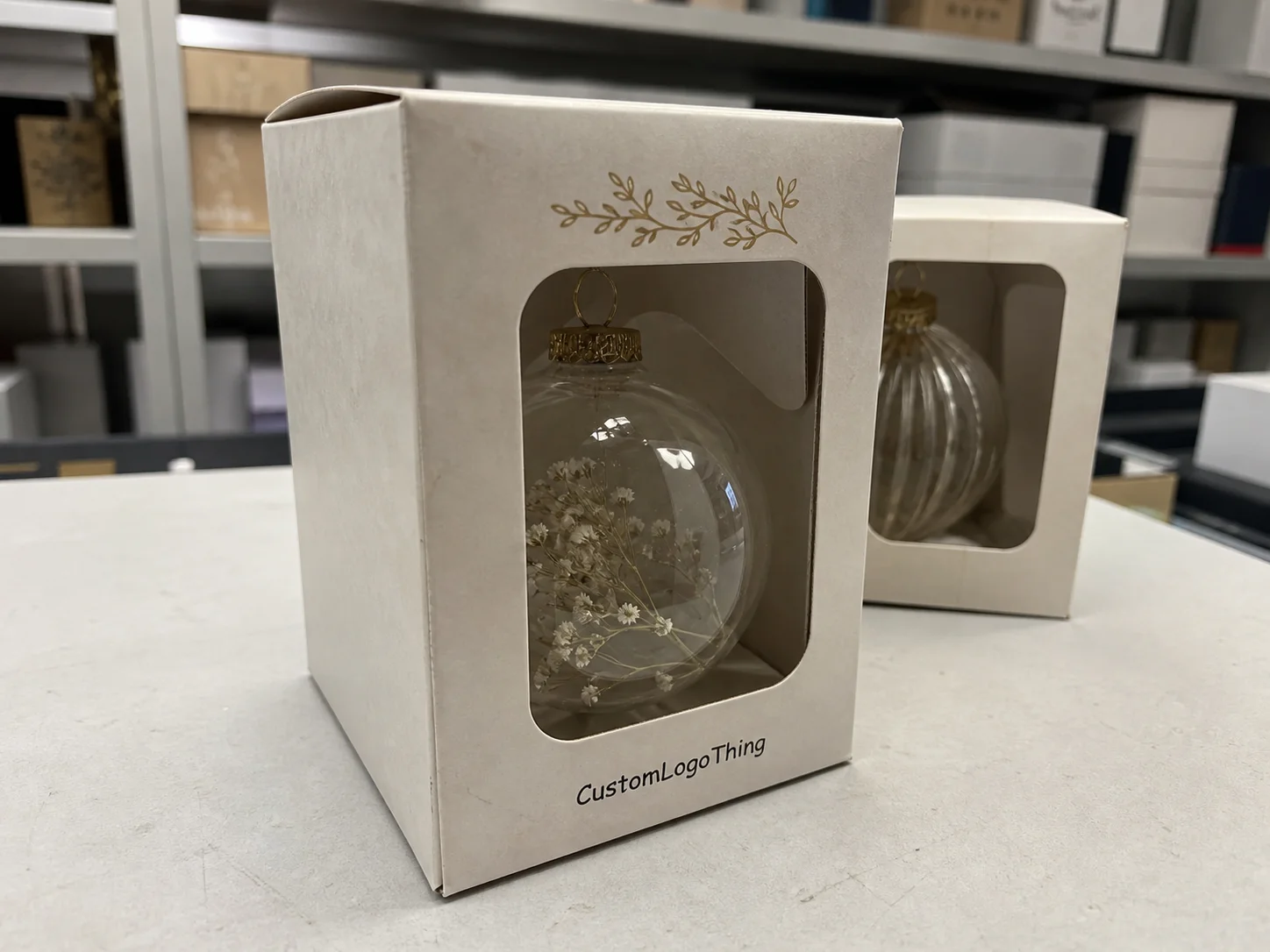
Ornaments are small, but they are not simple. A round glass globe, a ceramic keepsake, and a flat metal ornament all create different stress points. A ribbon loop adds height. A cap adds a snag point. A delicate painted finish can be scarred by contact long before the item actually breaks. That is why generic cartons and decorative sleeves tend to underperform for this category.
Outer shipping protection can hide weak product packaging for a while. The carton looks fine on a shelf, the parcel survives a casual toss, and everyone assumes the system works. Then returns start to rise because the ornament moved inside the box, struck a hard wall, and failed at the most fragile point. Small gaps matter here. An inch of movement can be enough for a glass ornament to accelerate and crack on contact, especially after repeated vibration over a longer route.
From a buyer’s point of view, the package has to behave like retail packaging and like a shipping component. Shelf-ready packaging usually prioritizes presentation, print clarity, and easy merchandising. Ship-ready packaging prioritizes compression resistance, fit, and internal restraint. A box that does both usually needs a slightly more disciplined structure than a seasonal stock carton.
A nice-looking carton is not enough. If the ornament can rattle, the design is unfinished, no matter how polished the proof looks.
That is the practical value of custom packaging for ornaments. The packaging supports the unboxing moment, but it also reduces replacement stock, claim handling, and the hidden cost of reorders. For seasonal sellers, the link is direct: fewer damaged units usually means a cleaner margin and less time spent on damage control.
In production terms, the best solution sits between display and defense. It protects the product, reinforces the brand, and still packs efficiently on the line. That balance is what separates a seasonal box that merely looks festive from one that actually supports the business.
How ornament packaging is constructed and printed
Most ornament boxes start with paperboard. For a single ornament, a folding carton made from 16pt to 24pt SBS or coated kraft can work well if the insert is designed correctly. For premium gift sets, a rigid set-up box with 1.5 mm to 2 mm board gives a heavier feel and stronger sidewalls. Buyers comparing custom printed boxes should look at structure first, then worry about decorative finishes.
There are a few common construction styles:
- Folding cartons for lighter ornaments and shelf display.
- Rigid boxes for premium gifting, collector items, or pieces that need stronger compression resistance.
- Sleeve and tray sets for layered branding and a more deliberate reveal.
- Mailer-style cartons for direct-to-consumer shipments where the outer package is part of the protection system.
Print and finish choices affect both perceived value and production cost. Coated SBS gives a cleaner surface for CMYK graphics, metallic accents, and seasonal illustration work. Kraft gives a warmer, more natural look and fits brands that want a simpler material story. Foil stamping, embossing, debossing, soft-touch lamination, and spot UV can all improve presentation, but they should support the brand, not crowd it. Small ornament boxes rarely need every finish at once.
If sustainability is part of the brief, ask for FSC-certified board and verify the claim correctly through FSC certification guidance. Recycled content is useful, but it is not the whole story. Buyers still need documentation that matches the actual material and the production chain.
The insert matters as much as the carton. A die-cut paperboard cradle works for many lightweight ornaments because it is inexpensive and easy to pack. Molded pulp can be a good middle ground for protection and material efficiency. Foam protects well, but it is harder to justify unless the ornament is very fragile or the package has to survive rough distribution. The right choice depends on the route the product takes, not just on shelf appearance.
Stackability is another quiet issue. A flat top and squared shoulders usually stack better in palletized retail packing. If the box will ship individually, add enough rigidity to resist panel collapse under load. Good structure can lower damage without adding expensive decoration, and that is often where the real savings come from.
Cost, pricing, MOQ, and quote drivers
Pricing for ornament packaging usually comes down to five variables: box style, board thickness, print coverage, insert complexity, and order quantity. The same artwork can generate very different quotes if one vendor is pricing a simple folding carton and another is pricing a rigid box with a custom insert and finish work. Comparing those quotes without normalizing the spec is where mistakes begin.
For reference, a basic folding carton for a single ornament might land around $0.22 to $0.38 per unit at 5,000 pieces, depending on print coverage and board spec. A sleeve-and-tray package may sit closer to $0.30 to $0.52 per unit. Rigid boxes often move into the $0.85 to $1.60 per unit range, and custom mailer-style Boxes with Inserts can fall somewhere in the middle. At 1,000 units, unit cost usually rises sharply because setup costs are spread across fewer boxes.
The MOQ question is real. Lower minimums are helpful for testing a new ornament line or a short holiday program, but they often carry a higher unit cost and sometimes a tooling charge that does not appear in a quick quote. Larger runs usually reduce the cost per box because the press setup, die cutting, and finishing work are amortized more efficiently. The tradeoff is inventory risk. Seasonal packaging can become expensive to store if the forecast misses.
| Style | Best for | Typical unit cost | Notes |
|---|---|---|---|
| Folding carton | Single ornaments, shelf display | $0.22-$0.38 at 5,000 units | Lowest freight weight; add an insert if movement is an issue. |
| Sleeve + tray | Gift presentation with layered branding | $0.30-$0.52 at 5,000 units | Good for package branding and cleaner visual merchandising. |
| Rigid set-up box | Premium gifts and collector ornaments | $0.85-$1.60 at 5,000 units | Higher perceived value; more labor and freight cost. |
| Mailer-style custom box | DTC shipping and gift subscriptions | $0.45-$0.95 at 5,000 units | Prioritize compression strength and fit before print embellishment. |
Hidden costs are where buyers get surprised. Dielines, sampling, tooling, proofing, freight, and warehouse storage can all move the landed cost. A quote that looks cheap can become expensive if the vendor is excluding insert tooling or using an underquoted shipping method. Ask for a line-item breakdown before you compare suppliers.
If you need a starting point for construction types, Custom Packaging Products is useful because it helps you compare folding cartons, rigid formats, and other packaging design options before you ask for a detailed quote. The goal is to standardize the spec first, then let vendors compete on the same build.
A practical quote review should answer three questions:
- Does the quote include the exact board grade and finish?
- Is the insert part of the price, or treated as a separate add-on?
- Are proofing, freight, and setup charges already included in the landed cost?
Process and timeline from artwork to delivery
The fastest way to lose time is to begin with a guess. A clean ornament box project starts with a brief that lists the ornament dimensions, target quantity, retail channel, printing needs, and insert requirements. Once those inputs are clear, the supplier can select a dieline or build one from scratch, depending on the format.
- Brief and sizing - confirm the ornament shape, hook height, and channel requirements.
- Dieline selection - choose a standard structure or request a custom layout.
- Artwork setup - place logos, claims, seasonal graphics, and barcodes on the dieline.
- Proof review - check fold lines, bleed, safe zones, and finish callouts.
- Sampling - request a physical sample or pre-production proof for fit and print review.
- Approval and production - lock the file and move into print, cutting, finishing, and assembly.
- Shipment - confirm carton counts, pallet configuration, and delivery timing.
Most delays happen because measurements were vague, artwork arrived late, or the insert was still changing after the first proof. That pattern is common with seasonal product packaging, where teams compress schedules to hit launch dates. If the structure is simple, a standard folding carton with basic print can often move through production in 12 to 15 business days after proof approval. Rigid boxes, heavy finishing, or custom inserts can stretch that to 18 to 25 business days, sometimes longer if sampling changes are needed.
If the box will ship directly to consumers, ask about distribution testing. ISTA test methods such as 3A are commonly used for parcel shipping, and ASTM D4169 is another reference point buyers use for transport simulation. A carton that looks fine in a photo can still fail when it meets vibration, compression, and drop stress.
The planning rule is simple: lock structure first, artwork second, and finishes last. That sequence reduces revision loops. It also keeps the team from approving a glossy design that cannot actually be packed efficiently or shipped safely.
How to size ornament boxes for different shapes
Ornaments are not all the same shape, which is why internal fit matters more than outside dimensions on a spec sheet. A 3-inch round glass ornament with a hook is a different package problem than a flat ceramic piece or an oversized heirloom ornament with a ribbon loop. If the cavity is wrong, the box may look right and still fail in transit.
Start by measuring the ornament at its widest point, then include any added height from the hook, top loop, or ribbon. Add only enough clearance for the insert to hold the item snugly. For many small ornaments, that means a clearance window of roughly 1/8 to 1/4 inch around the item, not more. Too much space creates movement. Too little space creates pressure points.
Here is a practical sizing method:
- Measure the ornament itself, not the packaging it came in.
- Include the highest point, such as a cap, ribbon, or topper.
- Decide whether the ornament will sit alone or in a multi-pack tray.
- Choose the insert before finalizing the outer box size.
- Check whether the package needs a window, sleeve, or hanging feature for retail display.
For a single 3-inch round ornament, the internal cavity might end up closer to 3.25 x 3.25 x 4 inches once the hook and restraint space are included. That can vary. A flat keepsake ornament may need a shallower box, while a fragile glass globe may need more depth to keep the item from touching the top panel.
Multi-pack layouts are worth considering if the assortment includes sets or coordinated ornaments. A tray that holds two or four units can improve shelf presentation and reduce loose fill, but it also changes the insert design and the carton footprint. From a packaging design perspective, the best format is the one that protects the item without creating dead air.
If the package is also a gift, think about the opening sequence. A window can show the ornament without exposing it to damage. A sleeve can make the reveal feel more deliberate. A fitted lid can reinforce premium positioning. Those choices affect branding, but they also influence how easy the box is to pack on the line.
Common mistakes that increase damage and reorder risk
The classic mistake is simple: the box looks premium on paper, but the ornament still moves inside it. That is usually a fit failure, not a print failure. Buyers sometimes approve the artwork and forget that a beautiful carton with too much empty space is still a weak package.
Another common problem is weak closure design. Tabs that barely hold, lids that bow, and inserts that arrive undersized all make damage more likely. If the ornament is fragile, the box should survive a real handling test, not just a tabletop inspection. In many programs, a simple drop and compression check reveals more than a design review ever will.
The most expensive packaging mistake is not overspending on finishes. It is ordering a carton that cannot protect the ornament once the item leaves the warehouse.
Buyers also overspec the visual side. Foil, embossing, spot UV, matte lamination, and window features can add value, but they do not fix bad internal fit. If the budget is tight, protect the structure first and add decoration only where it supports sell-through. That is usually a better use of spend than piling every finish onto a small box.
Inventory timing creates its own risk. Ordering too early can lock in artwork before the assortment is finalized. Ordering too late can make a second proof round impossible. Seasonal lines need a buffer, especially if multiple SKUs are being coordinated. The safer approach is to freeze measurements early, approve artwork on the approved dieline, and leave enough time for one physical sample before production.
For shipping programs, do not skip distribution testing. If the box ships individually, ask for a test plan aligned with ISTA or a comparable transit protocol. It is cheaper to catch a fail before production than to discover it after launch.
One more issue shows up often with holiday lines: teams choose the wrong material for the channel. A retail-only box can be lighter and more decorative. A direct-ship box needs more compression resistance, better edge strength, and an insert that holds after repeated handling. Matching the structure to the channel is basic, but it is also where a lot of packaging mistakes begin.
Next steps for ordering custom ornament boxes
The cleanest way to move forward is to audit the assortment first. Rank each SKU by fragility, size, and volume. A glass ornament with a high return risk deserves a different spec than a shatter-resistant plastic piece that ships in a mass retail set. That simple ranking tells you where to spend on structure and where to keep the box efficient.
Then build a brief that includes the essentials:
- Exact ornament dimensions, including hooks, loops, and toppers.
- Target quantity and acceptable MOQ range.
- Print requirements, finish preferences, and barcode needs.
- Insert type, if the ornament needs one.
- Retail or shipping channel, or both.
- Any certification requirements, such as FSC sourcing.
Once the brief is clean, ask for a pre-production sample or physical proof before mass production. That step is especially useful for glass items, premium gifts, and any design that combines a custom insert with detailed artwork. A sample costs less than a pallet of damaged inventory.
From there, compare quotes on the same spec, not on general promises. Look at board grade, insert detail, finish count, freight, and lead time. If one supplier is cheaper because they excluded the insert or quoted a different board weight, the quote is not really cheaper. It is just less complete.
The final step is the pilot run. A short production run tells you whether the box closes cleanly, stacks well, and protects the ornament under real handling. If that pilot holds up, the scale-up is much easier. That is the point where custom ornament boxes stop being a seasonal guess and become a repeatable part of your product packaging.
What size custom ornament box should I order for a 3-inch ornament?
Measure the ornament itself plus any hook, ribbon, or top loop, then add only enough clearance for a snug insert. For many pieces, the internal cavity ends up slightly larger than the ornament name suggests, because movement is the real risk. A box that looks compact but allows rattling is more dangerous than one with a bit of extra visual space.
Are rigid or folding custom ornament boxes better for shipping?
Rigid boxes usually feel more premium and can protect better for gifting, but folding cartons are lighter and more efficient for freight and storage. If the order ships individually, pay more attention to insert design and compression resistance than to outer style alone. The best choice depends on channel, fragility, and the level of brand presentation you need.
How many custom ornament boxes should I order for a first run?
Base the first run on SKU count, forecasted demand, and whether you need replacement stock for damage or promotions. A smaller test run is often smarter than overcommitting if the ornament line is new or the artwork may still change. Short seasonal programs can justify lower quantities, but the unit cost usually rises as volume drops.
What drives the price of custom ornament boxes the most?
The biggest drivers are board material, print coverage, finishing, insert complexity, and order volume. Freight, sampling, and setup charges can also change the landed cost in a meaningful way even when the unit quote looks similar. If two vendors are not quoting the same structure, the pricing comparison is not reliable.
How do I prep artwork for custom ornament boxes?
Start with the approved dieline, then place logos, product claims, and seasonal graphics inside the bleed and safe zones. Confirm color expectations, finish callouts, and barcode placement before proof approval so you do not pay for avoidable reprints. Good artwork prep is part of package branding, but it also reduces production mistakes.

