Custom printed burlap bags work because the material already carries part of the brand message. Burlap has a rough, tactile surface and a natural tone that reads as honest, handmade, and a little less polished than coated paper or film. That can be an advantage. A simple logo, a short line of copy, or even a single ink color often feels more deliberate on burlap than a busy design would on a smoother substrate.
These bags show up in coffee, tea, herbs, seeds, handmade goods, gift sets, promotional kits, and small retail programs that need texture without moving into rigid box territory. They are also common for seasonal bundles and market-style packaging, where the package needs to look approachable and distinct from standard pouches. Buyers usually choose them for presentation first, then discover that the structure, closure style, and print method matter just as much as the artwork.
The most useful way to think about custom printed burlap bags is not as novelty packaging, but as a functional format with a very specific visual language. Burlap rewards clear branding, careful sizing, and realistic expectations about what the weave can and cannot do. If the brief is tight, the final package can look premium without trying too hard.
What Custom Printed Burlap Bags Do Best
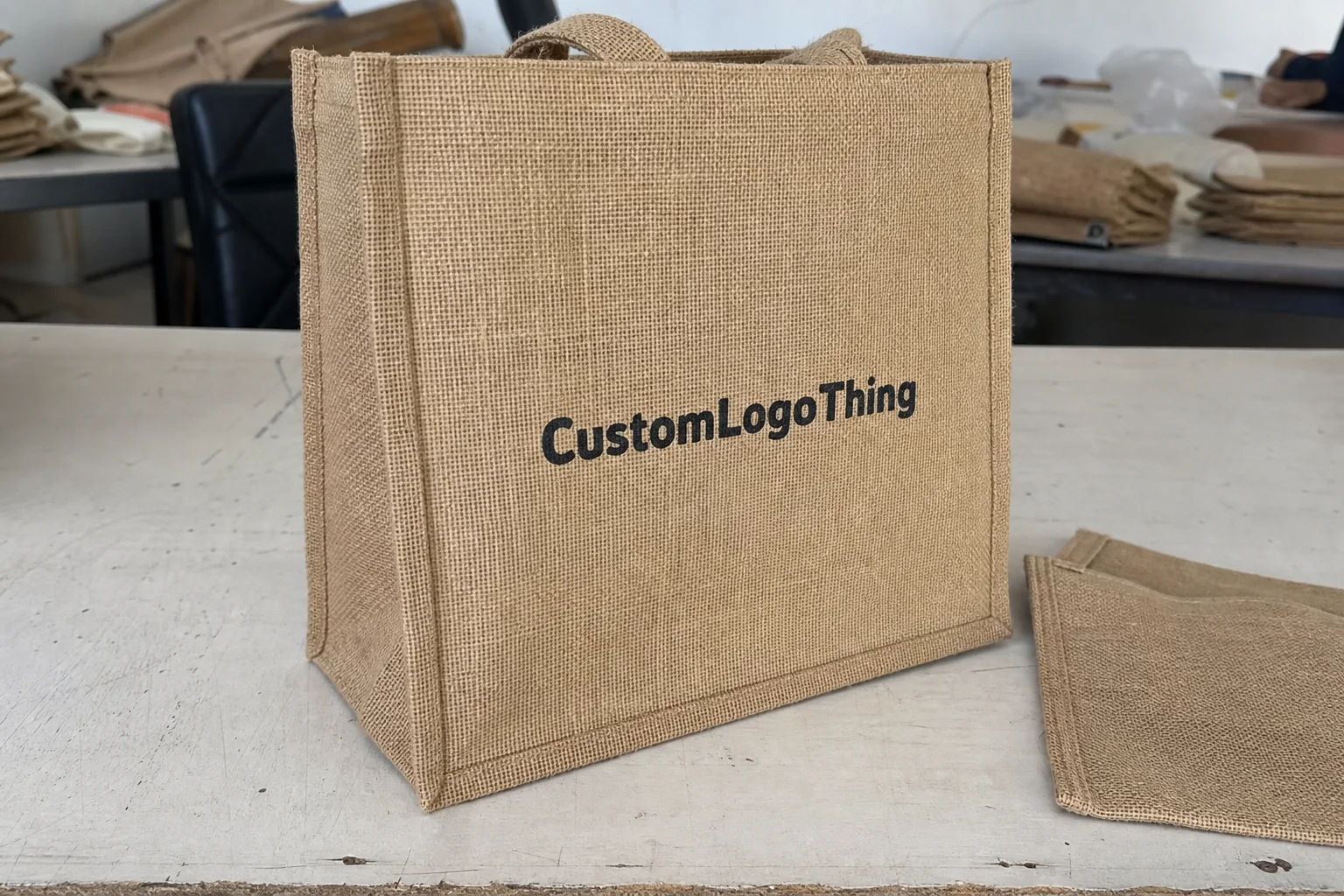
Burlap is usually made from jute fiber, woven into a fabric that is breathable, textured, and visibly natural. That weave is the point. It creates a dry hand feel and a surface that behaves differently from paper, cotton, or synthetics. Print sits on top of the texture rather than disappearing into a smooth coating, so contrast and spacing matter more than decorative complexity.
That is why custom printed burlap bags tend to work best for brands that want a rustic, farm-direct, artisanal, or giftable look. They are a strong fit for products that benefit from being perceived as handmade or minimally processed. A coffee roaster, for example, may use burlap packaging to reinforce a small-batch story; a food gift brand may choose it because the bag feels less disposable and more intentional than an ordinary poly pouch.
There is a practical side as well. Burlap bags can be easy to fill, compact to ship, and flexible across different product types. Depending on the build, they may include a drawstring, stitched top, gusset, or liner. That flexibility is useful, but it also means the buyer has to think through the packing process early. A bag that looks right flat on screen may behave very differently once it is filled, closed, stacked, and handled repeatedly.
Burlap does not hide weak artwork or poor sizing. It exposes both quickly, which is why the brief matters so much.
For brands comparing packaging formats, burlap sits in an interesting middle zone. It is softer and less engineered than a carton, but more distinctive than a generic pouch. If the goal is to create a tactile impression without building a full rigid package, this format often makes sense. If you need sharper edges, stronger stacking, or a more controlled print surface, a custom box may be the better direction.
How the Production Process Actually Runs
The production path usually starts with artwork review, not printing. On a woven substrate, the first risk is not color mismatch; it is whether the artwork can survive the texture. Fine rules, tiny type, and low-contrast elements can disappear or blur slightly once they meet the weave. A good supplier will check file format, print area, placement, and whether the mark needs simplification before anything is approved.
After that comes proofing. For custom printed burlap bags, a proof should confirm the logo position, the usable print area, the closure style, and any visible seam or fold that might interfere with the design. If the order is more complex, a physical sample is usually worth the time. Burlap can vary by weave density and fiber lot, and that affects how a print looks once it lands on the bag.
Once the proof is signed off, production moves through cutting, printing, stitching, finishing, and inspection. The exact sequence depends on the build, but most orders follow that general path. If the order includes liners, reinforced seams, or a special top finish, those steps add labor and can extend the schedule. A straightforward run may take roughly 12 to 20 business days after approval, while a sample-heavy project or one with repeated artwork changes can run longer.
Timelines are often affected by things buyers do not see. A last-minute logo change, a missing dieline, or a decision to add a second color can force the file back into setup. Stock availability also matters. Natural-fiber materials do not always move like standard paper inventory, so it is safer to treat lead times as working estimates rather than promises.
Inspection should not be a formality. For this type of bag, the practical checks are easy to define: print alignment against the seam, color consistency across the lot, stitch quality at stress points, drawstring function if one is included, and any loose fiber or edge fraying that would make the bag look unfinished. If the package is going into a larger distribution chain, carton strength and outer pack handling should also be considered, especially for shipping to warehouses or retail replenishment centers.
Specs That Change the Final Result
Weave density and fabric weight influence almost everything people notice first: how the bag feels in the hand, how crisp the print appears, and how the package holds its shape. A looser weave has more of a rustic character, but it can soften edges and make small type harder to read. A denser weave usually gives the artwork a cleaner base and can improve the overall appearance, even if the bag still keeps its natural texture.
Size is another place where practical details matter more than design intent. Buyers often measure the product itself and stop there, but the filled package is what has to fit. A rigid jar, a folded textile, a product set with inserts, or a bundle wrapped in tissue all need extra room. If the bag is too tight, the closure looks strained and the seams take unnecessary stress. If it is too loose, the package can look underfilled and sloppy.
The closure style should match how the bag will be used. Drawstrings are convenient for repeated opening and closing. Stitched tops give a more finished appearance and are sometimes better for presentation. Gussets add capacity and can improve the shape of bulkier products. Liners are useful when smaller contents need containment or when the bag is being used for food-related applications that need a more controlled interior. Each of those choices changes cost, handling, and appearance.
Print design deserves the same level of restraint. Burlap rarely flatters photo-heavy graphics, tiny copy, or delicate gradients. Strong shapes, generous spacing, and limited colors usually print better and read more clearly from a distance. That does not mean the artwork has to be plain. It means the design should be built around the material, not against it.
There is also a sourcing angle that matters in larger packaging programs. If the burlap bag is part of a system that includes printed cartons, inserts, or hang tags, ask about documentation for any paper components where that applies. If the broader brand story includes sustainability claims, the paperwork should support those claims instead of depending on loose language that cannot be verified.
Costs, MOQ, and What Drives the Quote
Pricing for custom printed burlap bags is driven by several variables at once, and unit price alone can be misleading. Size, fabric weight, print method, number of colors, closure type, seam construction, liner choice, and order quantity all affect the quote. Minimum order quantity matters because setup costs have to be spread across the run, which is why smaller orders tend to carry a higher per-unit price even when the artwork is simple.
For planning purposes, a plain burlap pouch may sit around $0.35 to $0.70 per unit at moderate quantities. Add one-color printing and the working range often moves to roughly $0.55 to $1.10. Two-color work, gussets, reinforced seams, or more elaborate finishing can push the cost into the $0.85 to $1.60 range, and lined or highly finished versions can land around $1.20 to $2.40 depending on volume and complexity. Those ranges are directional, not guarantees, but they help buyers compare quotes without assuming every supplier is pricing the same spec.
It is smart to compare offers on an all-in basis. One quote may include proofing and packaging, while another separates those charges. Freight can change the economics more than buyers expect, especially for time-sensitive orders or shipments crossing a long distance. The lowest unit number is not always the best landed cost once cartons, transit, and rework risk are included.
| Option | Typical Use | Indicative Unit Cost | Main Cost Drivers |
|---|---|---|---|
| Plain burlap bag | Sample kits, favors, simple fills | $0.35-$0.70 | Size, fabric weight, closure style |
| One-color logo print | Retail, coffee, gifting | $0.55-$1.10 | Setup, print area, MOQ |
| Two-color print with gusset | Premium product packaging | $0.85-$1.60 | Extra print pass, labor, construction |
| Lined bag with custom finish | Specialty food, premium sets | $1.20-$2.40 | Liner, stitching, closure, inspection |
If the burlap order is part of a broader rollout, compare it against the rest of the packaging system rather than treating it as an isolated line item. A bag, label, insert, and carton that are all purchased under different assumptions can end up looking mismatched, even if each piece looks fine on its own.
How to Spec an Order With Fewer Revisions
Start with the product that goes inside the bag. That sounds basic, but it is where a lot of problems begin. The packed form, not the raw item alone, should drive the bag dimensions. A rigid container, a soft fill, and a multi-piece gift set all need different allowances. Once the package has to be packed on a real line or by hand in volume, a few millimeters matter more than the mockup suggested.
Measure the final packed size with everything included: inserts, tissue, fillers, tags, or protective wrap. Then decide whether the bag needs room for easy loading or for a cleaner visual finish. If the contents are oversized or irregular, a gusset or a wider flat pattern may be more useful than a taller bag. This is one of those choices that is easier to make early than to fix later.
Next, simplify the artwork to fit the material. A bold mark with enough clear space will usually outperform a dense design trying to communicate too much. The woven surface already provides visual interest. If the logo is small, thin, or built from fine details, ask for a proof or sample before moving to full production. Custom printed burlap bags can look excellent, but the best versions are usually the ones that respect the surface instead of fighting it.
Delivery timing should be stated from the start, not after the quote is accepted. If the order needs to hit a launch date, an event, or a retail reset, mention that early. A supplier can only give a realistic schedule if they know the date that matters. The same is true for destination. Orders bound for a warehouse, a store network, or direct-to-consumer fulfillment can require different packing and carton assumptions.
For final approval, separate the sample decision from the production decision. A sample confirms shape, texture, print behavior, and closure feel. Production confirms whether the lot can be repeated consistently. That distinction matters with natural materials, where slight variation is normal. The goal is not to eliminate every difference; it is to control the ones that affect appearance and function.
Mistakes That Slow Orders Down
The most common mistake is undersizing the bag. Buyers often measure the product itself and forget the space needed for filling and closure. The bag technically fits, but the finished pack looks tight or stressed. That problem gets worse with rigid contents, because the bag cannot compress around a hard shape the way a soft pouch can.
Artwork that is too fine for the weave is another repeat issue. Thin strokes, tiny type, low-contrast text, and soft gradients can disappear into the fabric or print unevenly across the texture. If a design only works at a very small size on a smooth mockup, it usually needs to be simplified before production. The weave will not forgive weak hierarchy.
Skipping proof review is expensive in a way that does not always show up immediately. The logo might be technically correct in the file but sit too low on the bag, or the margin might look off once the artwork is printed on a textured surface. When the bag is part of a coordinated retail package, that small mistake makes the whole set feel less considered.
Lead time is often handled too late. Waiting until the artwork is final before asking about production time leaves no room for approval cycles, material sourcing, or transit variability. That is where rushed orders happen, and rushed orders are usually the most expensive ones. The production schedule does not compress just because the launch date is fixed.
Burlap is forgiving in appearance, but only up to a point. Bad dimensions and tiny typography still show up every time the bag is filled.
One more issue gets overlooked: how the bag behaves in actual use. A drawstring that looks fine in a rendering may be slow during packing. A stitched top may look clean but reduce access for the end user. The right choice depends on whether the bag is meant to be reopened, displayed, shipped once, or handled repeatedly. That part of the brief should be explicit.
Practical Checks Before You Release Artwork
Use vector artwork wherever possible. Clean vector files scale better and keep the edges sharper through proofing and setup. If the only available file is a low-resolution image, the quote may still be possible, but the file will likely need cleanup, and that creates avoidable back-and-forth. The cleaner the source file, the fewer surprises later.
Ask for a spec sheet that states the bag size, fabric type, closure, print count, and target ship date. That gives you a better quote and makes supplier comparisons much easier. It also reduces the chance that two vendors are pricing different versions of the same product, which is a common source of confusion when buyers are moving fast.
Check for consistency across the rest of the packaging system. If the bag is meant to sit next to a carton, insert, or label, make sure the color temperature, finish, and tone are aligned. A burlap bag does not need to match perfectly, but it does need to feel like it belongs to the same brand family. That coherence is often what separates a coordinated package from a collection of separate items.
Finally, build a little schedule buffer. Even a straightforward order can lose time to proof adjustments, minor corrections, or shipping delays. That buffer is not a luxury when the bags are tied to a seasonal promotion or an event launch. It is part of the actual production plan.
FAQs
What size should I choose for custom printed burlap bags?
Choose the size based on the final packed product, not just the item alone. Include inserts, tissue, filler, and any rigid container in the measurement. If the item is irregular or bulky, leave room for filling and closure so the finished bag does not look stretched or awkward.
Can custom printed burlap bags be printed in full color?
Sometimes, but burlap usually performs better with limited colors and strong contrast. The weave softens fine detail, so bold logos and simple artwork tend to read more cleanly than gradients or photo-style graphics. If full-color branding is non-negotiable, ask for a proof or sample before approving production.
What drives the price the most?
The biggest cost drivers are quantity, bag size, fabric weight, print method, number of colors, and construction details such as gussets, liners, or reinforced seams. Shipping and packaging can also affect the final landed cost. Smaller orders usually cost more per unit because setup is spread across fewer bags.
How long does production usually take?
A straightforward order often takes about 12 to 20 business days after proof approval, but the actual schedule depends on artwork readiness, sample requirements, quantity, and any special finishing. Revisions, material shortages, or a late design change can extend the timeline. It is safer to ask for lead time before final approval than to assume the standard turn will hold.
Are burlap bags reusable and food safe?
Many burlap bags are reusable if the stitching and closure are durable enough for repeated handling. Food suitability depends on the exact construction, lining, and material specification, so it should never be assumed. If the contents are edible, request the supplier’s packaging and contact details before placing the order.
Handled with the right spec, custom printed burlap bags can give a product a natural, premium presentation without asking the artwork to do all the work. The best results usually come from simple graphics, accurate dimensions, a realistic timeline, and a proofing step that catches the details a mockup will not. If the bag fits the product, the closure fits the process, and the print respects the weave, the package usually feels more finished than most buyers expect.

