Custom printed cosmetic bags have one advantage buyers often undervalue: people keep them. A flyer gets tossed and a carton gets recycled, but a decent pouch usually ends up in a travel kit, bathroom drawer, or tote bag for months. That gives the brand repeated visibility and makes the bag part of the product experience, not just the shipment.
The spec still has to be justified. A flimsy bag makes a product feel cheaper. An overbuilt one can burn through budget before the cosmetics are even packed. The right answer is usually the one that fits the contents, the channel, and the expected reuse, not the fanciest option available.
Custom Printed Cosmetic Bags: Why They Outsell Inserts
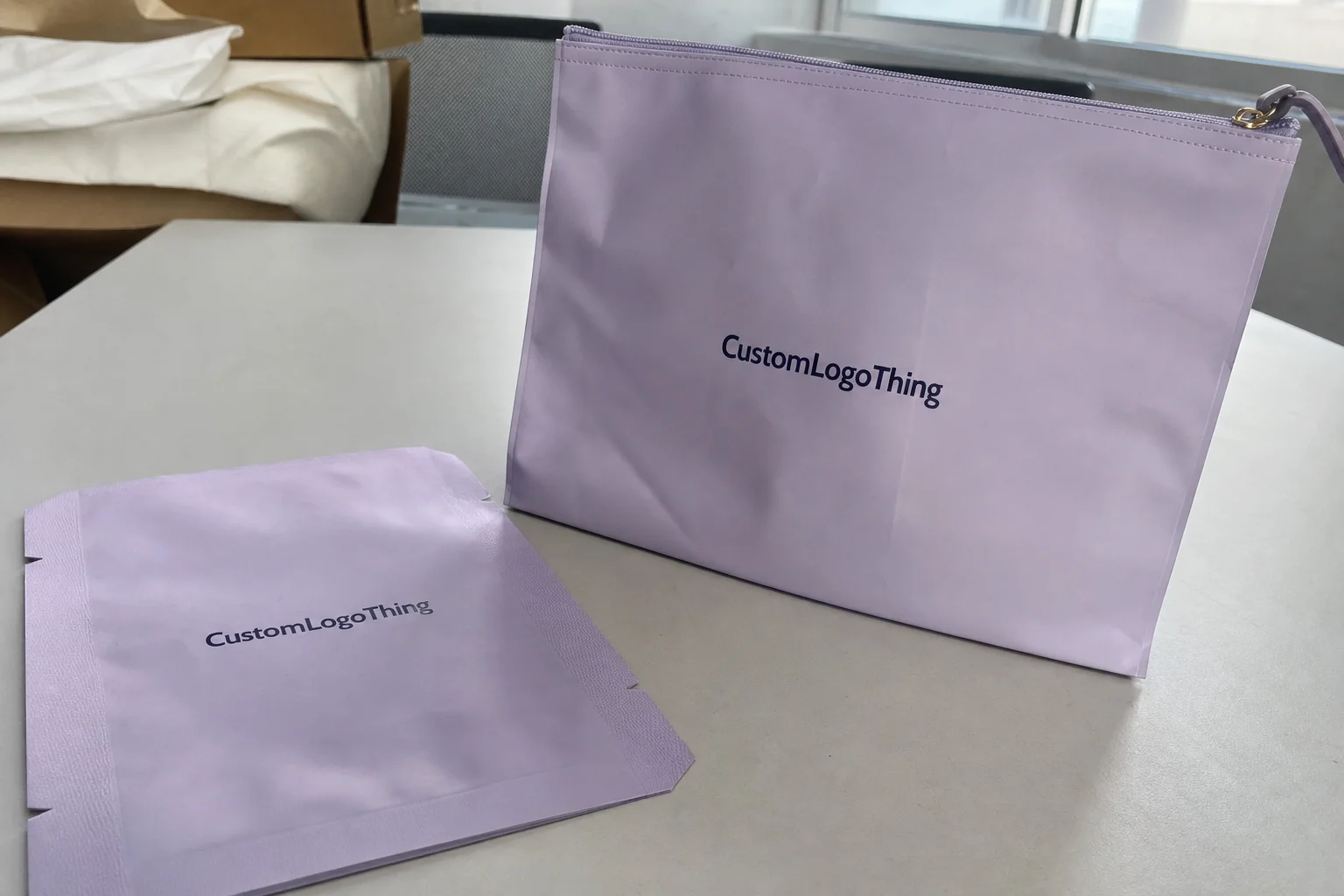
A cosmetic bag does more than contain items. It becomes packaging, display, and sometimes a reusable accessory. That is why many brands prefer pouches over inserts, sleeves, or plain secondary packaging. Inserts rarely survive the first use; a pouch can keep working and keep the logo visible.
For skincare, makeup, hotel amenities, and gift-with-purchase programs, that extended life is the point. The right bag can hold minis, tools, cotton pads, travel bottles, or sample sets while carrying the brand mark in plain sight. The use case matters. A retail pouch that sits on a shelf needs different material and finish choices than a promo pouch meant for shipping and travel photos.
Where custom printed cosmetic bags tend to outperform other packaging:
- Product launches where the reveal is part of the campaign.
- Influencer kits that must look polished in photos and survive shipping.
- Retail gift-with-purchase programs that need stronger perceived value.
- Travel sets for cosmetics, skincare, and amenity bundles.
- Salon and spa bundles where repeated use keeps branding visible.
If the goal is pure containment, a simpler pouch or another Custom Packaging Products option may be a better fit. If the goal is visibility, reuse, and tactile brand memory, the pouch is usually the stronger choice.
Material, Closure, and Print Choices That Change the Result
Material changes almost everything: appearance, hand-feel, stiffness, odor, transparency, and how the pouch behaves after a week in transit. Sample photos rarely show those differences well. A clear image can hide a tacky surface, a weak seal, or a material that remembers every fold.
For custom printed cosmetic bags, the common plastic-based materials are PVC, EVA, PEVA, TPU, and laminated film. Each has a different balance of cost, finish, and utility.
PVC is widely used for clear cosmetic bags because it is flexible and easy to see through. It is also the material some buyers avoid for regulatory or brand reasons. EVA usually feels softer and can look more refined than basic clear vinyl. PEVA is popular for lightweight pouches and is often a sensible middle ground for utility-focused programs. TPU sits higher on the spec ladder; it tends to feel cleaner and more premium, though it usually costs more. Laminated film adds structure and can make a pouch feel more retail-ready, especially when it has to stand upright.
Thickness matters as well. Buyers often see quotes around 0.2 mm, 0.3 mm, or 0.5 mm for plastic-based bags. Thinner material lowers cost and weight, but it also makes the pouch more dependent on good pattern design and careful sealing. Thicker material improves structure, though it can add shipping weight and move the bag into a higher price band.
Closures are another practical decision. A zipper is still the default because it is secure and familiar. A slider can feel cleaner and more premium, but it adds hardware complexity. A snap can work for smaller kits. A flap may suit some cosmetic assortments, although it can change the sealing process and reduce water resistance. If the bag is meant to carry liquids, the closure and the gusset should be considered together.
Print method changes the final appearance as much as the material does.
- Screen print is a strong fit for bold logos, solid colors, and straightforward artwork.
- Heat transfer is useful when the design needs finer detail or more color separation.
- Digital print works well for shorter runs and more complex graphics.
- Opaque inks or white underlays may be needed on clear substrates so the logo does not wash out.
Small design details are easy to overlook until the sample arrives. Gussets help the bag stand up. Pull tabs make zippers easier to use. Linings can hide rougher seams and improve the interior feel. A flatter base can matter more than a larger logo if the pouch has to sit upright on a shelf.
| Option | Typical Feel | Best For | Watch Out For |
|---|---|---|---|
| PVC | Clear, flexible, familiar | Visibility, promo kits | Perceived value may be lower |
| EVA | Softer, slightly more premium | Travel pouches, gift sets | Color and transparency vary |
| PEVA | Lightweight, practical | Budget-conscious runs | May feel less structured |
| TPU | Cleaner, higher-end | Retail packaging, premium sets | Higher material cost |
| Laminated film | More structured, polished | Retail display, branded packaging | Requires careful print and seal planning |
For broader material and disposal context, the EPA recycling resources are a useful starting point. That matters when a retail partner or sustainability reviewer asks why one pouch material was chosen over another.
Cost, MOQ, and Quote Drivers
Pricing usually comes down to five variables: material, size, print complexity, quantity, and closure quality. Add custom lining, specialty hardware, or unusual finishing and the quote shifts again. Many buyers assume the logo is the expensive part. Usually it is the structure around the logo that changes the number.
For a simple promo pouch, small runs often fall somewhere around $0.60-$1.50 per unit, though the range moves quickly with size, thickness, and print coverage. Retail-oriented bags can still be economical, but the unit cost improves once the order is large enough to dilute setup charges. Larger orders, especially in the 5,000-10,000 piece range, usually bring better pricing.
MOQ changes the math because fixed costs do not disappear. Screen charges, artwork setup, dies, and factory preparation are spread across the order. A 500-piece run can look expensive per unit while a 5,000-piece run looks far better. The tradeoff is obvious: if you do not need the volume, the low unit price can become dead stock.
Hidden costs are where budgets slip:
- Sampling or pre-production samples
- Plate or screen charges for printed artwork
- Artwork cleanup when files are not production-ready
- Freight, especially for bulkier bags
- Import duties and customs fees
- Split shipments when part of the order ships separately
Ask for an itemized quote. A proper quote should show unit price, setup charges, sampling cost if applicable, packaging details, and shipping assumptions. If the numbers are not broken out clearly, comparing suppliers becomes guesswork. One vendor’s low unit price can hide freight or extras that another vendor disclosed up front.
It also helps to compare the pouch against other Custom Packaging Products if the bag is part of a broader launch. Sometimes the pouch carries the branding burden. Sometimes it is just one component in a package that already does most of the work.
Production Steps and Lead Time
Production follows a predictable path: brief collection, artwork review, proof approval, sample or pre-production approval, mass production, inspection, packing, and shipping. The factory process is usually not the slowest part. Artwork review and approvals are where schedules tend to drift.
A straightforward run often looks like this:
- Artwork check: 1-3 business days
- Sample or pre-production confirmation: 3-7 business days
- Mass production: 10-20 business days
- Inspection and packing: 1-3 business days
- Shipping: depends on destination and transport method
Several things slow the job down fast: blurry files, missing fonts, late color changes, zipper sourcing, and last-minute size changes. The most expensive delay is often the one caused by a proof approved too quickly and revised too late. A pouch is a small item, but it still depends on disciplined signoff.
If timing is tight, simplify before production begins. Finalize dimensions early. Send vector artwork. Use standard materials rather than a custom-mixed finish. Approve the proof quickly and keep the design clean. For orders moving through multiple distribution points, transport testing may be worth discussing. Standards such as ISTA are useful if the package has to survive a rougher shipping path, even though not every cosmetic pouch needs formal testing.
How to Match the Bag to the Use Case
Retail and promotional packaging can look similar from a distance. Up close, they have different priorities. Retail buyers usually care about shelf appearance, tactile quality, and durability. Promo buyers usually care about speed, unit cost, and how well the logo reproduces in photos. Trying to make one spec do both jobs often leads to a compromise that satisfies neither side.
Start with what goes inside the bag. A travel set with liquids and bottles needs different dimensions than a sample drop with compacts and tubes. If the pouch is too small, it looks cramped and cheap. If it is too large, it wastes material and shipping volume. Match the size to the actual contents first, then add just enough room for closure and movement.
Common use cases include:
- Travel kits with liquids, minis, and tools
- Makeup sets that need compact but visible presentation
- Sample drops for launches and press mailers
- Hotel amenities where water resistance matters
- Event gifts that need fast branding impact
- Influencer mailers that need to look polished on camera
Functional choices should follow the use case. If liquids are involved, water resistance matters more than decorative detail. If the contents need to be visible, transparency matters. If the pouch must stand upright on a shelf, rigidity and gusset design matter. If it is going into a premium retail package, a cleaner finish and smoother zipper can justify a higher price.
If your program includes paper components such as inserts or hang tags, FSC certification may be relevant there even when the pouch itself is plastic-based. Packaging decisions are usually made across several components, not one item at a time.
Common Mistakes That Blow the Budget
The first mistake is chasing the lowest unit price without checking the landed cost. A bag that looks cheap on paper can become expensive once freight, duties, sampling, and rework are added. Buyers sometimes celebrate the quote before they see the shipping bill.
The second mistake is weak artwork. Low-resolution logos, missing fonts, and unclear color references create revision loops. Those loops add time and sometimes cost. A production team can do plenty, but not much with a screenshot pulled from a website header.
The third mistake is skipping samples. If finish, zipper feel, clarity, or seal line matters, sample it. Photos rarely show everything. A pouch can look polished online and still feel thin in hand. For cosmetics, that tactile impression is part of the brand signal.
Other budget-drainers show up regularly:
- Changing dimensions after proof approval
- Adding print colors late in the process
- Over-specifying hardware for a promo run
- Mixing several bag sizes without enough volume
- Ignoring carton counts and shipping cube size
There is also packaging drift. If the bag, carton, and insert look like they came from different brands, the whole presentation feels less intentional. Sometimes a simpler pouch and a cleaner outer carton produce a stronger result than a complicated mixed-material setup. Spending everywhere is not the same as spending well.
Expert Specs to Collect Before You Request Quotes
If you want comparable quotes, send a proper spec sheet. A paragraph or a few screenshots is not enough. A one-page brief can save days of back-and-forth and make supplier responses much easier to compare.
Include these items:
- Dimensions - width, height, and depth if there is a gusset.
- Material - PVC, EVA, PEVA, TPU, laminated film, or another option.
- Thickness - for example, 0.2 mm, 0.3 mm, or 0.5 mm if relevant.
- Closure type - zipper, slider, snap, flap, or custom closure.
- Print method - screen, digital, heat transfer, or another process.
- Logo files - vector preferred, with exact color references.
- Quantity - and whether a reorder is likely.
- Delivery location - so freight assumptions are realistic.
Ask for two quote versions if possible: one value-focused and one higher-end. That makes the tradeoff visible. Maybe the premium option uses thicker material, a better zipper, or a cleaner print process. Maybe the middle option is the right answer. Without side-by-side specs, it is hard to tell whether the added cost improves the result or just improves the supplier’s margin.
These extra details help too:
- Sample photos of similar finished bags
- Production timeline from approval to shipment
- Packaging details, including carton size and counts
- Inspection approach or quality checks
- Any standards followed for transport or material handling
A one-page spec sheet, a fixed target ship date, and the same brief sent to every supplier will make the comparison far more honest. That is usually how custom printed cosmetic bags move from vague idea to usable packaging without extra rounds of revisions.
FAQ
How do I choose custom printed cosmetic bags for a product launch?
Start with what the bag will hold, because size and closure should follow the contents. Then choose a material and print method that fit the brand look and the budget. If the launch has a fixed deadline, ask suppliers for sample and production timelines before you finalize the design.
What size works best for printed cosmetic pouches?
There is no single best size. Sample kits, travel sets, and full retail bundles each need different dimensions. Add enough depth for zipper closure and product clearance, or the bag will feel cramped. A physical sample or mockup is worth asking for when the pouch has to fit more than one product type.
What affects the price of custom printed cosmetic bags the most?
Material choice, bag size, print complexity, and order quantity drive most of the cost differences. Setup charges and freight can matter just as much as the unit price on smaller runs. A useful quote is itemized, so you can see the real landed cost rather than guessing.
How long does production usually take for custom cosmetic bags?
Lead time depends on artwork approval, sampling, material availability, and shipping method. Simple designs can move quickly, but revisions and color changes add time fast. If the deadline matters, ask for a production schedule before you approve the order.
Can I order a small MOQ without getting stuck with poor pricing?
Yes, but the per-unit cost will usually be higher because setup is spread across fewer pieces. To keep pricing under control, simplify the design and use standard materials where possible. Ask whether the supplier can offer a sample run or staged production if you are testing demand.


