Custom Printed Jute Bags: What Buyers Should Know Before Ordering
Custom printed jute bags can look more refined than many buyers expect, but the result depends on choices that are easy to overlook. The weave, ink method, handle style, and artwork scale all change how the finished bag reads in person. A simple logo can look expensive on jute. The same logo, squeezed too small or printed with too much detail, can disappear into the fiber pattern.
That tension is what makes jute interesting as a packaging material. It is not a flat surface. It behaves more like woven fabric than paper, which means the bag introduces texture before the artwork even starts. For retail packaging, gifting, trade shows, or reusable shopping bags, that texture can do real branding work. It can also expose weak specs fast.
For teams comparing Custom Packaging Products, jute often lands in a practical middle ground. It feels sturdier than lightweight promotional bags, looks more considered than many disposable options, and supports a natural brand story without requiring a large visual system. The tradeoff is precision. Jute rewards clear decisions and punishes vague ones.
What Buyers Should Know
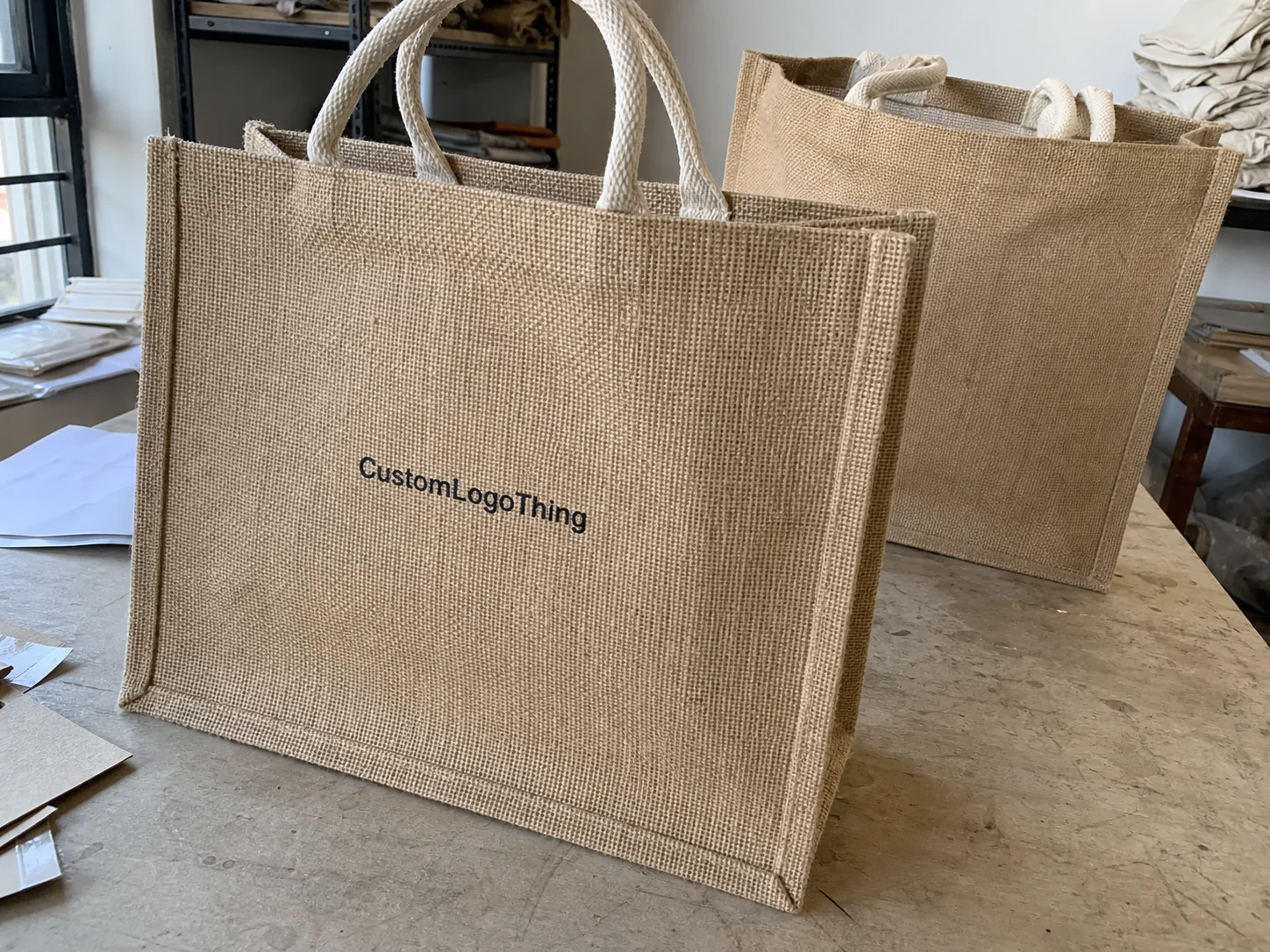
Jute is a plant fiber used to make coarse woven fabric, and that weave changes how printing behaves. The bag usually carries more structure than cotton totes and more texture than nonwoven polypropylene. In plain terms, it feels substantial in the hand, but it is less forgiving on tiny artwork details. That is the first thing buyers need to account for.
A good jute bag does not need much decoration to look deliberate. A one-color logo, centered cleanly and sized with restraint, can look stronger than a busy layout with multiple fonts and small icons. On a textured substrate, contrast matters more than ornament. The bag is already providing part of the visual interest.
That same material character affects perception of quality. Midweight woven jute with reinforced handles tends to read as more premium than thin, floppy construction. Heavier builds usually carry better, hold their shape longer, and photograph more cleanly. They also cost more, weigh more in freight, and may need additional packing protection. That is the trade, and it is worth stating plainly before an order is placed.
A jute bag is judged twice, once by how it looks on a shelf and again by how it behaves after the first customer uses it. If the seams twist, the handles stretch, or the print blurs into the weave, the bag stops feeling premium very quickly.
There is another point that often gets missed. Jute is not automatically a sustainability credential. Raw woven jute is a natural fiber, but lamination, synthetic linings, plastic handles, or heavy coatings change the end-of-life profile. A buyer who wants a more natural positioning should ask about the full construction, not just the outer face fabric.
- Retail use: choose a firmer build, balanced proportions, and cleaner print placement.
- Events and giveaways: keep the artwork bold and the print area simple.
- Gift packaging: consider lining, closure style, and a more finished interior.
- Shopping totes: prioritize handle strength and gusset depth.
How Printing Works on Jute
The printing process starts with the substrate, not the artwork. Suppliers check weave density, surface consistency, and bag construction before they commit to a method. That matters because jute is not uniform enough to treat like coated board or smooth film. Two bags from the same run can vary slightly in texture, and those differences show up under ink.
Screen printing is usually the best first option for custom printed jute bags. It handles solid spot colors, bold logos, and moderate coverage well. The print sits with the material instead of trying to fight it. If the design is simple, the result can be crisp and durable, with strong cost efficiency on larger runs.
Heat transfer can work for designs that need sharper edges or more color variation, but it has limits on rougher surfaces. It often looks cleaner on the proof sheet than it does on the actual bag, especially if the transfer film is large or the jute surface is particularly coarse. It is a useful method, just not a magic fix for bad artwork.
Digital decoration is possible on some jobs, though it depends heavily on the supplier’s equipment and the bag’s finish. Fine gradients, hairline rules, and reverse text are still risky on rough jute. The texture interrupts detail in a way that clients often underestimate from a screen mockup.
Embroidery comes up occasionally, but it is not common for standard jute bags. The material is stiff, the surface is uneven, and stitch density can distort the panel. If a buyer wants an embroidered look, the sample stage becomes more important than usual.
Color selection deserves more attention than it usually gets. Light ink on natural jute can lose contrast because the fabric itself has a warm, uneven tone. Darker inks generally read better from a distance. Small text is another weak point. A font that looks neat on a monitor may break apart once it is printed across a woven surface. The fix is usually boring and effective: enlarge the logo, reduce the copy, and simplify the palette.
Placement matters too. Logos printed too low can disappear when the bag is carried. Logos placed too close to a seam or gusset can distort. On structured tote styles, the printable area is usually smaller than the front panel suggests, because folds, stitch lines, and handle attachments reduce usable space. That should be measured before artwork is approved, not after.
Proofing should be treated as a physical review, not a formality. A mockup can show color, scale, and positioning, but it cannot show how the weave interacts with the ink, how the handle stitching changes the panel, or how the bag folds in transit. Those details are the difference between a bag that feels designed and one that feels assembled.
Material, Size, and Branding Factors
Before a quote means anything, the buyer should lock down the basic specification: dimensions, gusset depth, handle length, fabric weight, lining, closure, and reinforcement. Those details change both the look and the function of the bag. A large bag with a small logo can feel empty. A small bag with a large logo can feel crowded. Proportion is doing a lot of work here.
Typical woven jute bags are often built from midweight material, with heavier constructions used for repeated shopping or premium retail applications. A common range is roughly 250 to 400 gsm, though exact build varies by supplier and construction method. Lighter builds are easier on budget and freight. Heavier builds usually feel better in hand and hold shape more reliably.
Handle style changes the experience more than many buyers expect. Short carry handles feel compact and retail-oriented. Longer shoulder handles make the bag more useful for transport but can change the visual balance of the front panel. Reinforced stitching usually improves durability and also makes the bag look more finished. If the bag is meant to sit beside product packaging at a counter, those details matter as much as the logo.
Lining and coating deserve a separate decision. Some bags are left raw for a visibly natural finish. Others use lamination or a simple inner liner to improve moisture resistance, reduce fiber shedding, or create a cleaner interior. That can be useful for food, cosmetics, or gift programs, but it also adds cost and can reduce the bag’s recyclability. Buyers should be clear about which benefit they want more.
Size and branding coverage have a direct relationship. A narrow panel limits what can be printed cleanly. A wide panel gives more room, but only if the artwork is scaled to match. Oversized graphics can overpower the bag and make it feel like a giveaway item. A restrained mark often performs better on jute because the material already communicates texture and naturalness.
For teams weighing options, the table below is a useful shorthand.
| Spec Choice | Best For | Branding Effect | Tradeoff |
|---|---|---|---|
| Light jute, simple print | Events, giveaways | Clean and budget-friendly | Lower load capacity, less premium feel |
| Midweight jute, one-color logo | Retail packaging, gifting | Balanced presentation and utility | Slightly higher unit cost |
| Heavier jute, reinforced handles | Shopping totes, repeated use | Stronger, more premium impression | More shipping weight, higher freight |
| Lined or laminated construction | Retail displays, higher-end gifts | Cleaner interior and more polished look | Higher price and longer lead time |
If the bag is part of a broader packaging system, the visual language should stay consistent. Labels, inserts, tissue, and any other branded packaging should feel like they belong to the same program. Buyers who treat each component separately often end up with a technically acceptable but visually disjointed result. A more coherent system usually looks more expensive, even when the components themselves are simple.
Pricing, MOQ, and Unit Cost Factors
Pricing is driven by five main variables: material grade, print colors, artwork complexity, bag size, and finishing details. The moment a design moves away from a standard tote shape or a single-color logo, cost starts climbing. Special lining, extra reinforcement, custom closures, or stitched details all add labor and handling.
MOQ, or minimum order quantity, matters because setup costs do not shrink just because the order is small. Screens need preparing, artwork must be checked, materials have to be reserved, and production time has to be scheduled. A 300-piece run and a 3,000-piece run can use the same press time, but the fixed costs are spread very differently.
In most cases, unit price steps down as quantity rises. Not smoothly, and not forever. The first meaningful break usually comes once setup costs are diluted enough to matter. After that, the curve tends to flatten. Buyers who are comparing quotes should look for those breakpoints instead of assuming every extra 500 units produces the same savings.
Broad market-style ranges for standard custom printed jute bags often look something like this. They are not guarantees. Freight, packaging, sourcing location, and print detail can move the numbers materially.
| Order Size | Typical Unit Cost Range | What Usually Drives It |
|---|---|---|
| 300-499 pieces | $2.80-$5.50 | Setup spread over fewer bags, higher handling cost |
| 500-999 pieces | $2.10-$4.20 | Better balance, but setup is still visible |
| 1,000-2,999 pieces | $1.45-$3.10 | Material and print efficiency improve |
| 3,000-5,000 pieces | $1.05-$2.20 | Volume pricing starts to matter more than setup |
| 5,000+ pieces | $0.85-$1.80 | Lower setup burden per unit and better freight efficiency |
Those figures still leave out several costs that buyers should ask about directly. Freight can swing the landed price more than expected, especially with heavier jute. Sampling may be charged separately. Carton specifications matter if the bags need retail-ready packing or distribution into multiple stores. Rush production usually adds cost and narrows the room for revision. If a quote does not separate these items, comparing suppliers becomes guesswork.
There is a second budgeting trap: underestimating how much a slightly larger order can improve landed cost per bag. If the bags are for repeated promotions, multiple retail locations, or a seasonal launch with spillover stock, a modest increase in quantity often produces a lower effective unit cost than a tight order that has to absorb all the fixed charges.
Production Process and Lead Time Expectations
The standard sequence is straightforward: artwork approval, sampling, pre-production checks, printing, curing or drying, inspection, packing, and shipment. The frustrating part is that delays often happen before production begins. A slow proof cycle can consume more time than the actual print run, especially if the buyer is waiting on internal sign-off from marketing, procurement, and operations.
Artwork revision is one of the most common causes of delay. Color matching is another. If the brand uses a specific Pantone reference, the supplier may need to adjust ink mix or print pressure to get close enough on a woven surface. That process takes longer than a simple yes-or-no approval, because jute does not accept color as evenly as coated paper or film.
Buyers should separate sample lead time from bulk lead time. They are different jobs. A sample might be available in roughly 5 to 10 business days after artwork approval. Standard bulk runs often fall into the 12 to 20 business day range, though larger quantities, special finishes, imported materials, or crowded production schedules can push that out. Freight booking adds another layer when the bags have to move across borders or hit a fixed launch date.
Lead time also depends on what is being controlled. A simple run with one print color and standard handles is faster than a bag with lining, reinforcement, multiple print positions, or custom closure hardware. The more moving parts, the more places there are for delay.
For buyers with retail distribution requirements, carton quality and transport handling matter more than people expect. If the bags are heading into a supply chain rather than a single office delivery, it is worth asking how the cartons will be packed and stacked. Packaging transit performance is a real issue, and groups such as the International Safe Transit Association publish widely used test methods at ISTA testing guidance. That kind of testing is more relevant to the carton and packing system than to the tote itself, but the system still matters.
There is also a documentation side to the order. If paper inserts, tags, or outer cartons are part of the program and the buyer wants a certified sourcing claim, the Forest Stewardship Council provides chain-of-custody information at FSC chain-of-custody guidance. That does not certify the jute fiber, but it can support the wider packaging story.
Ask for a production calendar with checkpoints, not a rough promise. Proof approval, sampling, print start, completion, and dispatch should all be visible. That is the difference between managing the order and reacting to it.
Common Mistakes Buyers Make
The first mistake is sending artwork that is too fine for the substrate. Tiny text, thin rules, and delicate gradients can vanish once they meet the weave. The fix is usually to simplify, enlarge, and increase contrast. A strong mark will survive the material much better than a detailed one.
The second mistake is overdesigning the bag. Jute already carries a lot of visual texture. If the artwork includes multiple taglines, symbols, and secondary copy, the final piece can feel crowded. A cleaner layout usually performs better, especially for retail packaging where the bag has to read quickly from a distance.
The third mistake is approving the wrong size. A logo that looks acceptable in a digital mockup can feel undersized once it is printed across a real front panel. The reverse is true as well. A design that is too large can overpower the bag and make it feel promotional rather than retail-ready. Scale should be checked against the actual panel dimensions, not estimated by eye.
The fourth mistake is skipping the sample. That may save time on paper, but it usually costs more later. Handle placement, seam quality, print registration, and color tone all deserve a physical review. Jute is not a forgiving material, so small defects are easier to see and harder to ignore.
The fifth mistake is buying only on headline price. A lower quote can hide thin seams, weaker handles, inconsistent weave, or simplified finishing. The bag may still arrive on time and look acceptable in the carton. Then the first round of customer use reveals the weak point. That is a poor trade for any brand that wants the packaging to support its product story.
- Do not rely on low-resolution logo files.
- Do not assume every supplier prints jute the same way.
- Do not approve a layout that feels crowded on a mockup.
- Do not skip freight and carton costs when comparing quotes.
The best buyers treat the bag as both a branding surface and a functional carry item. If one of those roles is ignored, the weakness usually shows up in the finished product.
Practical Checklist Before You Order
Start with the use case. Is the bag meant for retail packaging, an event giveaway, a gift set, or repeated shopping use? That single answer shapes the rest of the spec. A premium gift program usually needs a more finished look than a mass giveaway. A shopping tote needs stronger handles than a short-term promo bag. The wrong starting assumption costs money later.
Put the order into a simple specification sheet before requesting quotes. Include quantity, dimensions, gusset depth, handle length, print colors, logo placement, delivery destination, and target date. If the bags will carry a product with meaningful weight, include that too. A supplier can recommend the right construction only if the expected load is clear. “Nice jute bag” is not enough information to price accurately.
If the final result depends on exact color or texture, review a sample in real lighting. Jute reflects light differently from coated stock, and monitor color rarely matches the finished surface. Natural daylight exposes tonal differences faster than a screen does. If the bag will sit beside labels, tissue, or another packaging element, compare the sample against the whole set, not in isolation.
Ask for proof of the print area, not just a design mockup. A proof should show the usable space after seams, folds, and handle attachments are accounted for. This is especially important if the artwork includes a centered logo or a multi-line lockup. What looks centered on a flat digital rectangle can sit awkwardly once the bag is assembled.
A clean purchasing process is simple: confirm the structure, approve the artwork, lock the timeline, and place the order only after the quote matches the way the bags will really be used.
For teams comparing jute against other Custom Packaging Products, the right question is not which option looks best in isolation. It is which one delivers the right mix of presentation, durability, and landed cost for the actual job. Jute is often a strong choice, but only when the artwork, construction, and order size are aligned.
Used well, the material gives a lot of visual value for the money. Used carelessly, it exposes weak decisions in the spec sheet almost immediately. That is why jute orders reward disciplined planning more than flashy concepts. The surface is honest.
FAQ
What is the minimum order for custom printed jute bags?
MOQ varies by supplier, print method, and bag style. Smaller runs are possible, but the unit price usually rises because setup costs are spread over fewer pieces. Ask whether the quote includes screens, setup, and freight before comparing options. On small orders, those extras can matter more than the bag price itself.
Which print method works best for logos on jute bags?
Screen printing is usually the most practical choice for bold logos and simple spot colors. Heat transfer or digital methods can help with more detailed artwork, but the weave still limits ultra-fine detail. The best method depends on artwork complexity, order size, and how closely the final color has to match the brand standard.
How long does production usually take?
Simple samples may be ready in about 5 to 10 business days after artwork approval. Bulk production often takes 12 to 20 business days for standard runs, with longer timelines for larger quantities, special finishes, or imported materials. Freight adds its own schedule, especially if the bags are crossing borders.
Are jute bags durable enough for retail use?
Yes, if the construction matches the load. Heavier jute, reinforced handles, and clean stitching make a noticeable difference. Durability should be judged by the seam quality, handle attachment, and fabric weight, not just by the appearance of the mockup.
What artwork files should I send?
Vector files are usually best because they preserve clean edges at print size. If vector art is unavailable, send the highest-resolution file you have and ask the supplier for their minimum standard. Include brand colors, print placement, and any copy limits so the proof stage moves faster.
Do all custom printed jute bags qualify as eco-friendly?
No. Raw jute is a natural fiber, but lamination, synthetic linings, plastic components, and heavy coatings change the environmental profile. If sustainability is part of the purchase case, review the full construction and not just the outer material.


