A sticker is usually the smallest printed piece at a sorority event. Oddly, it may become the most photographed. Custom sorority stickers end up on laptops, water bottles, bid day baskets, notebooks, mirrors, phone cases, coolers, envelopes, and table displays. One 3-inch decal can travel farther than the banner behind the check-in table.
That reach is useful, but it also exposes weak ordering decisions. The chapter thinks it is buying “just stickers.” The printer sees face stock, adhesive, ink coverage, cut path, proofing, finishing, counting, packing, and shipping. Both views are true. The better order sits in the middle: clean artwork, the right material, a realistic timeline, and a quantity tied to the event rather than a guess from a group chat.
What Custom Sorority Stickers Are Really Used For
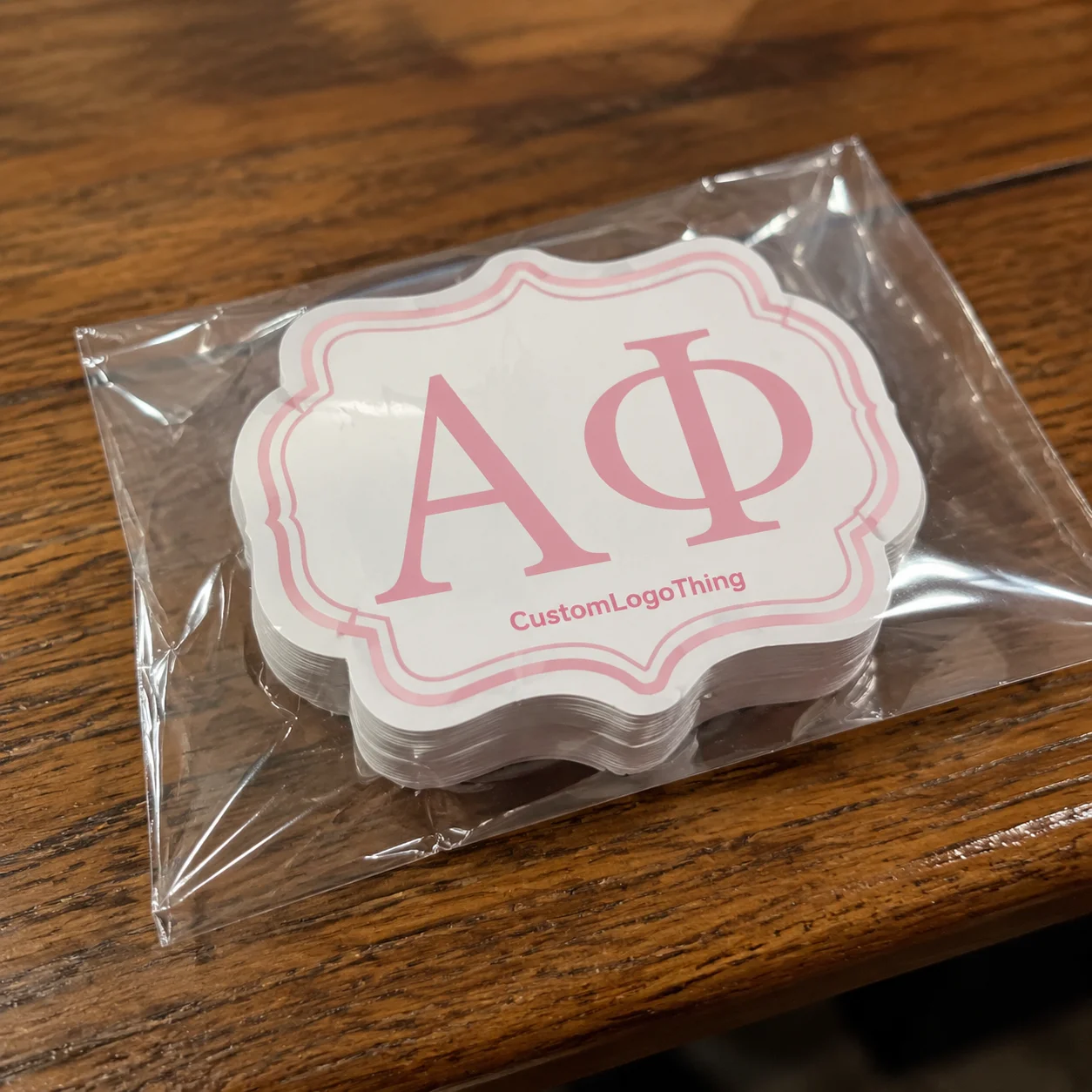
Custom sorority stickers are adhesive printed pieces made with chapter colors, Greek letters, mascots, event graphics, recruitment messaging, member names, slogans, or approved organization marks. Some are simple 2-inch circles used as envelope seals. Others are waterproof die-cut decals built for laptops, bottles, coolers, car windows, or outdoor philanthropy tables.
The practical list is wider than most first-time buyers expect. Stickers help with recognition, belonging, event wayfinding, merch bundles, fundraising, alumni mailers, welcome kits, and gift packaging. A bid day basket may use one sticker on the outside of a box, another inside tissue wrap, and a third as a keepsake. That turns a low-cost printed item into packaging with memory attached.
Rush week handouts need quick-read designs. Bid day reveal packs can be louder: larger shapes, brighter finishes, more theme-driven graphics. Big/Little gifts often require smaller batches or personalization. Philanthropy events may need sponsor-safe wording and a design that works on donation mailers as well as giveaway tables. Formal favors and retreat swag sit somewhere between retail packaging and keepsake merch.
The first trap is treating sorority sticker design like generic campus sticker design. Greek licensing rules, national organization marks, chapter identity, approved colors, and event-sensitive wording can matter more than the artwork trend. A phrase that looks harmless on a mockup can become a problem if it conflicts with national branding guidelines, campus policy, or a sponsor agreement.
Packaging buyer rule: decide where the sticker will live before deciding what it should look like. A mirror decal, water-bottle sticker, favor-bag seal, and alumni mailer label do not need the same material or budget.
Once the use case is settled, the rest of the order becomes less fuzzy. Format, finish, size, price, and timeline all follow from the environment where the sticker has to perform.
How Sorority Sticker Materials, Shapes, and Finishes Work
A sticker has more layers than it appears to. The basic anatomy includes a face stock, adhesive, printed ink, a coating or laminate, a kiss-cut or die-cut outline, and a backing liner. Change one layer and the finished piece can feel entirely different.
Paper stickers are the budget-friendly choice for indoor, short-term use: envelopes, notebooks, favor bags, tissue closures, hang tags, and event packaging. A 2-inch paper circle can be a smart buy for sealing 300 welcome envelopes because it does not need to survive dishwashers, sunscreen, or daily backpack abrasion.
Vinyl costs more, but it earns the upgrade when durability matters. White vinyl, clear vinyl, and weather-resistant decal stocks handle moisture and repeated handling better than paper. For laptops, water bottles, coolers, car windows, or outdoor event signage, vinyl is usually safer. Not always. If the sticker is going on a kraft favor bag for two hours, paper may be enough.
Finishes change both appearance and performance. Matte gives a softer boutique look, often useful for minimalist chapter branding. Gloss boosts color saturation and makes pinks, blues, and metallic-inspired graphics feel brighter. Clear works well on glass, bottles, and smooth packaging where the background should show through. Holographic material fits high-energy bid day themes, but it can reduce readability if thin white type sits over a busy rainbow reflection. Textured or soft-touch finishes can make gift kits feel more premium, closer to upscale product packaging.
| Sticker Type | Best Use | Typical Size Range | Relative Cost | Watch-Out |
|---|---|---|---|---|
| Paper circle | Envelope seals, favor bags, tissue wrap | 1.5 to 2.5 inches | Lowest | Not ideal for moisture or heavy handling |
| White vinyl | Laptops, bottles, coolers, merch tables | 2.5 to 4 inches | Medium | Needs clean artwork for small text |
| Clear vinyl | Glass, bottles, mirrors, sleek packaging | 2 to 4 inches | Medium to high | White ink may be needed for opacity |
| Holographic die-cut | Bid day, social themes, premium gifts | 2.5 to 5 inches | Higher | Busy reflections can fight detailed art |
Shape is the other major lever. Circles, squares, rectangles, and ovals are efficient to price and easy to produce. Custom die-cut shapes—Greek letters, mascots, crests, bows, stars, flowers, lightning bolts, or chapter icons—create stronger recognition but demand cleaner artwork. Intricate cut paths can slow production and are less forgiving around narrow stems, tight corners, or tiny negative spaces.
Size should be practical, not arbitrary. A 2-inch sticker suits favor bags, seals, and small notebooks. A 3-inch sticker is the classic laptop and water-bottle zone because it gives Greek letters and a short phrase enough room to breathe. Larger decals, often 4 to 6 inches, make sense for windows, mirrors, coolers, chapter house storage bins, or event signage.
Material choice should follow the environment. Dishwasher exposure, sunscreen, outdoor heat, backpack abrasion, and repeated handling all change the right specification. Standards bodies such as the International Safe Transit Association focus on transport testing for packaged goods, but the same mindset applies here: define the stress before choosing the build.
Design Specs That Make Greek Letter Stickers Look Clean
Artwork that looks sharp on a phone screen can fail in print. Screens are forgiving. Sticker cutters and ink are not. Thin outlines disappear, compressed social graphics pixelate, tiny script fonts fill in, and screenshots often carry hidden resolution problems that only become obvious after proofing.
For Greek letters, crests, mascots, and custom die-cut shapes, vector artwork is the safest file type. AI, EPS, SVG, or press-ready PDF files scale without losing edge quality. That matters because the same artwork may later be used for a 2.5-inch sticker, a 10-inch table decal, and future branded packaging. Clean source files save money over time.
Raster files can work if they are high-resolution. As a practical rule, avoid screenshots, copied social posts, and tiny PNGs pulled from a chat thread. Use original artwork when possible, and keep important details large enough to survive trimming, coating, and normal viewing distance. A flower pattern that looks elegant at 8 inches wide can turn into visual noise at 2 inches.
Three production terms matter more than almost anything else: bleed, safe zone, and cut line. Bleed is extra artwork beyond the final edge, often around 0.125 inch, that prevents accidental white slivers after cutting. The safe zone keeps text and key graphics away from the trim edge. The cut line tells the machine where to shape the sticker. If the cut line is jagged, too tight, or too complex, the finished sticker may look less polished than the mockup.
Color control deserves a sober conversation. PMS references, hex codes, and brand guides help, but printed color can shift based on vinyl versus paper, matte versus gloss coating, white versus clear stock, ink density, laminate, and normal screen differences. If a chapter color must be exact, ask about proofing options and provide a reference. If paper sourcing claims matter for a sustainability-minded event or mailer, the Forest Stewardship Council is a useful standard to recognize.
Small stickers need discipline. A 2.5-inch design may only have room for Greek letters, one icon, and a short phrase. That is not a creative failure. It is packaging design doing its job: hierarchy first, decoration second. Put the chapter identifier first, event or theme second, accents last.
- Good hierarchy: Greek letters, theme name, one supporting icon.
- Risky hierarchy: Greek letters, full event title, date, location, motto, mascot, pattern, and four fonts.
- Safer type choice: bold serif, clean sans serif, or readable script used sparingly.
- Risky type choice: hairline script below 8 points on a small decal.
Licensing should be checked before artwork approval. Greek letters are commonly used, but official crests, national marks, protected slogans, and some mascot artwork may require permission or must follow brand rules. Ask the advisor, national office, or campus licensing contact before printing official marks on sorority stickers that will be sold, mailed, photographed, or distributed at a public event.
Process and Timeline From Artwork to Delivery
The process is straightforward, but the handoffs matter. A typical order moves through seven steps: choose sticker type and quantity, submit artwork or request design support, receive a proof, approve or revise, move to production, pass quality checks, then ship. The project does not truly become a production order until the proof is approved.
The proof stage is where chapters should slow down for ten focused minutes. Verify spelling, Greek letters, event dates, color references, cut shape, size, quantity, and delivery address. Read it at actual size if possible. A sticker can look perfectly legible when zoomed to 400 percent on a laptop and crowded when printed at 2 inches.
Timelines vary by design complexity, proof response time, material availability, order quantity, finishing method, and shipping distance. Simple paper circles can often move faster than custom die-cut holographic vinyl because there are fewer variables. Specialty stocks, clear materials with white ink, intricate cut paths, and hand-bundled packaging all add steps.
Many standard sticker orders are planned around roughly 5 to 10 business days after proof approval, with complex work or larger quantities stretching beyond that. Rush orders may be possible, but rush usually compresses review time, not physics. Printing, curing, cutting, weeding where needed, counting, packing, carrier pickup, and transit still require real time.
Recruitment, bid day, and philanthropy orders deserve earlier starts because they involve more reviewers. The design chair may care about the artwork. The recruitment chair may care about messaging. The treasurer may care about quantity and price. An advisor may care about policy. Without one final decision-maker, a proof can bounce for three days while production waits.
- Set the in-hand deadline, not just the event date.
- Add a shipping buffer for campus mailrooms, apartment deliveries, or chapter house receiving.
- Work backward to the production window.
- Set a proof approval deadline.
- Submit artwork before that deadline, with one person authorized to approve changes.
If the order is part of a larger merch table or gift kit, coordinate sticker timing with other packaging pieces. Stickers often pair with Custom Labels & Tags, tissue, mailers, printed boxes, or hang tags. A delay in one small component can hold up the whole assembly.
Cost, Pricing, and MOQ Factors Chapters Should Expect
Sticker pricing is driven by size, material, finish, shape complexity, quantity, artwork help, packaging requirements, and shipping speed. The lowest quote is usually a simple paper sticker in a standard shape. A higher quote may involve waterproof vinyl, specialty film, clear stock, white ink, holographic material, tight die-cutting, or short-deadline shipping.
Unit cost usually drops as quantity rises because setup, proofing, file prep, machine calibration, and quality checks are spread across more pieces. A 2.5-inch paper circle may feel expensive at 100 pieces but much more efficient at 500. A vinyl die-cut often follows the same pattern. The fixed work is real, even if the finished object is small.
Exact pricing depends on the supplier and specification, but buyers can think in tiers. Small paper stickers for envelope seals and favor bags are often the lowest-cost option. Durable Vinyl Decals sit in the middle. Clear, holographic, textured, or intricate die-cut stickers cost more. Add rush production or expedited shipping and the budget changes again.
MOQ, or minimum order quantity, protects production efficiency. It can be frustrating for chapters that only need 80 pieces, but the printer still has to check the file, prepare the proof, set up the run, cut the material, count the order, and pack it. Compare the MOQ against actual attendance, extras for mistakes, future use, alumni mailers, and last-minute add-ons before assuming it is too high.
Hidden cost traps are predictable. Ordering too few and needing a second run is one. Choosing rush shipping because the proof sat unapproved is another. Submitting unusable artwork can add design time. Adding a special finish without a clear purpose can make the sticker prettier but not more useful. Chapters often lose money on uncertainty, not on the sticker itself.
Ask for two or three quantity breaks. The difference between 250 and 500 custom sorority stickers may be smaller than expected, especially for standard materials. If extra inventory can support future tabling, member gifts, social content props, or alumni notes, the higher quantity may be rational. If the design has a date or one-time theme, overordering can create dead stock.
Price should follow the use case. A temporary favor seal and a water-bottle decal should not be specified, or budgeted, the same way. Chapters ordering broader Custom Packaging Products should treat stickers as one part of the kit, not an isolated afterthought.
Common Ordering Mistakes That Delay Sorority Sticker Projects
The first mistake is submitting Canva exports, screenshots, or social media graphics without checking resolution, bleed, or transparent backgrounds. Canva can be useful for layout, but export settings matter. A low-resolution PNG with no bleed is not the same as a press-ready PDF with vector letters and a defined cut line.
The second mistake is casual proofreading. Misspelled chapter names, incorrect Greek letters, wrong event dates, and inconsistent abbreviations slip through when six people glance at a proof but no one owns approval. Assign one reviewer to check content line by line. Then assign one person to approve the final proof.
Material mismatch is another common problem. A chapter chooses paper because it is cheaper, then puts the sticker on water bottles, coolers, or outdoor event gear. The result may peel, wrinkle, or scuff quickly. The opposite happens too: premium waterproof vinyl for one-night favor bags. That is not a disaster, but the extra spend may be better used on quantity, cleaner artwork, or stronger retail packaging for the full gift set.
Overdesign hurts small stickers. Tiny taglines, multiple fonts, dense patterns, detailed crests, and fine outlines can turn muddy once printed. If the sticker is smaller than 3 inches, reduce the idea. One strong mark beats six weak details.
Late proof approval causes more delays than printing itself. The clock often starts after approval, not after the first inquiry. If a chapter requests a quote on Monday, receives a proof Tuesday, debates revisions until Friday, and needs delivery the following week, the production window has already shrunk.
Quantity mistakes are just as common. Chapters forget advisors, alumni, new member bags, table displays, staff, sponsor packets, photo props, damaged pieces, and backup inventory. A safe planning number often includes event attendance plus 10 to 15 percent extra, though dated event designs should be ordered more carefully.
Shipping addresses deserve boring precision. Campus mailrooms, apartment complexes, and chapter houses can introduce delays if suite numbers, building names, phone numbers, access instructions, or signature requirements are missing. If delivery must arrive before recruitment setup at 9 a.m., do not rely on a vague address and hope.
Future reorders are easier when the chapter saves one final approved file and one order record. Put the artwork, invoice, dimensions, material, finish, quantity, and supplier notes in the chapter drive. Future officers should not have to rebuild a successful project from screenshots.
Next Steps Before You Place a Sticker Order
Before requesting a quote, define the event and the application. Will the sticker seal tissue paper, decorate a laptop, label a gift box, dress up a mailer, or sit in a merch bundle? That single answer narrows the material, size, finish, and budget faster than any mood board.
Then estimate quantity with real categories. Count active members, potential new members, advisors, alumni, staff, table samples, gift baskets, sponsor packets, photo extras, and replacement pieces. If the design is evergreen, order more. If it includes a date, event theme, or officer name, be conservative.
Separate must-haves from nice-to-haves. Official colors, readable Greek letters, correct spelling, and delivery date are usually critical. Holographic stock, textured finishes, custom backing cards, and specialty packing may be optional. They are not automatically wasteful; they should simply earn their place in the budget.
A one-page order brief helps. Include the chapter name, event name, sticker use, preferred dimensions, material preference, quantity range, delivery address, in-hand date, artwork files, color references, and approval contact. For a busy printer or packaging supplier, that brief removes guesswork.
- Event: recruitment, bid day, philanthropy, formal, retreat, alumni mailer, or chapter store.
- Application: water bottle, laptop, envelope, favor bag, mirror, cooler, gift box, or mailer.
- Specification: paper, white vinyl, clear vinyl, matte, gloss, holographic, kiss-cut, or die-cut.
- Deadline: in-hand date plus shipping buffer, not only the event date.
- Approval: one person responsible for final proof review.
Request at least two options if the budget is still moving. A paper version and a durable vinyl version can show the real tradeoff. So can pricing at 250, 500, and 1,000 pieces. A quote is not only a price; it is data for the chapter’s decision.
Review the proof on a laptop, not only a phone. Check spelling, Greek letters, color notes, trim, cut shape, and readability at actual size. If possible, print the proof on a desktop printer at 100 percent scale, cut it roughly, and hold it near the item it will decorate. Crude test. Very useful.
Finally, save the final artwork, invoice details, reorder notes, and supplier contact in the chapter drive. Officers rotate. Files vanish. Good documentation keeps the next order from becoming a scavenger hunt. Before ordering custom sorority stickers, match the design and material to the event, timeline, and budget so the final pieces feel intentional instead of rushed.
FAQ
What size should custom sorority stickers be for bid day bags?
A 2.5-inch to 3-inch sticker usually works well for bid day bags because it is large enough to show Greek letters and a theme graphic without overpowering the rest of the gift. Use smaller 1.5-inch to 2-inch stickers for envelope seals, tags, tissue paper closures, or small favor packaging.
Are sorority vinyl stickers better than paper stickers?
Vinyl is better for laptops, water bottles, coolers, cars, and outdoor use because it handles moisture and abrasion better. Paper is usually better for short-term indoor packaging, mailers, notebooks, favor bags, and lower-budget event handouts.
How early should a chapter order custom Greek stickers?
Start once the event theme and quantity are known, especially for recruitment, bid day, or philanthropy events with fixed dates. Build in time for artwork prep, proof review, revisions, production, shipping, and campus mailroom handling.
What affects the price of custom sorority decal orders most?
The biggest pricing factors are quantity, size, material, finish, die-cut complexity, artwork support, and shipping speed. Requesting multiple quantity breaks can reveal whether ordering more pieces lowers the unit cost enough to justify extra inventory.
Can custom sorority stickers use official Greek letters and crests?
Greek letters are commonly used, but official crests, national marks, and protected slogans may require permission or must follow organization branding rules. Chapters should confirm national guidelines or advisor requirements before approving artwork for print.


