Custom tie boxes are part protection, part presentation. They keep the fold intact, control movement in transit, and give the product a cleaner retail read. For neckwear, that matters because buyers judge fast. If the pack looks weak, oversized, or awkward to open, the tie starts at a disadvantage no matter how good the fabric is.
The right order of decisions is structure, then material, then branding. Print and finish are visible, but they cannot fix a box that crushes, gaps, or wastes space. For brands comparing packaging formats, it is usually better to think in terms of the full system. A box that works on shelf, in warehouse handling, and in parcel delivery is more valuable than one that only looks good in a mockup. That is why sourcing through a broader Custom Packaging Products portfolio can be more efficient than trying to adapt a generic carton to an accessory line.
What Custom Tie Boxes Do on Shelf and in Transit
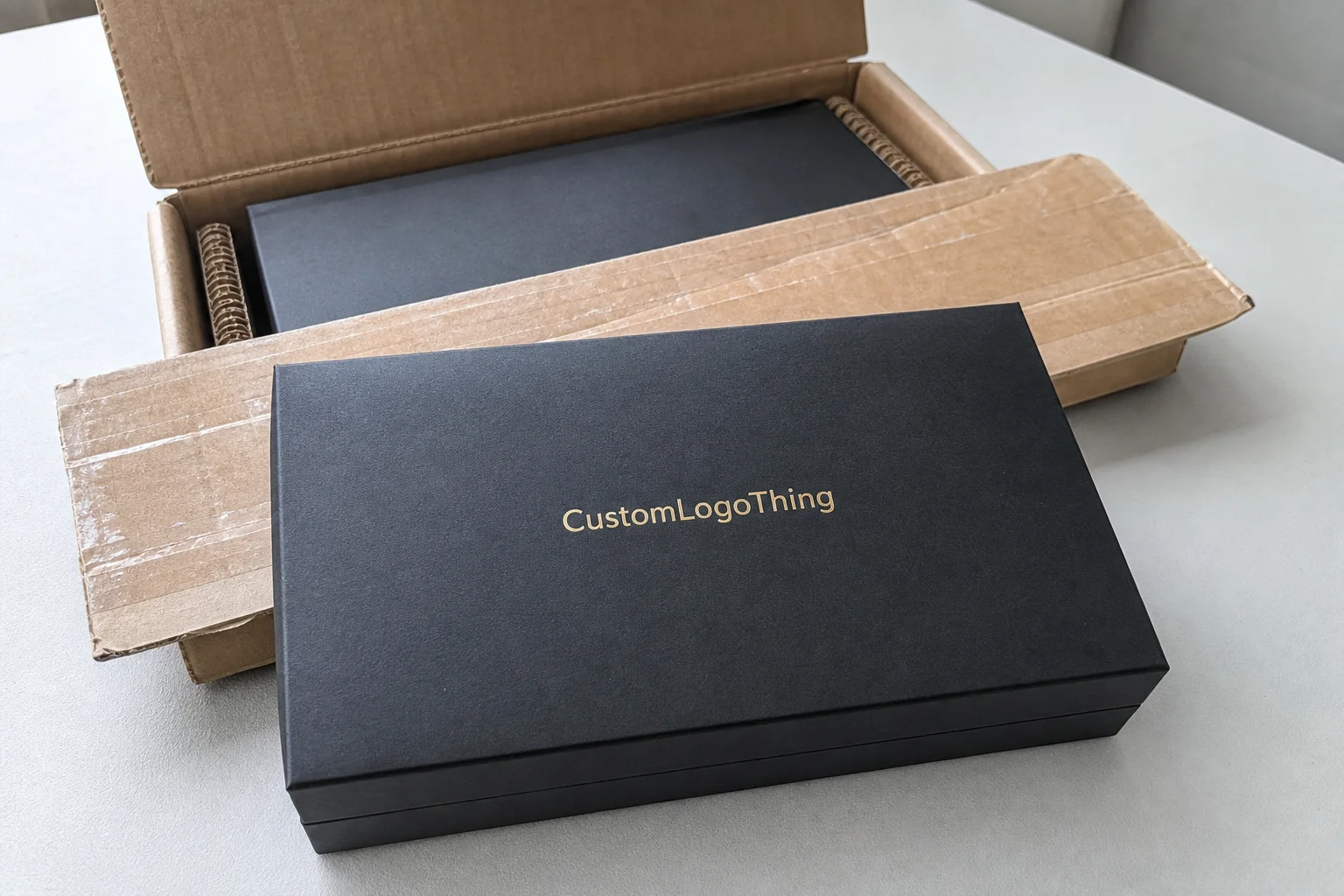
A tie is small, but the packaging carries a lot of the perceived value. A well-built box creates an immediate cue that the product is organized, protected, and intended to be gifted or displayed. If the dimensions are off or the lid flexes, the tie can feel less premium even when the garment itself is strong.
On shelf, the box helps the product stack cleanly and keeps the front face consistent across SKUs. In transit, it reduces wrinkling, edge damage, and loose movement that can make the item look handled. That is not just cosmetic. A folded tie in a rigid pack looks deliberate. The same item in a loose sleeve often reads as lower value.
Packaging also affects pricing power. Private label accessories, seasonal launches, and gift sets rely on presentation to support margin. The box does not create value by itself, but it can reinforce the value already in the product. When the range includes multiple tie designs, the packaging standard should stay consistent so the line feels intentional rather than pieced together.
How the Box Structure, Inserts, and Finishes Work
Structure is the main cost and experience driver. A folding carton is efficient for retail and lower-budget programs. Rigid Setup Boxes are heavier, sturdier, and more premium, but they cost more to make and assemble. Drawer boxes sit between those two options. Magnetic Closure Boxes add ceremony, though they also add tolerance risk if the fit is not controlled tightly.
The inside matters as much as the outside. Inserts determine whether the tie sits flat, shifts during shipping, or creases at the edges. Paperboard inserts are usually the most practical starting point. Tissue wraps work well when the brand wants a lighter, softer presentation. Foam improves retention but adds complexity and can weaken sustainability claims unless the use case truly needs it. If recycled content or chain-of-custody claims matter, ask whether the full construction supports them and whether FSC-certified board is available for the chosen build.
Finishes should do one job, not five. Matte lamination reduces glare and usually photographs well. Soft-touch adds a tactile premium feel, though it can show wear if the boxes are handled heavily. Foil, embossing, and spot UV are most effective as accents. Overusing them on a lightweight structure usually makes the packaging look busy instead of refined. For shipping-heavy programs, it is worth checking the design against common distribution testing approaches such as those used by ISTA. If sustainability claims will appear on-pack, verify material sourcing through FSC rather than assuming a board grade is enough.
Key Sizing, Material, and Branding Factors to Decide First
Start with the folded tie, not the box. Measure the finished length, width, and thickness after the tie is folded the way it will actually ship or display. Then add enough clearance for the insert and lid so the box closes without compressing the fabric. Too tight leaves marks. Too loose allows movement and makes the product look underpacked.
Material choice should follow the channel. Paperboard is often enough for retail shelves and lighter gift programs. Ecommerce needs more crush resistance because the box has to survive stacking, corner pressure, and repeated handling in parcel networks. A pack that looks fine on a desk can fail once it enters shipping flow.
Branding should match the audience and the surface area. Minimal typography and restrained color usually suit formal neckwear and premium gifting. Stronger color blocks or seasonal artwork can work for promotional lines or broader fashion programs. What does not work well is trying to say everything on a small box panel. Good package branding depends on visual discipline and practical layout, including space for barcodes, SKU labels, and readable copy.
Before locking the dieline, confirm the following:
- Folded tie dimensions and insert clearance
- Retail, gifting, or ecommerce use case
- Board thickness and crush resistance target
- Barcode, SKU, and label placement
- Finish compatibility with handling and shipping
Step-by-Step Guide to Ordering the Right Pack
Ordering custom packaging goes faster when the brief is specific. Vague instructions create samples that look fine in theory but fail in practice. A supplier can produce custom printed boxes accurately, but only if the buyer gives clear inputs before artwork is finalized.
- Define the use case. Decide whether the box is for retail display, gifting, subscription fulfillment, or direct-to-consumer shipping.
- Collect exact measurements. Provide the folded tie size, closure preference, insert needs, and target quantity.
- Review the dieline first. Confirm the structure before the artwork is designed. That prevents expensive rework later.
- Request a physical sample. A sample reveals fit, opening feel, board stiffness, and print behavior better than a screen proof.
- Approve the production proof. Check copy, barcode placement, color tolerance, and assembly time before signoff.
Experienced buyers ask for both structural and print samples because the failure modes are different. A box can look balanced on screen and still fail in the hand. The lid may rub, the insert may sit too high, or a logo may cross a fold line and distort once the board is creased. Those are small issues until they repeat across a run.
Packaging that takes extra effort to open, fold, or store creates cost in two places: production and operations.
That is why a pilot run is often the cheapest form of risk control. It exposes fit issues, assembly friction, and color problems before the full order is committed. For seasonal launches or gift-led collections, that step is usually worth more than a faster approval on paper.
Cost, Pricing, and MOQ: What Actually Drives the Quote
Packaging pricing is mostly a function of structure, material, print coverage, insert type, and finish complexity. A simple folding carton will usually sit at the low end. A rigid box with foil and embossing will sit higher because it uses more material, more labor, and more setup time.
MOQ matters just as much. Smaller runs carry more overhead per unit because die cutting, plates, press setup, and finishing costs are spread across fewer boxes. That is why a 500-piece order can look disproportionately expensive next to a 5,000-piece run, even when the design is simple. The quote reflects fixed production work, not just the box itself.
Planning ranges are useful for budgeting, but they are not firm pricing. Supplier location, shipping mode, material grade, and decoration method all move the number.
| Style | Best Use | Typical Unit Range | What Moves the Price |
|---|---|---|---|
| Printed folding carton | Retail shelf, budget gift sets | $0.35-$0.85 | Print coverage, coating, board thickness |
| Drawer box | Mid-premium presentation | $0.85-$1.80 | Rider fit, pull ribbon, insert style |
| Rigid setup box | Premium gifting, specialty collections | $1.50-$3.50+ | Greyboard weight, wrap material, foil, embossing |
| Magnetic closure box | High-end unboxing, gift programs | $2.00-$4.50+ | Magnet count, assembly time, finish depth |
Tiered quotes are more useful than a single number. Ask for pricing at multiple quantities so the breakpoints are visible. Sometimes the jump between 1,000 and 3,000 units is small enough to justify the larger buy. Sometimes it is not. The point is to see the curve before the design is locked.
Process and Lead Time: From Dieline to Delivery
Lead time depends on complexity, but the sequence is predictable: brief, structural design, artwork, proofing, sampling, production, finishing, packing, and freight. Each stage has a different failure mode. Miss one approval or delay one revision, and the schedule slips.
A straightforward printed carton can move faster than a rigid box with specialty finishes. A new dieline adds time. Tight color matching adds time. A seasonal order placed close to peak shipping periods adds even more. These are normal constraints, not exceptions, so the safest schedule is the one that assumes some revision time.
Physical samples are the practical way to validate the design. They show whether the tie sits flat, whether the closure feels secure, and whether the artwork still looks clean once the board is folded and glued. They also expose slow assembly, awkward nesting, or a box that is hard to pack at scale. Those are production problems, not minor details.
For transit-sensitive programs, ask how the box will be validated. Some teams use methods aligned with common distribution testing practices, including ISTA-style profiles. That is not a guarantee, but it is a better way to assess risk than relying on appearance alone. A box can look sturdy and still fail under load.
Build in revision time for color shifts, copy changes, and barcode adjustments. The most reliable projects leave room for one or two corrective rounds instead of assuming every detail will be perfect on the first proof.
Common Mistakes That Make Tie Packaging Look Cheap
The fastest way to weaken a tie package is to oversize it. Empty space makes the product feel less considered and increases movement during shipping. A tie that rattles in transit rarely arrives with the same visual discipline it had at packing.
Another common problem is asking thin board to carry too much visual weight. Dense graphics, dark solids, and high-gloss coatings can look muddy on weak material, especially near folds and score lines. The result is not premium. It is visually tired. A simpler layout on a stronger substrate usually performs better and photographs better.
Closures matter more than teams expect. A weak hinge, loose flap, or sloppy magnetic alignment reads as poor quality almost immediately. Even when the tie itself is excellent, the pack can drag down the perception of the entire item. Buyers rarely separate the two.
Assembly problems are another hidden cost. If the box is hard to fold, slow to fill, or inconsistent from unit to unit, the warehouse pays for it. Labor rises, mistakes increase, and the packaging begins to look worse simply because it is harder to handle. In that sense, design quality includes operations quality.
- Avoid large unused cavities inside the box
- Do not bury the logo in a finish that dulls it at normal viewing distance
- Keep inserts simple unless the product truly needs higher retention
- Check stackability, storage, and opening behavior before mass production
Decoration cannot rescue weak fundamentals. Foil will not fix a mis-sized box. Embossing will not solve a poor closure. The box has to work as a package first and a branded object second. That order is easy to forget and expensive to ignore.
Expert Tips and Next Steps Before You Request Quotes
Before requesting quotes, build a one-page spec sheet. Include dimensions, quantity, use case, board preference, insert needs, finish options, shipping method, and whether the box must support retail packaging or ecommerce transit. That one document usually does more to improve quote quality than several rounds of email clarification.
Ask for two pricing paths if the project allows it. One should optimize for cost. The other should optimize for presentation. Seeing them side by side makes the tradeoff concrete. Sometimes the premium version is only slightly more expensive and is worth the difference. Sometimes the cost jump is too steep for the channel. Either way, the comparison should be visible before the order is committed.
If the packaging supports a launch, a gift set, or a seasonal program, sample early. That matters more when the brand wants the box to feel refined while the shipping environment is rough. That tension is common in custom tie boxes: the customer should see elegance, while the warehouse still needs something practical, stackable, and easy to close.
Use the final review to evaluate fit, cost, and assembly time together. A box that looks sharp but slows fulfillment is not efficient. A box that is inexpensive but weak in transit is not efficient either. The strongest option is usually the one that balances presentation with production reality.
For brands building a wider accessory line, it helps to think about how tie packaging fits with other categories in the same range. Consistent board, print logic, and finish choices can make the line feel more deliberate without making every box identical. That kind of coherence reads as control, which is often what premium packaging is trying to communicate.
What size custom tie boxes do I need for a standard necktie?
Measure the folded tie first, then add enough clearance for the insert and lid depth. The goal is to keep the tie flat without compressing the fold or forcing the edges against the wall of the box. If the box will ship, size it for presentation and transit protection together.
Do custom tie boxes need inserts or can the tie sit loose?
Loose placement can work for a very short retail display cycle, but most brands use inserts. Inserts keep the tie centered, reduce shifting, and help the box open with a cleaner presentation. A simple card insert is often enough unless the design is especially premium or the product has a shape that moves easily.
How much do custom tie boxes cost at smaller quantities?
Smaller runs usually cost more per unit because setup and production overhead are spread across fewer boxes. The price rises faster with rigid construction, foil, embossing, and custom inserts. Ask for multiple quantity tiers before approving the design so you can see where the price break actually is.
What is the usual lead time for custom tie boxes?
Lead time depends on structure, print complexity, sampling needs, and order size. A simple printed carton is faster than a rigid box with special finishes. Add time for dieline development, proof revisions, sample approval, and freight, especially if the order lands near a peak season.
What finish makes custom tie boxes feel premium without overspending?
Matte or soft-touch lamination usually gives a premium feel without pushing cost as aggressively as full embellishment. A single accent such as foil or embossing can lift the design without overcomplicating production. The best finish is the one that fits the brand and still holds up during handling and shipping.
The strongest custom tie boxes are usually not the loudest. They fit properly, ship cleanly, and present the product with enough restraint to let the tie do its job. When structure, finish, and insert work together, the packaging stops being an accessory to the product and becomes part of the buying decision.


