Custom Velvet Jewelry boxes change the way a piece is read before anyone touches the jewelry itself. That sounds soft, almost intangible, but packaging buyers see the effect every day: the same ring can look like a routine item in a paper carton and a far more considered purchase in a velvet presentation box. The box does not create value out of nowhere, yet it changes how quickly value is recognized.
That is why velvet continues to show up in bridal sets, gift packaging, limited releases, and higher-margin SKUs. The material carries a visual weight that plain folding cartons rarely match. It also photographs well, which matters more than many teams admit. A package that looks strong on a retail shelf but dull in an online listing is only doing half the job.
If you are comparing box formats for a broader line, it helps to review the available Custom Packaging Products early, since the jewelry box, shipper, and accessory packaging usually need to work as one system.
The real decision is not whether velvet looks premium. It does. The real decision is whether the construction, insert, decoration, and cost structure fit the jewelry line without creating avoidable problems in production or transit.
Custom Velvet Jewelry Boxes: Why They Change Perceived Value
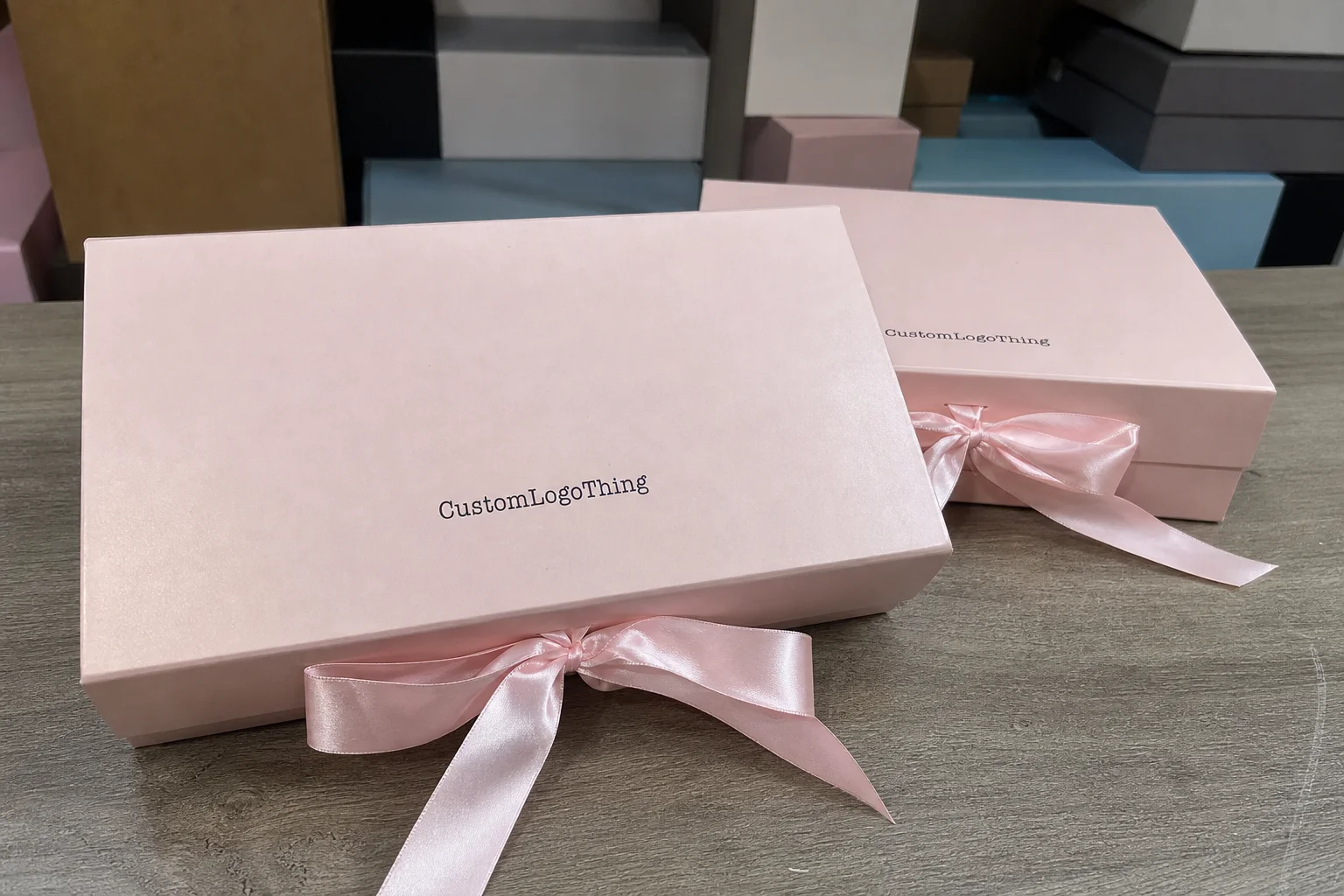
Consumers tend to judge jewelry packaging in seconds. Velvet helps because it signals softness, ceremony, and care immediately. It is closer to a presentation object than an ordinary box, which is exactly why it works for items bought as gifts or kept as mementos.
Compared with plain paperboard, velvet adds tactile depth. Compared with glossy finishes, it usually feels less commercial and more deliberate. Deep navy, black, burgundy, and forest tones are common because they absorb light in a way that makes the box feel richer. Lighter colors can work, but they reveal compression marks, lint, and handling faster, so the quality bar rises quickly.
That visual logic matters most for rings, earrings, pendants, and bridal sets. Those items often depend on the presentation moment to reinforce price. If the product is meant to feel giftable, collectible, or high-touch, the packaging cannot look like an afterthought.
Practical takeaway: if the jewelry is sold on presentation as much as on materials, the box should reinforce that promise from the first glance through the close.
The box also carries a branding job. Velvet gives enough texture that the decoration should usually stay restrained. A foil mark, a small deboss, or a metal emblem can be enough. Overloading the surface with badges, ribbons, and multiple finishes can make the box feel crowded rather than premium. A good package is often memorable because it is controlled, not busy.
For teams building a wider packaging system, the box should sit comfortably beside the rest of the line. That is where planning across Custom Packaging Products becomes useful. A velvet box, shipping carton, and accessory insert should feel like parts of one product family, not isolated purchases made one by one.
How Velvet Box Construction Affects Feel and Protection
A velvet jewelry box is usually built on rigid board or paperboard, then wrapped in velvet or a velvet-like outer material. Inside, the lining may be satin, suede-like, flocked, or another soft finish depending on budget and intended use. The outer wrap creates the first impression, but the insert decides whether the jewelry stays in place or rattles around in transit.
Board thickness is one of the first specs worth checking. A thinner shell can reduce cost, but once the box gets too large or the jewelry too heavy, the package starts to feel soft. For premium jewelry packaging, rigid board around 1.5 mm to 2.5 mm is common, although the right level depends on box size, closure style, and how much stress the package will take in shipping.
Common closure styles
Tuck lids are simple and usually keep costs lower. They work for lighter pieces and promotional runs, though they do not always feel as ceremonial as a hinged box. Hinged lids give a more formal presentation and are common in bridal or gifting formats. Magnetic closures add a satisfying close and often make the box feel more substantial, but they also increase material cost and can complicate assembly.
Ribbon pulls and similar accents can add polish, but they should have a job. If the ribbon only decorates the lid and does not improve handling, it can look ornamental in a way that feels disconnected from the rest of the build. Buyers often assume small decorative details are cheap to add; in practice, they can increase labor and inspection time more than expected.
Velvet quality deserves the same scrutiny. Short-pile velvet typically looks cleaner, resists snagging better, and packs more predictably. Higher-pile velvet feels richer, but it can mark more easily and may show movement during transit. The difference is not just visual. It affects reject rates, packing speed, and how often boxes need to be wiped or brushed before use.
Insert options that actually work
For rings and stud earrings, die-cut foam or flocked inserts are common because they keep the item centered and upright. Pendants and necklaces need more room for chain length, clasp shape, and the way the piece naturally falls when opened. Bridal packaging often needs layered cavities or a tray-plus-cushion arrangement so each component stays visible without crowding the others.
There is no shortcut here: test the actual jewelry in the actual insert. Dimensions on paper are not enough. A ring that fits nominally can still sit too low, tilt to one side, or press against the lid once the package is assembled. A necklace can also appear awkward if the chain path was not planned carefully.
In quality checks, buyers should inspect closure tension, edge alignment, pile consistency, and whether the insert compresses the jewelry too much. If the piece slides, the package feels cheap. If the piece is forced in, the packaging becomes a risk to the product.
Cost, Pricing, and MOQ Factors to Compare
Pricing for velvet jewelry packaging is driven by a handful of concrete variables, and the quote usually makes more sense once those are separated. Size comes first. Larger boxes use more material, need larger inserts, and take more labor to wrap and finish. Board grade comes next because heavier board improves stiffness and perceived quality. Velvet quality also matters, especially if the fabric is tight, even, and less prone to visible marks.
Decoration changes the number quickly. Foil stamping, debossing, printed logos, metal labels, custom color matching, and specialty ribbons all add cost. Each extra step also adds the chance of a defect or a registration issue, which is why two boxes that look similar can price very differently.
MOQ is where many buyers get surprised. Smaller runs almost always cost more per unit because setup, cutting, tooling, and assembly are spread across fewer boxes. A test run of 300 pieces can be sensible for a launch, but the unit economics are rarely as friendly as a 5,000-piece order. In market terms, a simpler velvet jewelry box in moderate volume may fall around $0.80-$1.60 per unit, while more complex structures with magnetic closures, custom inserts, or multiple decoration steps can run higher depending on quantity and finish.
| Option | Typical Spec | Relative Unit Cost | Best Use Case |
|---|---|---|---|
| Basic velvet tuck box | Standard board, simple insert, one-color logo | Lower | Entry-level gift packaging and seasonal promos |
| Rigid velvet hinged box | Heavier board, lined interior, foil logo | Medium | Core jewelry line and retail presentation |
| Magnetic velvet presentation box | Rigid board, foam insert, ribbon detail | Medium to higher | Premium launches and bridal sets |
| Custom-matched luxury build | Special color, complex insert, multiple decorations | Higher | Brand-defining collections and limited editions |
The best way to compare quotes is to ask for the build spec line by line. Otherwise, one supplier may be quoting a thinner shell, lower pile velvet, or simpler insert while another is quoting a heavier structure with better finishing. A single bottom-line number tells you very little unless the construction is identical.
For sourcing and materials language, a few outside references can help teams stay aligned. The FSC certification framework is useful if your team needs traceability language around fiber-based components. If waste reduction is part of the brief, the EPA remains a practical source for general material and waste terminology.
Production Steps and Lead Time From Sample to Shipment
Most projects start with a spec confirmation. That should include dimensions, jewelry type, insert style, logo method, velvet color, quantity, and destination. If that information is incomplete, the quote may look fast but the project will slow down later when the sample does not fit the product or the decoration method is unclear.
After the brief is reviewed, a sample is usually made. That sample is doing a lot of work: it confirms fit, closure pressure, decoration placement, color, pile behavior, and whether the structure feels stable in hand. If the box will be opened and closed often, the closure should be tested more than once. One clean open is not enough to judge long-term handling.
After approval, full production begins. A typical lead time often lands around 12-20 business days after sample approval, although custom color matching, insert revisions, or nonstandard materials can extend that. Shipping sits on top of production, and the difference between air and sea freight can change the calendar by more than the packaging itself.
Where schedules usually slip
Artwork changes are a common cause. A logo that needs resizing, a foil line that is too thin, or a mark that sits too close to the edge can stop the run until the proof is corrected. Insert revisions are another frequent delay, especially when the jewelry sits too low or the cavity is too tight. Material sourcing matters too, particularly if the velvet shade is unusual or the board spec is not stock.
There is also a planning mistake that shows up often: people assume every order should move at the fastest possible pace. It usually should not. A simple run may need a week or two for sampling, another one to three weeks for production, and then transit time after that. Complex builds need more room. If the launch date is fixed, the schedule should include buffer time rather than assuming the first sample will be the final sample.
Fast feedback from the buyer side is one of the few things that can genuinely shorten the lead time. Slow approvals create drag, and that delay is hard to recover once a batch enters the line.
Common Mistakes That Create Delays or Weak Presentation
The most common mistake is sizing the box by appearance instead of function. A box can look right on screen and still fail once the jewelry is inside. If the cavity is too loose, the piece shifts and the package feels cheap. If it is too tight, prongs, posts, clasps, or chains can be stressed during packing and opening.
Color is another issue that buyers underestimate. Velvet is rich, but it is also sensitive to light and camera settings. A shade that looks elegant in a sample room can read flat or muddy in photos, especially if the pile reflects light unevenly. If the box is part of an e-commerce program, ask for images under more than one lighting condition before approving the final shade.
Skipping sample review is expensive because that is where the real problems surface. Logo placement, lid alignment, closure pressure, lining wrinkles, and edge finish are all easier to fix before production than after the cartons are closed. A mistake that looks minor in a prototype can create a large reject rate once the order scales.
Overdesign causes its own problems. Too many finishes, too much hardware, or too much contrast can make the box feel visually noisy. The jewelry should still be the focus. A velvet box should support the piece, not compete with it.
Rule of thumb: if an added feature does not improve protection, presentation, or brand recognition, it probably does not belong on the spec sheet.
One more issue is inconsistent packout. If the insert, outer wrap, and carton are handled differently from one batch to the next, the customer experience changes even when the artwork stays the same. That kind of drift is hard to detect on paper and easy to notice in the hand.
Expert Tips for Sizing, Inserts, and Brand Fit
Start with the sales channel. A retail shelf box needs a clear face and strong visual readability. An e-commerce box needs more crush resistance and a structure that survives secondary packaging. Bridal presentation boxes can justify a richer open-and-close sequence, while everyDay Gift Packaging usually has to stay closer to a practical cost ceiling.
Test the actual jewelry, not a drawing or a guess. Small design details change fit more than people expect. A necklace with a large clasp, an earring with a long post, or a ring with an oversized setting may need more room than the nominal dimensions suggest. Even a few millimeters in insert depth can change how polished the package feels.
Brand restraint usually wins. One good logo application, a carefully selected velvet shade, and a well-fitted insert are often enough. First-time buyers of branded packaging sometimes assume premium means more decoration. In practice, premium usually means cleaner decisions and tighter tolerances.
The package should be judged on three basics: it protects the jewelry, presents it cleanly, and reopens without strain. If any one of those fails, the experience drops quickly. That standard is simple, but it is more reliable than a long list of cosmetic features.
For brands building across formats, consistency matters. A jewelry box, outer mailer, and accessory package should feel like part of the same system. That is where packaging design becomes more than surface styling. It sets expectations before the product is even opened.
If sustainability is part of the brief, ask whether the board content can be traced or whether the supplier can document material origin. That does not solve every environmental question, but it does give procurement teams a clearer basis for comparison.
What to Prepare Before You Request a Quote
A good quote starts with a complete brief. Before contacting a supplier, gather the jewelry type, exact dimensions, target quantity, closure preference, logo method, velvet color, insert needs, and delivery window. If the piece is unusual in shape or weight, include reference images or a sample. Those details reduce revision cycles and keep the estimate anchored to the actual build.
Use a checklist like this:
- Construction: rigid board, tuck lid, hinged lid, or magnetic closure
- Outer finish: velvet color, pile type, and texture preference
- Insert: foam, flocked tray, die-cut cavity, or custom shape
- Decoration: foil stamping, debossing, printed logo, label, or metal accent
- Quantity: trial run or full production volume
- Packaging method: individual wrap, master carton, or retail-ready packout
- Timeline: sample date, approval date, ship date
That level of clarity makes pricing more meaningful. Two boxes can look similar in photos and be built very differently underneath. One may use a heavier shell, better velvet, and a more secure insert; another may be cheaper because it trims those details. The difference shows up in hand feel, wear resistance, and how the finished piece is perceived.
If you are ordering Custom Velvet Jewelry Boxes for a launch, ask for a sample before committing to the full quantity. One sample can confirm the color under real light, the logo visibility, and whether the jewelry sits correctly. It is a small step compared with the cost of fixing a bad full run.
In short, the best results come from a clear brief, a careful sample review, and a realistic schedule. Done that way, the box does not just hold the jewelry. It supports the sale, protects the piece, and makes the product feel finished.
Frequently Asked Questions
The questions below cover the parts of custom velvet jewelry boxes that usually affect pricing, lead time, and fit. If you are comparing formats, it can also help to review Custom Packaging Products so the box spec matches the broader packaging system.
How much do custom velvet jewelry boxes usually cost per unit?
Unit price depends on size, velvet grade, insert complexity, logo method, and order quantity. Smaller runs cost more per box because setup and labor are spread across fewer units. In moderate volume, simpler builds may fall around $0.80-$1.60 per unit, while more complex versions with magnetic closures, custom inserts, or multiple decoration steps can cost more.
What affects the lead time for custom velvet jewelry boxes?
Lead time is shaped by sample approval, material sourcing, decoration setup, and production volume. Custom colors, layered inserts, or multiple revision rounds usually add days or weeks. A complete spec sheet and quick feedback on samples are the most effective ways to keep the schedule moving.
What size should I choose for rings, earrings, or necklaces?
Choose the box around the actual jewelry plus the clearance needed to secure it in the insert. Rings and studs usually need compact cavities, while necklaces and pendant sets need more interior depth and chain room. The safest method is to test the real piece in a sample instead of relying on nominal dimensions alone.
Can I add a logo to custom velvet jewelry boxes?
Yes. Common methods include foil stamping, debossing, printed logos, labels, and metal accents. The best option depends on the velvet color, the complexity of the artwork, and the level of finish you want to project. A sample is the only reliable way to check visibility and placement before production.
What should I send to get an accurate quote for custom velvet jewelry boxes?
Send box dimensions, quantity, jewelry type, insert needs, logo artwork, preferred color, and target delivery date. If possible, include photos or a sample spec so the supplier can price the correct structure. The tighter the brief, the fewer surprises in pricing, sample revisions, and lead time.


