Personalized Brown Bags: What Actually Matters Before You Place an Order
Personalized brown bags look straightforward until the order is under pressure. The paper has to carry the product, the print has to hold up on a darker surface, and the finished bag has to make sense for the way customers actually use it. A bag that leaves the counter, rides in a car, and gets reused later is doing more brand work than a logo on a shelf tag ever will.
That is why the strongest orders start with use case, not artwork. A bakery bag, a boutique bag, and a trade show handout are not variations of the same thing. They differ in load, dimensions, handle style, print area, and the amount of visual contrast the artwork needs to remain readable at arm's length. Buyers who define those constraints first usually avoid the most expensive mistakes later.
What Personalized Brown Bags Actually Are
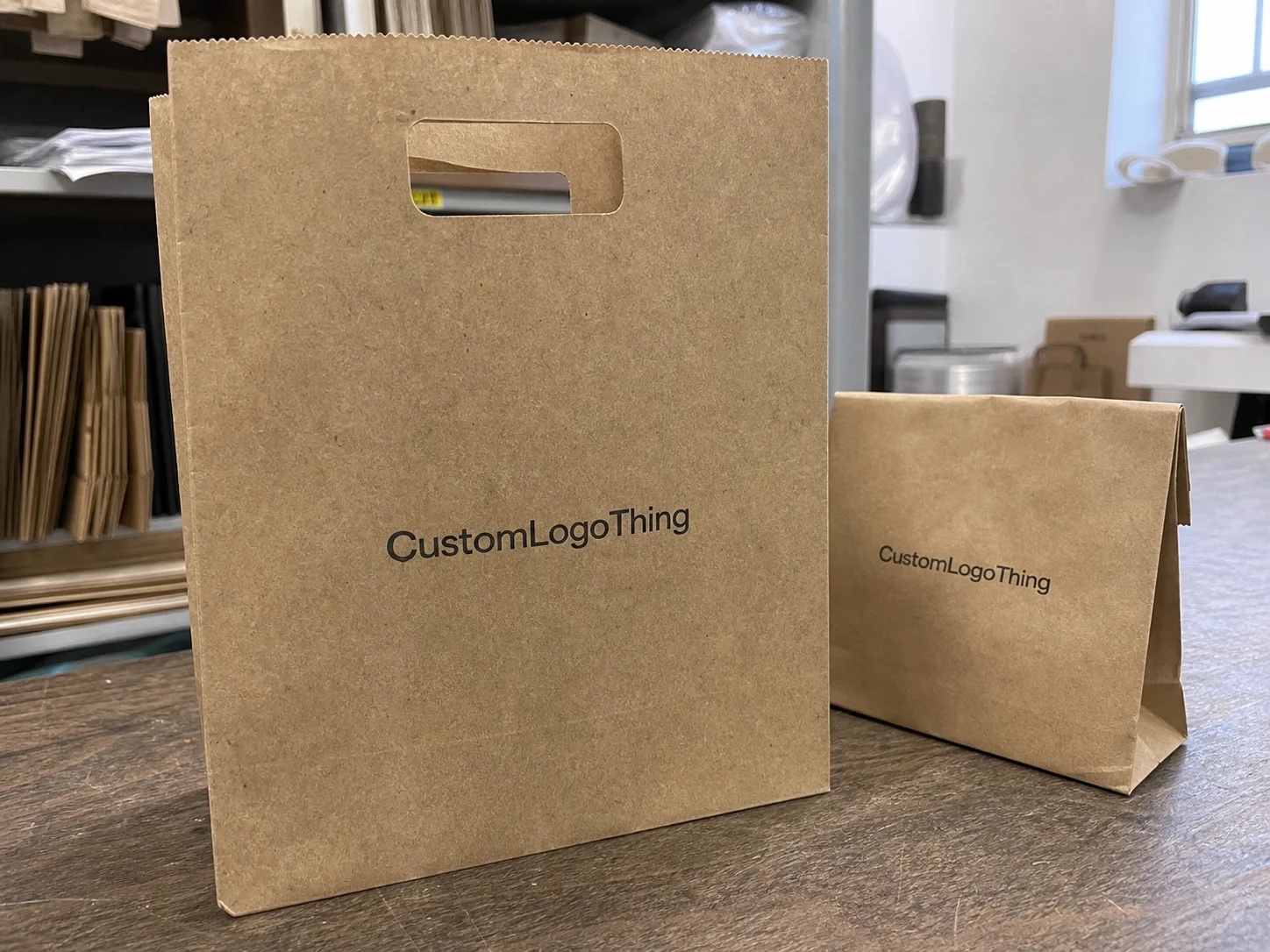
Personalized brown bags are Printed Paper Bags, usually made from kraft stock, that carry a logo, seasonal graphic, message, or pattern. The brown base gives the bag a practical, grounded look that works across food service, retail, gifting, and events without feeling overdesigned. For many brands, that restraint is the point.
Kraft is not one material so much as a family of paper choices. Lighter bags often use paper in the roughly 60-90 gsm range, while stronger retail or takeaway bags move into heavier stock. The exact number matters less than whether the paper, handle, and bottom construction match the load. A pretty bag with weak seams is still a weak bag.
Brown stock also changes print behavior. Ink sits differently on unbleached kraft than on white paper, so small type, thin rules, and low-contrast colors can lose clarity fast. A one-color logo with clean edges often outperforms a clever but delicate layout. The surface is working against you before the press ever starts.
That does not mean the design has to be minimal. It means the design has to be legible. A simple mark, a bold wordmark, or a short seasonal message usually survives kraft better than fine gradients, tiny taglines, or artwork that depends on subtle shading. If the brand message cannot be read from a few feet away, the print system is doing too much.
The bag style matters as much as the graphics. Flat paper bags, SOS grocery-style bags, and twisted-handle retail bags each carry differently and present differently at checkout. Flat bags are efficient for lightweight items. SOS bags stand up better for foodservice and boxed goods. Twisted-handle bags signal a more retail-oriented presentation and usually tolerate more frequent reuse. Choosing the wrong structure is a common reason an order feels underwhelming even when the print itself is fine.
There is also a subtle but important difference between a bag that looks good in a mockup and a bag that performs in the hand. Texture, rigidity, gusset depth, and handle attachment all affect how the finished piece feels. A customer notices that immediately, even if they never think about it in technical terms.
How Production, Proofing, and Lead Time Work
Most custom bag orders follow a predictable path: artwork intake, file cleanup, proof creation, proof approval, printing, drying or curing, finishing, and packing. The process is not complex. The delays come from ambiguity. If the artwork is not press-ready, if the bag dimensions are still being argued, or if different teams are reviewing different versions of the file, time disappears quickly.
Vector artwork is usually the safest starting point. It holds edges cleanly, scales without distortion, and reduces the chance that logos or text will soften in print. If raster files are the only option, resolution matters, but so does simplicity. A high-resolution file packed with thin details can still fail on kraft if the print area is small or the contrast is weak.
Lead time depends on what the order actually needs. Stock bags with one-color print can move relatively quickly if the supplier already has blank inventory. Once the order adds multiple colors, special inks, foil, custom sizing, or heavier finishing, the calendar stretches. A practical planning window for straightforward jobs is often 10-15 business days after proof approval. Custom structures, imported paper, or busy seasonal periods can push that longer.
That estimate is only useful if the approval chain is clear. If marketing wants one change, operations wants another, and purchasing is waiting for a third sign-off, the clock keeps restarting. The cleanest orders are the ones with one owner for the final proof and one source of truth for the spec.
A proof should answer three questions before anyone signs off: does the artwork read cleanly, does the bag carry the intended load, and does the schedule still work if there is one more round of edits?
For sustainability or transit checks, buyers often ask for documentation rather than claims. If paper sourcing matters, request FSC chain-of-custody records from the supplier. If shipping durability matters, a packaging team can borrow from transit-testing thinking such as the methods described by ISTA. Neither step replaces a real sample, but both give purchasing a firmer standard than a marketing sentence.
When a project is organized well, personalized brown bags are usually a production problem, not a creative one. The hard part is not printing the logo. It is making sure the printed bag still works after folding, handling, shipping, and real customer use.
Cost, MOQ, and Unit Price Drivers
Unit price is driven less by the logo than by the physical spec around it. Quantity, paper weight, handle type, print coverage, number of colors, and finishing all affect the final number. Setup costs matter too. The smaller the run, the more those fixed costs show up in each bag.
That is why a small order can look expensive without being overpriced. If a supplier has to prepare plates, calibrate color, or set up a custom run, those costs do not vanish just because the order is small. Larger quantities spread the setup over more units, but they also increase inventory risk. A buyer who orders too much to save a few cents can end up with boxes of obsolete bags.
| Option | Typical MOQ | Directional Unit Price | Best For |
|---|---|---|---|
| Stock kraft bag, one-color logo | 500-1,000 | $0.18-$0.35 | Retail counters, small events, basic brand visibility |
| Twisted-handle retail bag, one or two colors | 1,000-3,000 | $0.28-$0.55 | Boutiques, gift shops, apparel, higher perceived value |
| Heavier kraft bag with custom print coverage | 3,000-5,000+ | $0.40-$0.85 | Premium retail, larger products, repeated reuse |
| Special finish or complex artwork | Usually 5,000+ | Varies widely | Campaign launches, seasonal programs, high-impact branding |
Those figures are directional. Freight, paper market swings, regional labor, and production capacity all move the final quote. A low quoted unit price can also hide setup, proof, plate, or art-revision charges, which is why the landed cost matters more than the headline number.
Ask for the full picture. That means the printed bag price, setup fees, proof charges if any, shipping, and rush costs if the timeline is compressed. Heavy stock changes freight math more than buyers expect. A thicker kraft bag can cost more to move than a lighter one even before printing enters the conversation.
MOQ is not just a procurement issue. It affects design freedom. A seasonal design can justify a smaller run so the brand is not stuck with old artwork. A stable retail program can absorb a larger run if the bag is reused across many months. The correct quantity is the one that fits demand, not the one that simply looks efficient on paper.
Spec Choices That Change Look and Performance
The spec is where appearance and function finally collide. Width, gusset depth, handle style, paper weight, and printable area all influence how the bag behaves in use and how the print reads from a distance. A bag that looks polished in a proof but collapses under weight is a bad buy, no matter how clean the artwork is.
Natural kraft gives a warmer, more tactile look. A smoother or coated stock can make print edges sharper and colors more consistent. Very glossy finishes, however, can work against brands that want an earthy or artisanal feel. The finish should support the message, not overpower it.
Color contrast deserves more attention than it usually gets. Brown paper absorbs and alters color in a way white stock does not. Thin lines, pale inks, and detailed gradients can flatten out. For many buyers, a strong single-color logo in a darker ink is the most reliable path. It is less dramatic on screen and more dependable in print.
Performance details matter too. Reinforced handles help with bottled drinks, boxed items, and heavier retail purchases. Gusset depth controls capacity and shape. Bottom construction affects whether the bag stands on its own at checkout. For food service, seam integrity and grease resistance are not optional. A bag that fails under takeout conditions becomes a liability fast.
Common print methods also have tradeoffs. Digital printing is useful for short runs and complex artwork, but the economics can shift quickly as quantity rises. Flexographic printing tends to suit repeatable one- or two-color branding better. The right method depends on run size, artwork complexity, and how closely the color needs to match other brand assets.
The table below is a useful shorthand when buyers are comparing spec paths:
| Spec Choice | Visual Effect | Functional Impact | Buyer Tradeoff |
|---|---|---|---|
| Light kraft, minimal print | Natural, understated | Lower cost, lighter carry capacity | Good for small retail items and inserts |
| Heavier kraft, stronger handles | More substantial, premium feel | Better for weight and reuse | Higher unit price and shipping weight |
| High-contrast one-color logo | Clear and readable | Lower print risk | Less visual complexity, better legibility |
| Full-front artwork | Higher brand impact | More setup and tighter proof control | Higher cost and more revision sensitivity |
The safest version is not always the simplest, but it is often the most disciplined. If the bag has to survive customer handling, short-term reuse, and mixed lighting, clarity tends to matter more than ornament.
Step-by-Step Buying Checklist From Artwork to Approval
Start with the payload. Measure the widest product, then add space for tissue, inserts, or a box. If the item will be carried farther than a few steps, handle comfort and bag stiffness become part of the requirement, not an afterthought.
- Confirm the payload and dimensions.
- Choose the bag style based on weight and customer use.
- Set the print goal, including side count and visual intensity.
- Prepare vector artwork where possible.
- Review color expectations against brown stock, not against a white monitor background.
- Request a proof and check placement, safety margins, and type size.
- Approve the full spec, including count, packaging, and ship date.
- Keep a master file for the next reorder.
The proof deserves more scrutiny than it usually gets. A logo can look fine in isolation and still fail once it lands near a handle anchor, a gusset fold, or a bottom seam. Look at the bag as a whole object. Ask whether the artwork is readable from three to five feet away, whether the smallest text still holds shape, and whether the negative space feels intentional rather than accidental.
One mistake buyers make is reviewing the art and the construction separately. They are not separate. If the logo is centered beautifully but sits in a zone where the bag folds during assembly, the result can still look awkward. Good proof review is mechanical in the best sense: dimensions, placement, contrast, and fold behavior all checked in the same pass.
If three departments approve the bag, one person still needs ownership of the final version. Otherwise the spec drifts, and every future reorder becomes a negotiation.
For repeat programs, a written control file is worth more than a folder of old emails. Keep the approved artwork, exact dimensions, paper weight, handle type, print colors, quantity history, and any notes about shipping or packaging. That reduces drift between runs and makes reordering faster without guessing.
Ordering Mistakes That Inflate Reorders
The most expensive mistake is choosing the bag by appearance before capacity. A bag can look polished on screen and still fail in use if the gusset is too narrow or the handles are not rated for the load. Once customers notice weak construction, the brand pays for the original order and the replacement run.
Artwork problems create a different kind of loss. Thin fonts, tiny taglines, and complex gradients often degrade on textured kraft. Buyers sometimes catch the issue only after the proof is printed, which means the file has to be fixed and reviewed again. Vector art and simplified typography reduce that risk before it reaches production.
Overdesign causes its own damage. A busy layout may feel strong in a mockup, but once it is mapped onto the real printable area, it can crowd seams, handles, or folds. That creates awkward placement and more revisions. In practice, a cleaner composition often looks more confident than an overworked one.
Lead time is another area where teams overpromise and under-plan. "We need them soon" is not a schedule. Rush orders narrow the available print methods, increase the chance of freight cost spikes, and leave less room for approval changes. If the event date cannot move, everything else should be arranged around that fixed point.
Inventory planning matters too. Most buyers should budget a small overage for spoilage, testing, drop damage, and unexpected demand. A 2% to 5% buffer is common for cautious programs, especially when the bags support openings, holiday peaks, or pop-up retail. Ordering exactly to the last piece is efficient only until the first shipment arrives damaged.
Finally, some teams forget that the bag is a system, not a single object. The paper, ink, handle, and packaging method all interact. If one piece changes between reorders, the customer may not be able to explain what feels off, but they will notice it anyway.
Expert Next Steps for a Faster, Cleaner Order
Three inputs speed up almost any quote request: quantity, dimensions, and use case. If those are missing, the supplier has to assume too much, and assumptions cost time. A clean brief is more useful than a prettier logo file.
Ask for quotes that separate setup from unit cost. That makes comparisons honest. One vendor may look cheaper up front but make up the difference through revision charges, freight, or a less efficient MOQs structure. Another may quote a higher unit price but include more of the work in a cleaner total. The only way to compare them fairly is to see the full stack of costs.
If the order allows flexibility, compare two versions. One can prioritize visual impact with heavier paper or fuller print coverage. The other can prioritize repeatability with a simpler one-color layout on a standard kraft bag. That side-by-side view usually makes the tradeoff obvious without a long discussion.
For repeat programs, the best improvement is not a new mockup. It is a written standard. Keep one approved spec and use it until the business case changes. Bags ordered from memory tend to drift by small but noticeable amounts, and those small differences are exactly what create inconsistency across stores, events, or seasons.
Personalized brown bags work best when they are treated as packaging infrastructure rather than an accessory. Once the bag spec is stable, the order becomes easier to quote, easier to approve, and easier to reorder without rethinking the whole project.
What size personalized brown bags should I order for retail items?
Choose the width and gusset around the widest product, then add room for tissue, inserts, or a box. If the item is boxed, measure the box first and leave clearance so the top does not buckle when the bag is closed.
How much do personalized brown bags usually cost per unit?
Price depends mostly on quantity, print complexity, and the bag spec. Smaller runs usually cost more per bag because setup charges are spread across fewer pieces, while larger runs reduce the unit number more efficiently. As a directional range, stock kraft bags with one-color printing often land in the low cents to mid-30-cent range, while heavier or more elaborate programs can move well above that.
What artwork format is best for personalized brown bags?
Vector files are usually the safest choice because they scale cleanly and keep logos sharp on textured kraft. If raster art is the only option, send the highest-resolution version available and confirm the supplier can reproduce it without soft edges or pixelation in small text.
How long does production usually take for personalized brown bags?
Timeline depends on proof approval, stock availability, print method, and whether the order needs custom finishing. Straightforward stock orders can often ship in 10-15 business days after approval, while custom specs or busy seasonal periods may take longer. Build in buffer for revisions and freight.
What is the biggest mistake buyers make with personalized brown bags?
They choose by appearance first and capacity second. That leads to weak handles, poor fit, or artwork that disappears against kraft stock. The stronger buying decision is the one that fits the product, the timeline, and the brand without pretending those three things are identical.

