Personalized christmas gift labels do more than decorate a package. They help a gift feel specific, even before the box is opened. That matters because presentation often does half the work in holiday gifting: a folded sweater in a plain carton can look ordinary, while the same item with a clean custom label reads as deliberate and finished.
For buyers, these labels are also practical. They keep names straight when multiple gifts are stacked together, give tissue wraps and garment boxes a cleaner look, and add a branded or family-specific touch without pushing the budget into premium territory. If you need a place to compare formats, Custom Labels & Tags is a useful starting point because it brings the material, adhesive, and finish decisions into one view.
The real value is not only aesthetic. A good label survives handling, reads clearly at arm’s length, and adheres to the actual surface it will live on. That sounds basic, but holiday orders go wrong when people choose by mockup instead of use case. A label that looks polished on screen can still fail on a textured box, a coated mailer, or a tissue-wrapped apparel set.
Why personalized christmas gift labels feel more useful than generic tags
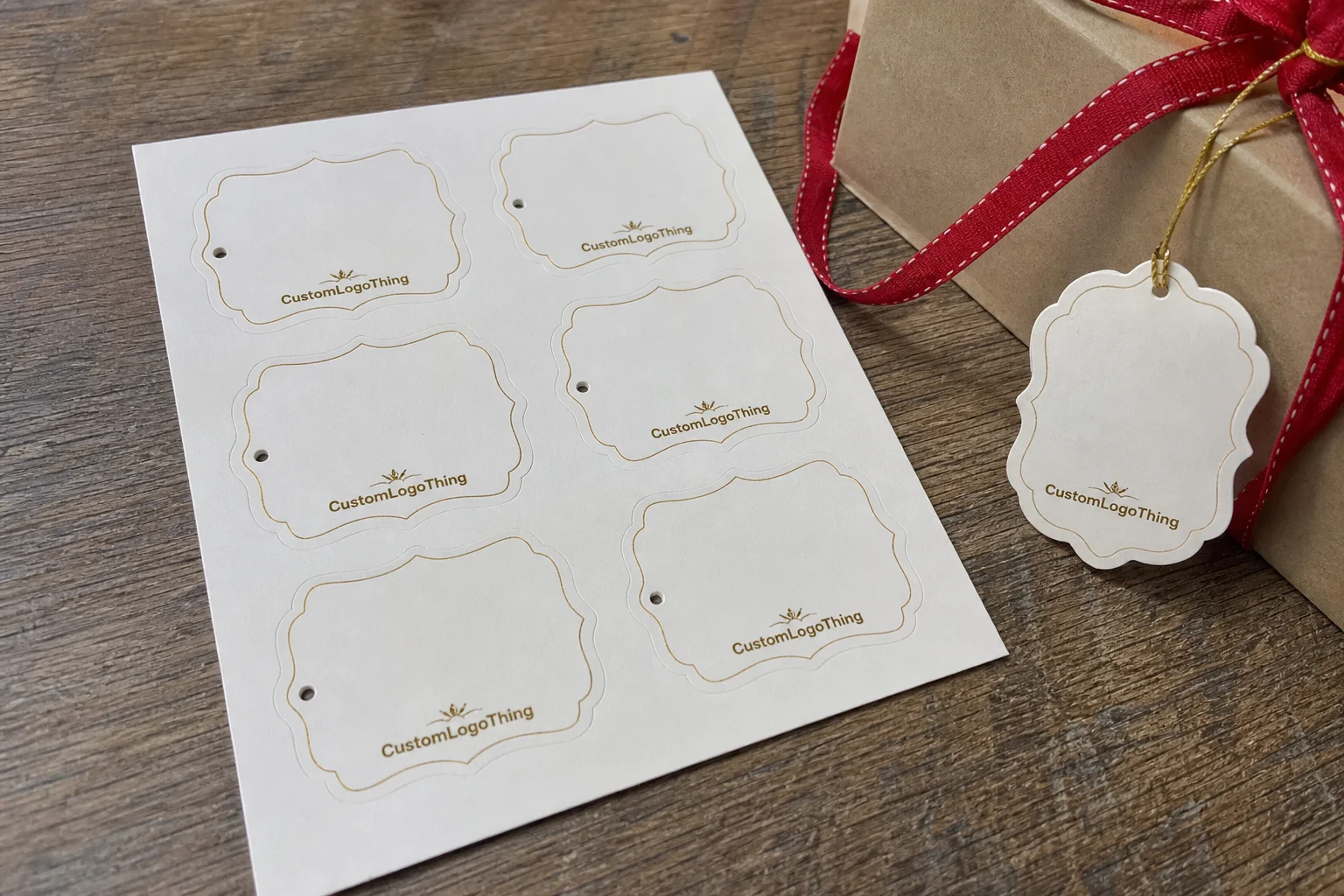
Generic tags identify a package. Personalized christmas gift labels create a small sense of ownership around it. That difference is easy to dismiss until you are managing a stack of gifts for a family, a boutique, or a corporate holiday send. At that point, the label is doing two jobs at once: organizing the pile and improving the presentation.
They are especially effective for clothing gifts because apparel packaging tends to rely on restraint. A shirt or sweater does not need heavy ornamentation. It needs a clean box, a neat wrap, and one visible cue that says the recipient was considered when the package was assembled. A custom label handles that cue without adding bulk.
There is also a visual reason they work. Human attention notices contrast, order, and specificity before it notices price. That is why a modest package can look more premium with a restrained, well-placed label than with ribbon, oversized bows, or extra filler. Packaging is often a low-cost psychological signal, and labels are one of the most efficient ways to use it.
From a production standpoint, labels are a compact piece of print work with a long list of choices: stock, adhesive, size, print method, and finish. Each choice changes how the final piece behaves. Matte paper feels quiet and handmade. Gloss reads brighter. Soft-touch adds a richer surface feel. Foil can lift a simple layout, but only if the composition has enough space to breathe.
The practical rule is simple: start with the package, not the decoration. A label that fits the box, sticks to the surface, and remains readable after handling will always outperform a prettier option that was chosen too early.
How the label production process and turnaround actually works
Most label orders follow the same path: artwork, proof, production, packing, shipping. Delays usually happen at one of those handoffs. If the timeline feels uncertain, the issue is often not the press time itself. It is the time lost waiting for approvals, correcting files, or clarifying what the order is supposed to look like.
The buyer typically supplies names, a short greeting, any logo or family mark, quantity, and intended surface. That last part is easy to overlook, but it affects almost everything. A label for a garment box needs different proportions than one meant for a tissue seal or a gift bag. If the use case is missing, the proof often comes back with cramped type or awkward spacing.
Proofing is where most quality control lives. It catches spelling mistakes, layout problems, crop line issues, and color mismatches before any stock is wasted. The better the proof process, the fewer unpleasant surprises later. A rushed approval is useful only if the proof has actually been checked against the final packaging dimensions.
Turnaround depends on the print method and finish. Basic digital printing is usually the fastest path. Foil stamping, embossing, custom die-cut shapes, and textured stocks add setup and handling time, so the schedule stretches. For a straightforward order, production may move in a few business days. Specialty work can take longer, sometimes a week or two more, depending on quantity and finishing complexity.
Approval speed matters more than many buyers expect. A file can be ready for the press, but if the proof sits untouched for several days, the order does not move. Holiday work tends to expose this problem because the packaging deadline is fixed while the proof queue is not. That is why a buffer is essential, especially if the labels need to arrive before wrapping begins.
Shipping adds another variable. A label order is small enough to look easy, but transit still counts. If the package has to cross regions during peak season, add extra time. For teams that care about handling quality, standards and guidance from organizations such as the International Safe Transit Association help frame how printed items should be packed and shipped so they arrive usable, not curled, scuffed, or crushed.
Cost, pricing, MOQ, and what changes the unit cost
Label pricing is usually built from six variables: setup, quantity, stock, print method, finish, and shipping. Buyers often focus on the per-piece number and ignore the rest, which is how an apparently cheap quote turns into an expensive order once setup and freight are added. The unit price matters, but the total order cost matters more.
Quantity has the largest impact on unit cost. A short run carries a heavier share of setup work, so each label costs more. That is normal manufacturing behavior, not an arbitrary markup. The press still needs calibration, the artwork still needs checking, and the stock still needs feeding whether the order is 100 pieces or 5,000.
Minimum order quantity exists for the same reason. It protects efficiency and keeps very small runs from becoming unreasonably expensive to produce. Some vendors can accommodate low quantities, but the convenience comes with a higher per-label price. For a single family batch, that may be acceptable. For broader holiday gifting, larger runs usually make more financial sense.
| Option | Typical use | Approx. unit cost | Tradeoff |
|---|---|---|---|
| Standard paper label | Simple box seals, tissue wraps, name labels | $0.10-$0.22 at 5,000+ pieces | Lowest cost, less durable on rough surfaces |
| Coated matte or gloss label | Cleaner color, stronger presentation | $0.14-$0.30 at 5,000+ pieces | Better look, modest price increase |
| Foil or specialty finish | Premium gift sets, brand-forward packaging | $0.25-$0.60+ depending on complexity | Higher setup and longer turnaround |
| Custom shape or textured stock | Distinctive holiday presentation | Quoted case by case | More design and tooling cost |
Those ranges move with coverage, stock thickness, die shape, and the amount of finishing work required. A simple printed label with restrained ink coverage is usually the most budget-friendly option. Waterproof stock, metallic foil, soft-touch coating, and custom cuts all push the price up because each one adds handling or material cost.
There are also hidden costs that show up later. Artwork revisions take time. Last-minute quantity changes can force a new press plan. Rush shipping adds a premium, and complex shapes can require additional tooling. None of that is unusual. It is just what happens when the order asks more from production than the first quote assumed.
If the labels are for one holiday season and the use is straightforward, speed and clarity usually win over premium effects. If the labels will be reused across multiple gift types, or they need to support a stronger brand impression, then the extra cost of a better stock or finish can be justified. The right answer depends on use, not just appearance.
Choose the right material, size, and finish for gift packaging
Material should match the surface it will touch. Paper labels work well on dry indoor wrapping, clean carton tops, and gift bags with a smooth finish. Coated stocks sharpen color and reduce the dullness that can happen on cheaper paper. If the package will be handled frequently or travel a long distance, tougher stock is usually worth the small increase in cost.
Size deserves more discipline than it usually gets. Small labels suit tissue seals, hangtags, and compact closures. Larger labels are better for box tops or gift bags where the label needs to carry more visual weight. If the label is too small, it looks accidental. If it is too large, it dominates the package and makes the rest of the design feel crowded.
Adhesive is where buyers often make the wrong assumption. A label that performs well on a smooth carton may behave differently on textured kraft, coated board, or tissue wrap. Some applications need strong hold. Others need cleaner removal so the wrapper is not torn during unboxing. That distinction matters more for clothing gifts, where the label may sit on a garment box, a folded tissue layer, or a delicate bag surface.
Finish changes tone immediately. Matte feels restrained and handcrafted. Gloss is brighter and more retail-driven. Soft-touch has a premium feel in the hand, but it is not always the best value if the package is handled briefly. Metallic accents can be sharp when the layout is simple. Clear labels can work well on the right background and disappear badly on the wrong one. The finish only works if the rest of the package supports it.
Typography is another place where packaging either succeeds or gets noisy. Holiday designs often already have pattern, texture, and color competing for space. Small type and weak contrast disappear quickly. A better approach is a clear hierarchy: recipient name first, greeting second, any brand or family detail after that. There is no prize for squeezing in more information than the label can carry comfortably.
For buyers comparing presentation with application constraints, references from the Packaging Machinery Manufacturers Institute and related packaging standards are useful. The point is not to make a gift label technical for its own sake. It is to remember that packaging is both visual and physical, and both sides have to work.
Step-by-step: ordering personalized christmas gift labels without mistakes
Start with the package surface. Box top, tissue wrap, gift bag, shipping carton, or garment tag. That decision sets the size, adhesive, and finish. Many ordering mistakes come from choosing a design first and forcing it onto a surface later. The result may be visually fine in a mockup but wrong in practice.
Next, simplify the message. A label does not need to explain everything. It needs to identify the gift, fit the space, and read cleanly. Long greetings, decorative quotes, and multiple brand elements often become clutter on small formats. Good packaging design gives the eye a place to rest.
Then request a proof and compare it to the actual package dimensions. A screen image is not enough. A proper proof should make the layout, cut line, color direction, and finish notes clear. Check spelling, line breaks, spacing, alignment, and quantity. If anything feels vague, ask for clarification before approving. Every unclear proof becomes a more expensive problem later.
Testing a sample order is a practical move when the labels are for a boutique, a recurring family tradition, or a larger gifting program. One small run tells you more than a dozen opinions. You can see whether the adhesive grabs the surface correctly, whether the color reads as expected under normal room light, and whether the size feels balanced in hand.
- Confirm names, wording, and punctuation before quoting.
- Measure the real package instead of estimating from a photo.
- Check whether the surface is coated, rough, or fabric-adjacent.
- Ask how the labels will be packed for shipping and storage.
- Keep the approved file for repeat orders next season.
Holiday timing needs slack. Add room for proof revisions, production, transit, and the occasional issue in the chain. That is not pessimism. That is a realistic schedule. If the deadline is tight, order before wrapping starts, not after. Once the gifts are stacked and the labels are still in transit, the process has already become more expensive than it needed to be.
It also helps to keep the artwork organized for future reuse. If the same personalized christmas gift labels will be used across different clothing gifts or family batches, save the exact size, font, finish, and color values in one place. Rebuilding the same file every year is wasted effort. A stable master file makes reordering faster and keeps the presentation consistent.
Common mistakes that waste money and create sloppy holiday packaging
Overdesigning a small label is one of the easiest ways to ruin a good package. Fine details, tiny script, and too many decorative elements lose clarity fast once the design is scaled down. What looks elegant on a monitor can become visual noise on a two- or three-inch label.
Choosing finish based only on appearance causes a different kind of problem. A glossy label may look strong in a mockup, but it can be less forgiving on textured kraft or tissue wrap. Presentation is not only about the finish itself. It is about how that finish interacts with the actual package surface.
Ignoring surface type is another expensive habit. Adhesive performance varies on coated board, rough paper, bag stock, and wrapping materials. If the packaging is slippery, heavily textured, or likely to be handled a lot, test the label before committing to a full run. The least useful discovery is the one that arrives after the order has been printed.
Late ordering is the classic holiday problem. Rush production helps sometimes, but it does not erase proofing, setup, shipping, or stock availability. A compressed timeline usually increases cost and reduces flexibility. That is a poor trade, especially for a piece of packaging that is supposed to make the gift feel calmer, not more frantic.
Skipping proof review is the most avoidable mistake of all. One typo on a holiday label is visible immediately, and the cost of fixing it after production is high. Fast approval is only useful when the proof has been checked carefully. Otherwise, speed just moves the error from the file to the printed order.
Buying the cheapest option without checking the use case can also backfire. Cheap is acceptable when the application is simple. Cheap and wrong is not. That usually means weak contrast, flimsy stock, or adhesive that does not suit the surface. The label then undermines the rest of the package instead of supporting it.
Finally, consistency matters. Mixed fonts, random sizes, and mismatched colors make the batch look assembled in a hurry. A cohesive set feels more intentional, even when the materials are modest. That is one of the quieter truths of packaging: order and restraint usually look more expensive than excess.
Expert tips for cleaner design, smoother ordering, and better gifting
Keep the hierarchy simple. Recipient name first. Holiday greeting second. Brand or family detail last. That structure helps the eye understand the label quickly and keeps the smallest element from becoming cluttered.
Use high-contrast combinations. Black on pale matte stock. White on dark paper. Deep green on kraft. These pairings work because they stay readable at a glance. If the wrapping paper is busy, the label should get simpler, not louder.
Save a master spec sheet. Include dimensions, font names, color values, stock, adhesive, finish, and any production notes. The next order becomes much easier when the file is documented properly. Without that record, even a familiar design can turn into a guessing exercise.
If the labels are tied to clothing gifts, coordinate them with hangtags or care cards so the whole package speaks the same visual language. A consistent system always looks more deliberate than a collection of decent pieces that do not relate to each other.
Use physical samples whenever color matters. Screens are a poor judge of print color, especially with metallic tones, deep reds, and dark greens. A sample or test print reveals how the label behaves under normal room lighting and against the actual package surface.
Plan quantities around real use, not ideal use. Holiday wrapping tends to generate waste through last-minute changes, damaged pieces, or extra gifts that were not counted at the start. Ordering a little more than the exact minimum can be smart. Ordering a box full of leftovers because the plan was fictional is not.
Seasonal wording should be useful beyond a single day when possible. A flexible greeting can carry into later use, while highly date-specific wording can make leftover stock feel stranded in January. That matters if the order is larger than one household batch.
“The cleanest holiday packaging is usually the one that finishes the gift without shouting over it.”
Next steps: compare specs, request a proof, and order early
Begin with the package surface, then choose the label size and adhesive to match it. That order saves time and reduces the most common fit problems. Once the surface is defined, gather the wording, quantity, and any artwork so pricing reflects the real job instead of assumptions.
Ask for a proof and check the timing before you approve anything, especially if the labels have to arrive before wrapping day. If you are uncertain about stock or finish, a small test order is worth the extra step. Holiday schedules are unforgiving, and the cheapest insurance is a little extra lead time.
For repeat gifting, keep the design structure stable and change only the parts that need to change. That gives you cleaner reorders and a more consistent presentation year after year. The best personalized christmas gift labels are not the most complicated ones. They are the ones that fit the package, survive handling, and arrive when needed.
FAQ
What size should personalized christmas gift labels be for clothing gifts?
Small labels work best for tissue seals, hangtags, and compact package closures. Larger labels fit box tops or gift bags that need a stronger visual presence. If the name is long, choose a wider format so the text stays readable without shrinking the font too much.
How much do personalized christmas gift labels usually cost?
Cost depends on quantity, stock, finish, shape, and shipping. Simple printed labels are the most affordable, while foil, textured stock, and custom cuts cost more. Unit price usually drops as the order size increases, so the cheapest per-piece option is often the larger run, not the smallest one.
What is the normal turnaround for personalized christmas gift labels?
Simple printed orders are usually faster than specialty finishes or custom die-cut shapes. Proof approval can affect the schedule as much as production itself. If the labels are needed for holiday wrapping, add transit time and leave enough buffer for one revision.
Can personalized christmas gift labels be used on clothing packaging?
Yes. They work well on folded apparel boxes, tissue wrap, garment bags, and hangtag bundles. The key is matching the adhesive and stock to the surface. If the package is delicate or textured, test adhesion before committing to a full order.
What should I check before approving the proof?
Check spelling, spacing, line breaks, quantity, size, color direction, and finish notes. Compare the proof to the actual box, bag, or wrap rather than relying only on the screen preview. Make sure the label remains readable and proportionate once placed on the final package.