Personalized gable boxes do more than carry a product from one place to another. They add structure to the handoff, make the package feel deliberate, and give the buyer a brand touchpoint before the box is even opened. That matters because packaging usually gets judged fast, and the wrong box can make a good product look unfinished.
For bakeries, party favors, retail kits, and takeaway packaging, the handle changes the economics a little. It can cut out extra bags, simplify packing, and reduce the number of steps needed at the counter or in fulfillment. None of that sounds glamorous. It is still the part that saves time.
The real question is not whether the box looks nice in a mockup. It is whether it fits the product, survives handling, and stays inside budget once you factor in print, board, freight, and storage. If you are comparing formats, you can also browse our Custom Packaging Products catalog for broader packaging options.
Personalized Gable Boxes: What They Do at Shelf and Doorstep
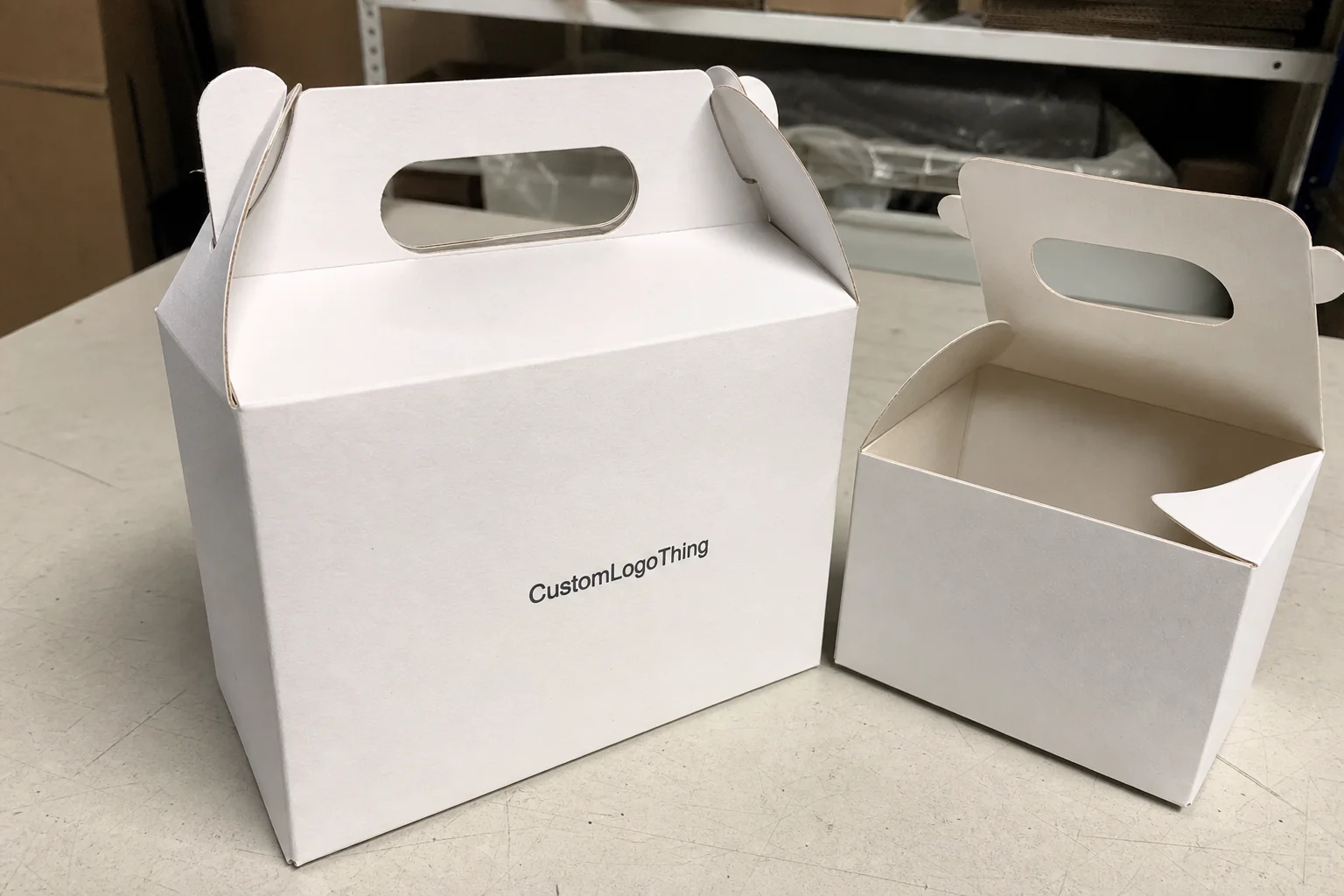
Gable boxes sit in a useful middle ground. They feel more gift-like than a plain folding carton, but they are still practical enough for carryout, sampling, and retail bundles. That combination is why they show up so often in short-run promotions and seasonal packaging.
The customization is where the value becomes obvious. With personalized gable boxes, you can add full-color print, simple logo branding, inside graphics, windows, inserts, reinforced handles, matte or gloss coating, and food-safe liners if the application needs them. Those features are not just decoration. They shape how the package performs in a real sales or delivery environment.
These boxes usually make sense where the package has to do some of the selling on its own:
- Holiday gift sets and seasonal promotions
- Bakery items, confectionery, and snack bundles
- Party favors and event giveaways
- Retail kits, samples, and influencer mailers
- Carryout packaging that needs a cleaner customer handoff
The handle is more than a visual feature. It removes friction. If the alternative is a separate bag, a stack of tissue, or an extra wrap step, the gable box can simplify the line and make the package feel more finished at the same time. That is why buyers keep returning to this format after a few rounds of testing.
For first-time orders, I would treat the box as a working component, not a design exercise. A nice graphic cannot rescue poor dimensions, a weak board, or a closure that pops open under load. The job starts with fit and function. Branding comes after that.
A useful gable box does three things at once: it looks branded, it holds up during handling, and it is still easy to fill. Miss any one of those and the order gets more expensive than it should.
How the Customization Process and Lead Time Work
The production path is usually simple on paper. In real life, delays come from small decisions that get pushed too late. The usual sequence is size selection, dieline approval, artwork setup, proofing, printing, finishing, die-cutting, folding, and shipment. Change the dimensions after proof approval and you can reset the schedule.
Digital printing is often the quickest option for shorter runs because setup is lighter and the file can move into production sooner. Offset and flexographic methods tend to make more sense at larger quantities, where the per-unit cost starts to improve enough to justify the setup work. The right process depends on run size, print coverage, and finish requirements.
The slow part is rarely the press. It is the review cycle. Buyers lose days on copy changes, barcode placement, panel orientation, and late artwork fixes. A physical sample can add time up front, but it usually pays for itself by catching structural issues before the full run is committed.
Common delay points include:
- Low-resolution artwork or missing fonts
- Incorrect bleed, trim, or fold-line placement
- Changing the box size after proof approval
- Switching board stock at the last minute
- Adding a coating or insert after the quote is accepted
For a clean, straightforward order, some suppliers can turn around personalized gable boxes in about 7-10 business days after proof approval. Larger quantities, special finishes, custom inserts, or heavier print coverage can push that into the 12-18 business day range. That does not include revision time. Seasonal demand can stretch the schedule again.
If the boxes are tied to a launch or a paid campaign, build in one revision cycle and one sample check. That buffer looks conservative until the press slot slips. It is easier to absorb a delay before production starts than after the schedule is already fixed.
For buyers comparing suppliers, ask for the production sequence in writing. Also ask whether proof approval is treated as a hard stop. That tells you quickly whether the supplier is controlling the workflow or simply estimating it.
Cost, Pricing, and MOQ Factors Buyers Should Compare
Unit price depends on more than size. Quantity, board stock, ink coverage, finish, inserts, and whether a new die is needed all move the number. A useful quote shows those pieces clearly instead of burying them in a single line item.
MOQ matters because it changes the economics of the first order. Low minimums are useful for testing a design, running a seasonal promotion, or validating demand. The tradeoff is predictable: smaller runs usually carry a higher unit cost because setup and handling are spread across fewer boxes.
Here is a practical pricing range for personalized gable boxes. These are typical numbers, not guarantees. Board grade, print coverage, finish, and freight can shift them quickly.
| Order Size | Typical Unit Price | Best Use Case | Main Tradeoff |
|---|---|---|---|
| 250-500 units | $1.10-$2.25 | Testing, short promotions, small events | Higher setup cost per box |
| 1,000 units | $0.72-$1.40 | Retail launches and repeatable seasonal packaging | Needs tighter forecast discipline |
| 5,000 units | $0.28-$0.70 | Ongoing programs and higher-volume food or retail use | More storage and freight planning |
Plain stock packaging can look cheaper on the quote sheet, but branded packaging changes how the product is perceived. A modest print upgrade can make a box feel like a gift item instead of a shipping carton. That shift can matter more than a small difference in unit cost.
Do not ignore the hidden pieces. Inserts, white ink underprint, metallic accents, lamination, and separate shipping cartons all add cost. Freight can be just as important as the box itself, especially if the run is bulky or you do not have warehouse space ready.
Ask for tiered pricing. A quote that shows 500, 1,000, and 5,000 units makes the cost curve easier to read. It also shows whether a slightly larger order improves the unit rate enough to justify the extra inventory. In practice, the total packaged cost matters more than the carton alone.
For boxes that will travel through parcel networks, ask whether the design has been tested against ISTA distribution methods. If the board is being sourced with responsible fiber claims, verify whether it aligns with FSC certification. Those details affect shipping confidence and procurement review, not just marketing language.
Material, Size, and Print Choices That Change Performance
Board thickness affects more than crush resistance. It changes how the handle feels, how the box stacks, and how much weight it can carry without deforming. A light board may look fine in a render and still fail once the product is packed and moved through normal handling.
Size choice should be treated as a performance decision. Too much empty space lets the contents shift, which is a problem for bakery items, gift bundles, and kits with mixed components. Too little room creates bulging panels and weak closure tabs. The best fit is the one that accommodates the product and any protective material without forcing the structure.
Printing options carry their own tradeoffs. Full-color CMYK works well for graphics-heavy artwork. Spot colors make sense for logos that need tighter brand consistency. Inside printing can add value for gift packaging, while selective panel coverage can keep ink costs down without flattening the design.
Finish also changes the final result. Matte lamination usually feels softer and more premium. Gloss makes graphics pop more aggressively and can improve contrast. Protective coatings help if the box will be handled often or exposed to minor scuffing during transport or retail display.
Structural details deserve the same attention as the artwork:
- Lock tabs help keep the box closed during transport
- Reinforced handles matter for heavier fills
- Window cutouts improve shelf visibility but can weaken some panels
- Inserts help stabilize fragile or mixed products
Material choice should match the actual use case. If the box is for a dry, lightweight set, you do not need to overbuild it. If it carries dense products or will be picked up repeatedly, under-specifying the board is the mistake that costs more later. Samples are the fastest way to catch that.
Production Steps That Keep Personalized Gable Boxes On Spec
The cleanest ordering process follows the same pattern every time: define the product dimensions, choose the board stock, request a dieline, upload artwork, confirm the proof, approve the sample, and schedule delivery. That sounds basic because it is. The mistakes happen when buyers skip a step and try to fix it after production is already in motion.
- Measure the product in its final packed state, not just as a bare item.
- Specify the filled weight, finish preference, and whether inserts are needed.
- Ask for a dieline and build artwork to that template.
- Review the proof for panel orientation, fold lines, barcode readability, and safe margins.
- Approve a sample if the order is tied to a launch, paid media, or a new product weight.
A useful spec sheet is plain and specific. It should state dimensions, quantity, delivery address, finish, board type, packaging method, and whether the boxes need to arrive flat or pre-folded. If the packaging will be reordered later, store that spec with the final artwork so the next run does not depend on memory.
Proof review is not optional. A screen mockup can hide text too close to a fold, panel misalignment, or a barcode that will not scan cleanly in print. It can also hide color drift. A brand color that looks fine on a monitor can shift enough in production to irritate a buyer or a retail team.
Schedule matters too. Boxes that arrive too early create storage pressure. Boxes that arrive too late stop the packing line. That is a boring problem until it becomes a real one.
Acceptance should be defined before production starts: print quality, die-cut accuracy, glue integrity, flat-pack consistency, and whether the finished box opens, closes, and carries the stated weight without distortion.
If the packaging program will repeat, keep the approved dieline and final print settings on file. That record shortens future setup and lowers the odds of version drift across reorders. Buyers who document the final spec usually move faster on the second and third run than on the first.
For structure and print comparisons before you commit, review our Custom Packaging Products page and match the box style to the product category instead of guessing from a catalog image.
Common Ordering Mistakes That Inflate Waste and Rework
The most expensive errors usually start in design, not on the press. Oversized artwork, tiny text, and heavy ink coverage can create problems that only show up after proofing or after the first run has already been approved. A box that looks strong on a slide deck can be awkward to print, hard to fold, or too weak for the actual product.
Approving a proof without checking scale is another classic mistake. A flat image does not reveal whether the handle cuts through copy, whether the fold lines clip the logo, or whether the window opening weakens a load-bearing panel. Those problems look small on screen and obvious in hand.
Filled weight gets underestimated all the time. That matters for bakery items, bundled goods, and kits with bottles or dense components. If the contents are heavier than planned, the handle can deform, the bottom can bow, or the closure tabs can fail during transport. A small weight change can create a large quality problem.
Buyers also forget the packaging around the packaging. Shipping cartons, inner pack counts, pallet space, and storage area can change the real landed cost enough to alter the buying decision. Bulky cartons are a warehouse issue as much as a unit-price issue.
Finish can backfire if the environment is messy or humid. High gloss looks sharp, but it shows fingerprints and scuffs quickly. Soft-touch feels premium, but it is not necessary for every use case. If the box is going to meet grease, moisture, or repeated handling, ask how the finish will look after a few touches.
A simple internal sign-off checklist prevents a lot of waste:
- Design has approved dimensions and bleed
- Operations has confirmed filled weight and packing method
- Purchasing has reviewed the tiered price quote
- Fulfillment has confirmed receiving dates and storage space
That is the difference between a controlled packaging order and a rework cycle that burns time on avoidable fixes.
Expert Tips for Better Branding, Faster Reorders, and Smarter Next Steps
Standardize sizes wherever you can. If two product lines can share the same footprint, the reorder process gets simpler and the artwork changes stay smaller. Shared dimensions also reduce the chance that one SKU becomes a packaging exception later.
Use a base template with variable panels for seasonal art, QR codes, promo copy, or ingredient updates. That keeps the package recognizable while letting the message change. It is a practical way to keep personalized gable boxes flexible without rebuilding the file every season.
Keep a record of approved dielines, color references, finish notes, and supplier comments. It sounds administrative because it is. It also saves time. Reorders fail most often when the original context disappears and someone assumes the new run is identical to the last one.
If the box will carry a new product weight, a different board grade, or a fresh finish, order a small pilot run first. Ten or twenty test pieces can reveal more than a dozen opinions in a meeting. The pilot should answer one question: does the box perform in the conditions it will actually face?
For a clean next step, keep the decision order simple:
- Verify dimensions and filled weight
- Request a quote with tiered quantities
- Ask for a sample or proof
- Confirm timelines against the launch date
- Approve production only after operations and design sign off
If branding, cost, and shipping reality are all pulling in different directions, that sequence usually keeps the order grounded. The package should support the product and the schedule, not compete with them.
For most programs, the strongest move is not a flashy finish or a crowded graphic. It is a box that fits the contents, carries cleanly, and looks intentional when the customer picks it up. That is the standard this format should meet before production gets the final approval.
What should I know before ordering personalized gable boxes for retail use?
Confirm the exact product dimensions, filled weight, and whether the box needs inserts or reinforcement. Ask for a proof that shows artwork placement, the handle area, and fold lines before production starts. Check that the finish and board stock will hold up during shipping, display, and customer carryout.
How long does the production timeline usually take for custom gable boxes?
Simple digitally printed runs can move quickly, while specialty finishes or larger quantities take longer. Build extra time for artwork revisions, proof approval, and sample review if the order is tied to a launch. The fastest orders are usually the ones with final artwork, standard sizing, and no structural changes.
What affects the price of personalized gable boxes the most?
Quantity has the biggest impact on unit cost, followed by size, print coverage, and finishing choices. MOQ, insert requirements, and custom dies can raise pricing even if the design looks simple. Shipping and storage can matter as much as the box itself, especially for bulky runs.
Can personalized gable boxes be used for food packaging?
Yes, if the material and coatings are suitable for the food application and any required lining or barrier needs. Grease resistance, moisture exposure, and temperature changes should be considered before approval. Always confirm whether the box will touch food directly or only serve as outer packaging.
What files do I need to get an accurate quote for personalized gable boxes?
Provide dimensions, quantity, print coverage, finish preferences, and target delivery date. Send print-ready artwork or at least a layout with logos, copy, and color references. Include any special requirements such as inserts, windows, food-safe needs, or retail packaging constraints.


