A small apparel brand does not always need sewn-in labels to look finished. Sometimes the better fit is printed vinyl labels, especially when the goal is to carry clear branding, size marks, care symbols, barcodes, or short product messages without adding sewing labor or slowing pack-out. They can also work well on hang tags, polybags, inserts, and other surfaces that need a clean, finished look with minimal handling.
The catch is that vinyl is not a single material with one behavior. Buyers often use the phrase loosely, but in production it can mean very different constructions, adhesive systems, and surface finishes. A label that looks crisp on a digital proof may behave differently once it is placed on textured fabric, coated board, a curved tag, or a surface that has dust, oils, or stretch. That gap between mockup and real-world use is where most problems start.
For that reason, these labels are best treated as a spec-driven component rather than a generic accessory. The right choice depends on where the label will go, how long it needs to last, and whether the visual priority is premium presentation, fast application, or reliable identification. In short runs, those decisions often matter more than the artwork itself.
Printed vinyl labels: why they show up on more clothing than you think
For apparel buyers, the appeal is practical. Printed vinyl labels can hold fine logos, QR codes, size codes, short legal copy, and brand identifiers without the extra labor of folding, stitching, or trimming a sewn label system. That matters if you are shipping from a small back room, updating branding often, or testing a new product line before committing to a more permanent construction.
They also fit situations where speed matters. A label can be printed, cut, and applied very quickly, which makes it useful for e-commerce packs, promotional apparel, and limited drops where inventory changes frequently. Compared with a stitched woven label, the production chain is shorter and the application step is simpler. For small and mid-size runs, that difference can decide whether the label format is economical at all.
The best use cases are usually the ones that benefit from a balance of appearance and handling efficiency. A vinyl label is not automatically the strongest or most durable option, but it can be a smart middle ground when you need something cleaner than a handwritten sticker and less labor-intensive than sewn-in branding. For items that will be washed repeatedly or rubbed hard over time, woven labels, satin labels, or heat-transfer labels are still better choices. For retail packaging, temporary branding, or product identification, vinyl often makes more sense.
That is why buyers keep returning to it. It can look polished without being complicated. It can be specified for a lot of different surfaces. And if the application surface is chosen correctly, the result can be surprisingly dependable for the price.
“The expensive label is often the one that lifts at the edge, smears under handling, or forces a reprint after launch.”
How the label printing and adhesion process works
The process is usually straightforward, but the details matter more than many first-time buyers expect. It starts with artwork setup, and that means preparing files at the correct size and resolution, using vector art whenever possible for logos and line work, and keeping raster elements at 300 dpi or better at final scale. Small text and barcodes deserve extra care because they may look fine on screen and still fail when printed at actual size.
Next comes material selection. The face stock, coating, and adhesive all need to match the intended surface and use conditions. A smooth carton or coated tag may accept a standard adhesive well, while textured fabric, soft-touch packaging, or curved surfaces may require a different tack level or a more forgiving construction. If the label must sit on a garment-adjacent surface, that choice becomes even more important because edge lift and residue are both real risks.
Printing method comes after the spec is defined. Digital printing is common for smaller quantities and variable data because it handles short runs, version changes, and fast turnarounds well. Conventional printing can be more efficient at higher volumes when the artwork is fixed. Either way, the finish changes the result: gloss gives strong color and a sharper visual hit, while matte reduces glare and is often easier to read under retail lighting.
Adhesion is where a project succeeds or fails. A permanent adhesive works well for many smooth packaging applications, but it can be the wrong choice if the label needs to be repositioned or removed cleanly. A removable adhesive may be better for temporary applications, though it can struggle on rough or dusty surfaces. Specialty adhesives exist for more demanding conditions, but they still need to be matched to the exact material, not just the category name.
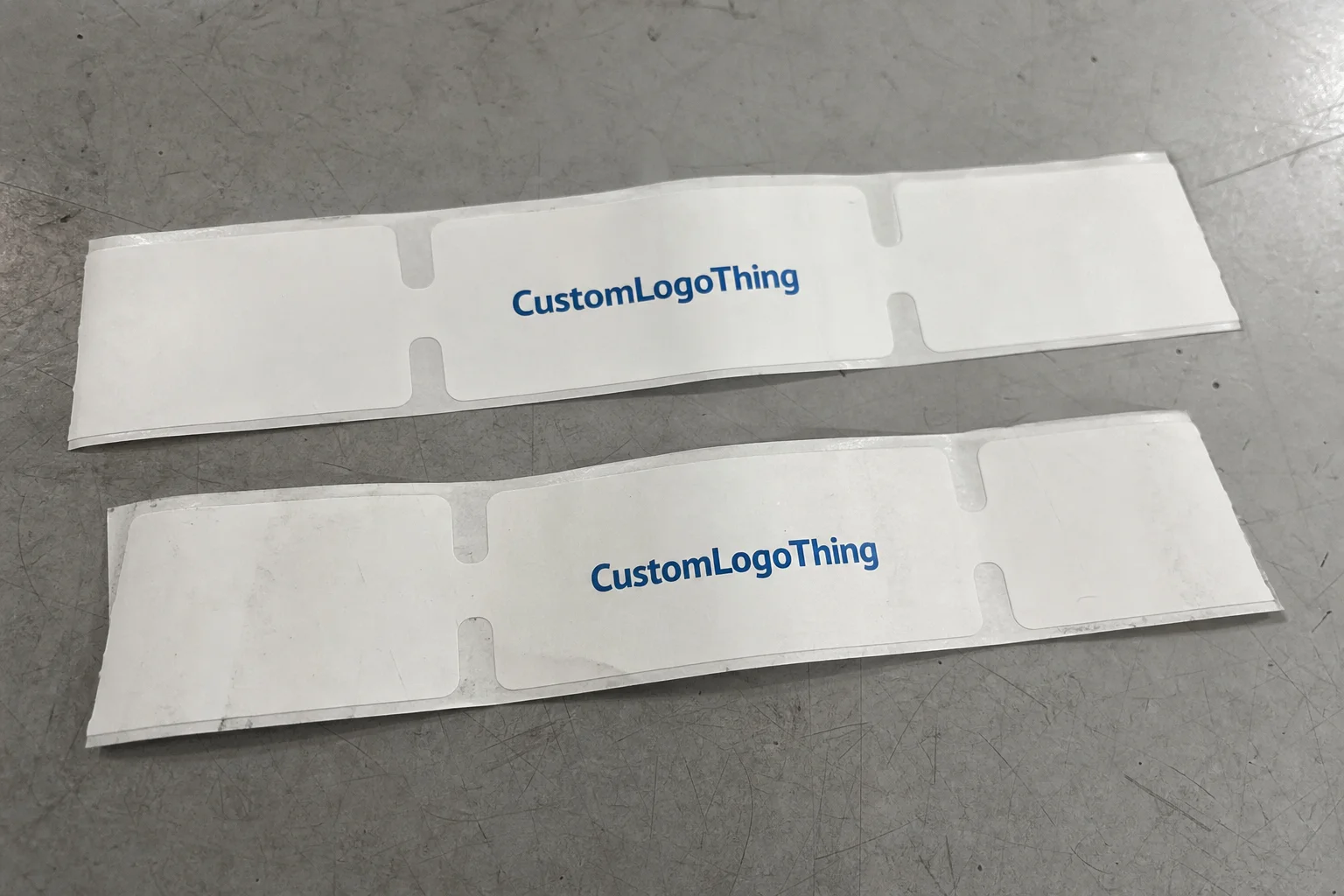
After printing, the labels are finished as sheets, rolls, or individual die-cut pieces. Some are kiss-cut on a liner for easy peeling; others are fully die-cut to a custom outline. The final inspection step matters more than it gets credit for. A label should be checked for print alignment, adhesive consistency, edge cleanliness, and color balance before it leaves production.
- Cotton often has more surface texture and can create weak points at the edges.
- Polyester is usually slicker and can be less forgiving if the adhesive is too weak.
- Coated paper usually bonds more predictably, especially for short-term packaging use.
- Textured or uneven surfaces raise the chance of lifting, wrinkling, or partial contact.
A practical buyer habit is to request a sample or proof on the actual substrate whenever the application is important. A flat label on a sample card can look perfect and still fail when applied to a curved package, a ribbed garment, or a surface with a coating that changes how the adhesive bonds. That is not a defect in the label so much as a mismatch between spec and use case.
Key factors that determine performance, look, and durability
Material thickness changes both feel and behavior. Thinner labels conform more easily and usually curl less at the edges, which is useful on smaller packages or slightly curved surfaces. Thicker stocks can feel more substantial and may create a stronger premium impression, but they can crease or bridge if the application surface is uneven. The right choice depends on whether the priority is flexibility, visual weight, or resistance to handling.
Adhesive strength is the next major variable. For packaging and apparel-adjacent surfaces, you want enough tack to hold through shipping, packing, and warehouse handling without leaving residue or damaging the material if the label is removed. Too little adhesion leads to lifted corners and wasted units. Too much adhesion can create a removal problem that ends up being more expensive than the label itself.
Durability has to be matched to real use conditions. A label on a folded polybag may only need to survive shipping friction and storage. A label on a retail garment may face skin contact, repeated bending, and abrasion from hangers or shelves. Add moisture, heat, or warehouse handling, and the spec becomes more demanding quickly. At that point, rub resistance and scuff resistance stop being marketing terms and start becoming production checks.
Finish influences both readability and brand impression. Gloss can make colors look richer, but it can also reflect light and make fine type harder to read. Matte usually photographs better and is easier on the eyes in bright retail settings. Clear vinyl can look very clean, especially on light packaging, but it demands stronger contrast and disciplined placement because weak artwork disappears fast.
Artwork complexity deserves more attention than it often gets. Tiny type, ultra-thin rules, and very small QR codes may survive a PDF proof and still fail at print size if the line weights are too light. If the label is under 25 mm wide, simplicity usually performs better:
- One primary logo or mark
- One readable line of supporting text
- Enough negative space to preserve legibility
| Label option | Best for | Typical strength | Main tradeoff |
|---|---|---|---|
| Gloss printed vinyl | High color impact, retail presentation | Strong visual contrast | Can reflect light and reduce readability |
| Matte printed vinyl | Packaging, subtle branding, easier legibility | Low glare, clean finish | Less dramatic appearance |
| Clear vinyl | Minimal branding, transparent applications | Neat, understated look | Needs strong contrast and careful placement |
| Fabric-friendly adhesive label | Temporary apparel use, garment handling | Better on textile-adjacent surfaces | Must be tested on the exact material |
If sustainability claims are part of the package, confirm the materials before you print them on a sales sheet. Ask whether the label stock or liner aligns with your packaging goals, and make sure the claim is supported by the actual construction. For broader packaging criteria and material guidance, the Packaging School and packaging industry resources can be useful, while formal transit testing standards such as ISTA help frame how labels and packages should hold up in shipping.
Printed vinyl labels cost: pricing drivers and quote questions
Pricing is driven less by the word “vinyl” and more by the actual construction. Quantity is the biggest swing factor. A run of 500 pieces usually costs far more per label than 5,000 because setup, proofing, and finishing are spread across fewer units. Size matters too, along with shape complexity, ink coverage, adhesive type, and whether the order needs sheets, rolls, or individual pieces.
For many buyers, a simple rectangular label with standard adhesive and a matte finish is the least expensive route. Custom contours, clear construction, specialty removability, and multi-layer formats all add cost. Variable data, barcode sequencing, and extra finishing steps can raise pricing further. Even small design changes can affect waste, and waste shows up in the quote whether the line item says so or not.
As a rough benchmark, smaller short-run label projects often land somewhere around $0.18 to $0.45 per unit, depending on size, print coverage, adhesive choice, and the number of setup steps involved. More complex or lower-volume jobs can sit above that range. The useful part of the estimate is not the exact number; it is understanding what pushes the number up.
MOQ changes the risk profile as much as the unit cost. A higher minimum order quantity may reduce piece price, but it also increases inventory exposure if the artwork changes or the adhesive does not perform as expected. New apparel brands often do better with a smaller first run even if the unit price is higher. That is usually the safer trade when the label is unproven.
Before requesting a quote for printed vinyl labels, gather the information that affects the spec:
- Dimensions and shape
- Quantity and expected reorder volume
- Artwork file in a usable format
- Finish: matte, gloss, or clear
- Application surface: garment, tag, bag, box, or insert
- Expected lifespan and handling conditions
- Packaging format: sheeted, roll, or individual pieces
Hidden costs are easy to miss. Proofing may be included, but revision cycles can affect the schedule. Shipping can matter more than expected on light orders. Rush production adds cost. And if the first run has to be replaced because the adhesive was wrong, the real expense is the reprint plus the delay, not the line item on the original quote.
Process and turnaround: from artwork file to finished labels
The typical workflow is simple on paper: Request a Quote, submit artwork, approve a proof, confirm the material and adhesive, then move into production. The problems usually begin when one of those steps is rushed or left vague. A clean file and a complete brief save more time than most buyers expect.
Turnaround depends on the setup and the level of confirmation required. A straightforward short run with final artwork may move through production in roughly 7 to 12 business days after proof approval. More complex projects, unusual materials, or sample-based approvals often stretch to 12 to 15 business days or more. Shipping is separate from production time, which matters if you are planning a launch date around receiving inventory.
Delays tend to come from the same places. Late design changes. Color corrections after proof approval. Unclear instructions about the actual application surface. Or a sample needing approval from someone who was not included in the process until the end. Each of those issues can feel small in isolation, but together they can push a project back by days or even a full week.
Digital production is helpful when quantity is modest or the design may change later. Conventional printing can make more sense once the design is locked and the run is larger. In either case, clean files make the biggest difference. A vector logo, outlined fonts, and complete application notes can cut back-and-forth dramatically.
For apparel launches, the label schedule should be treated as part of the production plan, not as a last-minute add-on. The timeline needs to account for photo samples, pack-out, internal QA, and the possibility of a short reprint if the first test reveals a problem. Missing that cushion is how a label issue turns into a shipping issue.
That is especially true for brands handling fulfillment in-house. A delayed label proof can affect receiving, which affects application, which affects launch. Even a small delay can ripple into inventory and customer service if the label is tied to packaging compliance or a retail deadline.
Common mistakes buyers make with apparel label specs
The first mistake is choosing a finish because it looks good on screen. Gloss often looks sharp in mockups and still becomes hard to read under bright lighting. Clear material can look elegant in a proof and then disappear on the wrong background. Screens do not tell you how the label will behave in a warehouse or on a shelf.
The second mistake is underestimating surface texture. A label that performs well on smooth packaging can fail on ribbed fabric, soft-touch cartons, dusty bags, or anything with stretch. If the substrate is not flat and consistent, adhesion testing is not optional. The better the test matches the actual surface, the fewer surprises later.
Artwork problems are common too. Files arrive too low-resolution for the printed size, and then crisp logos become fuzzy or type starts to break apart. Barcodes and QR codes deserve a real scan test at final dimensions, not just a visual check on a monitor. That sounds basic, but it is one of the most common avoidable errors in label production.
Some buyers also forget that retail needs and operational needs are not always the same. A label may need to hold care information, batch data, SKU numbers, or a barcode, while still keeping the design clean enough for front-of-house presentation. If the layout tries to do too much, it often does none of it well.
The last mistake is buying on price alone. A low quote can be perfectly fine if the spec is correct. If the adhesive is wrong or the finish is mismatched to the surface, the savings disappear the moment a batch starts lifting. Rework and delays are usually more expensive than the difference between two honest quotes.
For shipments that need to survive handling and transit, ISTA handling requirements are a practical benchmark for how labels and packages should hold up. If sustainability is part of the decision, the EPA recycling guidance is a better starting point than guesswork when you are thinking about separation, disposal, and the material choices that affect end-of-life behavior.
Expert tips for getting better results on the first run
Start with the surface, not the artwork. That is the most reliable way to improve the odds. Ask what adhesive is recommended for the exact garment or packaging surface you plan to use, not a generic “clothing label” answer. A cotton tee collar, a coated folding carton, and a polybag each behave differently, and the adhesive needs to reflect that.
Request a physical sample if the project has any color sensitivity or handling risk. If the brand uses a specific black, a deep red, or a Pantone-sensitive logo, the proof should be checked on the actual substrate. So should edge adhesion after the label has sat for a day or two, because some problems only show up after the adhesive settles.
Keep the layout simple unless the label is large enough to support more detail. A strong logo and one line of supporting text usually perform better than a crowded design packed with icons and small copy. Negative space is not wasted space. It helps the eye read the label faster and makes the piece feel more intentional.
Match the construction to the job:
- Retail presentation: prioritize finish, contrast, and legibility
- Internal inventory: prioritize barcode clarity and consistency
- Promotional packaging: prioritize quick application and visual recognition
- Temporary branding: prioritize removability and low residue
Order a small overage as well. Five to ten percent is a reasonable buffer for hand application, placement mistakes, or last-minute line changes. If labels are being applied in-house, human variation is part of the process. Building a little slack into the quantity is cheaper than discovering a shortage at packing time.
Next steps: how to spec, test, and order with confidence
The cleanest way to buy printed vinyl labels is to write a one-page spec before asking for quotes. Include dimensions, artwork, quantity, finish, surface type, target lifespan, and turnaround needs. If the labels are part of a broader packaging system, it helps to keep the label format consistent across the line so the art, size, and application method do not drift from product to product.
Then compare two or three suppliers on more than price. Look at the proofing process, sample support, lead time, and whether they ask sensible questions about substrate and use case. A supplier that asks about the actual garment or package finish is usually thinking beyond the order form, and that is a sign of a better production process.
Ask for a sample pack or a short test run, then apply the labels to the real item. Check three things: adhesion, readability, and handling. If possible, simulate light abrasion or package movement. You do not need a lab to catch obvious issues; you just need to test the real object instead of a generic sample card.
Record what happens. Did the edges stay flat? Did the finish match the intended brand look under normal lighting? Did the barcode scan at the final size? Once those answers are clear, lock the spec and save it for reorder. That is how a label stops being a one-off purchase and becomes a repeatable part of the production system.
From a buyer’s point of view, that is the real value. Printed vinyl labels are not just decorative pieces; they are practical tools for controlling cost, speed, and presentation. Spec them carefully, test them on the right surface, and they can solve more problems than many apparel teams expect.
Are printed vinyl labels good for clothing labels that need durability?
Yes, if the label needs strong print clarity and resistance to handling, scuffing, or short-term wear. The outcome depends on the adhesive, the garment surface, and the use conditions. For repeated laundering or long-term sewn-in branding, another label construction is usually a better fit.
What affects printed vinyl labels pricing the most?
Quantity, size, shape complexity, finish, and adhesive type are the biggest pricing drivers. Rush production and extra proofing can also raise the quote. Simple shapes and standard specs usually lower unit cost, especially on repeat orders.
How long does the printed vinyl labels production process usually take?
The total timeline depends on proof approval, artwork readiness, and the production method. Simple orders can move quickly if files are final and specs are standard. Build in extra time for samples, revisions, shipping, and color matching if brand color is critical.
What should I send when requesting a quote for printed vinyl labels?
Send dimensions, quantity, artwork files, finish preference, application surface, and desired turnaround. Include any compliance text, barcode requirements, or packaging format needs so the quote reflects the real spec. A complete brief usually means fewer surprises later.
Can printed vinyl labels be used on all clothing materials?
Not all materials behave the same, so testing is essential. Textured, stretchy, oily, or heavily coated surfaces may need a different adhesive or label format. A sample test on the actual garment is the safest way to confirm compatibility before volume ordering.