Buyer Fit Snapshot
| Best fit | recyclable flat pouches moq for packaging buyers comparing material specs, print proof, MOQ, unit cost, freight, and repeat-order risk where brand print, material, artwork control, and repeat-order consistency matter. |
|---|---|
| Quote inputs | Share finished size, material target, print colors, finish, packing count, annual reorder estimate, and delivery region. |
| Proofing check | Approve dieline scale, logo placement, barcode or warning zones, color tolerance, and any recyclable or compostable wording before bulk production. |
| Main risk | Vague material claims, crowded artwork, or missing packing details can create delays even when the unit price looks attractive. |
Fast answer: Recyclable Flat Pouches MOQ: Pricing, Specs, and Timelines should be specified like a repeatable production item. The safest quote includes material, print method, finish, artwork proof, carton packing, and reorder notes in one written spec.
What to confirm before approving the packaging proof
Check the product dimensions against the actual filled item, not only the sales mockup. Ask for tolerance on folds, seals, hang holes, label areas, and retail display edges. If the package carries a logo, QR code, warning copy, or legal claim, reserve that space before decorative graphics fill the panel.
How to compare quotes without losing quality
Compare board or film grade, print process, finish, sampling route, tooling charges, carton quantity, and freight assumptions side by side. A lower quote is only useful if the supplier can repeat the same color, closure quality, and packing count on the next order.
Recyclable Flat Pouches MOQ: Pricing, Specs, and Timelines
A brand launching three SKUs can burn through budget faster than expected if the recyclable flat pouches MOQ lands in the wrong place. Push it too high and cash gets trapped in inventory that sits in a warehouse while the sales team asks for more runway. Push it too low and the per-piece price often climbs once setup charges, freight, and color matching enter the picture. The smartest buyers treat recyclable flat pouches MOQ as a planning tool, not a detail to skim past.
That detail matters more than most teams admit. A lower MOQ can cut waste, but only if the pouch size, print method, and demand forecast all point in the same direction. Miss that alignment and the order can look sustainable on paper while creating obsolescence in practice. For a brand like Custom Logo Things, the right recyclable flat pouches MOQ is the one that supports a launch without forcing a redesign six weeks later, right when the first shipment starts moving.
The commercial logic is pretty simple. A smaller first run lowers overage, helps test-market risk, and preserves room for reformulation or artwork changes. A larger run can improve unit cost, but it also raises the cost of being wrong. I have seen teams save a few cents per pouch and then lose thousands in write-offs because the forecast was a little too optimistic. The rest of this guide compares the construction, specs, price tiers, production timing, and compliance details that deserve a hard look before a quote is requested. If you want a quick reference point while reading, the FAQ page is a useful place to sanity-check the basics.
Why Recyclable Flat Pouches MOQ Matters for Sustainable Packaging
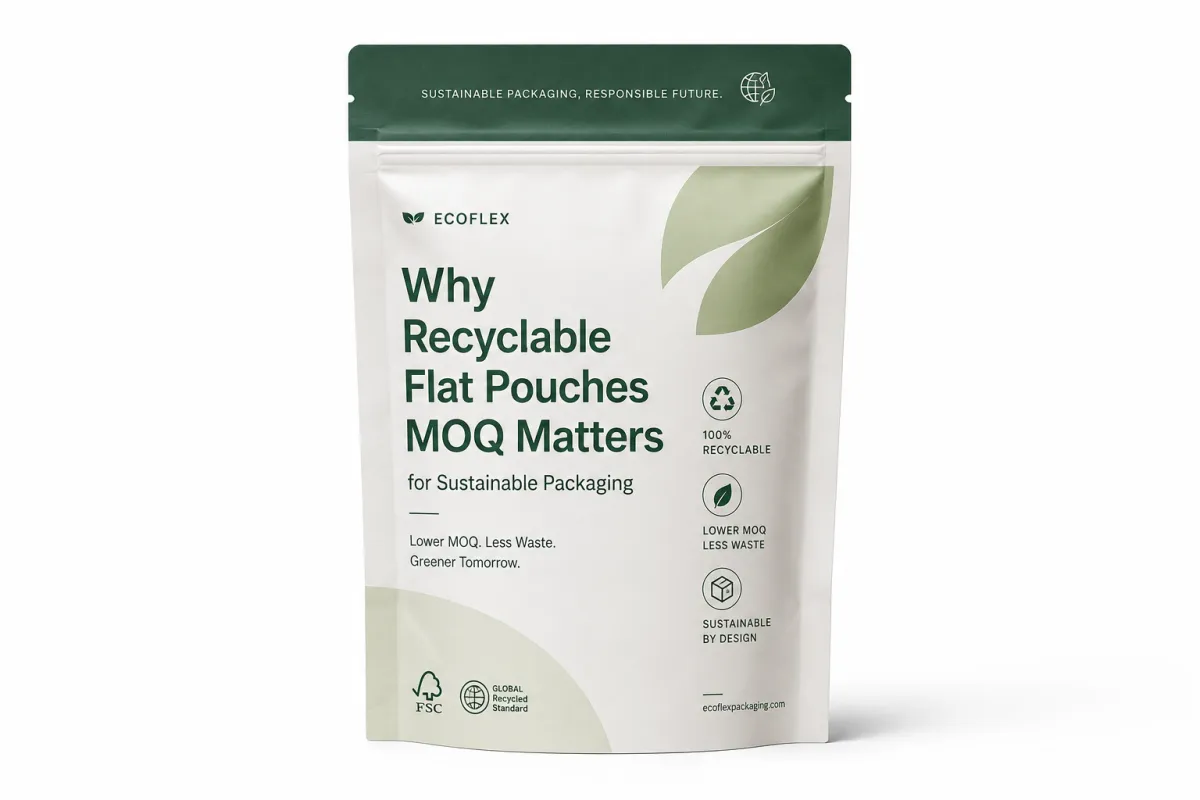
Recyclable flat pouches MOQ affects far more than procurement. It shapes launch timing, inventory risk, and the ability to move from pilot run to repeat order without rebuilding the whole pack from scratch. A buyer who misses the quantity can end up with slow-moving stock, obsolete graphics, or a warehouse full of material that no longer matches the market plan. From a packaging buyer's point of view, that is not an abstract problem. It is a cash-flow problem with very visible consequences.
A sharp point many teams learn late: low MOQ is not automatically the greener choice. A short run can cut waste, yes, but only if the pouch format is right, the print method is efficient, and the forecast is grounded in reality. If the team orders a small quantity of a highly customized structure, the unit cost may climb enough to wipe out the sustainability advantage. The best recyclable flat pouches MOQ balances less obsolescence with a production path that keeps total landed cost honest.
Launch timing is where this shows up first. A beverage powder, dry food, supplement, or pet treat brand might need a first order of 1,000 to 3,000 pouches just to test demand across channels. If the recyclable flat pouches MOQ is set at 10,000 pieces with heavy setup charges, the brand may delay launch or overbuy. Both outcomes hurt. One slows market entry. The other locks in inventory that has to be discounted later, which is a very expensive way to learn a lesson.
Another advantage of a disciplined recyclable flat pouches MOQ strategy is the ability to move from pilot to reorders without redesigning the pack. Once dimensions, barriers, and graphics are standardized, repeat ordering becomes easier to forecast and easier to compare across suppliers. That matters because the sustainable packaging market is full of claims that sound impressive but do not survive a closer look. Real savings come from fewer remakes, fewer obsolete cartons, and less packaging sitting unused after a formulation change.
"The cheapest pouch is not always the best deal. The best deal is the pouch that lands on time, matches the product, and does not force a reprint after the first shipment."
There is also a simple business case. Lower overage means less capital tied up. Better fit between demand and purchase volume means less warehouse space. A smarter recyclable flat pouches MOQ can reduce the risk of buying a standard run that looks economical in a spreadsheet but does not match the actual sales curve. That is especially true for startups, seasonal products, and multi-SKU launches where demand can change fast. A 20 percent shift in sell-through can turn a good order into dead weight, and pouches are unforgiving that way.
Recyclable Flat Pouches MOQ: Product Details That Matter
A recyclable flat pouch is best understood in practical terms. It is a flexible pack built from a structure intended to fit a recycling stream, usually a mono-material film such as mono-PE or mono-PP, with seals, closures, and barrier properties selected to protect the product without turning the pouch into a multi-material puzzle. That is the real test behind recyclable flat pouches MOQ: not whether the brochure says "eco," but whether the construction can support the product and the end-of-life pathway at the same time.
Buyers should compare film type, thickness, closure style, surface finish, and print coverage. A dry snack or supplement may work with a 3.5 to 4.5 mil mono-PE structure. A pet treat or odor-sensitive item may need higher puncture resistance or stronger barrier performance. The format can also change depending on whether the pouch is three-side seal, center seal, or another flat format. Every feature has a cost effect, and every feature can move the recyclable flat pouches MOQ if the supplier needs different tooling or a separate production window.
The technical question behind the sustainability claim is simple: recyclable in what system, and under what conditions? A pouch can be well-designed, but if the local collection stream does not accept that resin or does not have the processing capacity, the claim becomes weaker. That is why a credible supplier will ask where the product will be sold before finalizing the recyclable flat pouches MOQ. The answer changes by region, and it changes again if the brand sells across multiple channels or countries. A pouch for a regional launch is not the same thing as a pouch built for a coast-to-coast rollout.
Features that add convenience often raise complexity at lower quantities. A matte finish, spot varnish, custom-shaped zipper, wide tear notch, or special print effect may all be possible, but they can push the order into a different production setup. For a buyer planning a first order, the question is not "Can this be made?" It is "Can this be made at the target recyclable flat pouches MOQ without inflating unit cost or delaying the launch?" That is a different conversation, and it usually leads to better decisions.
For food, supplements, pet treats, and non-food items alike, product selection should be a matching exercise. The pouch must meet shelf-life needs, look good on shelf, and stay within budget. If one of those three drops out, the package stops working. The best recyclable flat pouches MOQ is therefore the one built around the product's actual needs, not the most fashionable structure on the quoting sheet.
Common specification choices buyers compare include:
- Film family: mono-PE or mono-PP for better recyclability alignment.
- Thickness: often 80-120 microns depending on barrier and puncture requirements.
- Closure: no zipper, press-to-close zipper, or tear-and-reseal design.
- Finish: gloss for brightness or matte for a softer shelf presentation.
- Print coverage: light coverage for faster setup or full-bleed graphics for stronger branding.
For claims and consumer guidance, it helps to anchor decisions to public references rather than vague marketing language. The EPA's recycling pages are a practical starting point for understanding why local rules matter more than general slogans: EPA recycling guidance. That kind of reality check is useful before a buyer locks in a recyclable flat pouches MOQ based on assumptions that may not hold in every market. I would rather tell a client that a claim needs tightening than watch them print thousands of pouches with wording that creates headaches later.
Recyclable Flat Pouches MOQ: Key Specifications to Lock In
A supplier cannot quote accurately without a complete spec set. The minimum information should include finished size, seal dimensions, film gauge, print count, closure type, and quantity by SKU. If those details are missing, the first quote will be rough, and the second quote will usually be higher. That is why disciplined buyers treat recyclable flat pouches MOQ as a spec exercise first and a price exercise second.
Quantity alone is not enough. If one SKU uses a 120 mm pouch and another uses a 150 mm pouch, the MOQ may effectively be different even if the total order volume looks similar. The same is true for print versions. A single art file across all sizes makes lower recyclable flat pouches MOQ targets more realistic. Three pouch widths, two closures, and different finish requirements usually push the project into more complicated production planning.
Performance requirements matter just as much as visuals. Oxygen barrier, moisture barrier, puncture resistance, and heat seal consistency all affect whether the pouch will survive distribution and shelf life. A dry product with a short shelf life may tolerate a simpler structure. A product that ships nationally and sits in hot warehouses cannot. The supplier should know this before the recyclable flat pouches MOQ is finalized, because the barrier package can influence both material choice and production efficiency. A small tweak in seal strength can save more returns than a flashy graphic ever could.
Design decisions can reduce complexity in very practical ways. Standardizing pouch sizes across the line, using one closure style, simplifying artwork, and keeping the same base film family across SKUs can all make a lower recyclable flat pouches MOQ more realistic. The biggest mistake is asking for a low minimum while also asking for six special details. That combination usually produces a quote that looks technically possible but financially awkward. It is the packaging version of ordering a compact car with truck-level expectations.
A useful buyer checklist keeps the conversation efficient:
- Confirm finished pouch size and fill volume.
- Specify product type, shelf-life target, and barrier needs.
- Choose film family, thickness, and finish.
- State print method, color count, and whether artwork is final.
- Clarify closure style, tear notch, and any functional extras.
- Set the quantity target by SKU, not just by total project volume.
That checklist does more than save time. It reduces quote surprises. It also helps the supplier tell you whether the target recyclable flat pouches MOQ is realistic or whether a small adjustment in size or print coverage could save real money. In practice, the best sourcing conversations are less about insisting on the lowest possible number and more about aligning the package with how the product will actually be sold.
Recyclable Flat Pouches MOQ and Pricing: What Drives Cost
Price starts with material. Mono-PE and mono-PP structures are usually the baseline for recyclable flat pouches, but the exact film stack, gauge, and barrier treatment matter a lot. Add in print method, color count, pouch size, and extras like tear notches or zippers, and the recyclable flat pouches MOQ can move quickly. That is why two quotes that look close at first glance may not be comparable at all.
Unit cost almost always improves as quantity rises. That sounds obvious, but it is easy to miss the real step changes. A 1,000-piece run may carry setup charges that make each pouch look expensive. At 5,000 or 10,000 units, the same setup gets spread across more pieces and the cost per piece drops. In a recyclable flat pouches MOQ conversation, the goal is not just to get the lowest minimum. The goal is to get the best ratio of inventory risk to unit cost.
The distinction between piece price and total landed cost matters here. Freight, tooling fees, plate charges, color matching, testing, and packaging all add to the final bill. A quote that looks cheap on paper can become the most expensive option once those items are added. For that reason, buyers should compare recyclable flat pouches MOQ proposals like-for-like: same material, same finish, same print method, same ship date, same destination.
Sometimes a slightly higher MOQ is the cheaper decision. If ordering 3,000 pieces instead of 2,000 reduces the unit cost enough to absorb the extra inventory without hurting storage or cash flow, the larger order may be the better commercial move. That is a basic sourcing truth. It shows up constantly with recyclable flat pouches MOQ decisions, especially in product lines where reorders are likely within a few months. The spread can be surprisingly large. On a modest run, a ten-cent difference per pouch adds up quickly once the order reaches a few thousand pieces.
Use this comparison as a practical starting point. The numbers are directional, because structure, artwork, and finish can move them materially.
| Order Type | Typical MOQ Range | Estimated Unit Cost | Best Fit | Cost Notes |
|---|---|---|---|---|
| Pilot / Test Run | 500-2,000 pieces | $0.40-$0.85 | Market testing, small launches, rapid artwork validation | Higher setup charges and less favorable bulk pricing |
| Standard Custom Run | 2,500-10,000 pieces | $0.18-$0.38 | Established products, multi-channel launches | Balanced unit cost, but tooling fees may still apply |
| Scale Order | 10,000+ pieces | $0.10-$0.24 | Repeat demand, stable forecasts, national distribution | Lowest cost per piece, higher inventory commitment |
That table is useful because it forces the right question. Are you buying a packaging test or a production program? A low recyclable flat pouches MOQ can be the right answer for a new SKU, but the economics shift once demand is predictable. At that point, bulk pricing starts to matter more than flexibility.
One more point often missed: pricing is not only about the pouch. It is about the whole project. If a supplier needs additional setup charges for a custom size or a nonstandard print sequence, those charges may be justified if the format is a good fit. But the buyer should ask for a clear breakdown. A quote that separates material, tooling fees, setup charges, freight, and testing is much easier to evaluate than one large number tied to a vague promise.
For buyers managing multiple product lines, that breakdown also makes future reorders cleaner. Once you know the exact cost structure, you can decide whether a higher recyclable flat pouches MOQ will reduce the next order enough to justify the added storage. In many cases, the answer is yes, but only when the forecast is stable enough to support it. That is the boring part of packaging economics, and it is also the part that keeps a launch from turning into a cleanup project.
Recyclable Flat Pouches MOQ: Process and Timeline
The ordering process usually begins with a brief: size, product type, print count, finish, closure, quantity, and target market. Once that is assembled, the supplier can review technical fit and issue a quote. If the project moves forward, artwork is submitted, proofing begins, and revisions are handled before production starts. That sequence sounds simple, but every delay in it affects the recyclable flat pouches MOQ timeline more than most teams expect.
Lead time should be split into two buckets. The first is approval time. The second is manufacturing time. Many late shipments are not caused by the press or the film line at all. They happen because artwork is still changing, a recyclability claim needs review, or the color proof is not signed off. A well-planned recyclable flat pouches MOQ order can move quickly once those items are settled, but only then.
Low MOQ orders can be faster when the artwork is final and the technical requirements are straightforward. If the pouch uses a standard mono-material structure, a common closure style, and a simple print layout, production is easier to slot into a schedule. That is one reason simplified packaging often wins in early-stage launches. It keeps the recyclable flat pouches MOQ manageable and shortens the path from quote to shipment.
The risks are predictable. Change requests after proofing can add days. Unclear environmental claims can trigger back-and-forth. Late sign-off can push a project into the next production window. Freight delays can be the final problem, especially when launch timing is tight. A buyer should build buffer into the schedule, because the real threat is not always manufacturing. Often it is the calendar wrapped around manufacturing.
Most teams do best when they work backward from the launch date. Allow time for sample review, print proofing, and a final compliance check. If the product is seasonal, the buffer should be larger. If the pouch needs broader transit testing, use references such as ISTA to align package durability expectations with the distribution environment. That kind of planning can keep the recyclable flat pouches MOQ order from becoming a bottleneck during rollout.
A realistic planning rhythm looks like this:
- Lock product size and structure first.
- Finalize artwork before asking for a production quote.
- Confirm recyclability claims for the target market.
- Approve proofs early and set a firm sign-off date.
- Keep one reorder window open in case demand rises faster than expected.
The main lesson is simple: time is part of the price. A fast recyclable flat pouches MOQ order is only fast when the buyer removes uncertainty early. If the pouch is still being redesigned while production is waiting, the clock becomes expensive.
Why Choose Us for Recyclable Flat Pouches MOQ Programs
Custom Logo Things is positioned for buyers who want straight answers, not packaging theater. That matters in a recyclable flat pouches MOQ project, because the most expensive mistake is not choosing the wrong decoration style. It is choosing a structure that cannot support the product, the forecast, or the budget. A good supplier should explain tradeoffs clearly: what improves recyclability alignment, what raises cost, and what can be simplified without damaging shelf appeal.
Small runs deserve special attention. Pilot launches, subscription tests, and multi-SKU rollouts often need the recyclable flat pouches MOQ kept as low as possible while still maintaining color consistency and dependable sealing performance. That is a technical balancing act. When it is done well, the buyer gets a package that looks deliberate, performs reliably, and does not bury the launch in excess stock. The package should do its job quietly. No drama, no surprises.
Operational clarity is also a competitive advantage. Buyers value responsive quoting, stable print quality, predictable communication, and realistic timelines. Those things do not sound glamorous, but they are the details that keep a packaging program on track. A supplier who can explain the difference between unit price, setup charges, and bulk pricing gives the buyer better control over the final purchase. That is especially true when a project has more than one SKU or requires a phased reorder plan.
Trust grows when the supplier can document the decision-making process. Material recommendations, sample support, and clear guidance on compliance all reduce uncertainty. If the target market has specific recycling expectations, the team should ask for those assumptions up front. If the product needs a better barrier, that should be discussed before artwork is finalized. In a recyclable flat pouches MOQ program, the supplier should help narrow the options, not overwhelm the buyer with them.
There is also a practical reason brands return after a first order. Reorders get easier. Specs are already locked. Color references exist. The commercial terms are known. And the next recyclable flat pouches MOQ can often be optimized around actual sell-through instead of forecast-only planning. That shift from guessing to measuring is where the strongest sourcing relationships usually pay off. It is also where a packaging program starts to feel less like procurement and more like part of the growth engine.
Next Steps: Finalize Specs, Request Quotes, and Order
If the goal is a successful launch, the next move is to gather the details that make a quote accurate. Confirm pouch size, structure, closure, finish, print count, and quantity by SKU. Add shelf-life expectations and the target sales region. Then ask for a side-by-side comparison that shows MOQ, unit cost, total landed cost, and expected ship date. That is the fastest way to see whether the recyclable flat pouches MOQ fits the plan or needs an adjustment.
From there, compare the options with discipline. A pilot-sized order may be the right choice if the artwork is still being tested or the forecast is uncertain. A higher quantity may be smarter if the product already has demand and the unit cost drop is meaningful. The right answer is not always the cheapest quote. It is the quote that fits the launch, the inventory plan, and the brand's sustainability goals. That is the core of any recyclable flat pouches MOQ decision.
Before signing off, verify the end-market recyclability claim, not just the packaging wording. A pouch that is theoretically recyclable but mismatched to the target region creates confusion later. If the brand sells in more than one market, clarify whether the claim can be used consistently. Then move forward with the brief, the sample, and the production order. The best recyclable flat pouches MOQ is the one that supports growth without creating excess inventory, extra cost, or unnecessary redesigns.
For teams ready to move from research to action, the next step is simple: lock the specs, request pricing, and choose the MOQ that protects both the launch and the budget. In practice, that is where the strongest packaging programs begin. Not with the biggest order. With the clearest one. A clear order is easier to approve, easier to forecast, and easier to repeat. And yes, it is a lot less annoying six months later when someone asks why there are 8,000 extra pouches in storage.
What Is the Recyclable Flat Pouches MOQ?
The recyclable flat pouches MOQ is the minimum quantity a supplier will produce for a recyclable flat pouch order. It usually depends on pouch size, mono-material film choice, print method, closure style, and the amount of customization in the design. A simple, standard structure can support a lower MOQ, while custom printing, special finishes, and added barrier features often raise the minimum.
For many brands, the practical range starts with pilot runs of 500 to 2,000 pieces and moves up to standard custom runs of 2,500 to 10,000 pieces. The right recyclable flat pouches MOQ is the one that balances launch risk, unit cost, and inventory exposure. If demand is still uncertain, a lower MOQ can protect cash flow. If demand is steady, a larger run may lower total landed cost.
What is the usual MOQ for recyclable flat pouches?
Recyclable flat pouches MOQ varies by pouch size, material structure, print method, and whether the order uses standard or custom tooling. Digital or simplified print setups can support lower quantities than highly customized runs. Ask for MOQ by SKU, not just by project, because mixed sizes or graphics can change the minimum.
Can I get recyclable flat pouches MOQ with custom printing?
Yes, but custom print usually raises the minimum and can affect unit price. Lower-volume custom runs are easier when the design uses fewer colors and a standardized pouch size. Provide final artwork early so the supplier can confirm whether the print method fits the target recyclable flat pouches MOQ.
Do recyclable flat pouches cost more than standard pouches?
Sometimes, but not always; the real answer depends on barrier needs, material choice, and order size. The better comparison is total landed cost, not just piece price, because shipping and waste can change the economics. A slightly higher recyclable flat pouches MOQ may lower unit cost enough to offset the larger purchase.
What specs should I send to get an accurate recyclable flat pouches MOQ quote?
Send finished dimensions, material preference, thickness, closure style, print count, and quantity by SKU. Include product type and shelf-life requirements so barrier and seal recommendations match the application. If you need market-specific recyclability claims, note the target region up front so the recyclable flat pouches MOQ quote reflects the right compliance path.
How long does a recyclable flat pouches MOQ order take?
Timeline depends on proof approval, production schedule, and freight method. Fast orders usually happen when artwork is final and the specs are standard. Build in buffer time for revisions, because delays often come from approvals rather than manufacturing. A realistic recyclable flat pouches MOQ timeline is one of the easiest ways to protect a launch date.