People asking where can i Get Custom Stickers often need more than a vendor name. The better answer depends on what the sticker has to do: look good for an event, stay bonded on a cold bottle, seal a mailer, or survive outdoor handling. Those jobs use different materials, adhesives, finishes, and formats, so the cheapest quote is not always the lowest real cost.
Most buying problems start when the online mockup looks fine but the finished sticker curls, smears, lifts at the corners, or feels too flimsy for the package. If you match the supplier to the application first, you avoid most reprints and delays.
Where Can I Get Custom Stickers Without Wasting Money?
The best source depends on performance, not storefront polish. A giveaway sticker only needs decent print and clean peeling. A product label may need to stay readable and bonded through filling, packing, refrigeration, shipping, and repeated handling.
Most vendors fall into a few groups:
- Online custom printers — convenient for standard sizes, simple ordering, and low to mid-volume runs.
- Local print shops — useful for fast pickup, direct communication, and short runs.
- Packaging suppliers — better when stickers are part of a repeat packaging program.
- Wholesale manufacturers — often better for large volumes, tighter consistency, and lower long-run unit cost.
- Marketplace sellers — workable for simple promo use, but specs and consistency can vary.
For product packaging, suppliers that treat labels as functional packaging components are usually safer than general promo sellers. A label on a jar, pouch, bottle, or carton has to apply square, stay down, and remain readable. That makes material and adhesive choice more important than a fast online preview.
Ask better questions than “What’s your best price?” Ask what stock they recommend for your surface, whether they offer removable or freezer-grade adhesive, how they handle color matching, and whether they can send samples. Suppliers who can explain those decisions clearly are usually easier to trust.
Good sticker sourcing is less about finding a vendor and more about matching the vendor to the job.
If the project also includes boxes, tags, or related printed pieces, align the specs early. You can review options through Custom Packaging Products and Custom Labels & Tags so the sticker order fits the rest of the packaging system.
How Custom Sticker Ordering Works From Idea to Delivery
Ordering usually starts with size, quantity, and artwork upload, but production decisions go further. A typical workflow includes defining the use case, choosing the format, selecting material and adhesive, submitting artwork, reviewing a proof, approving it, then moving into printing, finishing, packing, and shipping.
Format affects both use and cost:
- Roll labels — best for product packaging and faster hand or machine application.
- Sheet stickers — useful for office use, inserts, or small promo batches.
- Individually die-cut stickers — common for giveaways and merch packs, but slower to apply at scale.
The proof matters more than many buyers expect. It should show trim, bleed, cut line, artwork placement, and orientation. This is where you catch borders that are too tight, text that will print too small, or a shape that leaves too little margin around the design.
Suppliers also vary in how much artwork review they provide. Some only verify that the file opens and fits the order size. Others will flag fine type, low contrast, weak bleed, or die lines set too close to the artwork. That extra review is valuable if the sticker is customer-facing or part of retail inventory.
It also helps to know whether you are buying through a broker or directly from a manufacturer. Brokers can simplify sourcing across print categories, but direct manufacturers often have better control over material substitutions, schedule, and repeat consistency.
| Order Type | Best For | Common Format | Typical Tradeoff |
|---|---|---|---|
| Promo stickers | Events, giveaways, inserts | Sheet or die-cut | Easy ordering, lighter technical support |
| Packaging labels | Jars, bottles, boxes, pouches | Roll or sheet | More detailed specs needed |
| Outdoor stickers | Vehicles, windows, long-wear branding | Vinyl or laminated film | Higher cost, stronger durability |
Sticker Materials, Adhesives, and Finishes That Change the Result
Material choice affects appearance, durability, and cost. Paper stock works for many dry indoor applications and lower-cost branding uses. BOPP film is widely used for retail packaging because it handles moisture and routine handling better than standard paper. Vinyl is tougher and better suited to outdoor exposure, abrasion, and long-wear applications.
Clear film can look sharp on glass and smooth plastic, but only if the artwork is built for it. Light colors may lose contrast, and some designs need white ink to remain readable. That can raise both cost and lead time.
The adhesive matters as much as the face stock:
- Permanent adhesive — standard for many packaging labels.
- Removable adhesive — better for short-term use or clean peel-off.
- Freezer-grade adhesive — useful for refrigerated or condensation-prone products.
- Repositionable adhesive — helpful for hand application when labels may need to be lifted and reset.
- Tamper-evident constructions — best when security matters.
Finish changes both look and performance. Gloss gives stronger color pop. Matte reduces glare and can improve legibility under bright light. Lamination adds scuff and oil resistance. Writable coatings help when lot codes or notes need to be added after printing.
The package surface is often the real challenge. Glass is usually easy. Coated cartons are manageable. Kraft paper can show earlier edge lift depending on texture and dust. Curved bottles and jars are less forgiving because the material must conform without wrinkling. Low-surface-energy plastics often need a more aggressive adhesive than buyers expect.
If you are unsure what to order, ask these questions:
- What stock works best on my package surface?
- Will the adhesive hold under moisture, refrigeration, or outdoor use?
- Do I need lamination, varnish, or no added coating?
- Would rolls, sheets, or die-cut singles suit application best?
For shipping durability and handling performance, reference material from ISTA can help when labels must survive packed distribution. Buyers considering disposal or broader packaging waste can also review guidance from the EPA.
Custom Sticker Pricing, MOQ, and Unit Cost: What You Actually Pay For
Sticker pricing is driven by size, quantity, material, finish, shape complexity, proofing, and shipping. Two similar-looking quotes may describe very different products. One may include lamination, stronger adhesive, and white ink, while the other may use a thinner stock with basic adhesive.
MOQ means minimum order quantity. Low minimums help with testing, but short runs usually cost more per piece because setup, file handling, cutting, and packing still take time.
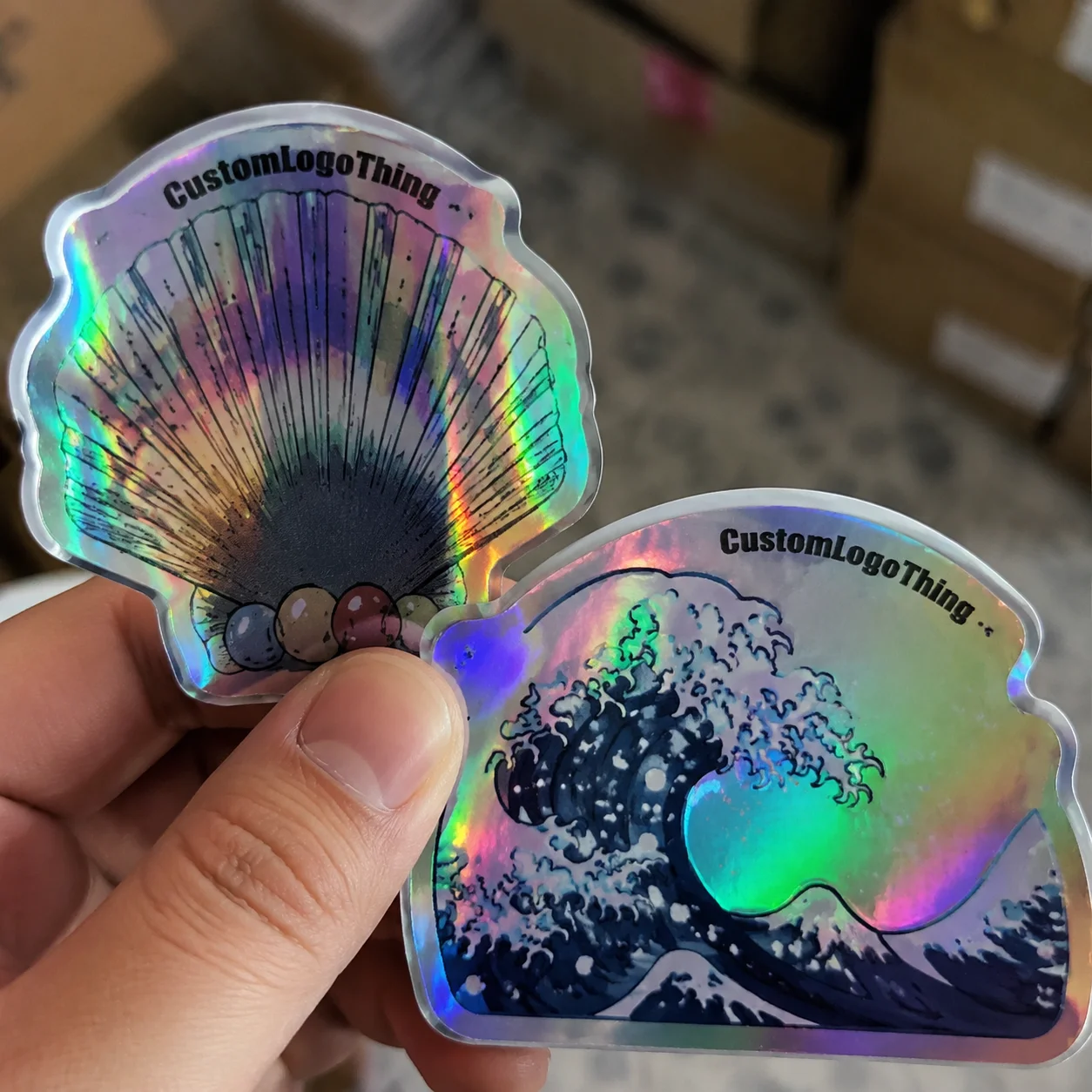
Digital printing often makes sense at lower volumes. As quantity rises, unit cost usually falls, especially when the artwork and material spec stay consistent. Specialty finishes push pricing back up quickly. Foil, holographic film, textured stock, soft-touch lamination, and white ink are common cost drivers.
Charges outside the headline quote often include:
- Rush production fees
- File cleanup or art correction
- White ink or specialty color charges
- Split shipping to multiple locations
- Sample fees or pilot runs
- Premium finishing such as foil or soft-touch lamination
These ranges are useful reference points, not fixed promises:
| Order Example | Approx. Unit Cost | Notes |
|---|---|---|
| 1,000 simple die-cut stickers | $0.20-$0.60 | Depends on size, finish, and freight |
| 5,000 product labels | $0.08-$0.22 | Better pricing once setup is spread across more units |
| Specialty film or foil run | $0.25-$0.90 | Premium materials and extra finishing increase cost |
The cleanest comparison is to send each supplier the same spec sheet: finished size, quantity tiers, stock, adhesive, finish, format, proof process, lead time, and shipping terms. If those details are vague, the quotes are not truly comparable.
Process and Lead Time: How Long Custom Stickers Really Take
Lead time includes more than printing. A real schedule covers quoting, artwork review, proof approval, printing, finishing, packing, and transit. Delays often happen before production starts because the artwork is still changing, dimensions are not final, or the requested material is unavailable.
Simple standard jobs can move quickly after proof approval. Specialty orders take longer, especially when they involve custom die shapes, clear films, laminates, metallic effects, or unusual adhesives.
Always confirm whether quoted timing means production only or delivered to your door. That one detail prevents many deadline problems.
A practical planning range:
- Simple standard runs: often 5-10 business days after proof approval
- Custom shapes or specialty materials: often 10-15 business days
- Complex premium jobs: often 15+ business days
SKU count matters too. Five thousand copies of one label usually move faster than several versions in smaller counts with split packing or multiple ship-to locations. Rush service can help when the art and specs are final, but it rarely fixes a still-unclear project.
Before ordering, confirm proof cutoff times, stock availability, shipping method, and whether the arrival date is estimated or guaranteed. Also check application conditions. Even a well-made sticker can fail on a dusty, oily, damp, or very cold surface.
How to Choose the Right Sticker Supplier Step by Step
A practical buying workflow is simple:
- Define the application and the surface.
- Estimate quantity, reorder frequency, and delivery timing.
- Shortlist two or three supplier types that fit the job.
- Compare material and adhesive recommendations, not just price.
- Request samples or a pilot run.
- Review landed cost, proof quality, and schedule reliability.
Local print shops suit fast pickup and simple short runs. Online custom printers are convenient for standard formats. A packaging manufacturer or label specialist is often the better choice for larger runs, recurring orders, or projects tied closely to package branding.
Samples matter more than a polished proof. Test the sticker on the actual carton, bottle, jar, or mailer you plan to use. That shows whether the finish causes glare, the corners lift on a curve, or the color changes once applied to the real surface.
Compare suppliers on the points that actually affect results:
- Print quality and color consistency
- Material fit for your surface
- Adhesive performance
- Proof clarity and revision support
- Turnaround reliability
- Total landed cost
Common Sticker Buying Mistakes That Cause Reprints and Delays
Most sticker failures are ordinary buying mistakes, not dramatic manufacturing defects. The wrong size, low-resolution art, missing bleed, weak adhesive selection, and loose delivery planning cause a large share of reprints.
Scale is one of the biggest issues. Artwork that looks balanced on-screen can end up too small on a jar lid or too large for a narrow carton flap. Print a paper mockup at full size before ordering.
Another common mistake is using indoor paper stock for moisture, refrigeration, abrasion, or outdoor handling. In that case, the sticker is not bad; the specification is. The same applies to clear materials chosen without considering background color, or matte finishes used on already low-contrast designs.
Proof approval is another weak point. Buyers often assume the printer corrected everything important, then approve art with cut lines too close to text, borders that will trim unevenly, or type too fine for the final size.
Application method matters too. Hand-applied stickers behave differently from machine-applied roll labels. Flat cartons are easier than tapered bottles. Storage after delivery also affects performance; heat, humidity, dust, and rough stacking can create problems before the sticker is ever used.
Most sticker failures are not print failures. They are spec failures.
Next Steps Before You Order: Samples, Specs, and Smart Quote Requests
Before requesting quotes, collect the production basics: exact dimensions, application surface, indoor or outdoor use, quantity tiers, finish preference, artwork format, target delivery date, and whether the stickers should arrive on rolls, sheets, or as individual die-cut pieces.
If the sticker will sit on retail packaging, food jars, cosmetics, shipping boxes, or other customer-facing surfaces, order a sample pack or pilot run first. That is even more important if the sticker is part of a larger custom printed boxes launch, because one weak label can lower the quality of the whole package.
A solid pre-order checklist should include:
- Final size and shape
- Surface material
- Indoor, outdoor, or refrigerated use
- Adhesive preference
- Finish choice
- Quantity and reorder plan
- Artwork file type
- Delivery deadline
Once quotes come back, compare landed price, response quality, proof clarity, material recommendation, and timeline confidence. If you are still deciding where can i Get Custom Stickers, choose the supplier whose specs fit your actual use, not the one with the loudest sales pitch.
FAQ
Where can I get custom stickers in small quantities?
Small runs are usually easiest through online custom printers or local print shops. Expect a higher per-piece cost at low volumes, especially for unusual shapes, specialty films, or premium finishes. Ask about minimum order quantity, sample options, and any setup fees before ordering.
Where can I order custom stickers for product packaging?
Packaging suppliers and specialty label manufacturers are often a better fit than general promo sticker sellers. They are more likely to help with stock selection, adhesive choice, and label format. For packaging, confirm whether you need roll labels, sheet labels, or die-cut pieces based on how the sticker will actually be applied.
How much do custom stickers usually cost?
Cost depends on size, quantity, material, finish, shape complexity, proofing, and shipping. Small orders cost more per piece, while larger runs usually lower the unit price. White ink, foil, holographic film, and lamination can increase pricing quickly, so compare the full landed cost rather than the base print number.
How long does it take to get custom stickers made?
The timeline usually includes proofing, production, finishing, and shipping. Standard jobs often move in 5 to 10 business days after proof approval, while specialty materials, premium finishes, or custom shapes can take longer. Delayed proof approval is one of the most common reasons an order slips.
What should I ask before buying custom stickers online?
Ask about material, adhesive, finish, file requirements, proof process, turnaround time, and sample availability. Confirm whether the supplier manufactures directly or outsources production. It also helps to get shipping, rush fees, and revision terms in writing so there is less room for confusion later.