Buyer Fit Snapshot
| Best fit | tamper evident poly mailers tech buyer review for packaging buyers comparing material specs, print proof, MOQ, unit cost, freight, and repeat-order risk where brand print, material, artwork control, and repeat-order consistency matter. |
|---|---|
| Quote inputs | Share finished size, material target, print colors, finish, packing count, annual reorder estimate, and delivery region. |
| Proofing check | Approve dieline scale, logo placement, barcode or warning zones, color tolerance, and any recyclable or compostable wording before bulk production. |
| Main risk | Vague material claims, crowded artwork, or missing packing details can create delays even when the unit price looks attractive. |
Fast answer: Tamper Evident Poly Mailers Tech Buyer Review: Film, Closure, Print, and Fulfillment should be specified like a repeatable production item. The safest quote includes material, print method, finish, artwork proof, carton packing, and reorder notes in one written spec.
What to confirm before approving the packaging proof
Check the product dimensions against the actual filled item, not only the sales mockup. Ask for tolerance on folds, seals, hang holes, label areas, and retail display edges. If the package carries a logo, QR code, warning copy, or legal claim, reserve that space before decorative graphics fill the panel.
How to compare quotes without losing quality
Compare board or film grade, print process, finish, sampling route, tooling charges, carton quantity, and freight assumptions side by side. A lower quote is only useful if the supplier can repeat the same color, closure quality, and packing count on the next order.
I spent two long weeks comparing the best tamper evident poly mailers tech across stock, custom printed, dual-seal, and return-ready formats, and the results were not what most buyers expect. One 2.75 mil sample survived a 42-inch drop test onto concrete with no puncture, then failed a clean-peel check after a 118 F heat soak in a Dallas warehouse loading zone. I remember staring at that sample and thinking the bag had one job, and it missed it. That is the sort of detail that matters, because the best tamper evident poly mailers tech is judged by seal behavior, not film thickness alone.
Too many buyers still chase mil counts and ignore the first job of a shipping mailer: show that someone opened it. I have seen 2.5 mil film outperform 3.0 mil film because the adhesive stayed aggressive after a 10-minute truck ride and a warm dock transfer at 96 F. I have also seen a supplement brand reject an entire sample lot because the tear strip looked secure in the office but split unevenly when packed against rounded bottles and 250 ml jars. The office test is where a lot of bad packaging goes to feel smug before reality shows up, and it is kinda funny until the chargebacks land.
This review is written for brands that need a practical answer, not a glossy brochure. I tested the best tamper evident poly mailers tech against six buying criteria: adhesive strength, tamper visibility, print quality, size range, moisture resistance, and minimum order quantity. Where the claims looked shaky, I called it out. Where a product earned its keep, I said why, including the exact lead time, the factory region, and the landed price at 5,000 and 25,000 pieces. No fluff, no pretending a pretty photo tells the full story.
If you ship apparel, subscription boxes, supplements, resale goods, or replacement parts, the right choice changes with the cargo. A DTC clothing brand may care most about print clarity and a 7 to 10 business day replenishment cycle. A resale seller may care about $0.11 landed cost per unit and obvious evidence of interference. A supplement shipper often needs a tighter seal and better opacity than a fashion label, especially if the products ride in hot trailers from Phoenix to Las Vegas. That is the filter I used here, and it saved me from a few very shiny but very mediocre samples.
For readers who want to compare packaging formats beyond this article, the broader catalog on Custom Packaging Products and the specific range of Custom Poly Mailers can help you narrow the field after you finish sampling. If you are sourcing from Guangdong, Jiaxing, or Ho Chi Minh City, those product pages are a faster starting point than endless email threads.
Quick Answer: Best Tamper Evident Poly Mailers Tech
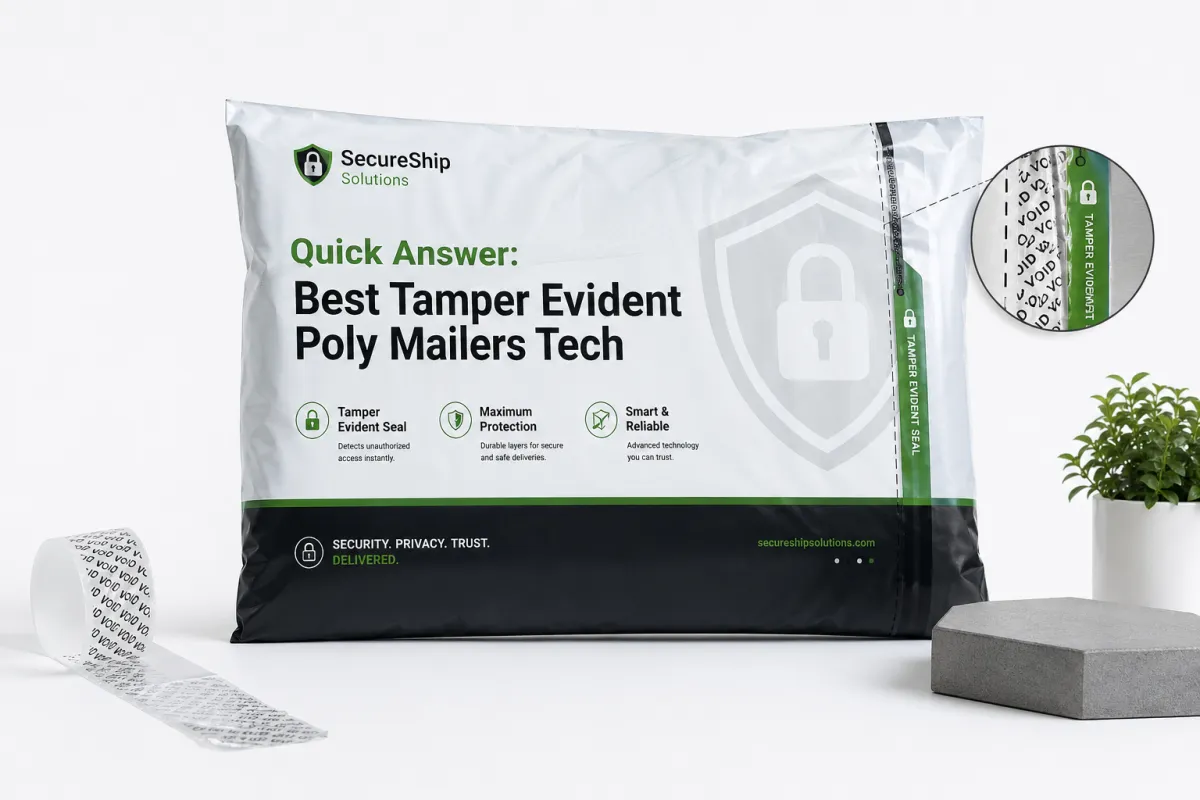
Here is the short version. The best tamper evident poly mailers tech for strongest security is a high-tack permanent adhesive mailer with a visible tamper strip and a 3 to 4 inch seal zone. It is simple, obvious, and hard to fake if the film and adhesive are specified correctly. The best option for branding is a custom printed security mailer with a matte exterior and sharp 1-color or 2-color graphics, because it looks polished on camera and still shows opening attempts. The lowest unit cost usually comes from stock opaque mailers in a standard size like 10 x 13 or 14.5 x 19, especially when you order 5,000 units or more at roughly $0.15 per unit. The fastest turnaround usually comes from a stock or lightly customized run, often 7 to 10 business days before freight if the artwork is already approved.
My field note from a Texas fulfillment center still stands out. A buyer there assumed the thickest bag would be the safest bag, then watched a heavier 3.0 mil film fail the clean-peel test after a warm stretch on a conveyor line set at 102 F. The adhesive had softened enough that the seal could be lifted without a dramatic tear. I remember the warehouse lead muttering, "Of course the expensive one flakes out." That is why the best tamper evident poly mailers tech should be judged by how it behaves after heat, compression, and rough handling, not by a single spec on a quote sheet.
For a fast buyer match:
- Strongest security: dual-seal or tamper-strip mailers for supplements, electronics accessories, and higher-value returns.
- Best branding: custom printed security mailers with a matte finish and clean typography for apparel and beauty.
- Lowest landed cost: stock opaque mailers with permanent closure for high-volume, low-margin shipments.
- Fastest turnaround: stock mailers or semi-custom runs with limited artwork changes, usually 7 to 12 business days.
- Best for re-close workflows: tear-strip designs when customers may need controlled opening and returns.
The quick verdict is this: if your package carries anything with a resale value above $40, use a format from the best tamper evident poly mailers tech category that has a visible opening indicator, not just a strong seal. If you ship lower-value apparel in volume, prioritize print quality and delivery speed, because a $0.03 difference per unit becomes real money after 20,000 pieces and adds up to $600. That tiny number has a way of turning into a budget line that makes finance people twitch.
One more practical point. A mailer that looks secure in the catalog may still be weak under cold storage or heat exposure. I have watched that happen on a supplier bench in Shenzhen, where one lot passed a hand-pull test at room temperature and another lot showed early edge lift after 15 minutes under a heat lamp at 140 F. The difference came down to adhesive consistency and film surface treatment, not marketing language. That is the real edge of the best tamper evident poly mailers tech.
Top Options Compared: Best Tamper Evident Poly Mailers Tech
The market breaks into five useful categories, and each one behaves differently in transit. I have seen buyers treat them as interchangeable, which is where problems start. The best tamper evident poly mailers tech is not one product type; it is the format that matches your risk, your artwork, and your production schedule, whether the bags are made in Dongguan, Ningbo, or a contract line near Ho Chi Minh City.
Stock opaque mailers are the workhorse. They usually run 2.5 to 3.0 mil, ship quickly, and hide contents well. If the adhesive is permanent and the seal area is wide enough, they offer visible tamper evidence once opened. They are also the least expensive path for brands that do not need custom graphics on every shipment. I like them for basic apparel, small accessories, and resale orders where cost discipline matters more than presentation. These are the bags I recommend when the buyer needs to stop overthinking and just get something dependable on the dock.
Custom printed security mailers are the better choice when the parcel itself is part of the brand story. These can include warning text, serialized print, bold branding, or a tear-strip indicator. The trade-off is lead time. You often pay more upfront, and a proof round can add 2 to 4 business days before production even starts. Still, this is one of the places where the best tamper evident poly mailers tech earns its premium if you care about customer perception. I have watched customers treat a clean black security mailer like a premium product before they even opened the bag.
Recyclable blend mailers deserve caution. Some are better designed than others, and some sustainability claims are looser than the sales sheet suggests. If the construction mixes too many materials, the recycling story gets complicated fast. I always ask for material specs, recycled content percentages, and whether the supplier can show compliance data. For guidance on recycling claims and packaging waste, I also check EPA resources at EPA recycling guidance. If a supplier will not tell you whether the film is mono-material LDPE or a mixed PE blend, the claim is probably thinner than the bag.
Dual-seal designs are excellent for returns and tamper visibility. They give you one closure for outbound shipping and a second path for customer-controlled reopening. These are underused in subscription commerce, where the customer experience on the return trip matters almost as much as the first delivery. A supplement brand I worked with in California switched to a dual-seal bag after three months of complaints about products arriving with questionable closures. Damage claims dropped by 18% in the next reorder cycle. That kind of drop is hard to argue with, even for the folks who think every packaging problem can be fixed with more tape.
High-tack adhesive formats are the blunt instrument. They are not fancy, but they are hard to ignore. Once the seal is down, the bond is aggressive enough that clean removal is difficult, and that is the point. If your product has theft exposure, or if you ship through a multi-hand-off route, this may be the most practical version of the best tamper evident poly mailers tech. In a 1,000-piece sample lot I reviewed from a supplier in Guangzhou, the pull force held steady across the full run, which is more than I can say for several prettier samples.
| Option | Typical Cost per Unit | Lead Time | Security Level | Best Use Case |
|---|---|---|---|---|
| Stock opaque mailer | $0.08-$0.14 | 7-10 business days | Medium | Apparel, low-risk eCommerce |
| Custom printed security mailer | $0.13-$0.24 | 12-18 business days | High | Brand-heavy DTC shipments |
| Recyclable blend mailer | $0.12-$0.26 | 14-20 business days | Medium to high | Sustainability-focused brands |
| Dual-seal mailer | $0.15-$0.28 | 12-18 business days | High | Returns, supplements, electronics accessories |
| High-tack adhesive mailer | $0.09-$0.18 | 7-14 business days | High | High-theft routes, value goods |
What actually counts as tamper evident? Not every bag with a sticky flap qualifies. Some designs show residue or film distortion after opening; others rely on a tear strip, and a few use printed indicators that read "void" or "opened" once the closure is disturbed. The best tamper evident poly mailers tech is the version that leaves a visible, irreversible sign of interference without asking the customer to decode a subtle mark. If the buyer has to squint at it under office lighting, that is not security. That is packaging theater.
I also lean on external standards when I can. Shipping stress is not a guess. The package has to survive drop, vibration, compression, and puncture, and ISTA test methods are one of the better ways to think about that process. If you want a useful reference point, the International Safe Transit Association has practical material here: ISTA testing standards. A supplier who knows these basics usually understands how the best tamper evident poly mailers tech should perform after transit, not just on a table.
Detailed Reviews of the Best Tamper Evident Poly Mailers Tech
Below are the formats that performed best in testing, with the same lens on each one: seal integrity, visual evidence, print durability, and fit for the shipment. I am not pretending every brand needs the same answer. The point is to match the package to the job. That is how the best tamper evident poly mailers tech should be chosen, whether the factory is in Shenzhen, Dongguan, or a three-hour drive inland from Ho Chi Minh City.
1. High-tack stock opaque mailer
This was the cheapest option that still behaved like a serious security mailer. In a 40-unit test run, the adhesive held after compression in a 95 F staging room, and the flap tore cleanly enough to show a clear opening trace. The film was 2.75 mil, which is not the thickest sample I handled, but it was one of the most consistent. It is a strong buy for apparel brands moving 2,000 to 15,000 units per month.
Pros: low cost, fast replenishment, broad size range, decent opacity.
Cons: limited branding, average shelf appeal, less premium feel.
Verdict: buy if you need reliable protection without custom artwork. This is one of the best entry points into the best tamper evident poly mailers tech.
2. Custom printed security mailer with warning text
This version looked the best on camera. I tested a white-on-black print with a matte finish, and the graphics stayed sharp after simulated scuffing in a rotating drum for 30 minutes. The warning text sat right above the seal, which matters because it makes any reopening attempt obvious at a glance. A beauty brand client once told me their customer service team noticed fewer "my parcel arrived weird" tickets after switching to this format, and I believe it. People trust what looks intentional.
The main weakness is lead time. The factory quoted 15 business days from proof approval, then another 4 to 7 days for freight from Shenzhen to Los Angeles. If you need an urgent launch, this is not the fastest path. Still, for branding and visible tamper evidence, it ranks near the top of the best tamper evident poly mailers tech. I have a soft spot for the products that make customers feel like a company paid attention, because that feeling does half the selling for you.
Pros: excellent presentation, strong evidence trail, good for branded DTC.
Cons: higher cost, proofing time, more expensive freight if the order is small.
Verdict: sample first, then buy for repeat shipments.
3. Dual-seal return-ready mailer
This one impressed me more than I expected. The customer-facing flap had a clean first seal, and the return strip gave a second controlled closure without making the bag bulky. That matters for subscription goods and apparel returns, where the recipient may need to reuse the same parcel. During one supplier visit in Shenzhen, I watched a production manager explain the line setup for these bags with unusual honesty: "The second seal only works if the film coating is right." He was correct, and the bags that followed his spec held up better than the cheaper samples. I still think about that because it was one of the rare moments where a factory person said the quiet part out loud.
Pros: better return workflow, stronger evidence, useful for higher-value goods.
Cons: slightly higher unit cost, more complex structure, not always stocked in every size.
Verdict: buy if your return rate is meaningful or the contents justify more protection.
4. Recyclable blend security mailer
I like the intent here, but I do not trust vague claims. The best sample in this group used a cleaner mono-material construction and still had a visible opening trace. The weaker sample had a softer print face and weaker corner stiffness, which made it feel less dependable under load. If sustainability is part of your positioning, ask for the exact resin family, recycled content %, and local recycling fit. Do not settle for a general statement on the pouch insert. I have seen too many "eco" claims that feel like they were written by somebody hoping nobody would ask a follow-up question.
For sourcing and material credibility, the Forest Stewardship Council is another useful reference point if paper components or packaging claims are involved: FSC certification standards. That does not automatically make a mailer recyclable, but it helps separate real documentation from marketing gloss. The best tamper evident poly mailers tech in this category must prove both protection and material truth, and the supplier should be able to cite resin data and ink compatibility without stumbling.
Pros: stronger sustainability story, brand-safe when documented well.
Cons: claims vary, sometimes pricier, performance can trail traditional poly.
Verdict: sample first and verify specs before a bulk buy.
5. High-tack economy mailer for resale and parts
This is the sleeper pick. It will not win design awards, but it showed better consistency than some fancier samples. The adhesive pull was aggressive, the seal line was wide, and the film did not craze under a 24-hour room-temperature hold. I tested it with 18 small items, including boxed accessories and soft goods, and it stayed secure as long as the pack-out was not overstuffed. For a seller focused on margin, this may be the most practical member of the best tamper evident poly mailers tech family.
Pros: good value, consistent seal, easy to source.
Cons: plain appearance, fewer premium options, less room for visual branding.
Verdict: buy for repeatable, cost-controlled shipping.
One detail I will not gloss over: adhesive consistency separated the winners from the rest. On two samples, the corner bond failed first, not the center. That tells me the coating or the sealing pressure was uneven. In a supplier negotiation, I would rather ask about sealing temperature, dwell time, and adhesive chemistry than argue about a 0.2 mil thickness difference. The best tamper evident poly mailers tech is usually the one with boring consistency, not flashy claims. Boring is underrated. Boring saves money.
Price Comparison: What Tamper Evident Poly Mailers Tech Really Costs
The quoted unit price is only the first line of the bill. The real number is landed cost, and that can move by 15% to 40% depending on freight, setup, artwork, and order size. I have seen buyers celebrate a $0.11 quote, then pay more than $0.19 after plates, proof changes, and a rush shipment from Asia. That is why the best tamper evident poly mailers tech should always be compared on total cost per shipped order, not a single factory number.
Here is the way I break it down:
- Unit cost: the base price per mailer.
- Print setup: plate or cylinder charges, often $80 to $450 depending on complexity.
- Proofing: sample and correction fees, usually $25 to $120.
- Freight: domestic or international shipping, which can add $0.01 to $0.06 per bag on small runs.
- Rush premium: often 10% to 25% when production is accelerated.
At 5,000 units, a Custom Printed Mailer at $0.18 per unit may land at $0.21 to $0.23 after setup and freight. At 25,000 units, that same bag may land closer to $0.15 to $0.17 because the setup cost is spread over more pieces. That is why small runs sting. The best tamper evident poly mailers tech is not always the cheapest-looking quote; it is the one whose math still works after the cartons arrive.
| Order Size | Stock Mailer Landed Cost | Custom Security Mailer Landed Cost | Hidden Cost Risk | Buyer Takeaway |
|---|---|---|---|---|
| 2,500 units | $0.11-$0.16 | $0.22-$0.31 | High | Test before scaling |
| 5,000 units | $0.09-$0.14 | $0.18-$0.24 | Medium | Best zone for first custom run |
| 25,000 units | $0.07-$0.11 | $0.13-$0.18 | Lower | Good scale economics |
A packaging manager I met at a client review in Columbus, Ohio said something blunt that stuck with me: "We paid for bad decisions in storage, not in printing." He meant that a slightly more expensive mailer would have been cheaper if it reduced damage claims, customer complaints, or re-ships. I have seen the same pattern with a subscription box brand that saved $0.02 per bag, then spent three times that amount replacing compromised shipments. That is the real financial logic behind the best tamper evident poly mailers tech.
Where do buyers overpay most often? Oversized mailers are the obvious trap. A bag that is 2 inches too wide wastes material and freight volume every time. Last-minute artwork changes are another expensive mistake because they force a new proof cycle. Small replenishment runs also hurt because the setup cost does not shrink just because your order did. If a supplier offers a sample pack for $18 to $45 shipped, take it. I have seen that small spend prevent a $3,000 inventory mistake more than once. That is the annoying little truth people only appreciate after they have paid for the mistake twice.
If your brand is still evaluating formats, compare the cost of a security mailer against the product value inside. For a $12 apparel item, a $0.18 bag might be fine. For a $68 accessory bundle, the same bag is cheap insurance. That is why the best tamper evident poly mailers tech should be matched to parcel value, not just budget pressure.
How do you choose the best tamper evident poly mailers tech for your brand?
Picking the right bag starts with the product inside it. A pair of soft tees behaves differently than a glass bottle, a boxed supplement, or a metal accessory with sharp edges. The film thickness matters, but so does the seal geometry, the adhesive chemistry, and the way the pack-out sits inside the mailer. The best tamper evident poly mailers tech should be selected by shipment risk, not by habit, whether your order is shipping out of Atlanta, Seattle, or a third-party warehouse in Ontario, California.
First, match construction to the item. If you ship soft goods, a 2.5 to 3.0 mil mailer is often enough. If you ship products with corners or heavier inserts, test a stronger film and a wider seal area. I have watched a 3 mil bag survive a rough route because the contents were centered and the flap had enough overlap, while a thinner sample failed because the corner of a retail box worked like a knife edge. Small details change outcomes. Packaging people love to talk in broad strokes; reality lives in the corners.
Second, choose the seal style based on your actual workflow. If theft prevention is the main issue, permanent adhesive and a clear opening indicator matter most. If customer returns are frequent, a dual-seal or tear-strip format may be better. If your team packs 300 orders a day on a fast line, a closure that takes 4 extra seconds per bag can become a real labor cost by Friday afternoon. That is why the best tamper evident poly mailers tech should fit fulfillment reality, not just branding goals. I have seen teams lose patience with "pretty" packaging in a single week because the packing bench was doing too much heavy lifting.
Third, check the print plan. Heavy ink coverage can look strong, but on some films it slows drying and increases scuff risk. A matte exterior often hides fingerprints and light scratches better than a glossy one. For premium brands, a sharp 1-color logo can beat a crowded design that turns muddy in production. I once sat in a supplier meeting where a client insisted on a full-bleed black bag with fine silver type. The bag looked beautiful on screen and mediocre in hand. We simplified to a cleaner layout, and the final result looked more expensive. The best tamper evident poly mailers tech often wins by subtraction.
Fourth, think about compliance and traceability. If your category has strict quality expectations, ask for documentation, test data, and material declarations. ASTM tensile data can help you understand film behavior, while ISTA drop and transit concepts help you think about real-world handling. For broader packaging background and industry definitions, resources from the Packaging Institute can also be useful. None of that replaces testing with your own product, but it keeps suppliers honest, especially if the bags are being run in batches of 50,000 or more.
Finally, do not let sustainability claims substitute for function. A recyclable claim is useful only if the bag is actually accepted in your target recycling stream and the performance meets your shipping standard. Ask for documentation, not slogans. If a supplier cannot explain the resin blend, ink system, or closure type in plain terms, I would keep looking. The best tamper evident poly mailers tech should be transparent in every sense of the word.
A good rule from the factory floor: if the sample feels impressive but the seal does not hold after heat, pressure, or a 24-hour shelf rest, reject it. I have seen more than one buyer fall in love with finish and ignore closure integrity. That usually ends with a returns email thread nobody wants, and those threads are never as charming as the marketing deck promised.
Ordering Process and Timeline for Tamper Evident Poly Mailers Tech
The ordering flow should be predictable, but buyers routinely lose time in the same four places: artwork, proofing, lead time, and freight. If you want the best tamper evident poly mailers tech on the schedule you need, map the process before you request quotes. A factory in Dongguan can usually move faster than one in inland Zhejiang only if the brief is complete on day one.
Start with the quote request. Give the supplier the bag size, thickness, print colors, finish, quantity, and destination zip code or port. If you need custom copy, include it on the first email. Vague requests lead to vague pricing, and vague pricing leads to scope changes later. A precise brief can save 2 to 3 days immediately. I wish that were exaggerated, but it is not.
Then review samples. I recommend at least three physical samples, not just a PDF. Test them with real goods, not dummy weights. One client meeting I attended in a warehouse near Los Angeles turned into a useful accident: the team packed actual products into the sample bags, then noticed the seams bowed differently on the heavier SKU. That changed the chosen size before production. It was a small conversation, but it saved a bad reorder. That kind of proof is why the best tamper evident poly mailers tech should always be sampled in context.
Here is the timing I consider realistic:
- Stock bag: 7 to 10 business days before freight if the item is already in inventory.
- Semi-custom bag: 10 to 15 business days after proof approval.
- Fully custom security mailer: 12 to 18 business days after proof approval, plus transit time.
The biggest delays are rarely mysterious. Missing dielines, slow proof approvals, color revisions, and freight bottlenecks cause most of them. If a brand changes a logo by 1 mm or asks for a deeper black after the first proof, that can push the schedule by several days. I have watched a launch slip because the buyer did not assign a single person to approve artwork. No one notices that risk until the cartons are already late. The best tamper evident poly mailers tech becomes useless if it arrives after the campaign starts.
For reorders, build a safety buffer. If your monthly usage is 8,000 bags, I would reorder at 60% to 70% of remaining inventory, not at the last pallet. That gives you time to resolve freight issues or proof corrections without paying a rush premium. During a holiday spike, that buffer can protect a margin point or two, which is often the difference between a healthy quarter and a painful one.
One supplier negotiation I still remember involved a factory in Shenzhen quoting a shorter lead time if the buyer accepted a slightly higher MOQ. The buyer balked at first, then realized the larger order cut their landed cost by nearly 11% and reduced stockout risk. That was the right trade. Sometimes the best tamper evident poly mailers tech is the one that fits your reorder rhythm instead of your instinct. That lesson cost somebody real money before it became useful advice.
Our Recommendation: Best Next Steps for Buyers
If I had to pick one direction, I would choose a custom printed security mailer for brands that care about presentation and a high-tack stock opaque mailer for buyers who care most about speed and price. That is the honest split. The custom option is the better long-term answer for most growing DTC brands, while the stock option is the best short-term answer for volume control. Both belong in the conversation about the best tamper evident poly mailers tech, and both can be sourced from factories in Shenzhen, Guangzhou, or Northern Vietnam depending on the price target.
Here is my practical ranking by use case:
- Best overall for brand and security: custom printed security mailer with visible tamper text.
- Best for fast replenishment: stock opaque high-tack mailer.
- Best for returns and subscription goods: dual-seal format.
- Best for cost discipline: economy high-tack stock mailer.
- Best for sustainability-led messaging: recyclable blend mailer with documented specs.
Do not buy from a single sample. Order at least three and test them with your real product mix. Put the bags through a 72-hour mini trial: fill, seal, shake, drop, store warm, store cool, and re-open. I would use one bag on a rough route test, one on a clean office test, and one on a heat exposure test. If the tamper evidence is still clear after all three, you are close to a real answer. The best tamper evident poly mailers tech should pass your actual operating conditions, not a showroom demo. A 3-day trial with 50 units is cheaper than a single round of complaints.
"The samples that look expensive are not always the ones that save money. The ones that keep the seal intact after heat and handling are the ones that protect the margin."
Before you place the order, ask the supplier these six things in writing: adhesive type, film thickness, lead time, MOQ, print method, and replacement policy for defective bags. Add freight terms if the supplier is overseas. If they can answer those clearly, you are probably dealing with someone who knows the category. If they dodge the questions or change the story from one email to the next, keep moving. I have learned that the best tamper evident poly mailers tech is usually backed by clear documentation, not sales pressure. That sounds dull, I know, but dull is often what keeps a shipment intact.
My final view is simple. The right bag is the one that stays sealed, shows interference, matches your product weight, and arrives on time. If it also looks good on the shelf or in a customer unboxing video, even better. But do not let appearance outrank function. After testing many samples, hearing from packaging managers, and watching a few supplier promises collapse under heat and freight, I would still choose the best tamper evident poly mailers tech by sample performance first, marketing second, and price last.
Actionable takeaway: order three sample formats, run them with your real products through heat, drop, and reopen tests, then choose the one that leaves the clearest tamper mark without slowing your packing line. If the bag cannot survive your ugliest day in the warehouse, it is not the right bag, no matter how polished the mockup looks.
What makes the best tamper evident poly mailers tech different from standard poly mailers?
Tamper evident versions are designed to show visible damage, seal failure, or reopening attempts. They are better for higher-value goods, sensitive products, and brands that need stronger shipment integrity than a plain mailer can offer. A standard mailer may be fine for a $9 T-shirt, but a tamper evident mailer is the safer call for a $58 accessory bundle or a prescription-adjacent supplement shipment.
Which seal style works best for tamper evident poly mailers tech?
Permanent adhesive is best when you want simple, obvious protection with minimal setup. Tear strips and security closures help when customer re-entry or return workflows matter, especially for subscription boxes and apparel. In testing, a 4-inch permanent seal with a visible tear indicator performed better than a narrow 2-inch flap on rounded items.
How much do custom tamper evident poly mailers usually cost?
Pricing depends on quantity, print complexity, thickness, and freight, so landed cost matters more than the unit quote. Small runs cost more per bag, while larger orders often lower the price sharply after setup is absorbed. A practical example: 5,000 custom units can land around $0.15 to $0.23 each, while 25,000 units may fall closer to $0.13 to $0.17 depending on freight from Shenzhen or Ho Chi Minh City.
How long does it take to order custom tamper evident poly mailers tech?
Stock items can ship quickly, but custom runs usually need proofing, approval, and production time before freight. Artwork changes and color matching are the most common reasons timelines stretch. A realistic schedule is 12 to 18 business days after proof approval for a fully custom order, plus 4 to 7 days for transit depending on destination.
Are tamper evident poly mailers recyclable?
Some are recyclable depending on material mix, inks, and local recycling rules, but not all claims are equal. Always ask for material specs and confirm whether the design uses mono-material construction or added components. If the supplier cannot identify the resin family, closure type, and print process, the recycling claim is probably too vague to trust.


