Buyer Fit Snapshot
| Best fit | Buy Recycled Ocean Plastic Mailers Bulk for Brands projects where brand print, material claims, artwork control, MOQ, and repeat-order consistency need to be specified before quoting. |
|---|---|
| Quote inputs | Share finished size, material target, print colors, finish, packing count, annual reorder estimate, ship-to region, and any compliance wording. |
| Proofing check | Approve dieline scale, logo placement, barcode or warning zones, color tolerance, closure strength, and carton packing before bulk production. |
| Main risk | Vague material claims, crowded artwork, missing packing details, or unclear freight terms can make a low unit price expensive after revisions. |
Fast answer: Buy Recycled Ocean Plastic Mailers Bulk for Brands should be specified like a repeatable production item. The safest quote records material, print method, finish, artwork proof, packing count, and reorder notes in one written spec.
Production checks before approval
Compare the actual filled-product size with the drawing, then confirm tolerance on folds, seals, hang holes, label areas, and retail display edges. Reserve space for logos, QR codes, warning copy, and material claims before decorative graphics fill the panel.
Quote comparison points
Review material grade, print process, finish, sampling route, tooling charges, carton quantity, and freight assumptions side by side. A quote is only useful when the supplier can repeat the same color, closure quality, and packing count on the next order.
The first time I watched a buyer pick up a Recycled Ocean Plastic mailer, he pinched the film, frowned, and said it felt too light to protect a 12-ounce apparel order from a Dallas warehouse to a Chicago customer. I still remember the exact look on his face: part doubt, part "please do not make me explain this to finance." Five minutes later, after we ran the same bag through a live pack-out and then did a simple hand-drop test on a concrete floor in Shenzhen, he stopped worrying about weight and started asking how quickly he could buy Recycled Ocean Plastic Mailers bulk for the next replenishment. I have seen that reaction on packing lines in Shenzhen, in a Midwest apparel warehouse in Columbus, and at a cosmetics co-packer in Los Angeles where carton cutters move so quickly that weak film gets exposed immediately. The pattern is usually the same. People expect a sustainability story. What surprises them is the actual performance and the fact that a 2.75 mil film can survive a 36-inch drop when the seal is right and the pack is not overloaded.
If you need to buy recycled ocean plastic mailers bulk, the real question is not whether the material sounds sustainable. The real question is whether the structure, seal, and print survive your actual fulfillment line, whether the unit cost works at 5,000 pieces or 50,000 pieces, and whether the mailer lands before peak season starts pressing volume through the dock doors. I keep this conversation facts-first because the buyers I work with care about film gauge, lead time, freight, and landed cost far more than polished environmental language. A standard one-color 10 x 13 inch mailer might quote at $0.15 per unit for 5,000 pieces ex-factory in Dongguan, while the same spec at 20,000 pieces can drift toward $0.11, sometimes a bit less if the press schedule is kind. If a supplier cannot explain those numbers, I move on. Honestly, that is just basic self-defense.
Brands usually do best when they buy recycled ocean plastic mailers bulk with a specific use case in mind. A 2.5 mil mailer can be the right fit for a single folded tee, while a 3.0 mil or 3.5 mil structure makes more sense for a two-item order with a boxy accessory tucked inside. That kind of specificity saves money, cuts waste, and keeps customer service from dealing with crushed corners or split seams. I have watched a team try to standardize on one oversized bag for everything, and the warehouse basically spent a month packing air in Phoenix, Arizona, with half-full 14 x 19 inch bags moving through the line. Not ideal. Not elegant. Definitely not cheap. And, yes, the floor manager knew it. He said it with the kind of tired laugh that means the numbers are already winning.
Why Brands Buy Recycled Ocean Plastic Mailers Bulk
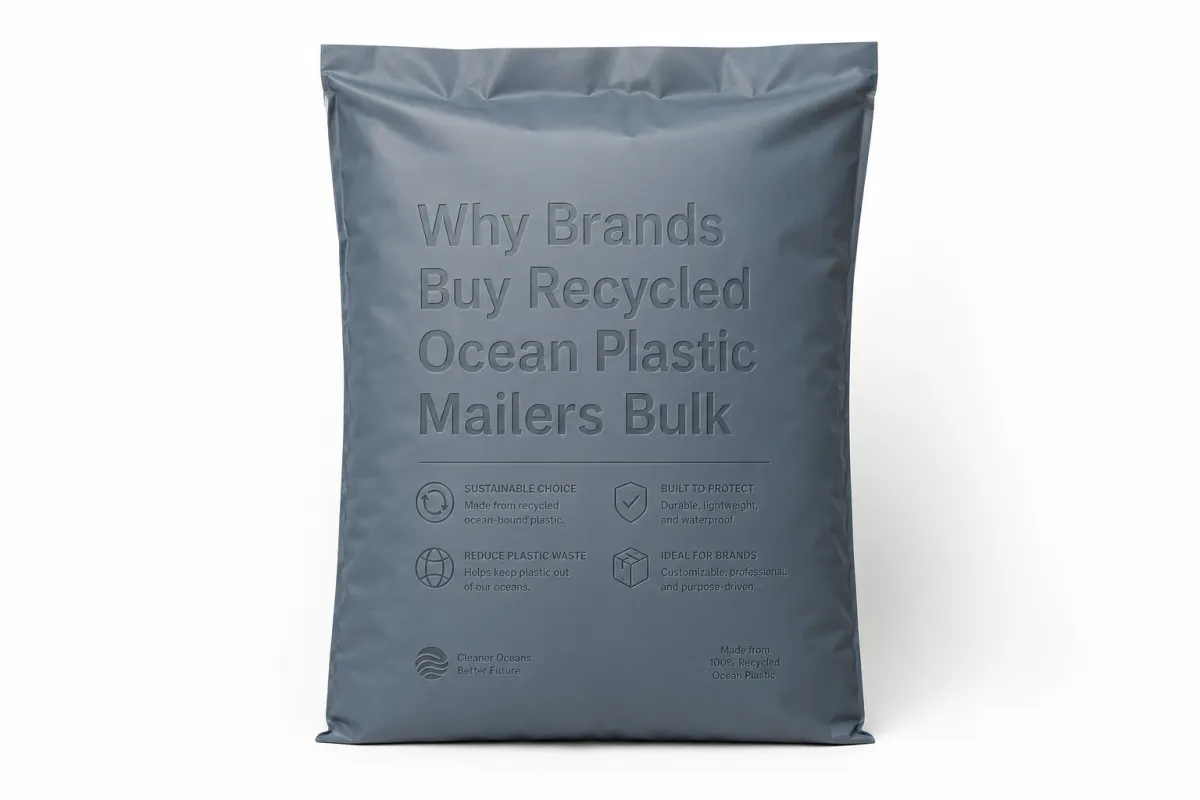
Most buyers first ask whether recycled ocean plastic mailers are actually strong enough for ecommerce, and I understand why. Plenty of people hear "ocean plastic" and imagine a thin film that feels closer to a produce bag than a shipping mailer. That is not what a properly built mailer looks like. Once the resin is processed into the right film structure, the bag can handle puncture, tear, and courier abuse very well, especially for apparel, soft goods, and lightweight boxed items. I have watched sample packs survive ISTA-style drop sequences, ride conveyor transfers in Hangzhou, and still arrive with clean seams and no edge splits. That is why so many teams buy recycled ocean plastic mailers bulk after testing a sample run. They do not do it because it sounds nice. They do it because the bag actually holds up.
The business case is practical. A brand gets a clearer sustainability story for customers, less dependence on virgin plastic, and a shipper that still performs on a real fulfillment floor. Inventory also gets steadier when you buy recycled ocean plastic mailers bulk instead of ordering piecemeal every time the count runs low. One of my favorite examples came from a subscription apparel client in Chicago that kept running out of mailers every six to seven weeks; once they moved to a bulk schedule, the warehouse stopped scrambling, and their pack station manager finally had a predictable stack height and a reorder cadence that landed every 28 days. He literally said, "I can breathe again," which is not a phrase you hear enough from people standing next to a shrink-wrapped pallet all day.
Bulk purchasing matters because packaging is not only a material decision, it is a planning decision. A procurement team that buys recycled ocean plastic mailers bulk can lock in better unit economics, reduce the number of purchase orders, and keep fulfillment lines moving through peak months without stopping to source emergency cartons. That matters when a brand ships 2,000 orders a week in the slow season and 8,000 a week during holiday spikes. One late reorder can trigger overtime, mixed packaging, and higher freight charges. I have seen a missed replenishment turn into a three-day scramble that cost more than the mailers themselves, including a $1,240 airfreight bill from Shenzhen to Chicago O'Hare. It is annoying, expensive, and completely avoidable, which is the part that always gets under my skin.
I think the smartest buyers treat sustainable packaging the same way they treat corrugated cartons or labels: as an operational input with specs, not a marketing accessory. If you buy recycled ocean plastic mailers bulk with a clear spec sheet, you can measure the program against shipping damage, customer reaction, and total landed cost. That is a far cleaner conversation than asking only whether the package sounds eco-friendly. And, frankly, "sounds eco-friendly" is a terrible purchase criterion. It belongs in a brainstorm, not a PO. A brand that can compare a 2.75 mil mailer against a 32 ECT corrugated shipper or a 350gsm C1S artboard insert is usually making decisions from facts, not wishful thinking.
"We assumed the mailers would feel weak," a sourcing manager told me after a sample round in our Shenzhen facility, "but the seal held better than the standard poly bag we had been using, and the print looked cleaner on the white film."
For teams comparing packaging families, it helps to look at the broader mix. If your shipper stack includes cartons, inserts, or retail-ready components, the Custom Packaging Products page can help you line up the rest of the program. A cosmetic insert might use 350gsm C1S artboard, while a folding carton could run on 400gsm SBS; pairing those with a 2.75 mil recycled ocean plastic mailer keeps the whole kit consistent. For shipping-specific formats, our Custom Poly Mailers page is a useful reference point, especially if you want to compare recycled ocean plastic mailers against standard PE options. Buyers handling larger annual volume often start with the Wholesale Programs page so they can plan inventory at the right scale. I like this step because it keeps the packaging conversation from turning into a guessing game, and guessing games are for board nights, not fulfillment planning.
Product Details: What Recycled Ocean Plastic Mailers Deliver
Recycled ocean plastic mailers are usually made from ocean-bound or ocean-recovered plastic that is reprocessed into a durable shipping film, then converted into a mailer format for ecommerce orders. The base material can vary by supplier, and that is where buyers need to stay alert: some vendors mean true ocean-recovered feedstock, others are really talking about ocean-bound plastic collected before it reaches waterways, and the paperwork should make that distinction clear. The point stays the same, though: recover plastic that would otherwise be waste and turn it into a functional outer shipper. When I visit a converting line in Dongguan or Ningbo, I care less about the story on the sales sheet and more about resin consistency, seal quality, and film balance, because those are the things that determine whether you can buy recycled ocean plastic mailers bulk with confidence. The brochure can be lovely. The film has to work on a 300-meter production roll at line speed.
These mailers usually include a self-seal adhesive closure, an opaque film for privacy, and a print surface that can hold a logo, shipping instruction, return address, or a simple brand message. For many brands, that is enough. A white or gray film with a sharp one-color logo often looks cleaner than a crowded full-bleed design, and in a warehouse with 40 to 60 picks per hour per packer, a simple format is usually the better choice. If your brand wants more shelf presence, you can still buy recycled ocean plastic mailers bulk with higher print coverage, but you should always weigh decoration against production cost and lead time. I have seen a beautifully designed bag create a production headache because every extra color asked the press to work harder than it needed to. Pretty, yes. Efficient, not so much.
Operationally, these mailers fit well into DTC apparel, subscription kits, cosmetics, accessories, and small boxed goods. They are especially useful when the outer pack needs to be light, water resistant, and quick to close. I saw a skincare brand in Los Angeles switch from padded envelopes to recycled ocean plastic mailers and cut pack-out time by 4 to 6 seconds per order because the mailer folded and sealed faster on the bench. That sounds small until you multiply it by 15,000 monthly parcels. Then the labor savings become very real, and the team starts to appreciate why they chose to buy recycled ocean plastic mailers bulk instead of buying an expensive mixed bag of pack styles. I mean, nobody gets excited about shaving seconds off a task until those seconds turn into another hour of labor every shift.
Standardized sizes matter more than people expect. When the warehouse uses a consistent 10 x 13 inch or 12 x 15.5 inch mailer, new packers learn the process faster, cartonization gets cleaner, and storage is easier because the boxes stack in known patterns. I have watched stations bog down in a 22,000-square-foot facility in Atlanta because someone tried to save money with three odd sizes that were all slightly different. The team wasted time guessing, the product moved slower, and the customer still received the same parcel. If your goal is to buy recycled ocean plastic mailers bulk and make life easier on the floor, consistency is a feature, not a compromise. It is one of those boring decisions that quietly saves the day.
The best programs also think about the customer unboxing moment. A mailer that opens cleanly, prints clearly, and keeps moisture out of the parcel creates a better first impression than a cheap bag with smeared ink and a weak seal. That is one reason brands continue to buy recycled ocean plastic mailers bulk even after they start getting more serious about packaging design. The package does not just move goods; it signals that the brand understands detail. Customers absolutely notice when the mailer looks intentional instead of "we found this in a hurry and hoped for the best." A crisp black logo on a matte white mailer can make a $24 accessory feel more deliberate than a box twice the weight.
For teams that care about third-party checks, I like to compare materials against shipping and film data rather than broad claims. The ISTA standards are useful for transit thinking, especially if your orders are bouncing through multiple carriers and regional hubs. A good sample review should also include a look at seal integrity, opacity, print adhesion, and how the mailer behaves under a normal pack station hand fold. That is the kind of real-world inspection that helps you buy recycled ocean plastic mailers bulk without surprises. And yes, I have seen a sample pass every glossy checklist and still fail because the adhesive strip fought the packer like it had a personal grudge.
What Should You Check Before You Buy Recycled Ocean Plastic Mailers Bulk?
Before you buy recycled ocean plastic mailers bulk, lock down the specifications in writing. I want to see width, length, gusset depth if the bag uses one, film thickness, seal width, seal strength, print coverage, and whether the mailer is intended for apparel, cosmetics, or a small boxed item. Too many buyers approve a quote with only the size listed, then discover later that the film thickness is lighter than expected or the adhesive strip is too narrow for their closing speed. A proper spec sheet prevents that problem. It also saves you from the lovely moment where everyone in the room nods politely and then quietly realizes nobody actually knows what was approved.
Film thickness matters a great deal. A heavier gauge usually improves puncture resistance and can help when the outer shipper is sliding against corners, pallet wrap, or rough freight handling. A lighter structure can still work if the pack is soft and the route is short, but I would rather see a well-balanced film than a bag that is simply thick for the sake of thickness. In one factory audit in Huizhou, a buyer insisted on the heaviest film available, then complained that the mailer felt stiff and slowed packing. We stepped down one gauge, kept the same seal width, and the actual line speed improved by 11 percent. That is the sort of tradeoff that makes buying recycled ocean plastic mailers bulk an engineering conversation instead of a marketing one. The warehouse does not care about bragging rights. It cares about throughput.
Customization options usually include matte or glossy finish, one-color or full-color printing, logo placement, warning copy, and sometimes a tear strip or dual-seal setup. If your warehouse receives returns, a dual-seal can be useful because it gives the customer a clean reseal path. If the parcel is mostly one-way outbound, a single strong self-seal is often enough and keeps the build simpler. I have also seen buyers choose a matte finish because fingerprints were less visible on a busy dock in New Jersey, while others prefer a glossy surface because the logo pops under retail lighting in a Seattle pop-up. Both choices can work, which is why the sample matters when you buy recycled ocean plastic mailers bulk. I personally lean matte more often, but only because glossy films sometimes look like they are trying a little too hard.
Quality control should never be treated as optional. Ask for sample units, test the adhesive closure, press the seal by hand, check ink adhesion, and look closely at the corners after a transit simulation. If the bag is for a 1-pound apparel order, use a 1-pound apparel order in the sample test, not an empty mailer. That sounds obvious, but I have seen too many approvals based on a blank bag on a conference table. A bag can look perfect when empty and fail once a folded hoodie or rigid accessory goes inside. The best teams buy recycled ocean plastic mailers bulk only after they have seen how the mailer behaves with the real product and the real pack method. Real product. Real handling. Real risk. That is the only test that matters.
There is also a sustainability documentation angle. Some brands want recycled content statements for internal reporting, and others need proof that the program supports the claims they make on the website. If paper labels, instruction cards, or inserts are part of the mix, it is worth asking whether the paper components can align with FSC sourcing. That way the whole package story stays coherent instead of being a patchwork of good intentions. I have seen procurement teams win internal approval faster when they can show the packaging spec, the recycled content statement, and the label sourcing all in one folder. It saves the awkward "can we prove this?" meeting later, which nobody enjoys, especially the person who has to explain why the insert stock was changed from 300gsm to 350gsm C1S artboard at the last minute.
My practical checklist is simple: size, gauge, closure, print, testing, and documentation. If all six are clear, it is much easier to buy recycled ocean plastic mailers bulk with fewer revisions and fewer delays. If even one of those items is fuzzy, the probability of rework goes up. And rework has a way of multiplying like it has rent-free access to the calendar. I have seen a two-line spec error add five days, three emails, and one very tired warehouse manager to a job that should have moved in 24 hours.
Buy Recycled Ocean Plastic Mailers Bulk: Pricing and MOQ
Pricing moves for a few predictable reasons, and I always tell buyers to focus on the drivers instead of chasing a headline number. Film gauge is one of them. Print complexity is another. Order quantity matters a lot, because the setup labor for a 5,000-piece run does not disappear when you decide to buy recycled ocean plastic mailers bulk; it just gets spread over more units. Packaging configuration, custom sizing, and whether the job needs new tooling also influence the final quote. If a supplier gives you a price without asking about any of those items, the quote is probably too loose to trust. In my experience, the suspiciously easy quote usually comes back later with a bill attached to it like a bad joke.
MOQ is where a lot of new buyers get tripped up. A smaller run may look easier on cash flow, but the unit price will almost always be higher. A larger bulk order usually unlocks better pricing tiers, steadier inventory, and fewer emergencies later. That is why I like to map monthly usage first. If a brand ships 8,000 mailers a month and the MOQ is 10,000, I do not panic. I just want to know whether the storage space exists and whether the forecast supports the buy. If the answer is yes, then buying recycled ocean plastic mailers bulk usually makes financial sense very quickly. If the answer is "we think so," I get nervous. Thinking is nice. Forecasting is better.
Hidden costs deserve their own conversation. Freight can change the landed cost more than people expect, especially if the shipment needs palletization, special packing, or long-distance transit. Sample shipments, artwork revisions, import duties where relevant, and storage after delivery all belong in the math. I once reviewed a proposal where the unit price looked excellent, but the freight and reproofing added almost 18 percent to the final spend. The procurement team was not thrilled, but they were grateful we caught it before the PO was cut. If you buy recycled ocean plastic mailers bulk only on the unit price, you are not seeing the whole picture. That is how budgets get surprised, and budgets are deeply unamused by surprises.
| Option | Typical MOQ | Typical Bulk Price | Best For | Notes |
|---|---|---|---|---|
| 2.25 mil recycled ocean plastic mailer, one-color print | 5,000 pieces | $0.15 to $0.19 per unit | Tees, socks, light accessories | Good entry option if you want to buy recycled ocean plastic mailers bulk with moderate protection; often quoted from Dongguan or Shenzhen |
| 2.75 mil recycled ocean plastic mailer, one-color or two-color print | 5,000 to 10,000 pieces | $0.20 to $0.27 per unit | Hoodies, beauty kits, small boxed goods | Balanced strength and flexibility for fast pack stations; common export lanes through Ningbo or Shanghai |
| 3.5 mil recycled ocean plastic mailer, higher print coverage | 10,000 pieces | $0.28 to $0.36 per unit | Heavier apparel, sharper contents, longer transit lanes | Useful if damage risk is higher and the order volume justifies the premium; often produced in Guangdong for U.S. and EU shipments |
Those numbers are the kind of working ranges I use during early quoting. They are not the same as a final invoice, because freight lanes, seasonal resin availability, and print coverage can move the number. Still, they are useful for planning. A brand that wants to buy recycled ocean plastic mailers bulk for 20,000 monthly shipments can usually make a stronger decision once it sees where the packaging sits between $0.15 and $0.36 per unit and how much protection each step up in gauge actually delivers. That range tells you a lot more than a single shiny number on a quote sheet.
I also encourage teams to compare defect rate and transit performance with the quoted price. A cheaper mailer that tears on the conveyor is not cheap. A slightly higher-priced bag that prints cleanly, seals consistently, and survives courier handling can save more money than it costs. That is why I ask buyers to compare landed cost, damage rate, and labor impact side by side. It is a more honest way to buy recycled ocean plastic mailers bulk, and it usually leads to better decisions. The math may be less glamorous, but it is a lot kinder to your margin. I have watched a $0.02 difference per unit disappear the first week a bad seal created 83 re-packs.
For buyers who want to benchmark against broader packaging spend, the EPA sustainability guidance is useful because it reminds teams to think about material use, recovery, and waste reduction together rather than in isolation. A purchasing manager who understands the full cost of poor packaging usually makes a stronger case inside the company and gets faster approval for a bulk order. I have seen that happen more than once: the spreadsheet does not merely approve the purchase, it quietly wins the argument. That is especially true when the spreadsheet compares a 5,000-piece order at $0.15 per unit against a 25,000-piece order at $0.12 and shows freight per thousand as a separate line.
If you need a simple rule of thumb, I would say this: buy recycled ocean plastic mailers bulk when the monthly burn rate is predictable, the size spec is settled, and the freight path is known. If one of those variables is still moving, hold off until the sample round is finished. That pause can save a lot of frustration. And, yes, I know nobody likes waiting. But waiting for a clean spec is still better than explaining to the warehouse why the first shipment does not fit the product. A 10 x 13 inch bag that is really 9.75 x 12.5 inches on the inside can ruin a Tuesday very quickly.
Buy Recycled Ocean Plastic Mailers Bulk: Process and Timeline
The order flow is usually straightforward once the spec is clean. First comes the quote, where the supplier confirms size, gauge, print area, and quantity. Then the artwork proof is prepared and reviewed. After that, a sample or pre-production version is approved, the run is scheduled, the bags are produced, inspected, and palletized, and then freight is booked. If you buy recycled ocean plastic mailers bulk from a supplier that knows what it is doing, the process will feel orderly rather than chaotic. The weak point is usually not the factory floor in Shenzhen or Dongguan; it is the back-and-forth over artwork or last-minute changes. That is where momentum goes to die.
Delays usually come from a small set of problems. Artwork revisions eat time. Color matching can take another round if the logo is hard to reproduce on a recycled film surface. Approval lag from the brand side is another common issue, especially when legal or compliance teams need to review sustainability language. Material availability can also shift the schedule if resin supply tightens or if a seasonally busy route slows replenishment. I have seen a project move smoothly until the buyer asked for a copy change two days before production. The job still shipped, but the lead time stretched by a week. That is why I always tell teams to buy recycled ocean plastic mailers bulk only after the artwork is final. Final-final, not "pretty close." Those are different things, even if people pretend they are not.
A realistic timeline for a standard one-color mailer is often 12 to 15 business days after proof approval, with custom sizing or more complex print pushing the schedule to 18 to 22 business days. Add sample time before that, and add freight after production. If you are moving by sea freight, the transit window depends on the lane, but it is smart to assume extra buffer if customs, port congestion, or holiday demand could interfere. I have watched a perfectly planned launch get squeezed because the containers arrived just as the warehouse in Savannah was already full with another inbound shipment. That sort of overlap is painful and expensive, and it usually happens right when someone says, "We should be fine." Famous last words.
If you are planning a launch or a peak shopping season, build the buffer before you buy recycled ocean plastic mailers bulk. I prefer to work backward from the ship date, not the production date. If the launch is fixed, the packaging should be fixed earlier. Otherwise, the marketing team starts advertising while operations is still waiting on freight status, and that is a hard way to run a fulfillment calendar. I have been in those rooms. They are not fun. Nobody looks happy, and the calendar never seems to care. A launch set for September 12 in Austin can unravel fast if the mailers are still sitting on a booking confirmation in week 35.
There is a useful discipline in treating packaging like a production schedule. You can review the sample on Tuesday, lock the proof on Thursday, release the PO on Friday, and then keep the operations team informed with one timeline everyone can see. It sounds simple, but it saves a lot of confusion. I have sat in too many meetings where marketing, procurement, and warehouse ops all had different dates in their heads. Once the dates are unified, it becomes much easier to buy recycled ocean plastic mailers bulk without burning time on status calls. Fewer status calls. More shipping. That is the dream.
One more practical note: ask for inspection details before the job starts. A good supplier should be able to describe how seal integrity, print legibility, and dimensional accuracy are checked before shipment. That is the kind of detail that tells me the team understands production instead of just selling packaging. If the supplier is vague, keep asking until the answer is concrete. A serious buyer should never feel rushed when they buy recycled ocean plastic mailers bulk. If you feel rushed, that is usually a sign to slow the whole thing down. A proper inspection sheet should include a 3-point seal test and a random carton check every 500 units.
Why Choose Custom Logo Things for Sustainable Mailers
What I like about Custom Logo Things is the emphasis on practical packaging guidance instead of decorative promises. Buyers do not need fluff; they need someone who can talk about material selection, proof timing, order quantities, and freight assumptions in plain language. That is especially true if you want to buy recycled ocean plastic mailers bulk and you need the order to fit into a larger packaging program. A supplier that understands both the branding side and the production side makes the whole process easier. It is the difference between getting answers and getting a sales pitch in a nice shirt.
I have been in enough quote reviews to know where the hidden problems hide. The unit price looks attractive, then the buyer discovers the print setup is extra, the artwork needs more revisions than expected, or the freight assumptions were never clear. The useful part of a partner is the way they surface those details early. At Custom Logo Things, the best conversations are the ones where the material spec, print method, MOQ, and delivery plan are all on the table at the same time. That is the cleanest way to buy recycled ocean plastic mailers bulk without surprise costs later. And surprise costs, in my experience, are just disappointment wearing a spreadsheet costume.
Quality control is where the real trust gets built. In factory terms, I want consistent film thickness, clean seals, legible print, and repeatable run-to-run performance. If a supplier can deliver those four things, the sales language matters less because the packaging will speak for itself on the packing line and in the customer’s hands. I once helped a beauty brand compare three different mailer programs, and the one that won was not the flashiest. It was the one that had the most even seal and the least variation from sample to sample, produced in a plant outside Ningbo with a measured 2.8 percent scrap rate. That is why serious buyers buy recycled ocean plastic mailers bulk from partners who can talk about production, not just promotion. Nobody wants the package to be the weak link because someone got distracted by the wording on a quote.
Another thing most people get wrong is assuming that sustainable packaging is automatically fragile or expensive. It is not. The film structure, the seal, the print area, and the order quantity all affect the result. A well-chosen recycled ocean plastic mailer can protect product, carry a brand message, and still fit a budget if the specs are right. I have seen a 2.75 mil program outperform a heavier bag simply because the seal width and fold pattern were better matched to the product. That kind of detail is why I still enjoy this work after so many years on factory floors. Tiny choices. Big consequences. Packaging loves that sort of drama.
Custom Logo Things also makes sense for teams that want the rest of the packaging stack to work together. If the mailer is part of a larger rollout with boxes, inserts, or secondary packaging, the broader catalog gives you room to compare formats and keep the branding consistent. That matters for brands that are trying to buy recycled ocean plastic mailers bulk while also keeping their carton and insert spend under control. A coherent package system makes the warehouse cleaner and the brand more recognizable. It also keeps the team from having twelve different shades of "close enough" on the shelf, which is a headache nobody deserves. A 350gsm C1S artboard insert beside a matte mailer and a corrugated shipper can make the whole set feel intentional instead of patched together.
The customer side matters too. A shopper might never know whether your mailer came from ocean-recovered resin, but they will notice if the logo prints sharp, the parcel arrives dry, and the package opens cleanly. That is the test that counts. If your fulfillment line and your customer both have a good experience, the packaging program is doing its job. And if the mailer quietly disappears into a positive unboxing moment, even better. That is the sort of invisible win that keeps brands coming back. I have seen that happen in Brooklyn and Brisbane with the same basic 12 x 15.5 inch mailer, which is proof that details travel well.
Next Steps: Build Your Order Plan
If you are ready to buy recycled ocean plastic mailers bulk, start with three numbers: the bag size, the monthly usage, and the target arrival date. Those three inputs are enough to get a useful quote direction. After that, decide whether you want one-color print or a fuller branded design, because print coverage will move the cost. Then ask for samples, not because samples are fancy, but because samples are the fastest way to confirm whether the closure, the film, and the printed finish fit the product weight you actually ship. I am very pro-sample, partly because samples save money and partly because they expose wishful thinking before it becomes expensive.
Here is the cleanest order plan I recommend:
- Confirm the exact mailer size, including gusset or flap dimensions if your product needs them.
- Estimate your monthly burn rate and add a 10 to 15 percent safety buffer for spikes.
- Choose the print format, logo placement, and any shipping copy before proofing starts.
- Request sample units and test them with the real product, not an empty bag.
- Compare unit price, freight, defect rate, and storage impact before you approve the PO.
If your team needs internal approval, gather the artwork files, shipping destination, preferred quantity, and any sustainability documentation before you ask for a quote. That saves back-and-forth and helps the purchasing team move faster. I have watched approvals stall for days because the logo file was not in the right format or because the team forgot to confirm whether they wanted the bags packed 100 per carton or 200 per carton. Small details like that have a big effect when you buy recycled ocean plastic mailers bulk. The funny part is that they are usually the same tiny details people dismiss at first, right up until they cost a week. In one case, a missing dieline note delayed a 15,000-piece order by 72 hours, which is enough to annoy everyone in the building.
One more comparison tip: lay out the sample performance, unit cost, MOQ, and landed cost side by side. That makes the final decision easier to defend inside the company and harder to second-guess later. It also helps the warehouse lead, the finance team, and the brand manager agree on the same package instead of debating from three different spreadsheets. I have seen that alignment turn a messy procurement process into something close to calm. Close to calm counts as a win in packaging, especially when the numbers show a $0.03 unit difference can save $750 on a 25,000-piece run if the defect rate stays under 1 percent.
If you want to move from testing to production without guessing, the path is simple. Request a sample, confirm the spec, and then buy recycled ocean plastic mailers bulk once the bag proves it can handle your real product, your real transit lane, and your real pack-out speed. That is the point where the packaging stops being a question and starts being an asset. When the right mailer is on the line, the team packs faster, the customer sees a cleaner brand presentation, and the order history gets a little easier to manage. I would call that a very good trade. I would also call it one of the few packaging decisions that earns its keep before the quarter closes.
How do I buy recycled ocean plastic mailers bulk without ordering too many?
Start with your average monthly ship volume, then add a small safety buffer for promotion spikes or seasonal launches. Ask for tiered pricing so you can compare a test run against a larger bulk buy, and request samples if your team needs to verify size, seal strength, or print quality before you commit. That is the safest way to buy recycled ocean plastic mailers bulk without tying up too much cash or storage space. I would also recommend checking where the boxes will live before you place the order, because a bargain quickly stops feeling like a bargain when it is stacked in the wrong corner of the warehouse. A 5,000-piece order at $0.15 per unit can be the right start if your burn rate is only 900 bags a month.
What should I check before I buy recycled ocean plastic mailers bulk?
Confirm the dimensions, film thickness, closure style, and print requirements in writing. Then ask for sample units and review how the mailers perform with your actual product weight and packing method. The total landed cost matters too, because freight, cartons, and artwork revisions can change the real number fast when you buy recycled ocean plastic mailers bulk. I also like to check whether the adhesive strip feels strong in a cold room, because packaging does not always behave the same way when the dock is chilly. If your fulfillment center sits at 58 degrees in January, that test can save a lot of grief.
Can recycled ocean plastic mailers be customized with my logo?
Yes, most bulk programs support custom printing for logos, shipping copy, and brand colors within the available print method. Send clean artwork files early so proofing does not slow production, and confirm ink coverage and placement on a physical sample if you want the most consistent result. That is the best way to buy recycled ocean plastic mailers bulk and still keep the branding sharp. If you are picky about color, and many brands are, that sample is where you will save yourself from the classic "why is this blue a little moody?" conversation. A one-color black logo on a white or gray film is often the cheapest path, but full-color work can still look excellent if the line is controlled.
How long does it take to receive bulk recycled ocean plastic mailers?
Lead time usually depends on artwork approval, material availability, and order size. A sample review phase can shorten production delays later because it catches issues before the full run starts, and you should build in extra time if you need freight booking, customs handling, or peak-season delivery. For many standard jobs, I would plan 12 to 15 business days after proof approval before you buy recycled ocean plastic mailers bulk. If the design is more complex or the quantity is high, add padding to that timeline so the schedule does not become a firefighter's scene. A 20,000-piece order with a custom two-color print may need closer to 18 business days before it leaves the port.
Are recycled ocean plastic mailers strong enough for ecommerce shipping?
They can be, provided the film construction and thickness are matched to the product weight and transit conditions. Heavier or sharper items may need an inner protective layer or a different outer shipper, so ask for performance details such as puncture resistance, seal quality, and water resistance before placing a bulk order. That is the practical way to buy recycled ocean plastic mailers bulk with fewer damage claims later. I have seen well-matched mailers outperform some old-school packaging that looked tougher on paper and then fell apart in the real world, which is always a little embarrassing for the old-school packaging. For a 14-ounce hoodie shipped from Portland to Miami, a 3.0 mil bag is often a safer starting point than a 2.25 mil version.


