Buyer Fit Snapshot
| Best fit | Black Friday Green Shipping Supplies projects where brand print, material claims, artwork control, MOQ, and repeat-order consistency need to be specified before quoting. |
|---|---|
| Quote inputs | Share finished size, material target, print colors, finish, packing count, annual reorder estimate, ship-to region, and any compliance wording. |
| Proofing check | Approve dieline scale, logo placement, barcode or warning zones, color tolerance, closure strength, and carton packing before bulk production. |
| Main risk | Vague material claims, crowded artwork, missing packing details, or unclear freight terms can make a low unit price expensive after revisions. |
Fast answer: Black Friday Green Shipping Supplies: Material, Print, Proofing, and Reorder Risk should be specified like a repeatable production item. The safest quote records material, print method, finish, artwork proof, packing count, and reorder notes in one written spec.
Production checks before approval
Compare the actual filled-product size with the drawing, then confirm tolerance on folds, seals, hang holes, label areas, and retail display edges. Reserve space for logos, QR codes, warning copy, and material claims before decorative graphics fill the panel.
Quote comparison points
Review material grade, print process, finish, sampling route, tooling charges, carton quantity, and freight assumptions side by side. A quote is only useful when the supplier can repeat the same color, closure quality, and packing count on the next order.
Black Friday Green Shipping Supplies: Smart Buying Tips
I still remember standing on a warehouse floor in Shenzhen's Longhua District, watching a pallet of recycled mailers vanish before lunch because a buyer had undercounted Black Friday demand by 18% and booked replenishment four business days too late. The forecast looked neat on paper, the spreadsheet looked calm enough to make everybody feel good, and then the receiving dock did what receiving docks always do: it told the truth in numbers, not opinions. That is the kind of mess black friday green shipping supplies are supposed to prevent, not create, especially when a small carton mistake can snowball into a 2,400-unit shortage by Friday afternoon. After years of walking factory floors in Dongguan, Ningbo, and Vietnam's Binh Duong Province, reviewing converter quotes, and sitting through procurement calls where everyone suddenly becomes an expert in freight, I have learned that packaging mistakes get expensive the moment volume spikes.
If you sell ecommerce shipping at scale, you do not need a lecture about sustainability. You need shipping materials that protect the product, keep the line moving, and keep the numbers honest, all while staying inside a target landed cost of, say, $0.42 to $1.15 per shipment depending on the category. Recycled corrugated boxes, paper tape, molded fiber inserts, recyclable void fill, and mailers with verified recycled content all have a place, but they are not interchangeable, and a 350gsm C1S artboard insert is not the same thing as a 2.5 mm E-flute divider. A glossy bag can still split at the seam if the seal width is only 8 mm, and a box with a nice eco badge can still crush if the board grade is too soft for a 12 lb product. Honestly, I think the best black friday green shipping supplies do three things at once: they reduce waste, protect margin, and avoid the dimensional weight surprises that quietly bleed profit out of every shipment.
Green packaging is not a mood. It is a specification, and in a decent factory in Shenzhen or Xiamen that means a written sheet with recycled-content percentage, basis weight, caliper, burst rating, and transit test result. If a supplier cannot show the post-consumer recycled percentage, the board grade, the certification, and the test data from an ISTA 3A or ASTM D4169 run, you are not buying sustainable packaging. You are buying a story with a price tag attached, usually after somebody in sales has polished it for 20 minutes and hoped the numbers would not get checked. I learned that on a client account that needed 12,000 units in nine business days; the first quote looked attractive until freight, minimum order quantity, and a custom sizing error showed up like unpaid invoices, and the factory in Dongguan could make the product but could not save the calendar.
This is for brands that need order fulfillment to stay steady through a brutal sales week without backing away from the sustainability promise they made to customers in September. You can buy black friday green shipping supplies well if you start with landed cost, ask direct questions, and test the packaging before your warehouse team is sprinting through peak season like the clock is being run by a foreman with a clipboard and zero patience. If you have 6,000 orders a day in November, an extra 0.04 seconds at the sealing station can become a real labor problem by the end of the week, so the buying decision should be rooted in pack-out speed, box fit, and the actual carrier zone map, not just a nice sustainability badge on a PDF.
What Are Black Friday Green Shipping Supplies?
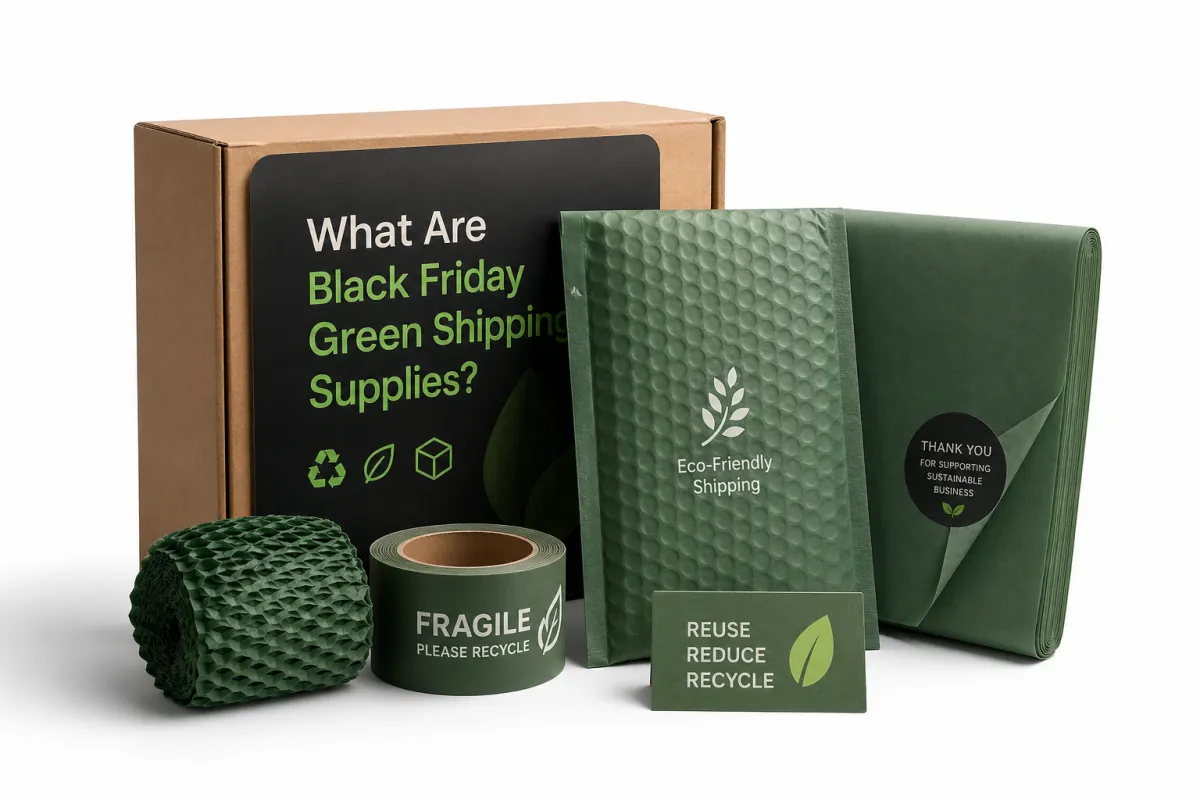
Black friday green shipping supplies are the packaging items you use to ship orders while keeping material waste, virgin plastic, and unnecessary bulk lower than standard options, usually by specifying fiber-based or recycled-content formats that can be verified on a mill certificate. That usually means recycled corrugated boxes, recycled-content or compostable mailers, paper tape, molded fiber inserts, and recyclable void fill such as paper or kraft-based cushioning, often sourced from converters in Guangdong, Jiangsu, Oregon, or North Carolina depending on lead time and volume. Buyers often group those categories together, yet the differences matter: a 60 micron mailer with a recycled claim is not the same as a 2.0 mm molded pulp tray, and a box with an FSC mark can still buckle if the board grade is not suited to a 9 lb item. I have seen both happen in real packing lines, and neither one is fun to explain to a customer service team already staring at 300 return tickets.
During one supplier negotiation in Dongguan's Houjie town, I saw how easily "green" claims get stretched across a spec sheet. The plant manager pointed to a pallet label that said 80% recycled content, but the document showed only 30% post-consumer material and 50% pre-consumer trim, which is a very different thing once you start talking to retail buyers. That gap matters, because if you are sourcing black friday green shipping supplies, you want measurable proof, not soft language and a friendly smile across a conference table. Look for FSC certification on fiber products, SFI chain-of-custody where it applies, and clear recycled-content percentages that can be traced back to the mill or converter, ideally with batch numbers and a 12-month audit trail.
"We thought the eco-mailer would fix everything, then our returns clerk told us 14% of them were splitting at the seam." That came from a client in Los Angeles County who moved too quickly and skipped testing. They saved $0.03 per unit on a 250,000-unit buy and spent $4,800 on replacements, plus another $1,120 in support labor during a 10-day return surge.
Peak season is exactly why this buying window matters so much. Production slots disappear, freight rates climb by the week, and warehouse teams stop being patient with sloppy packaging after the first 1,500 orders hit the floor. Well-chosen black friday green shipping supplies absorb the volume spike without forcing you to choose between sustainability and speed, especially if your fulfillment center in Dallas or Indianapolis is running a 2-shift schedule. Poorly chosen supplies lead to broken products, overpacked cartons, and a brand story that sounds polished in a pitch deck but falls apart in actual ecommerce shipping. I have seen beautiful decks; I have also seen the pile of crushed cartons behind the packing line. The second one always wins.
Most brands end up using a mix of stock and custom. Stock recycled mailers handle fast movers like socks, tees, and small accessories, while Custom Shipping Boxes and inserts handle products where package protection and dimensional weight matter more, such as glass bottles, premium skincare sets, or small electronics that ship at 3.2 lb and above. I keep repeating the same point to buyers because it stays true: the greener option is the one that gets used efficiently, arrives on time, and fits the item without three extra layers of filler, whether that filler is crumpled kraft paper, a molded pulp cradle, or a die-cut insert cut on a flatbed in Wenzhou. Waste is waste, even when the outer layer is dressed up to look like craft paper from a premium mill in Zhejiang.
How Do Black Friday Green Shipping Supplies Work?
Suppliers usually price black friday green shipping supplies based on bulk breaks, material cost, print coverage, and production setup time, and those four variables can swing a quote by 15% or more on the same form factor. A recycled poly mailer at 2,500 units might run from $0.19 to $0.31 each depending on thickness, seal width, and print, while a custom corrugated box can sit anywhere from $0.68 to $1.45 per unit depending on size, board grade, and ink coverage. Those ranges are grounded in the quotes I have reviewed from Uline, regional converters in Ohio and California, and overseas mills in Shenzhen and Ningbo. One small change in dimension, even 5 mm on length or width, can move the price more than people expect, which is one of those annoying little truths nobody likes until the invoice arrives.
Lead time matters just as much as unit cost. A stock carton may ship in 3 to 7 business days if it is already sitting in a warehouse in New Jersey or Texas, while a custom recycled box can need 12 to 18 business days after proof approval before freight even enters the picture. Add a 4- to 6-day ocean or rail leg, and the schedule gets sharp very quickly, especially if the factory is in Jiangsu and the warehouse is in Atlanta. That is why smart buyers of black friday green shipping supplies ask for landed cost first: product price, domestic freight, import duty if relevant, warehousing, and any rework allowance. A quote that looks cheap on a screen can turn into an expensive line item the moment the pallets hit the receiving dock in a 53-foot trailer.
Minimum order quantities can distort the whole conversation. A factory may quote $0.22 for 10,000 mailers and $0.29 for 2,500, which sounds reasonable until you discover the larger run needs another 180 cubic feet of storage and $340 in freight from the port. I watched one brand save $700 on unit price and then spend $1,250 on split shipments because the carton count exceeded their rack space by two full bays. That is not a win. That is a warehouse problem with a discount attached, which is somehow even more annoying than just paying full price.
Good sustainable packaging should fit your existing line without turning operators into amateur engineers. Paper tape has to feed cleanly through manual dispensers or machines like a Better Packages unit at 30 boxes an hour, molded fiber inserts need tolerance tight enough to hold the product without fighting the packer, and recycled boxes need clean fold scores so they do not pop open during sealing on a 36-inch tape head. The best black friday green shipping supplies are boring in the right way: they fit, they seal, they protect, and they do not make the team mutter under their breath before lunch on a Tuesday.
Compatibility checks save money. Measure the product, the inner fit, the outer carton, and the tape width before placing the order, and confirm crush strength, burst strength, and any transit test that applies to the lane from, say, Phoenix to Chicago. If you want a benchmark, the ISTA test standards are a solid place to start, and the EPA sustainable materials management guidance is useful if you want to sanity-check your claims before a retailer asks for backup. I have seen buyers skip that step and end up with a pretty mailer that failed on the second mile, which is an expensive lesson in package protection and one I wish more people could avoid by simply slowing down for an afternoon.
There is a rhythm to sourcing as well. Some vendors clear leftover inventory at the end of a production run and discount it 8% to 15% so they can free up floor space for the next SKU, especially in factories around Ningbo or Xiamen where line changeovers are costly. Others run seasonal promos before peak shipping because they know buyers are under pressure, and that can be useful when the spec is a close match to your packing line. A discounted green mailer that is 20 mm too narrow is not a deal. It is a return label waiting to happen, and I say that with the tired certainty of someone who has seen exactly that mistake more than once.
Black Friday Green Shipping Supplies: Cost and Timeline
The biggest price drivers in black friday green shipping supplies are paper grade, recycled content percentage, certification, print coverage, and custom sizing, and you can see the difference clearly on a 350gsm C1S artboard insert versus a 24pt SBS insert with a flood coat. A 100% recycled kraft mailer is not priced the same as a 30% recycled film mailer, and an FSC-certified box with two-color print costs more than a plain stock carton. On one buyer sheet I reviewed, a 32 ECT recycled box came in at $0.79 per unit for 5,000 pieces, while the same footprint in 200# test stock landed at $0.96 because the supplier had to source heavier board. Small percentage changes become real dollars when the order size reaches 20,000 units, which is where people suddenly start caring about pennies in a very sincere way.
Freight can flip the math. A flatter recycled mailer may cost a little more per unit and still save 14% on inbound shipping because it stacks better and uses less cube, especially if the supplier packs 500 pieces per master carton instead of 250. I have watched clients debate a $0.02 difference in unit price while ignoring the $280 they could save on pallet density and truck utilization. That is classic buyer tunnel vision. For black friday green shipping supplies, the real cost is not the sticker. It is unit price plus freight plus storage plus damage rate, and if you leave out any of those pieces, the picture lies to you in a way that looks tidy until the first invoice lands.
Timelines split into two buckets. Stock green packaging is the fast lane. Custom printed or custom-sized packaging is the planning lane. If you need branded mailers for a promotion, you are usually looking at proofing, production, and transit, so the total window can stretch from 15 to 25 business days, with 12 to 15 business days from proof approval being a realistic factory target in Guangzhou or Shenzhen for a moderate run. If your Black Friday forecast is shaky and your supply chain has already coughed once this quarter, do not pretend you have unlimited time. You do not. I have seen teams act like a last-minute rush order will magically arrange itself into a manageable schedule. It will not. The calendar is rude but honest.
Budget for samples too. Sample kits are not a nuisance charge. They are the least expensive insurance you will buy all quarter, and a proper sample pack may include a mailer, a carton, a die-cut insert, and a printed spec card for $75 to $150 depending on the vendor. I usually tell clients to set aside $75 to $150 for sample packs, plus $40 to $120 for expedited shipping if the calendar is tight and the sample has to move from Shenzhen to California in 3 to 5 days by air. That sounds small until a bad sample becomes a 3,000-unit mistake. The brands that treat black friday green shipping supplies as procurement, not decor, usually save money by the third reorder, and they also sleep a lot better during peak week.
| Option | Typical Use | Sample Unit Price | Lead Time | Notes |
|---|---|---|---|---|
| Recycled corrugated box | Fragile or heavier ecommerce orders | $0.68 to $1.45 | 3 to 18 business days | Best for package protection and right-sizing |
| Recycled-content poly mailer | Apparel, soft goods, low-fragility items | $0.19 to $0.31 | 5 to 20 business days | Lower cube, usually cheaper freight |
| Paper tape | Carton sealing for eco-forward fulfillment | $1.80 to $3.90 per roll | 3 to 12 business days | Works well with manual and semi-auto dispensers |
| Molded fiber insert | Electronics, glass, premium kits | $0.14 to $0.52 | 15 to 30 business days | Excellent transit packaging if the fit is right |
If you need an internal benchmark, compare packaging spend against the rest of your Custom Packaging Products budget, ideally on a per-order basis and not just as a monthly lump sum. A box that saves $0.06 and creates a 2% damage rate is not a savings. It is leakage. One client in Chicago learned that after swapping to a cheaper recycled carton that saved $420 on paper and cost $3,100 in replacement shipments and support labor across a 17-day peak window. The numbers were ugly enough to end the debate, which, frankly, was the only thing that finally got everybody aligned.
For brands that ship apparel or accessories, Custom Poly Mailers can be a practical bridge between sustainability and speed, especially if the stock is 100% recycled or at least 50% post-consumer content. For heavier items and products that need a rigid shell, Custom Shipping Boxes usually make more sense, especially if dimensional weight is chewing through margins on a carrier zone map from New York to Denver. I have seen both categories perform well in Black Friday shipping, but only after the dimensions, print area, and seal method were locked before production. Guessing is expensive. Guessing in peak season is just rude.
Step-by-Step Guide to Buying Black Friday Green Shipping Supplies
Start with a packaging audit. Pull the last 90 days of order fulfillment data and identify the items that create the most cost, the most waste, or the most damage claims, then sort the list by SKU, carrier zone, and return percentage. I like to break it into three buckets: top-volume SKUs, top-damage SKUs, and top-margin SKUs. If a product ships 1,000 units a week and uses a box that is 20% larger than necessary, that is usually the first place to cut, because right-sizing can trim both board usage and cubic inches at the same time. Right-sizing is often the fastest win in black friday green shipping supplies because it reduces dunnage, dimensional weight, and carrier surprises at the same time.
Next, request quotes from at least three suppliers. Do not compare only the per-unit price. Put recycled content, certifications, carton dimensions, lead time, MOQ, freight, and sample notes into the same sheet, and ask each vendor to quote the same spec, whether that is a 10 x 8 x 4 box or a 14 x 10 poly mailer with a 2-inch lip. I have sat in meetings where one supplier looked 11% cheaper until the buyer noticed the freight was only quoted to port, not to the warehouse in Ohio. That is not transparency. That is a math trick. The clearest way to buy black friday green shipping supplies is to compare the whole landed cost, line by line, and then compare it again after everyone has had coffee.
Then order samples and test them as if the warehouse depended on it, because it does. Put the product inside the mailer or box. Shake it. Drop it from waist height. Run it through the sealing process. If you use tape machines, verify adhesive performance on a 12-inch seal and a 24-inch seal after a 24-hour cure. If you use molded fiber, confirm the retention points hold product during a standard transit simulation from a distribution center in Atlanta to one in Phoenix. I have watched a buyer fall in love with a beautiful recycled insert and discover the corner cracked after three drops. Pretty packaging with weak transit performance is expensive confetti, and nobody enjoys cleaning that up.
Build a reorder calendar with a 30/60/90-day view. If your Black Friday volume forecast is 40% above normal, you do not want to place the next buy when inventory is already below safety stock. I usually recommend a trigger point at six weeks of supply for stock items and eight to ten weeks for custom items, though that depends on the supplier, the port schedule, and lane times from regions like Guangdong to the Midwest. The companies that stay calm during peak season treat black friday green shipping supplies like a planned input, not a last-minute fire drill. That calm is worth more than people admit when labor is short and the trailers are late.
Use a simple rule for stock versus custom. Stock packaging is for speed and stability. Custom packaging is for branding, better fit, or lower overall shipping cost. If your product is soft and your current box leaves 30% empty space, a custom size can pay for itself quickly, sometimes within two orders if the carrier zone is expensive enough. If you sell a seasonal item with unstable demand, stock mailers may be the better answer because they keep cash free and shelf space sane. Either way, the decision should be based on numbers, not a mockup that looks pretty in a presentation deck.
- Audit the top 20 SKUs by volume and damage rate.
- Request three landed-cost quotes with identical specs.
- Order samples and run fit, drop, seal, and machine tests.
- Lock in a primary supplier and a backup supplier.
- Place orders early enough to absorb a 7- to 10-day delay.
One more thing: if your team is debating recycled paper void fill versus a molded fiber cradle, ask how much labor each option takes per carton. A filler that saves $0.05 in material and adds 11 seconds of pack time can erase the savings at scale, especially at 2,000 cartons a day. I have watched a distribution center lose more money on slow pack-out than on actual material spend, and the labor data usually shows it by Friday afternoon. That is the sort of mistake that hides in plain sight until payroll shows up and suddenly everybody wants to talk about process improvement.
Common Mistakes When Shopping Green Packaging Deals
The first mistake is buying the cheapest eco option without checking the material proof. I have seen packaging labeled green that had no FSC claim, no post-consumer recycled percentage, and no test data from a lab in Chicago, Guangzhou, or Singapore. That is not responsible sourcing. That is marketing ink. For black friday green shipping supplies, ask for the spec sheet, the certificate, and the testing notes before approving anything, and make sure the spec sheet includes weight, caliper, and carton count. If the supplier gets defensive over simple documentation, that tells you plenty, and not in a good way.
The second mistake is ignoring freight and storage. Bulky boxes can be cheap per unit and expensive to move, especially if they ship from a plant in Dongguan in oversized cartons with too much air. Lightweight mailers can stack well and still blow up your inbound charge if the supplier packs them inefficiently or uses tall master cases. I once negotiated a mailer deal that looked brilliant until the pallet count doubled because the packing method was inefficient, and the freight bill turned a 9% savings into a 2% loss. That is why landed cost matters more than headline pricing for black friday green shipping supplies.
The third mistake is ordering too late. Rush charges do not care about your campaign calendar. Air freight does not care about your brand deck. If the team waits until the week before launch, the options shrink fast and the price rises faster, especially for a factory slot in Shenzhen that needs 10 business days just to retool. I have sat across from buyers in that spot, and the mood is always the same: tired, annoyed, and suddenly open to compromises on thickness, print, or box size. That is how bad packaging decisions get made, usually at exactly the moment everyone is least equipped to make them.
The fourth mistake is skipping performance tests. Adhesive strength, tear resistance, crush strength, and product movement inside the shipper all matter, and a mailer that looks fine at a trade show can still fail after 2 drops from 36 inches. If you are shipping premium goods, the unboxing experience matters too, because customers notice corner dents and sloppy filler on a $78 order just as quickly as they notice a premium finish. A supplier can promise a recyclable option that sounds perfect, but if the seal fails or the insert rattles, the return cost wipes out the savings. The right black friday green shipping supplies should protect the item from warehouse to doorstep, not just satisfy a sustainability checkbox.
There is also a trap with recycled content claims. A 30% recycled mailer and a 70% recycled mailer are not equal, and some buyers treat them like they are because both look brown on a sample table in conference room lighting. I do not. If two quotes are close, I want the higher verified recycled content, the clearer chain of custody, and the better fit for ecommerce shipping. If the supplier cannot prove the claim, I move on. There are too many capable vendors out there to gamble on a weak one, and I have learned that lesson the hard way more than once.
Expert Tips for Better Black Friday Green Shipping Supplies
Negotiate like a buyer, not a shopper. Ask for tiered pricing at 3,000, 5,000, and 10,000 units, and ask for a second curve if the order can be split across two production weeks in a factory near Ningbo or Qingdao. Ask whether mixed-SKU orders are allowed. Ask for freight help if your volume is real. I have cut deals by splitting a purchase into two shipments, which let the supplier optimize a production run and shave 6% off the quote. That is the kind of detail that matters in black friday green shipping supplies, because the best pricing usually comes from planning, not pressure.
Favor designs that reduce dunnage and dimensional weight. A box that is one inch smaller in each direction can create real savings across hundreds of cartons, especially if your carrier bills by dimensional weight on shipments above 1 lb. I have seen a client drop shipping charges by $0.43 per order by resizing the outer carton and switching to paper-based void fill from polyethylene pillows. That is not glamorous work. It is arithmetic. Arithmetic keeps margin alive, even if nobody claps for it in the weekly meeting.
Use branded recycled packaging where it actually improves the unboxing experience or repeat purchase rate. Do not pay for custom print just because the mockup looks attractive on a screen in the sales office. If your customer never sees the box, the print coverage may be wasted money. If your brand relies on premium presentation, a clean recycled box with one-color logo print can lift perceived value without blowing the budget. I have seen that approach work especially well for subscription kits and direct-to-consumer gifts, where the packaging becomes part of the product story and the difference between a 22% repeat rate and a 24% repeat rate can matter over a 90-day horizon.
Keep a backup SKU list. If your primary recycled mailer goes out of stock, have a second option with nearly identical dimensions, seal type, and recycled-content claim. That backup should be approved before peak season starts, not during it. A backup line item feels dull in August. In November, it feels like oxygen. The brands that survive Black Friday without chaos treat black friday green shipping supplies as a system, not a single product choice, and that makes a huge difference when the orders start piling up in a 7 a.m. shift.
One supplier in Vietnam once told me, "Fast, cheap, green - pick two." He was half joking, but the point landed because the warehouse math was real. If you want low waste, good package protection, and a strong timeline, you need to manage the trade-offs with clear specs. That is where standards help. FSC matters for fiber chain of custody. ASTM testing gives you performance confidence. ISTA gives you a transit lens. None of those are magic, but they are better than guessing, and guessing in peak season has a way of becoming very public.
If you are building a fresh sourcing list, start with packaging vendors that can handle both shipping materials and branding from one plant or one coordinated supply chain. That keeps the process cleaner, especially if you need Custom Printed Mailers, right-sized boxes, and paper-based fillers under one buying plan with proof approval in 48 hours or less. The fewer handoffs between vendors, the fewer things break in transit. I learned that after one client split packaging across four suppliers and spent two weeks reconciling mismatched sizes and delayed proof approvals. Never again. My blood pressure still remembers that project.
Next Steps for Black Friday Green Shipping Supplies
Start with a 30/60/90-day demand estimate and turn it into a buying sheet today. List every SKU, the current packaging format, unit price, lead time, MOQ, freight estimate, and recycled-content claim, plus the factory location if you have it, whether that is Shenzhen, Dongguan, Ho Chi Minh City, or Charlotte. That one sheet will save your team from panicked back-and-forth later. If you only do one thing this week, request samples and compare them against real product weights, not theoretical ones, because black friday green shipping supplies are easiest to buy before pressure starts building, when everyone is still willing to read the spec sheet instead of skimming it.
Then lock in a primary supplier and a backup supplier. I do not care how charming the first quote looks. If supply is tight, you need a second source that can step in with similar dimensions and a similar certification profile, ideally with proof approval already signed off and a 12- to 15-business-day production slot reserved. Panic ordering is expensive, and it gets more expensive every hour you wait. I have negotiated with enough factories to know that the last clean purchase order usually gets the best attention, probably because nobody wants to be the person who caused a line to miss peak season.
Finally, compare specs, not just prices. A $0.12 cheaper mailer can cost more in freight, damage, or labor, and a slightly better box can lower returns, improve package protection, and reduce wasted filler. That is the math that matters on a sheet where every line has to justify itself by December 1. If you are serious about black friday green shipping supplies, build the buying sheet, order the samples, and make the call with numbers in front of you instead of hope and a pretty quote PDF.
That is the playbook I would use if I were buying for my own warehouse tomorrow, whether the facility sat outside Phoenix, in suburban Atlanta, or near a port in New Jersey. Keep the specs tight, keep the backups ready, and treat black friday green shipping supplies like a profit decision, not a decoration choice. The brands that get this right do not just look greener. They ship faster, waste less, and keep their margins from leaking out through the carton seams.
What counts as black friday green shipping supplies?
Recycled corrugated boxes, compostable or recycled-content mailers, paper tape, molded fiber inserts, and recyclable void fill all count, especially when the spec sheet lists a recycled-content percentage such as 30%, 50%, or 70%. I would also check for clear proof such as FSC, SFI, or post-consumer recycled content claims instead of vague green branding from a vendor brochure. If the supplier cannot show a spec sheet or certification, I treat the claim as marketing until proven otherwise, which is usually the safer call in a 10,000-unit purchase.
Are black friday green shipping supplies more expensive?
Sometimes the unit price is higher, especially for certified fiber or custom-sized packaging made in a small run of 2,500 or 5,000 units. Still, total cost can be lower if the packaging cuts damage, freight, labor, or dimensional weight by even a few cents per order. Always compare landed cost, not just the per-piece quote, because a cheap product with expensive freight is not cheap when the pallets arrive at your warehouse in Columbus or Reno.
How early should I order green shipping supplies before Black Friday?
Stock items should be ordered several weeks ahead if possible, and custom printed items usually need more time for proofing, production, and transit from a factory in Shenzhen, Dongguan, or Ho Chi Minh City. I usually suggest building a buffer of at least 2 to 4 weeks for custom packaging, because one late approval can move the whole schedule and force air freight. If your supplier is overseas, add more time and do not pretend the ocean is a side detail.
Which green packaging upgrade saves the most money first?
Right-sizing boxes usually delivers the fastest savings because it cuts material, filler, and shipping waste at the same time, and the savings can show up on the first 1,000 orders. Paper tape and recycled mailers are also easy wins if your current setup uses too much plastic or too much void fill. I have seen right-sizing save $0.30 to $0.60 per order in categories where the original carton was oversized by 20% or more and shipped in a higher carrier zone.
How do I compare suppliers quickly?
Use one checklist: dimensions, recycled content, certifications, lead time, MOQ, freight, and sample performance, then ask each vendor to quote the same spec and the same destination. If a quote looks cheap but the freight or lead time is ugly, it is not a real deal. I would also ask for a sample within 24 hours of the first conversation, because a supplier that cannot move a sample is not going to save your peak season in November.


