Buyer Fit Snapshot
| Best fit | Order Custom Shipping Boxes Online for Faster Fulfillment projects where brand print, material claims, artwork control, MOQ, and repeat-order consistency need to be specified before quoting. |
|---|---|
| Quote inputs | Share finished size, material target, print colors, finish, packing count, annual reorder estimate, ship-to region, and any compliance wording. |
| Proofing check | Approve dieline scale, logo placement, barcode or warning zones, color tolerance, closure strength, and carton packing before bulk production. |
| Main risk | Vague material claims, crowded artwork, missing packing details, or unclear freight terms can make a low unit price expensive after revisions. |
Fast answer: Order Custom Shipping Boxes Online for Faster Fulfillment should be specified like a repeatable production item. The safest quote records material, print method, finish, artwork proof, packing count, and reorder notes in one written spec.
Production checks before approval
Compare the actual filled-product size with the drawing, then confirm tolerance on folds, seals, hang holes, label areas, and retail display edges. Reserve space for logos, QR codes, warning copy, and material claims before decorative graphics fill the panel.
Quote comparison points
Review material grade, print process, finish, sampling route, tooling charges, carton quantity, and freight assumptions side by side. A quote is only useful when the supplier can repeat the same color, closure quality, and packing count on the next order.
When a shipping team needs to Order Custom Shipping boxes online, the smartest move is usually the least glamorous one: gather every critical detail before the first quote goes out. Inside dimensions, board grade, print needs, quantity, ship-to information, and target pallet count belong in the same record. A carton spec scattered across three emails, one spreadsheet, and a voice memo from a Tuesday call tends to collect errors like lint in a dryer trap, especially when the product has a tolerance of 1/8 inch or less. Packaging is one of those areas where a tiny miss can become an expensive mistake.
I remember a buyer once sending me a sketch on a yellow sticky note. A sticky note. For a carton that had to fit a thermoformed insert, survive pallet stacking at 42 inches high, and ship through three distribution centers in Texas, Ohio, and New Jersey. We fixed it, but only after two rounds of revisions and a frustrated call from a plant in Dongguan, Guangdong, where the corrugator was already scheduled for a 6,000-piece run. That is one reason so many operations choose to order Custom Shipping Boxes online rather than rely on rough drawings and memory that gets fuzzy after lunch. The internet did not invent discipline, but it did make the paper trail easier to keep straight.
For busy facilities, the payoff is practical, not theoretical. A properly sized shipper improves cube utilization, keeps pallet patterns tighter, lowers the chance of edge crush, and cuts tape and dunnage because the carton is built around the product instead of around a random stock size. In one warehouse in Columbus, Ohio, moving from a 20 x 14 x 10 stock box to a 19.25 x 13.75 x 9.5 custom carton reduced filler use by 27% and cut carton voids enough to add 32 more units per pallet. If your program also needs broader Custom Packaging Products, the online ordering path keeps the whole setup organized so procurement, design, and fulfillment all work from the same spec.
Procurement teams like the paper trail too. One online quote record makes it easier to compare board grade, flute profile, print version, and destination addresses without digging through old inbox threads like a detective in a budget crime show. If you are sourcing from Dongguan, Guangdong, or Monterrey, Nuevo Leon, that record also helps compare lead time, pallet build style, and export documentation in one place. That is why I often tell clients to order Custom Shipping Boxes online if they care about repeatability, not just a quick price check. The operational upside is plain: fewer revisions, cleaner approvals, and a better chance that the next run matches the last one.
Why Order Custom Shipping Boxes Online?
The first reason to order Custom Shipping Boxes online is speed, but not the shiny kind people toss around in meetings. The real gain shows up in the paperwork and the accuracy behind it. Dimensions, corrugate spec, print copy, quantity, and delivery address stay in one request instead of drifting through four separate conversations. I have watched purchasing teams burn two full days because a carton was described as “about 18 by 12 by 8” when the inside size needed to be 17.875 by 11.75 by 7.5 to fit an insert with no slack. “About” is a dangerous word in packaging. It is also the favorite word of anyone who does not have to pay the freight bill.
Freight math makes the case just as clearly. A box that is 2 inches too tall can push a parcel into a higher dimensional weight tier, often by 8% to 14% depending on the carrier formula. A carton that is 1/8 inch too loose can let product rattle and show up later as scuffed corners or crushed edges. One warehouse manager in Atlanta told me their damage claims were running at 2.8% of outbound units. After the shipper was redesigned around the actual product footprint, claims dropped below 1% in eight weeks. That is not a cosmetic improvement. That is the kind of result that justifies a decision to order custom shipping boxes online with exact specifications.
There is also a control problem that stock cartons rarely solve. Procurement wants one price, operations wants one working spec, and fulfillment wants one carton that stacks cleanly on a 48 x 40 pallet without hanging over the edge. When those groups all pull from the same online quote, rework falls, approvals move faster, and reorder accuracy improves. On a 4,800-piece program I reviewed in Fort Worth, Texas, a shared spec cut revision emails from 19 down to 4 and shaved nearly a week off the approval cycle. That repeatability matters more than the thrill of a lower sticker price when a brand decides to order custom shipping boxes online.
“We stopped buying a box and a problem at the same time.” A plant manager said that during a review of a 6,000-piece shipper program in Shenzhen, Guangdong, and it stuck with me because the carton had been designed from the inside out, not the shelf out.
Online ordering also keeps package branding in the same conversation as operations. A warehouse may need simple identification marks for sortation, such as SKU 42819, orientation arrows, or a 2-inch barcode panel. An ecommerce team may want cleaner branded packaging for a customer-facing unboxing moment. The same online order can carry the print instructions, panel placement, and color count, whether that means one-color flexo or a litho-laminated face sheet on 350gsm C1S artboard for a retail-ready carton made in Foshan, Guangdong. For companies moving 10,000 units a month, that kind of consistency usually outperforms a low unit price on a generic carton.
How Do You Order Custom Shipping Boxes Online?
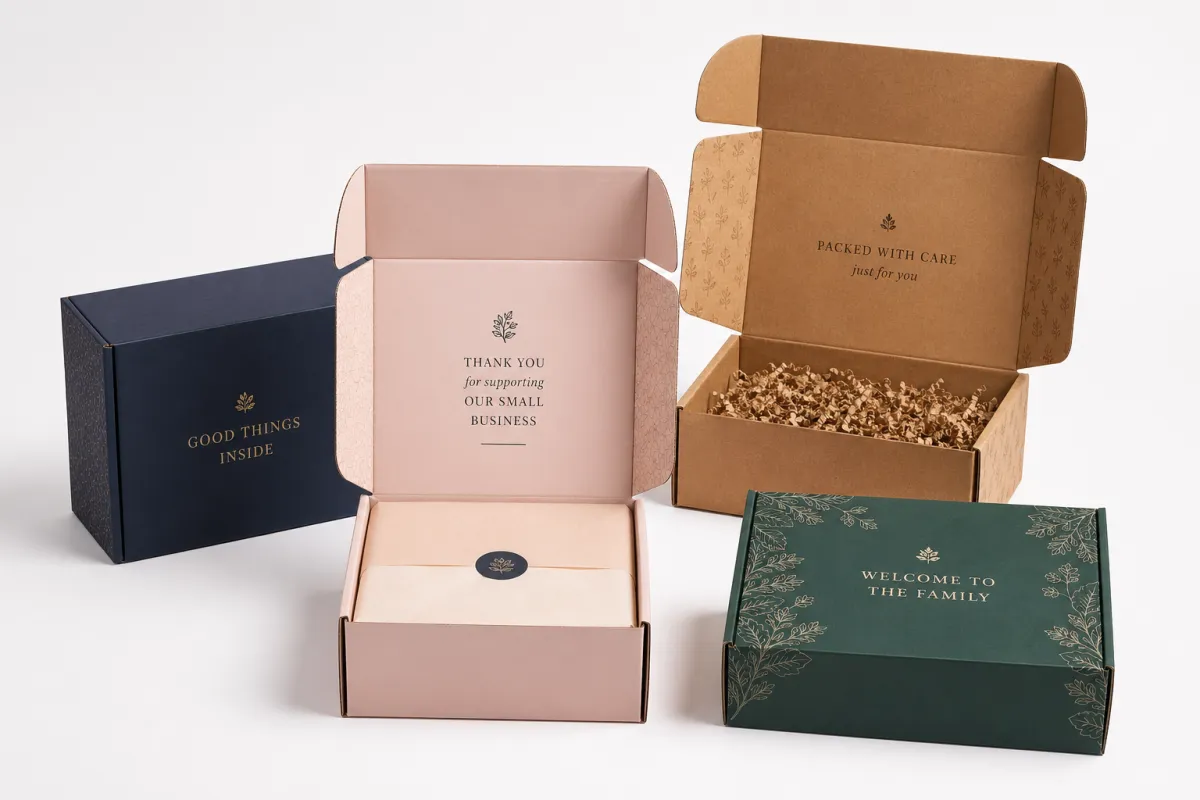
To order custom shipping boxes online, start with the box style that fits the product and the route it will travel. The most common choices include regular slotted cartons, mailer-style corrugated shippers, heavy-duty double-wall boxes, and retail-ready Custom Printed Boxes that can move from warehouse shelf to customer doorstep without repacking. If your program covers direct-to-consumer shipments, a Custom Shipping Boxes order usually begins with the same inside dimensions and then branches into closure type, print coverage, board strength, and whether the carton will be made in a U.S. plant in Ohio or a corrugation facility in Guangdong.
- Regular slotted cartons (RSC): well suited to standard ecommerce shipping, palletized distribution, and tape-closed packing lines.
- Mailer-style cartons: useful for smaller product packaging, subscription kits, and shelf-ready presentation with a tighter self-locking closure.
- Double-wall shippers: a practical fit for 30 lb to 60 lb loads, humid storage, or products that pass through multiple distribution centers.
- Retail-ready shippers: a good option when package branding matters and the outer carton needs a cleaner print face for stores or unboxing.
Material choice comes next, and the details matter. Corrugated boxes are not interchangeable. A 32 ECT single-wall carton with B-flute behaves very differently from a BC double-wall shipper with a kraft outer liner and recycled medium. I still remember standing beside a corrugator in Wuxi, Jiangsu, while a buyer compared a white-lined C-flute carton to a kraft single-wall box. The difference in panel stiffness was obvious before the stack even reached 36 inches high. If your route includes long transit lanes, a summer dock in Houston, or multiple handoffs through Chicago and Indianapolis, that sort of detail protects product more effectively than a generic size ever will.
Print options stay straightforward once you map the job. One-color flexographic print often handles SKU ID, handling marks, or a clean logo panel. Stronger outside graphics can support package branding and create a sharper first impression. For projects that need more visual impact, custom printed boxes can still stay efficient if the artwork is limited to a single side panel or a two-color logo with a short product line message. A retail packaging program can often use the same artwork files across multiple carton sizes without rebuilding the layout from scratch, especially if the face panel stays within a 5 x 7 inch print window.
Do not ignore finishing details. Die-cuts, hand holes, score placement, and flap style affect how easily the box folds, packs, and seals on the line, especially if the warehouse uses 24-inch tape heads or semi-automatic erectors. A box that arrives with the wrong score can slow order fulfillment by 5 to 10 seconds per pack. Multiply that by 4,000 units a day and the cost starts to show its teeth. Buyers who order custom shipping boxes online should ask whether the design needs standard closure, self-locking features, or tape-ready flaps before giving final approval. If the box will be hand-packed in Monterrey, Nuevo Leon, it may also need a wider minor flap for easier folding by operators wearing gloves.
Sizing and Specifications That Protect Shipments
If you want to order custom shipping boxes online without rework, start with three numbers: inside length, width, and depth. Add product weight, whether inserts or partitions are included, and how much headspace remains after dunnage, bubble, or molded pulp are loaded. I have seen a product that measured 14 by 10 by 6 on paper need a 15 by 11 by 7 shipper because foam corner pads ate nearly an inch on each side. Packaging math has a way of punishing optimism, especially when the finished pack weight lands at 17.6 lb instead of the 16.9 lb that was on the original spreadsheet.
Board grade matters more than many buyers expect. A light single-wall carton can work for a 6 lb apparel order. It is the wrong choice for a 38 lb industrial part, especially if the carton will be stacked six high on a pallet or sit in a humid dock area for 48 hours in Savannah, Georgia. For performance testing, I often point teams toward the methods and language used by the ISTA family of tests, because a carton that has to survive real parcel handling needs to do more than look good in a mockup.
The strongest spec sheets leave little room for interpretation. If a buyer sends a clean drawing with inside dimensions, flute type, target ECT or burst rating, and a note about whether the box must pass an ASTM D4169-style distribution profile, production moves faster and samples land closer to target. A one-page spec with six exact details beats a polished deck with vague phrases like “strong box” or “premium finish,” because the press operator cannot run on adjectives, no matter how charming the adjectives may be. If the carton is being produced in Dongguan, Guangdong, adding the target board caliper in millimeters can save a full sample round.
The most expensive packaging errors are often the quiet ones. Oversizing by 1 inch may not look dramatic, but it can add cube, raise freight class, and increase the amount of tape or void fill needed. Under-sizing by even 1/2 inch can force a line operator to crush a panel or skip an insert, which is not a situation any shipping supervisor wants to face at 4:30 p.m. The same rule applies when you order custom shipping boxes online for multiple SKUs: one shared size rarely protects all products equally, so it is worth asking whether a two-size program beats forcing everything into one compromise carton.
“The sample told us the truth in 90 seconds.” A fulfillment director in Nashville said that after one drop test, because the prototype made it obvious that a 275# single-wall board would not hold up to a 22 lb fill weight without corner reinforcement.
Clear specifications also make reorder cycles cleaner. If the original approval includes liner type, print panel, and score position, the next order does not need a fresh round of correction emails or a new engineering call. That is one reason teams return to order custom shipping boxes online: the record stays intact, the carton stays consistent, and the warehouse floor gets the same box every time, whether the next run is 3,000 units in Ohio or 12,000 units in Guangdong.
Pricing, MOQ, and What Changes Your Quote
People often ask what it costs to order custom shipping boxes online, and the honest answer is that five variables usually drive the quote: dimensions, board grade, print coverage, quantity, and whether the design needs a new die. A smaller 8 by 6 by 4 mailer with one-color print may price very differently from a 24 by 20 by 18 double-wall shipper, even if both carry the same logo. The more precisely you define the job, the faster the pricing returns. Vague specs are expensive in a surprisingly boring way.
| Program Type | Typical Quantity | Example Unit Price | Best Fit |
|---|---|---|---|
| RSC, 1-color flexo print | 5,000 pcs | $0.15 | Standard ecommerce shipping and warehouse packing |
| Mailer-style carton | 3,000 pcs | $0.39 | Subscription kits, small product packaging, retail-ready orders |
| Double-wall shipper | 2,500 pcs | $1.84 | Heavy goods, stacked pallet loads, long transit lanes |
| Retail-ready custom printed box | 10,000 pcs | $0.62 | Branded packaging, store presentation, and display-driven programs |
Those numbers are examples, not promises, but they show the pattern. A minimum order quantity exists because setup, cutting dies, print plates, and make-ready time all carry cost, and that cost gets spread across the run. I have negotiated plenty of programs where 1,500 boxes cost more per unit than 5,000 boxes simply because the press had to stop, wash up, and reset for a short run. It is a bit maddening, honestly, but the machine does not care about your timeline or your mood. Smaller quantities can still work well if you need to order custom shipping boxes online for a launch product, a seasonal line, or a pilot project that needs proof before volume. For a 2,000-piece pilot in Dallas, the per-unit price may be higher, but the risk is lower than committing to 15,000 cartons before the SKU has sold one full cycle.
Freight belongs in the landed-cost calculation too, and buyers sometimes get caught there. Corrugated cartons are bulky, so pallet count, accessorial charges, liftgate needs, and delivery zone can move the final number by a meaningful amount. A shipment that fits neatly onto four pallets for a dock with a forklift is usually simpler than one that needs residential delivery and liftgate service. Those details should be on the quote request from the start if you plan to order custom shipping boxes online, especially if the receiving dock is in a downtown building in Chicago or a third-party warehouse in Reno, Nevada.
Procurement teams often want a cleaner benchmark. I usually ask for five things before quoting anything: inside dimensions, annual usage, target ship date, shipping destination, and performance requirements such as compression, moisture resistance, or parcel survivability. If the carton needs chain-of-custody paper, the FSC framework can matter as much as the print layout because it gives the paper trail a defined standard. A strong quote is not just a price; it is a clear set of assumptions that lets you order custom shipping boxes online without reworking the request three times.
Process and Timeline to Order Custom Shipping Boxes Online
The easiest way to order custom shipping boxes online is to treat it like a production sequence, because that is what it is. First comes the quote request, then spec confirmation, then proof or sample review, then production approval, then manufacturing, and finally freight scheduling. When buyers send complete dimensions and artwork on day one, the process moves. When the spec is missing panel measurements or the print file is a low-resolution PDF, the schedule slows down right away. I have seen a “simple” job stall for four days because someone uploaded a logo that looked like it had been dragged through a microwave.
- Request quote: send dimensions, quantity, board grade target, and ship-to location.
- Confirm specs: approve box style, print area, flute profile, and any special features.
- Review proof: check artwork placement, score lines, and panel orientation.
- Approve production: lock the final version so the plant can schedule the run.
- Run manufacturing: corrugating, printing, die cutting, slotting, gluing or stitching, then palletizing.
- Ship freight: pallet wrap, bill of lading, and delivery appointment coordination.
In the plant, the work is highly specific. Sheets move through the corrugator, then through flexo printing, then to die cutting or slotting, and after that the cartons are bundled, counted, and pallet wrapped for shipment. On a recent run I watched in Foshan, Guangdong, the line used a 2-color flexo press with a water-based black and a spot orange, and the final pallets were banded to keep the stack from shifting during LTL transit. That kind of process control is the reason I tell buyers to order custom shipping boxes online only after the sample has been checked against the real product load.
Lead time depends on carton type. A simple RSC custom print order may leave production in 12 to 15 business days after proof approval, while a more involved die-cut design can take 18 to 25 business days if tooling, board availability, or freight scheduling adds complexity. None of that is guesswork; it is planning. If a warehouse needs cartons before a peak-season surge or a dock closeout, the purchase order should account for receiving time, not just plant time, because a box sitting on a trailer outside the building does nothing for order fulfillment. For example, a truck leaving Dongguan on a Monday may not reach a Midwest dock until the following week, even with an efficient export lane.
“The schedule only held because the proof was approved the same day.” A client who needed 8,000 cartons ahead of a Monday cutover learned that proof turnaround is often the real bottleneck, not the press.
Freight communication matters as much as production. If a receiving dock closes at 3:00 p.m., or if the warehouse has no liftgate access, the freight plan should reflect that before the order is released. I have seen one missed appointment add 48 hours to a launch, which is costly when inventory is already staged for ecommerce shipping. The best results come from treating lead time as a chain of small decisions, not a single promise on a quote page, especially when you order custom shipping boxes online. If your boxes are coming from Monterrey, Nuevo Leon, and the receiving dock is in Phoenix, Arizona, the transit calendar should be part of the approval email, not an afterthought.
Why Choose Us for Custom Shipping Boxes
Custom Logo Things is set up for buyers who need practical corrugated guidance, not a part number and a shrug. We understand what a carton has to do on a production floor, in a parcel network, and on a warehouse pallet, which is why teams come to us when they want to order custom shipping boxes online with fewer surprises and better control over the finished spec. The goal is simple: a box that arrives ready to run, not one that needs a second round of engineering before it can be used.
I like working with programs that need a manufacturing lens. A buyer may arrive asking for custom printed boxes, but after a 20-minute review of product weight, stack height, and ship method, it turns out they need a different flute or a stronger liner rather than a fancier logo. I have had those conversations in supplier meetings where the choice between B-flute and BC double-wall shifted the cost by pennies and saved dollars in avoided damage. One shipment in Birmingham, Alabama, moved from 275# single-wall to 44 ECT double-wall and cut corner failures by 83% over the next quarter. That is the kind of honest guidance that matters when you order custom shipping boxes online.
We keep the technical side plain. If your team needs help comparing compression strength, print method, or moisture resistance, we can walk through the tradeoffs in direct language without padding the answer. A 32 ECT single-wall carton may be fine for 8 lb product packaging, while a 44 ECT or double-wall structure may suit heavier loads or long transit lanes. If your program includes wholesale packaging or a broader rollup across SKUs, the quote can be shaped so the same supplier logic supports multiple cartons instead of forcing each one into a separate buying process. For a line running in Newark, New Jersey, that can mean one board spec across three SKUs and one reorder trigger at 5,000 units.
Repeatability matters most. Buyers return when the second run matches the first run on panel size, board feel, and print placement, because fulfillment teams do not want to relearn a carton every quarter. That is also where package branding and operations meet: if the shipper looks right, stacks right, and closes right, the warehouse stays moving and the customer sees a cleaner delivery experience. If you need related packaging options, our Custom Poly Mailers can pair with corrugated shippers for mixed ecommerce shipping programs, and our FAQ page can help with common material and ordering questions before you place the order. On a seasonal program in Portland, Oregon, that kind of consistency can save a full Friday shift of repacking.
Trust in this business rarely comes from flashy language. It comes from a clean quote, an accurate proof, a realistic timeline, and a carton that lands on the pallet the way the plant said it would. That is the standard I use when customers want to order custom shipping boxes online, and it is the standard we aim to bring to every box program we touch, whether the production run happens in Guangdong, Ohio, or central Mexico.
Actionable Next Steps to Order Custom Shipping Boxes Online
If you are ready to order custom shipping boxes online, gather the basics before you request a quote. Start with the product’s shipping dimensions, not just the product itself. Include any insert thickness, wrap, or void fill that changes the usable interior. Then add product weight, stack requirements, shipping method, artwork files if print is needed, and the annual quantity you expect to use. A clean request with six exact details usually moves faster than a vague one with a polished logo and no measurements.
- Measure the packed product: include inserts, trays, and closures, not just the bare item.
- Choose the shipping path: parcel, LTL, pallet, or mixed ecommerce shipping.
- Compare two constructions: for example, single-wall versus double-wall or RSC versus mailer style.
- Ask for a sample: especially if the item is fragile, heavy, or high-value.
- Confirm receiving details: dock access, appointment times, and liftgate needs.
My second recommendation is to compare two or three constructions instead of staring at a single price point. A carton that costs $0.12 more per unit can be cheaper overall if it saves one layer of dunnage, reduces returns by 1%, or packs 14% tighter on the pallet. I saw that firsthand with a food and beverage client in St. Louis who switched from a light single-wall to a stronger board and cut repacking labor by 18 hours per month, which easily justified the carton change. That is the sort of math that should guide anyone who wants to order custom shipping boxes online with confidence.
My third recommendation is simple: ask for a sample, a structural proof, or a short production run if the product is fragile, heavy, or expensive. A 20-piece test can reveal a weak score line, a closure issue, or a panel that bows under stack load long before a 5,000-piece run does. If you have the dimensions, weight, usage estimate, and destination ready, Custom Logo Things can help you order custom shipping boxes online with a tighter spec and a clearer path to production, so the next pallet that lands at your dock is ready to move. If the program starts in Guangzhou or ends in a fulfillment center in New Jersey, that small bit of planning can save a lot of corrective work later. A little up-front discipline is gonna save a lot of grief downstream.
How do I order custom shipping boxes online if I only know rough dimensions?
Start with the product size as it ships, not the bare product size, and include any inserts, wraps, or void fill that affect the finished carton. If the measurements are approximate, share the closest working size plus product weight and fragility so the box can be engineered around realistic shipping conditions. In my experience, a good packaging team can often recommend a standard board and a small dimensional adjustment that improves fit without changing your fulfillment workflow, which makes it much easier to order custom shipping boxes online without getting stuck in corrections. A difference of just 3/8 inch can be enough to change a fit from loose to secure.
Can I order custom shipping boxes online in small quantities?
Yes, but smaller quantities usually carry a higher unit price because setup, tooling, and production changeover are spread across fewer boxes. Small runs are useful for launch programs, seasonal products, prototype testing, or a low-volume SKU that still needs a professional shipping carton. If cost matters, ask whether a similar stock size or a simple one-color print can lower your minimum order requirement, and that can help you order custom shipping boxes online without overcommitting inventory space. A 500-piece test run in one region can often prevent a 5,000-piece mistake later.
What do I need before I place an online custom box order?
Have the inside dimensions, approximate weight, shipping method, quantity needed, and any performance concerns such as stacking, moisture, or impact resistance. If the box will carry print, prepare artwork files or at least a logo format and the number of print colors you want on the carton. Share your ship-to location and any dock restrictions so freight and delivery timing are quoted accurately, because those details affect the total cost when you order custom shipping boxes online. A ship-to address in Phoenix, Arizona, for example, can produce a very different freight number than one in Savannah, Georgia.
How long does it take to receive custom shipping boxes after I order online?
Lead time depends on whether the carton is a simple conversion or a fully custom die-cut design, plus the current material and production schedule. Proof approval, sample review, and freight distance can add time, so the fastest orders are the ones with complete specs and quick approvals. I tell buyers to ask for a realistic production window up front, then add receiving time at the warehouse so the boxes arrive before inventory runs tight, which keeps the plan on track when they order custom shipping boxes online. For many standard jobs, production is typically 12 to 15 business days from proof approval, with transit adding 2 to 5 more business days depending on the route.
What affects custom shipping box pricing the most?
The biggest price drivers are dimensions, board grade, quantity, print coverage, and whether the box needs a new die or special finishing. Freight can be a major part of the total landed cost because shipping boxes are bulky and often move on pallets. If you are balancing cost and protection, compare a slightly stronger board against the expense of damage, returns, or repacking labor, because that comparison usually shows the real value when you order custom shipping boxes online. A move from 32 ECT to 44 ECT might add a few cents per unit, but it can also prevent a $4 return or a damaged item write-off.
Can custom shipping boxes be made in different regions or countries?
Yes. Depending on the project, custom boxes may be produced in manufacturing hubs such as Dongguan and Foshan in Guangdong, China; Monterrey in Nuevo Leon, Mexico; or domestic plants in Ohio and Georgia. Region matters because it changes transit time, pallet configuration, and documentation. If your brand ships into the Midwest from a plant in Guangdong, for example, you may need extra days for ocean or air freight, while a Mexico-based run can sometimes shorten the route for North American distribution and help you order custom shipping boxes online with a more predictable calendar.
If your team needs a carton that protects product, supports faster order fulfillment, and keeps the specs organized from quote to reorder, the next move is straightforward. Send your dimensions, weight, quantity, print needs, and ship-to details, and we can help you order custom shipping boxes online with a clearer price, a more usable spec, and a box built for the work your warehouse handles every day. For many programs, the practical move is to start with a 5,000-piece quote, approve a sample against the real product, and lock production before the next freight booking closes.