Buyer Fit Snapshot
| Best fit | Branded Corrugated Sleeves Wholesale projects where brand print, material claims, artwork control, MOQ, and repeat-order consistency need to be specified before quoting. |
|---|---|
| Quote inputs | Share finished size, material target, print colors, finish, packing count, annual reorder estimate, ship-to region, and any compliance wording. |
| Proofing check | Approve dieline scale, logo placement, barcode or warning zones, color tolerance, closure strength, and carton packing before bulk production. |
| Main risk | Vague material claims, crowded artwork, missing packing details, or unclear freight terms can make a low unit price expensive after revisions. |
Fast answer: Branded Corrugated Sleeves Wholesale: Specs & Pricing should be specified like a repeatable production item. The safest quote records material, print method, finish, artwork proof, packing count, and reorder notes in one written spec.
Production checks before approval
Compare the actual filled-product size with the drawing, then confirm tolerance on folds, seals, hang holes, label areas, and retail display edges. Reserve space for logos, QR codes, warning copy, and material claims before decorative graphics fill the panel.
Quote comparison points
Review material grade, print process, finish, sampling route, tooling charges, carton quantity, and freight assumptions side by side. A quote is only useful when the supplier can repeat the same color, closure quality, and packing count on the next order.
Plain shipping packaging can do its job and still feel forgettable. Branded corrugated sleeves wholesale changes that quickly, giving the same carton, tray, or bundle a printed face, a cleaner shelf signal, and a more deliberate unboxing moment without forcing a full box redesign.
That matters because packaging budgets usually have limits, and most teams are trying to do more with the same spend. A sleeve lets you keep the structure that already works while giving the visible surface a stronger brand presence. For launches, line refreshes, and seasonal programs, branded corrugated sleeves wholesale often turns out to be the most practical way to improve presentation without rebuilding the entire pack. In a lot of real packaging reviews, that is the move that gets approved first because it solves the brand problem without stirring up the structural one.
From a packaging buyer's point of view, the attraction is easy to understand. The format can improve retail presence, support multiple SKUs, and move across channels with less friction than a fully custom printed carton. In many programs, branded corrugated sleeves wholesale delivers a bigger perceived upgrade than a plain corrugated box while keeping production complexity under control.
Branded Corrugated Sleeves Wholesale: Why Small Changes Sell Faster
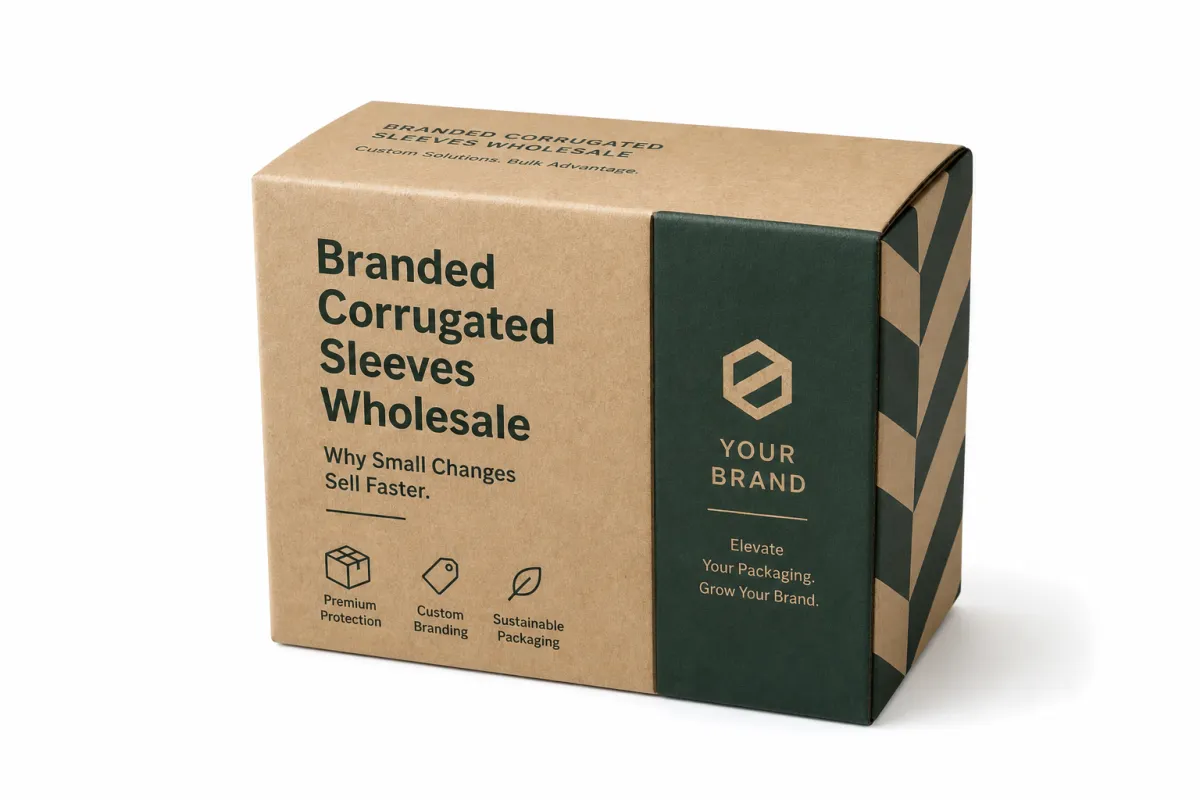
Shoppers make a lot of packaging decisions in a few seconds. A plain brown carton tells them the product is protected; a printed sleeve tells them the brand has paid attention to the presentation. That difference is a big reason branded corrugated sleeves wholesale performs so well for companies that need a sharper look without starting over from scratch. The sleeve becomes the brand surface, while the carton underneath continues doing the structural work.
That split between structure and graphics is where the efficiency lives. If the inner carton already fits the product and survives the trip through distribution, there is little reason to rebuild the entire pack just to improve appearance. Branded corrugated sleeves wholesale lets buyers focus spend on the visible layer, not the hidden one. For many teams, that is a better use of money than ordering a fully custom printed box on the first pass.
The format is especially useful for:
- Product launches that need a polished look before a full packaging refresh is approved.
- Seasonal campaigns that need a short production window and a strong shelf cue.
- Multi-SKU lines where one base carton can support several sleeve graphics.
- Retail or e-commerce programs that want more polish without changing the protective pack.
That flexibility is one of the main reasons branded corrugated sleeves wholesale keeps coming up in sourcing discussions. Sleeve changes can happen faster than a molded structure or a fully redesigned carton, and the format does not lock a brand into one look for every run. For teams handling several launches per quarter, that practical speed matters. Less time spent rebuilding packaging often means earlier sell-in, better inventory control, and fewer delays in prepress.
Another advantage shows up when programs need variation. A sleeve can be adjusted for a promotion, a retailer-specific version, a co-branded release, or a seasonal message without changing the base shipper. One carton can stay in place while the outer artwork shifts by flavor, shade, size, or channel. Branded corrugated sleeves wholesale works well as a bridge between a stable structure and a market that changes fast.
Packaging reality check: if the inner carton already protects the product, a well-executed sleeve often delivers more visible brand lift per dollar than a complete box rebuild.
For brands comparing packaging options, this is more than a design choice. It is a production strategy. Branded corrugated sleeves wholesale can shorten the route from artwork approval to inventory in hand, which is one reason it suits buyers who care about speed, consistency, and repeatable presentation.
Product Details: What Branded Corrugated Sleeves Actually Include
At the simplest level, a sleeve is a printed wrap that fits around an existing box, tray, carton, or bundled product. It does not replace the main package. It enhances it. That is what makes branded corrugated sleeves wholesale so useful for packaging programs built on a stable structural platform that only needs a better visual layer.
Common uses include retail gift sets, cosmetics kits, apparel bundles, food assortments, subscription boxes, and promotional packs. In each case, the sleeve can carry the logo, product story, color coding, regulatory copy, or seasonal artwork while the inner pack keeps the product secure. Branded corrugated sleeves wholesale also works well when a package has to move between channels. A pack can ship in one format and sell in another without reworking the entire structure.
Buyers usually choose between a few sleeve styles:
- Wraparound sleeves - These fully encircle the carton or tray and are a strong choice when broad graphic coverage matters.
- Face-panel sleeves - These leave more of the base pack visible and work well when the carton already looks good or already carries functional print.
- Display sleeves - These are shaped to support shelf presence, product callouts, or window openings.
- Bundle sleeves - These hold multiple items together and create a cleaner retail set or promotional kit.
That format choice affects both the look and the production method. A wraparound sleeve gives more print area, while a display sleeve may need a tighter dieline and more exact fold control. Either way, branded corrugated sleeves wholesale should match how the customer opens, carries, stacks, and stores the package. A sleeve that looks great on screen but slips around in transit does not solve the problem, and it can kinda undermine the whole point if the fit is off by even a little.
One overlooked benefit is SKU management. Brands with several variants can keep the carton common and change only the sleeve artwork. That reduces inventory complexity and lowers the chance of dead stock when a label or promotion changes. Branded corrugated sleeves wholesale can also support co-branded programs where two logos, a retailer mark, or a limited-edition message need to live on the same package.
For teams that need to move quickly, this format often creates a cleaner approval path than a full corrugated redesign. The base carton stays familiar. The sleeve becomes the branded surface. Because branded corrugated sleeves wholesale concentrates the message on the outside, it is often easier to test several looks before committing to a longer run.
Specifications That Matter: Materials, Print, Finish, and Fit
Specs are where a sleeve program either becomes efficient or turns into a rework cycle. In branded corrugated sleeves wholesale, the most important decisions are board type, flute or board thickness, dieline accuracy, print coverage, and finish. Get those right early, and the rest of the process usually moves more smoothly.
For many sleeve programs, lighter board is enough when the sleeve is mainly decorative and the inner carton already carries the load. A stronger build makes more sense when the sleeve has to stay crisp on shelf, survive repeated handling, or carry a heavier visual presence. Some buyers prefer folding carton board for a cleaner premium feel; others want corrugated board for more body and a sturdier hand. The right answer depends on product weight, shipping method, and the stiffness customers expect when they lift the package. If you are packaging a lighter set with a premium retail look, paperboard can be a good fit; if the sleeve needs more structure, an E-flute style build often holds its shape better.
Dieline accuracy matters more than many first-time buyers expect. If the sleeve is too tight, it can scrape or buckle during assembly. If it is too loose, the panel alignment shifts and the branding looks off-center. Good branded corrugated sleeves wholesale production starts with exact carton dimensions, fold allowances, closure overlap, and any windows, tabs, or tuck points that affect the final fit.
Print decisions should be confirmed before artwork is locked. Ask these questions up front:
- How many colors are being printed?
- Is the artwork on the outside only, or do you need inside print too?
- Will the design use full coverage, spot graphics, or a simple logo lockup?
- Does the finish need to be matte, gloss, soft-touch, or uncoated?
- Are brand colors tied to a specific standard such as Pantone?
Those answers affect price, lead time, and proofing complexity. A full-coverage sleeve with rich inks and a specialty coating will cost more than a single-color design on a simple board. That is normal. The key is to request specs clearly so branded corrugated sleeves wholesale quotes can be compared on equal terms. If one supplier is quoting aqueous coating and another is quoting a laminate, the numbers are not really talking about the same product.
Artwork setup can also slow things down if the file is not ready. Confirm bleed, safe area, fold direction, barcode placement, and any glue or lock-tab zones before release. A sleeve is not just a printed rectangle; it is a folded, registered component that has to perform after assembly. Even a strong design can fail if the panel breaks, trims, or wrap direction are wrong, and that is the kind of issue that burns time nobody wanted to lose.
For shipping-related programs, transit testing should be part of the spec review. Industry groups such as the ISTA publish methods that help buyers evaluate package performance, and that can be useful when sleeves are paired with shipping cartons or display shippers. If sustainability claims matter, the FSC chain-of-custody system is another reference point worth checking for paper-based packaging materials.
Branded corrugated sleeves wholesale works best when the structural details are locked before artwork revisions begin. That reduces proof loops, keeps the order inside budget, and avoids the expensive surprise of discovering that a beautiful sleeve does not fit the carton it was built for.
Branded Corrugated Sleeves Wholesale Pricing, MOQ, and Quote Drivers
Pricing usually comes down to a handful of variables: dimensions, board grade, print method, color count, finish, and the complexity of the die cut or assembly style. Branded corrugated sleeves wholesale is rarely priced as a single flat number because two sleeves can look similar yet differ a lot in setup cost and material usage.
For rough planning, buyers often see unit pricing move within a range like $0.18-$0.45 per sleeve at higher quantities, with smaller runs climbing above that depending on print coverage and tooling. That is not a promise. It is a practical planning band. A compact two-color sleeve with simple folds sits near the low end, while a larger sleeve with premium coating, heavy coverage, or a more complex structure trends higher. Branded corrugated sleeves wholesale gets more efficient as quantity increases because setup and tooling costs spread across more pieces.
MOQ is the second major lever. A supplier may quote a lower unit cost at 5,000 pieces than at 1,000, but the real question is whether the run size matches the launch risk. For a test release or short seasonal drop, a smaller MOQ can be the better move if it protects cash flow and avoids excess inventory. For an ongoing line, larger branded corrugated sleeves wholesale orders usually make more sense because reordering becomes easier and the per-unit cost drops.
To compare quotes properly, ask every supplier to price the same specification set. If one quote includes a heavier board, a proof, and freight while another excludes those items, the lower number is misleading. A clean branded corrugated sleeves wholesale quote should break out:
- Unit cost by quantity tier
- Tooling or die-charge
- Proofing or plate setup
- Finishing or coating
- Packaging for shipment
- Freight or delivery charges
- Revision fees, if any
Here is a practical comparison buyers can use to frame the conversation.
| Option | Typical Use | Indicative Unit Range | Notes |
|---|---|---|---|
| Simple printed sleeve | Launches, promos, line refreshes | $0.18-$0.28 | Lower coverage, straightforward fold, good for budget control |
| Premium sleeve with coating | Retail sets, gift packaging, higher-value products | $0.28-$0.45 | Strong shelf impact, more finish options, often more prepress work |
| Complex sleeve system | Multi-panel branding, windows, lock tabs, or bundles | $0.35-$0.60+ | More tooling and fit checks; useful when the package has to do more than brand |
That table is a starting point, not a fixed rate card. It still helps buyers think clearly about branded corrugated sleeves wholesale before they submit artwork and expect a quick number. The more exact the spec, the less guesswork in the quote.
There is also a hidden cost to vague sourcing: revision time. If the supplier has to rebuild the dieline or rework artwork after proof, the project can lose days. In branded corrugated sleeves wholesale, speed often comes from discipline. A buyer who sends dimensions, product photos, carton samples, quantity tiers, and finish preferences usually gets a better answer the first time.
For brands managing multiple packaging categories, it helps to compare sleeve pricing against other formats. You may find that branded corrugated sleeves wholesale delivers the best balance of appearance and flexibility, especially if the base box already exists. If a full corrugated overhaul is also on the table, review Custom Shipping Boxes alongside sleeve pricing so the economics are compared honestly.
Process, Timeline, and Lead Time for Branded Corrugated Sleeves Wholesale
The best branded corrugated sleeves wholesale orders move through a predictable chain: inquiry, spec review, dieline confirmation, artwork submission, proof approval, production, finishing, packing, and shipment. That sounds simple. In practice, each step can be delayed by missing dimensions, unclear file setup, or last-minute brand changes.
The most common bottleneck is artwork. Teams often approve the visual direction before checking panel sizes, glue zones, or fold direction. Then the file has to be reworked. Another delay point is color correction. If the brand expects a specific shade but the file is not built with the right reference, the proof stage can take longer than planned. Branded corrugated sleeves wholesale rewards clean prepress work because the design is already aligned to the dieline when production starts.
Typical timing depends on quantity and complexity, but a useful framework looks like this:
- Quote stage: 1-3 business days if dimensions and artwork intent are clear.
- Proof stage: 2-5 business days, sometimes more if the design needs corrections.
- Production window: often 10-20 business days after approval, depending on print and finishing.
- Freight window: add transit time based on destination and shipping method.
That means the real schedule is not only production time. It is total project time from first inquiry to delivery. For seasonal launches, that distinction matters. A sleeve that arrives after the campaign starts is not useful. Branded corrugated sleeves wholesale works best when the order is planned backward from the shelf date or ship date, not forward from the date the quote lands.
Seasonal programs deserve extra padding. If the order is tied to a holiday release, retailer reset, or marketing push, build in room for proof corrections and freight delays. A buyer who plans tightly can still get a fast result, but the schedule should include slack. Otherwise, rush costs creep in, and those costs are rarely worth it unless the launch date is fixed.
It also helps to understand where a supplier can move quickly and where they cannot. A simple repeat order with the same dieline may turn faster than a new format. A sleeve with a known board and stable artwork is easier to produce than a full-coverage premium pack with multiple finishing steps. That is why branded corrugated sleeves wholesale is often a strong choice for replenishment programs: once the format is locked, repeat ordering gets more predictable.
Teams that manage packaging across channels should coordinate with fulfillment and merchandising early. If the sleeve has to arrive with other packaging components, align the dates so the assembly line does not wait on a missing part. For buyers who need a broader sourcing plan, our Wholesale Programs page shows how multi-run packaging orders can be organized around the same spec discipline.
There is one more practical point. If your product set is still changing, a sleeve is easier to update than a structural carton. That makes branded corrugated sleeves wholesale a good fit for evolving product lines, because design revisions can happen without starting over on the entire package. The time saved there shows up in less friction between marketing, procurement, and production.
Why Choose a Capable Partner for Corrugated Sleeve Programs
Packaging buyers do not need hype. They need dependable execution. The strongest reason to source branded corrugated sleeves wholesale from a capable packaging partner is consistency: consistent sizing, consistent print checks, and consistent communication before the order goes into production.
That consistency matters because sleeve programs are often judged on small details. A panel that sits one millimeter off can make the entire package feel less premium. A color shift can weaken the brand on shelf. A fold that does not register cleanly can make a good design look rushed. A solid supplier helps prevent those problems through prepress review, measurement verification, and practical advice on board choice and finish.
What buyers should expect from a capable partner:
- Clear confirmation of carton or tray dimensions before artwork release.
- Direct feedback on the best sleeve style for the product and channel.
- Proof support that catches alignment or fold issues early.
- Realistic lead times instead of optimistic guesses.
- Transparent pricing tied to spec changes, not vague package descriptions.
That is where branded corrugated sleeves wholesale either becomes manageable or turns into a headache. A supplier who understands the fit and print requirements can help a team avoid expensive rework. A supplier who only wants to sell the highest-priced option may not be the right fit for a buyer balancing quality and margin.
For companies comparing packaging partners, case studies can be useful because they reveal how a supplier handles repeat orders, spec changes, and deadline pressure. Our Case Studies page is a good place to see how packaging programs are approached when consistency matters across more than one run.
Another advantage of a strong partner is sample support. Physical samples catch mistakes that digital renders miss. A sleeve can look fine on a screen and still fail in hand because the overlap is too tight, the panel is too wide, or the finish changes the way the package folds. In branded corrugated sleeves wholesale, a sample is not a luxury. It is a practical check against avoidable waste.
From a buyer's perspective, the best packaging relationship is the one that reduces surprises. If a supplier can help you lock the dieline, explain the price drivers, and keep the run on schedule, that is worth more than a flashy sales pitch. Branded corrugated sleeves wholesale should make the packaging program cleaner, not more complicated.
Next Steps: How to Order Branded Corrugated Sleeves Wholesale
If you are preparing a quote request, the fastest path is to send complete information the first time. For branded corrugated sleeves wholesale, that means exact dimensions, carton or tray photos, target quantity, artwork files, delivery location, and a short note on how the package will be used. The clearer the brief, the faster the pricing.
Before you request pricing, confirm these points internally:
- What is the exact outer size of the carton or tray?
- Does the sleeve need full wrap coverage or only a branded face panel?
- Is the program for shelf display, e-commerce, gifting, or a mixed channel?
- Do you need a matte, gloss, soft-touch, or uncoated finish?
- Is this a test run, a seasonal order, or a recurring replenishment program?
That checklist saves time because it helps the supplier quote the right version of branded corrugated sleeves wholesale instead of guessing. It also helps you compare multiple bids on the same basis. One quote may look cheaper until you notice the board grade, proofing, or freight are different.
If the order is tied to a bigger packaging rollout, compare the sleeve against the rest of the system. Sometimes the sleeve is the right move. Sometimes a new box style is worth the extra spend. Sometimes the best answer is a mix: a standard structural pack with a branded outer layer. That is why product planning should include both the sleeve and the underlying carton, especially if the line is still changing. For many teams, branded corrugated sleeves wholesale is the fastest route to a shelf-ready package without overcommitting to a full redesign.
Ask for tiered pricing so you can see where the economics improve. Ask for a proof timeline so you know when artwork decisions have to be final. Ask whether a sample is available before production. Those three questions can prevent a lot of friction later. They also make branded corrugated sleeves wholesale easier to approve internally because procurement, marketing, and operations are all seeing the same facts.
There is a reason this format keeps winning budget conversations. It delivers visible branding, solid utility, and a lower barrier to launch than many full custom structures. For product teams that need movement, branded corrugated sleeves wholesale is often the straightest line between concept and a package that looks ready for market. If you are planning your next order, start with the dimensions, define the finish, and request a quote that shows every major cost driver before you commit.
FAQ
What size box works best for branded corrugated sleeves wholesale orders?
The sleeve should be built around the exact outer dimensions of the carton or tray, not an estimate. Provide width, depth, and height, plus any overlap or display-panel needs, so the sleeve stays aligned in use. If you have multiple SKUs, ask for a scalable dieline system so one design family can fit several package sizes.
How do print coverage and finish affect branded corrugated sleeves wholesale pricing?
Full-coverage printing and specialty finishes usually cost more than a simple one- or two-color design. Artwork complexity, color matching, coating choice, and fold count can all raise setup time and unit cost. Request line-item quotes so you can see exactly which spec changes affect the final price.
What MOQ should I expect for custom corrugated sleeve runs?
MOQ depends on board choice, print method, and setup requirements, so there is no universal minimum. Larger runs usually lower the unit price because tooling and setup are spread across more pieces. Ask for multiple quantity tiers if you are comparing a test launch, a seasonal run, or ongoing replenishment.
How long does turnaround usually take after artwork approval?
Turnaround starts after proof approval, not after the first inquiry, so file readiness matters. Simple orders move faster when the dieline is confirmed and no design revisions are needed. Freight distance and order size can affect delivery timing, so build shipping into your schedule.
Can branded corrugated sleeves wholesale work for both retail and shipping?
Yes, sleeves can improve shelf presentation while still fitting over a functional shipping carton. They are useful when the inner box already protects the product and the sleeve handles the branding job. That makes them practical for launches, limited editions, e-commerce, and retail display programs.
Actionable takeaway: lock the carton dimensions, choose the sleeve style, confirm board and finish, then ask for tiered pricing and a proof schedule before artwork is finalized. That order of operations keeps branded corrugated sleeves wholesale on budget and keeps the packaging looking intentional instead of rushed.