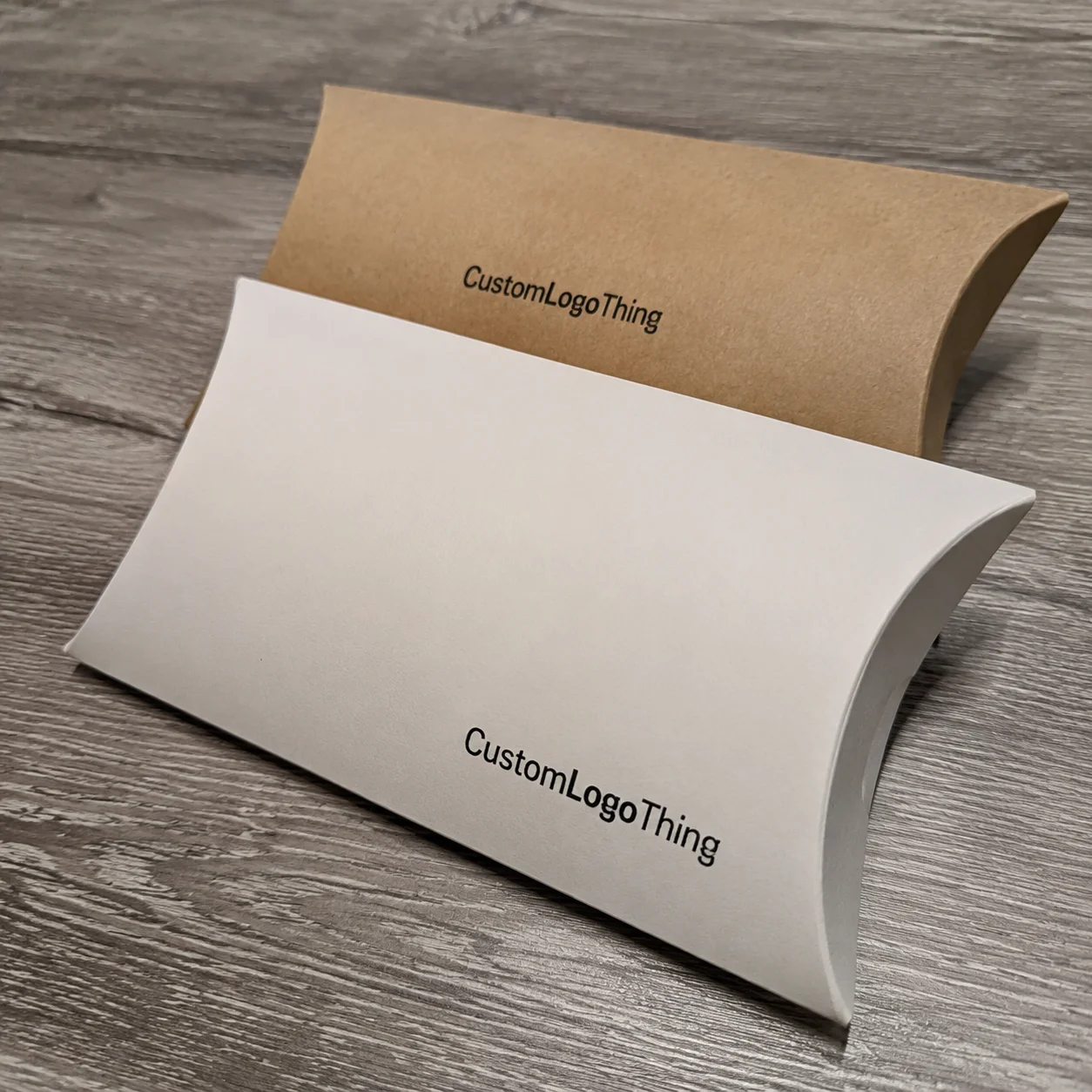
Custom Pillow Boxes Bulk Order: Specs, Cost, Timeline
Why a Custom Pillow Boxes Bulk Order Can Cut Packaging Waste
A bracelet shipped in a 9 x 6 inch mailer can carry more air than product. That hidden volume becomes filler, freight, shelf clutter, and slower packing. It is also the reason a Custom Pillow Boxes bulk order deserves a serious review before another case of oversized mailers lands beside the packing bench.
Pillow boxes look decorative. True. Their better commercial argument is less glamorous: better cube efficiency, faster hand assembly, and lower filler use for small, lightweight products. Cosmetics, wax melts, jewelry, gift cards, apparel accessories, compliant cannabis accessories, party favors, subscription inserts, and promotional kits often sit in the awkward middle. A rigid box feels excessive. A poly bag feels under-branded.
Compared with rigid setup boxes, paperboard pillow boxes use less material weight and usually ship flat before assembly. Compared with plain bags, they give the brand a larger printable surface. Compared with some tuck-end cartons, they can be quicker to fold by hand because the crescent ends lock without multiple dust flaps fighting the packer.
Bulk ordering changes the math. A buyer can hold one package standard across several SKUs, reduce per-unit cost, avoid emergency reorders, and plan seasonal campaigns without switching substrates halfway through launch. That matters. A mismatched reorder on a retail shelf can make the same product look like a different quality tier.
The right starting point is not foil, ribbon, or color. Start with product dimensions and fulfillment method. A beautiful box that adds 12 seconds to every packing cycle becomes expensive after 5,000 units. Good product packaging should look sharp, protect the item, and move through operations without creating another job.
Practical rule: if the package is mostly carrying air, the format is probably doing more brand theater than operational work.
A custom pillow boxes bulk order works best when the package removes friction: smaller storage footprint, cleaner presentation, less void fill, and more consistent shelf presence. Those are not abstract brand benefits. They show up in packing speed, freight planning, and fewer last-minute substitutions.
Product Details Buyers Should Confirm Before Ordering
Custom pillow boxes are curved-fold paperboard boxes with interlocking crescent ends. They are usually shipped flat, then folded into shape during packing. That flat-pack advantage lowers inbound storage volume, but it also puts pressure on the structure. The box must open, form, fill, and close without splitting at the score lines.
Construction options vary more than many buyers expect. Standard pillow boxes work for samples, soaps, jewelry, small accessories, and light gifts. Window pillow boxes show the product through a die-cut opening with a clear patch. Hanger-tab versions suit peg displays. Ribbon-slot styles lean toward gifting. Handle pillow boxes give small sets a boutique feel. Insert-supported versions can hold fragile, premium, or oddly shaped items in place.
Weight drives structure. A 40 g lip balm set can often use lighter board than a 220 g candle accessory kit. Heavier products may need higher caliper stock, stronger locking ends, or a simple insert to stop the item from pressing into the curved wall. Not every pillow box should stand on its own, either. If retail display orientation matters, say so before the dieline is made.
The visual surface has jobs to do. The front panel usually carries the logo, product promise, scent, shade, or collection name. The back panel may need a barcode, ingredient text, warning copy, QR code, batch label, country-of-origin statement, or retailer SKU. The curved side areas are better for pattern, color blocking, or secondary marks because fold arcs can distort small text.
Artwork needs discipline. Keep essential text, barcodes, and compliance copy away from crescent folds and end flaps. A 2 mm shift can be visible on a curved form, especially with borders, stripes, or centered medallion logos. Ask for the approved dieline before finalizing packaging design.
Fulfillment details belong in the first conversation, not after the proof. Will boxes be packed by hand on a retail counter, filled by a co-packer, kitted for subscription shipments, or inserted into corrugated mailers? The answer affects board selection, closure strength, coating, scuff resistance, and whether the packer needs extra time to square the box before filling.
Pillow boxes are not ideal for every product. Bulky, sharp-edged, liquid-heavy, or crush-sensitive items may need cartons, sleeves, trays, molded pulp, or rigid packaging instead. Forcing the format is one of the easiest ways to turn an attractive box into a damage claim.
For a first bulk order, product testing should be blunt. Put the real item in the box. Shake it. Stack it. Place it in the actual mailer, tray, shelf display, or kit configuration. If the package only works when handled gently on a conference table, it is not ready for production.
Specifications: Size, Stock, Printing, and Finishes
Accurate sizing starts with five facts: product length, width, depth, weight, and packed configuration. Add tissue, insert cards, foam, a protective sleeve, a sample vial, or a folded instruction card, and the usable interior space changes quickly. Pillow boxes are curved, so a flat ruler estimate can mislead buyers who assume the widest outside dimension equals usable inside space.
Inside and outside dimensions are not the same. Board thickness, score allowances, and the bowed body reduce usable room. A product measuring 4.0 x 2.0 x 0.75 inches may need extra tolerance, particularly if it has corners, caps, clasps, or uneven thickness. For tight products, a plain structural sample is usually cheaper than discovering the issue after production.
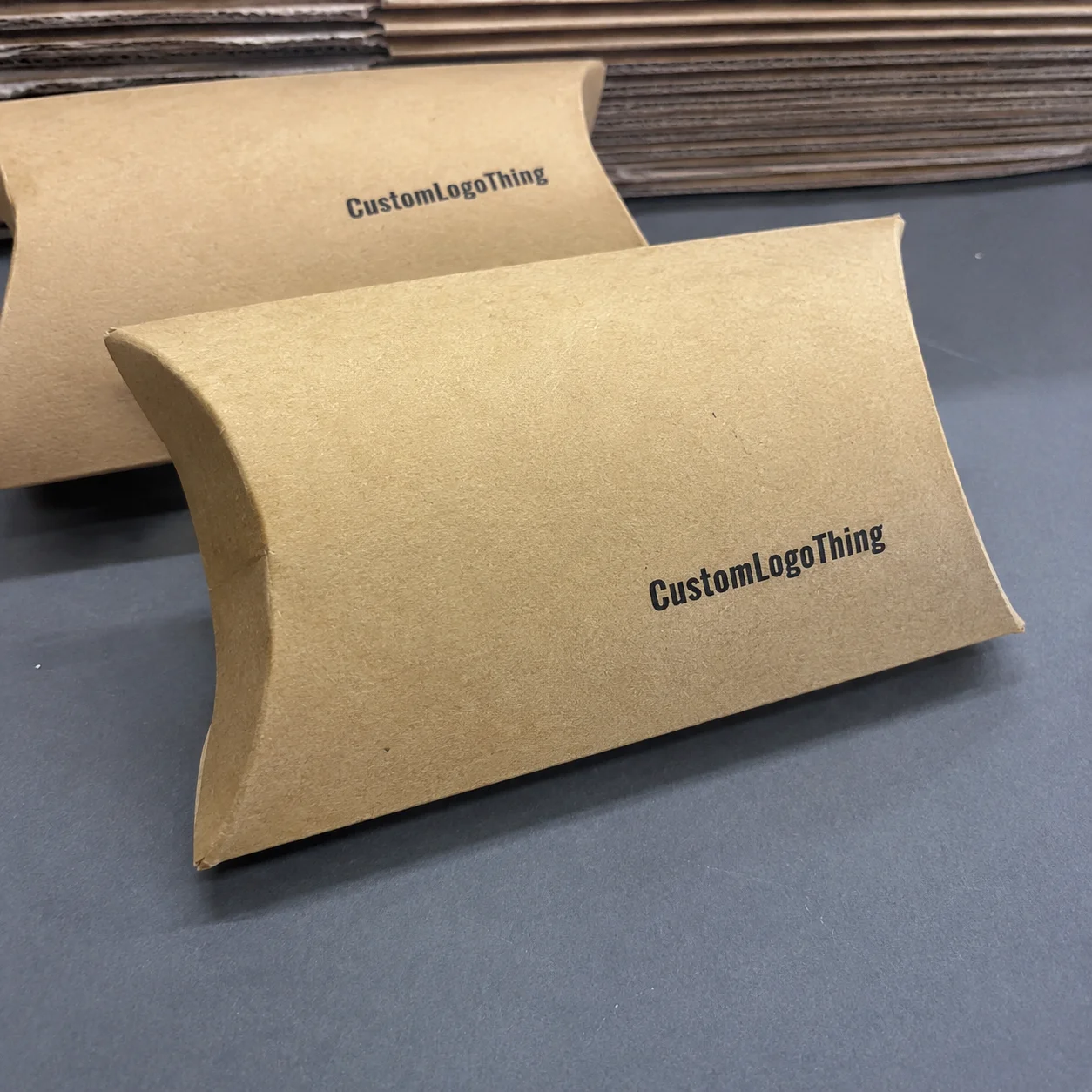
Board selection affects cost, print quality, stiffness, and sustainability claims. SBS paperboard gives clean white surfaces and strong graphic reproduction for premium retail packaging. Kraft paperboard gives a natural look, although colors print differently on brown stock. CCNB can be economical for certain retail runs. Specialty stocks, textured papers, and laminated constructions can lift the presentation, but they usually add cost and sourcing time.
Thickness is not universal. Light products may use lower caliper paperboard, while premium or heavier goods often need sturdier stock such as 300 gsm, 350 gsm, or higher depending on size and load. Larger pillow boxes flex more. The same board that works for a 3 inch jewelry box may feel weak on an 8 inch accessory kit.
Printing method also shapes the quote. Digital printing can fit prototypes and smaller runs because setup is lighter. Offset printing usually delivers sharper results and better unit economics for larger volumes. Flexographic or specialty methods may appear in certain production paths, especially where material, speed, or finish requirements point that way.
Finishes carry tradeoffs. Matte coating reduces glare. Gloss gives stronger shine and color pop. Soft-touch lamination feels premium but can show fingerprints on dark solids. Aqueous coating is common for print protection. Spot UV highlights logos or patterns. Foil stamping, embossing, and debossing add tactile value, but they require separate setup. Die-cut windows and PET window patching improve product visibility while complicating recycling language in some cases.
| Specification Choice | Best Fit | Cost and Production Impact |
|---|---|---|
| SBS paperboard, 300-350 gsm | Cosmetics, jewelry, premium samples | Strong print clarity; moderate to higher material cost |
| Kraft paperboard | Natural soaps, wax melts, handmade goods | Brand colors may shift; good for rustic presentation |
| Window patch | Retail products that benefit from visibility | Adds die-cutting, patching, and inspection steps |
| Foil or embossing | Gift, beauty, limited-run promotions | Higher setup cost; better suited to larger quantities |
| Digital print | Short runs, prototypes, market tests | Lower setup burden; unit cost may stay higher |
Before a custom pillow boxes bulk order moves into production, request a dieline and proof. Check barcode size, logo placement, fold lines, bleed, safety margins, and panel orientation. Many retailers follow barcode verification practices tied to ISO/IEC scan quality methods. Transport testing may reference standards from ISTA when the finished package ships inside a parcel system.
The same discipline applies to custom printed pillow boxes for seasonal sets, influencer kits, or retail promotions. Decorative effects should support the structure, not distract from weak sizing. A foil logo cannot compensate for a box that bows open in transit.
How Much Does a Custom Pillow Boxes Bulk Order Cost?
Bulk pillow box pricing depends on quantity, size, board grade, print coverage, number of colors, coatings, die-cut features, window patching, foil, embossing, inserts, and shipping destination. That is the factual answer. Any supplier quoting a single flat number before those variables are known is working from assumptions.
The economics are fixed-cost heavy. Dielines, setup, make-ready, plates for some print methods, tooling, and finishing setup get spread across the order. A 500-piece run may feel expensive per unit because setup costs sit on a small base. At 5,000 or 10,000 pieces, the same setup burden is spread wider, so the unit cost often drops sharply.
Realistic ranges depend on specs, but buyers commonly see simple paperboard pillow boxes land in broad bands such as $0.25-$0.70 per unit at moderate quantities. Small digitally printed runs, window patching, foil, embossing, heavier stocks, or custom inserts can move above that. Freight changes the math. Oversized flat shipping cartons, residential delivery fees, liftgate needs, and rush air shipments can turn a low unit price into a poor landed cost.
MOQ is practical, not mysterious. Minimums vary by material, print process, finishing, and production schedule. Digital production can support smaller quantities for testing or launch runs. Offset printing and specialty finishing usually favor larger runs because the setup has to be justified. Ask for two quantity tiers, such as 1,000 and 5,000 pieces, or 2,500 and 10,000 pieces, so the cost curve is visible.
Prepare the quote cleanly. Send final dimensions, target quantity range, artwork status, stock preference, finish requirements, delivery ZIP code, target in-hand date, and whether a prototype is needed. If the product shape is irregular, include photos. If the product is regulated, include compliance copy early.
Hidden cost variables deserve attention: extra proofing rounds, artwork repair, barcode correction, insert design, holiday congestion, rush freight, and late finish changes. A slightly higher box price may be cheaper overall if it lowers packing labor, damage, or gift-wrapping time. Total landed cost beats unit-cost tunnel vision.
For wholesale pillow boxes, the smartest comparison is rarely one quote against another quote. Compare the full spec: board, caliper, print method, coating, window material, sample policy, freight, and turnaround. Two prices can look close while describing very different boxes.
Custom Logo Things can quote through a spec-based process across Custom Packaging Products and larger Wholesale Programs. Pricing becomes more useful when it is tied to real production choices rather than broad ranges that collapse once stock, coating, and delivery details are added.
Process and Timeline From Dieline to Delivery
A typical order moves through inquiry, specification review, quote, dieline creation, artwork placement, proof approval, optional sample, printing, die-cutting, finishing, gluing if required, packing, quality control, and shipping. That looks linear on paper. In practice, delays often come from missing inputs rather than slow machines.
Buyers can shorten lead time by approving dimensions early, sending vector logo files, confirming Pantone or CMYK expectations, and avoiding late changes after proofing. A brand color described as "deep green" is not enough. A Pantone reference, approved CMYK build, or physical color target gives the printer something measurable.
A digital proof checks layout, copy, barcode placement, panel direction, and spelling. It does not prove folding behavior or product fit. A physical sample checks size, stiffness, closure, color impression, and how the product sits inside the curved body. For a first custom pillow boxes bulk order, a plain structural sample is often more useful than a polished screen proof when tolerances are tight.
Common production timelines can run 8-15 business days after proof approval for simpler jobs, with specialty finishes, custom inserts, window patching, or complex approvals adding time. Shipping may add 2-7 business days domestically depending on service level and destination. International or rush freight changes both cost and risk.
Timeline risks are predictable: missing artwork assets, unclear warning copy, unconfirmed shipping addresses, holiday production congestion, specialty material shortages, and freight delays. Window patching, foil stamping, embossing, and inserts each add setup and inspection. More steps mean more checkpoints.
Build the schedule backward from the retail launch, photo shoot, trade show, subscription drop, or seasonal campaign ship date. If timing is tight, approve a plain structural sample first, then finalize graphics while production planning continues where feasible. That cannot solve every deadline problem, but it can protect a launch when dimensions are the only real uncertainty.
Receiving time counts too. Someone has to inspect cartons, count cases, check labels, and move inventory into storage before the first customer order is packed. A delivery that arrives the morning of a launch is not early. Operationally, it is already late.
Quality Checks That Prevent Bulk Order Mistakes
Small packaging errors become expensive at scale. A 2 mm sizing issue repeated across 5,000 boxes can slow every packer, crush product corners, or create unusable inventory. The box may still look acceptable in a photo. The packing line will tell the truth.
Structural checks should include product fit, end-flap closure strength, board stiffness, fold cracking, window placement, hanger-tab durability, and display behavior. If the pillow box needs to hang, test the hang tab with real product weight. If it needs to sit in a tray or mailer, test that too. ASTM packaging test methods can be relevant for material and handling evaluation, while parcel distribution testing may draw from ISTA procedures depending on the shipping route.
Print checks are just as unforgiving. Review logo clarity, color match, barcode scanability, small text legibility, safe zones, bleed, fold alignment, and coating consistency. Dark backgrounds with soft-touch finishes can look premium, but fingerprints and rub marks show faster. Metallic foil can drift slightly from printed artwork if tolerances are not planned.
Compliance and retail checks belong in the proof stage, not after delivery. Ingredient labels, warnings, QR codes, batch stickers, SKU labels, country-of-origin text, and retailer-specific barcode rules should all be reviewed by the right person. Packaging failures often happen between departments, not inside the print file.
Artwork files should be production-ready or honestly labeled as not ready. Vector logos, high-resolution images, outlined fonts when requested, embedded links, correct dieline layer handling, and CMYK or Pantone color setup are common requirements. If a brand only has a PNG logo pulled from a website, print sharpness may suffer.
Sustainability claims need caution. Avoid broad language such as "eco-friendly" unless the stock, coating, window material, and disposal path support it. The FSC label, for example, has specific sourcing and chain-of-custody rules. Recyclability also depends on local collection systems, coatings, laminations, and window materials.
Use one shared approval chain. Marketing, operations, fulfillment, and compliance should review the same proof. For a custom pillow boxes bulk order, that extra review round can prevent a full pallet of boxes with a perfect logo and a barcode that scans poorly.
Inspection does not have to be elaborate. Pull samples from multiple cartons. Fold them. Fill them. Scan the barcode. Compare color to the approved proof under consistent light. Check that the crescent ends close without tearing. If pillow box packaging fails at the bench, the problem will multiply in the field.
What to Prepare Before Requesting a Quote
Before requesting pricing, measure the product in length, width, and depth. Weigh it. Confirm whether it will sit loose, wrapped in tissue, held by an insert, paired with a card, or protected by a sleeve. If the shape is irregular, send photos from several angles with a ruler in the frame.
Choose a target quantity and one comparison tier. A launch run of 1,000 pieces and a replenishment run of 5,000 pieces can show whether the lower unit cost justifies the inventory. For seasonal campaigns, also consider storage space and the risk of dated copy.
Decide the priority before the quote is built. Lowest unit cost, fastest turnaround, luxury presentation, sustainable material preference, retail display impact, and mailer compatibility can point to different specs. A foil-stamped window pillow box and a kraft one-color pillow box are not competing versions of the same production plan.
Send artwork status honestly: print-ready dieline, logo only, rough concept, or full design support needed. That changes both timeline and quote accuracy. If you need broader information before submitting specs, the FAQ can help clarify common ordering questions.
Custom Logo Things can price, prototype, and produce a custom pillow boxes bulk order once specs, artwork, quantity, and delivery details are confirmed. Tighter inputs make the quote more useful.
The best brief is specific but not overbuilt: product size, product weight, desired quantity, preferred material, printing needs, finish ideas, launch date, shipping address, and any retail or compliance requirements. That gives the supplier enough information to price the box you actually need, with fewer assumptions hiding inside the estimate.
FAQ
What is the MOQ for custom pillow box packaging in bulk?
MOQ depends on size, board, printing method, and finishing. Smaller digital runs may be available, while offset printing, foil, embossing, and custom windows usually require higher quantities for efficient setup. For the most accurate MOQ, provide dimensions, quantity target, finish preferences, and delivery location before requesting a quote.
How much does a custom pillow boxes bulk order cost?
A custom pillow boxes bulk order is priced by box size, material thickness, print coverage, finish complexity, die-cut windows, inserts, order quantity, and freight. Unit cost generally decreases at higher quantities because setup costs are spread across more boxes, but total landed cost should include shipping, sampling, and any artwork work.
How long does production take for bulk pillow boxes?
Lead time depends on proof approval speed, material availability, print process, finishing steps, and shipping method. Simple jobs may run about 8-15 business days after proof approval, while window patching, foil, inserts, specialty stocks, or rush freight can change the schedule.
Can I order custom printed pillow boxes with a window?
Yes, window pillow boxes can be made with die-cut openings and clear patching so shoppers can see the product. Window size and placement should be checked against product movement, barcode location, structural strength, and recycling or sustainability claims.
What files are needed for custom pillow box printing?
Print-ready orders usually need vector artwork, high-resolution images, outlined or supplied fonts, correct color setup, and artwork placed on the approved dieline. If artwork is not ready, provide logos, brand colors, copy, barcode files, and reference packaging so production-ready files can be prepared accurately.