Put two similar products on a shelf. Same category. Similar price. One carries a limp tag with muddy print and awkward spacing. The other has a crisp layout, readable barcode space, clear typography, and a finish that fits the product. The second one gets picked up first more often than brands like to admit. A branded hang tags bulk order is not just a print purchase. It shapes perceived value, supports SKU control, speeds store setup, and makes reorders much less painful.
Shoppers often handle the tag before they inspect stitching, ingredients, bottle details, or secondary packaging. That small piece of printed board has to do a lot of work: hold the logo, size, MSRP, barcode, care notes, origin, QR code, promo message, or seasonal callout without looking crowded. For teams buying at volume, consistent tags across a product line cut packing mistakes, help staff merchandise faster, and make mixed displays look considered instead of improvised.
Bulk ordering starts to make real sense once you need repeatable quality, stable unit pricing, and a clear replenishment path. The key is simple: lock the specification before final art approval. Not after the barcode fails, not after the drill hole lands in a line of text, and definitely not after 5,000 attractive tags arrive with no practical way to attach them. This article stays on the buying side of the process: materials, print methods, pricing, MOQ, lead time, and file prep, with enough detail to help you quote accurately the first time.
Your product can look expensive and still get ignored without the right tag

Hang tags do fast, visual selling work. They signal category, price point, and brand tone in a couple of seconds. In apparel, they often carry size, fit notes, and care symbols. In specialty food or bath products, they may hold ingredients, scent names, or short origin copy. In gift retail, they can deliver emotional language that the product itself cannot display clearly. That is a lot to ask of a 2 x 3.5 inch or 2.5 x 4 inch card.
A well-built tag also protects operations. Standardized tag size, common hole placement, and a consistent barcode zone reduce handling errors during packing. Store staff can steam, hang, and face products faster. Reorders move more smoothly because the spec sheet already exists. That operational side matters more than many buyers expect. A tag program is doing its job when no one has to stop and improvise during packing week.
Brands selling through boutiques, ecommerce pop-ups, gift stores, or chain retail often pair tags with broader packaging systems that include Custom Labels & Tags and secondary inserts. As assortments grow, a shared tag standard becomes one of the least expensive ways to keep the brand looking disciplined across many SKUs.
Practical rule: if your team reorders the same format more than twice, stop treating it like a one-off job and build a real spec.
What to decide before placing a branded hang tags bulk order
Most cost and performance decisions are straightforward, yet buyers skip them constantly. Set the size, shape, material, thickness, finish, hole position, attachment type, and print method before asking for prices. If those details are missing, every supplier fills in the blanks differently, and the quotes become impossible to compare cleanly.
Format usually follows product type. Apparel swing tags often land at 2 x 3.5 inches, 2.25 x 4 inches, or 3 x 5 inches. Jewelry tags run much smaller, often near 1.5 x 2 inches, sometimes with a notch or folded structure. Bottle neck tags may use a scored card with a die-cut neck opening. Boutique gift tags often lean toward thicker uncoated or textured stocks because they feel tactile and accept handwriting better for short notes or quick price changes.
Single-sided printing works for simple branding or short promotions. Double-sided printing earns its keep once you need room for barcodes, legal copy, care instructions, ingredients, QR codes, or bilingual messaging. In most cases, the front handles the selling while the back carries the practical information that keeps stores and warehouses moving.
Standard shapes usually cost less and move faster. Rectangles, squares, and simple rounds rely on common cutting paths and lower setup time. Custom Die Cuts make sense when the shape serves the product, such as bottle tags, ornament tags, or a silhouette strongly tied to the brand. Plenty of die cuts add cost without adding much else. Decorative is easy. Useful is harder, and usually more valuable.
Variable data needs to be flagged early. If different SKUs require unique barcodes, size runs, color names, or QR destinations, mention that before quoting. Digital printing handles versioned art well for smaller or mixed programs. Offset tends to be the better fit for larger static runs where the design stays mostly fixed.
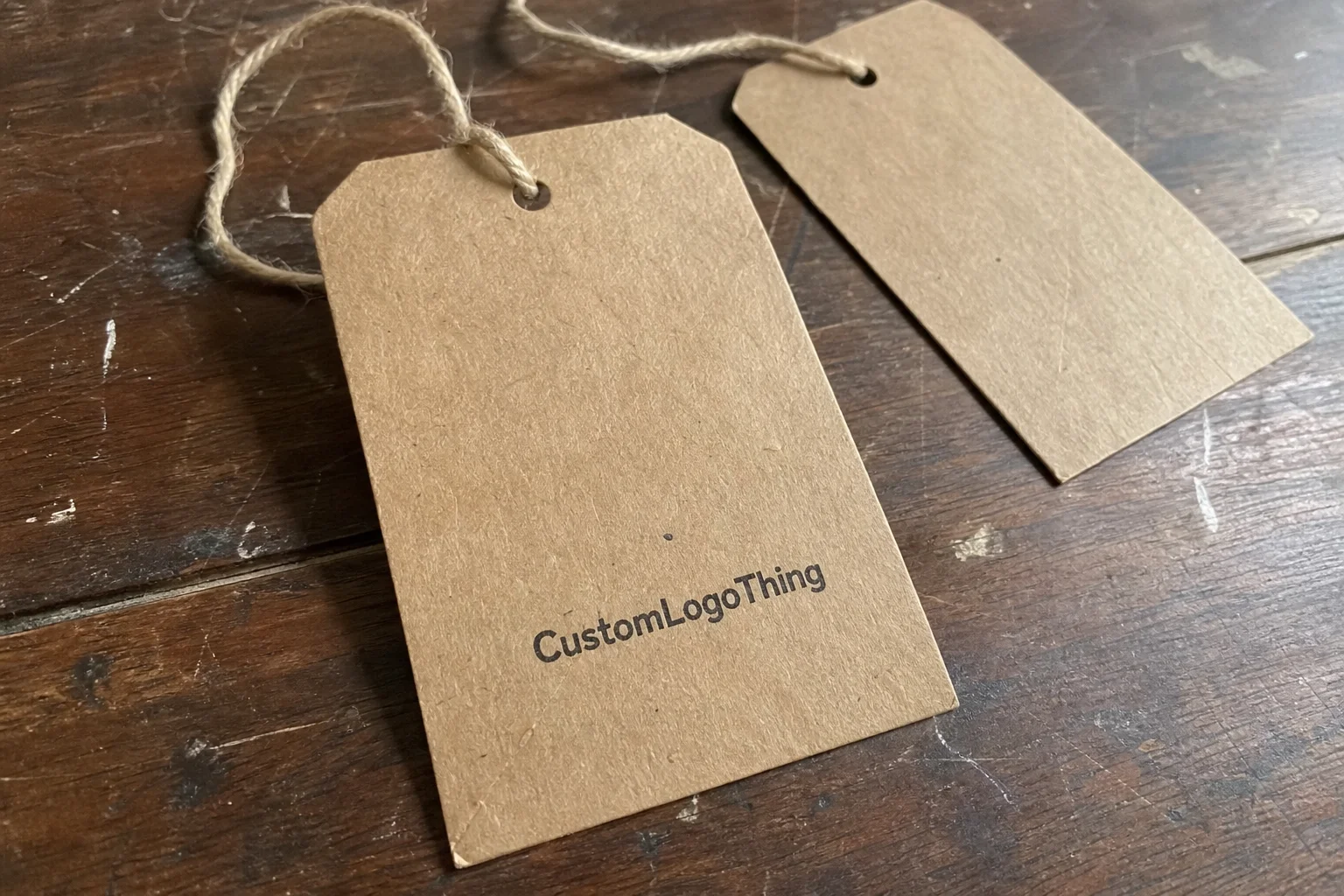
Attachment choices deserve closer attention than they usually get. Cotton string feels soft and premium but often costs more in both material and assembly. Elastic loops apply quickly and remain popular for apparel. Jute twine can support a rustic look but may shed fibers. Ribbon looks elevated on gift items and specialty packaging, though it pushes labor up. Safety pins solve certain fabric attachments but slow fulfillment and are less friendly for volume handling. Standardizing two or three approved attachment formats across product lines will help future purchasing far more than chasing novelty for its own sake.
A strong spec sheet prevents the classic failure: a beautiful tag with no practical barcode space, no room for required copy, and a hole that slices through the logo. That problem shows up more often than it should.
Materials, finishes, and print specs that change the result
Material choice changes both feel and function. Coated paper such as 250gsm to 350gsm C1S or C2S artboard gives sharp print and strong color, making it common in fashion, cosmetics, and mass retail. Uncoated cardstock feels warmer and accepts handwriting better, usually in the 250gsm to 400gsm range. Kraft paper suits brands with a natural position, though it can mute color and reduce contrast. Black core or dyed-edge boards create a premium impression, especially around 600gsm to 700gsm laminated thicknesses, but they cost more and need careful planning around barcode areas. Textured and recycled specialty papers add character, though they also demand cleaner artwork choices.
Thickness should match the product tier. Promotional tags can work well at 250gsm to 300gsm. Standard retail apparel often sits comfortably at 300gsm to 350gsm. Premium apparel, accessories, and gift lines often move into duplexed or layered constructions around 500gsm and above. Thicker does not automatically mean better. An oversized heavy tag on a low-ticket item can feel forced. Paper can overact just as easily as packaging can underdeliver.
Finishes that help and finishes that hurt
Matte lamination creates a refined, low-glare look and protects the print surface. Gloss lamination pushes color harder but reflects light and is tougher to write on. Soft-touch coatings can feel expensive, especially on fashion tags, though they may scuff during rough fulfillment handling. Spot UV works well for logos or small patterns on matte backgrounds. Foil stamping and embossing create shelf presence but need disciplined file prep and contrast planning. Debossing offers a quieter premium feel. Writable aqueous coatings or uncoated surfaces are the better choice if stores need to mark prices or sizes by hand.
Dark stocks, full gloss surfaces, and metallic backgrounds near barcode zones need caution. Scanners want contrast, not visual drama. Leave a clean quiet zone and test with typical retail scanners before moving into full production.
Print methods and technical prep
Offset lithography usually delivers the best value on larger runs because setup cost spreads across more units. Digital printing suits shorter runs, versioned SKUs, and faster proof cycles. Specialty embellishments such as foil, embossing, or raised UV add separate setup steps and often extend production by 3 to 7 business days depending on complexity.
Buyers should confirm a few basic artwork requirements before production starts:
- Bleed: typically 0.125 inch on all sides
- Safe area: usually 0.125 to 0.1875 inch inside the trim
- Color mode: CMYK, with Pantone references if brand color accuracy matters
- Logos: vector AI, EPS, or press-ready PDF
- Font size: avoid tiny legal copy below roughly 5.5 to 6 pt on textured stock
- Barcode zone: high contrast, no foil, no texture, no crowding
Folded tags, bottle tags, and specialty openings need a little more discussion up front. Ask about scoring, drill hole reinforcement, and corner radius. Those small construction details affect how well tags survive assembly, packing, and transport. If distribution will be rough, review packing methods and basic transit expectations alongside standards from groups like ISTA.
Bulk pricing, MOQ, and unit cost: what actually moves the numbers
A branded hang tags bulk order usually drops in per-piece cost as volume rises, but setup charges still need somewhere to land. The main cost drivers are quantity, dimensions, stock grade, color coverage, finishing steps, die cutting, string attachment, and packing method. Freight matters too, especially for assembled tags that take up more cube.
The table below gives a useful directional baseline for standard rectangular tags. It is not a universal price list, but it does reflect how buyers often see pricing move across common quantities and specs.
| Spec | 1,000 pcs | 2,500 pcs | 5,000 pcs | Notes |
|---|---|---|---|---|
| 2 x 3.5 in, 300gsm C1S, 4/0 print, no string | $0.16-$0.26 | $0.10-$0.18 | $0.07-$0.13 | Flat packed, standard die |
| 2 x 3.5 in, 350gsm uncoated, 4/4 print, drilled hole | $0.20-$0.32 | $0.13-$0.22 | $0.09-$0.16 | Better for writable backs |
| Custom die-cut, matte lamination, cotton string attached | $0.34-$0.58 | $0.24-$0.42 | $0.18-$0.31 | Tooling and labor extra in some quotes |
| Black stock, foil stamp, emboss, string attached | $0.55-$0.95 | $0.38-$0.72 | $0.28-$0.56 | Premium program pricing |
MOQ logic is fairly simple. Stock shapes and common board grades may start around 500 to 1,000 pieces, though those quantities rarely produce the best unit price. Custom dies usually make more sense from 2,500 pieces upward because tooling and makeready need enough volume to justify the extra setup. If your branded hang tags bulk order covers multiple SKUs, keeping the same size, stock, and finish across versions can trim cost even when artwork changes.
Flat-packed tags cost less to ship and are easier to store. Pre-strung tags reduce labor at the warehouse or sewing line, but the extra assembly cost is real. Depending on attachment type, pre-stringing can add roughly $0.03 to $0.10 per unit, and sometimes more for ribbon or specialty knots. That added cost may still be worthwhile if it removes hours of manual work during fulfillment.
Request quantity breaks at 1,000, 2,500, 5,000, and 10,000 when demand is recurring. Ask the supplier to separate tooling, printing, finishing, assembly, and shipping in the quote. Buyers who compare only the piece price often get surprised later by freight, spoilage allowance, or attachment labor. The cheap quote has a way of becoming less charming once the missing charges appear.
Production steps, lead time, and turnaround from quote to delivery
The usual workflow runs through inquiry, spec review, artwork check, quote, proof approval, sample if needed, production, packing, and shipment. It looks tidy on paper. Real timelines stretch when files are messy or the specification keeps moving.
Standard flat tags often take 7 to 12 business days after proof approval for digital or simpler offset jobs. More involved offset runs may land around 10 to 15 business days. Add Custom Die Cuts, foil, embossing, or hand assembly, and the schedule often moves into the 12 to 20 business day range before shipping. Transit time is separate. Customs is separate. Warehouse receiving is separate too, and those stages have a habit of being forgotten until the calendar gets tight.
What usually causes delays
- Missing dielines or artwork built to the wrong size
- Low-resolution logos or rasterized text
- Last-minute copy changes after proof approval
- Undecided string type or hole placement
- Barcode revisions after print files are imposed
- Multiple internal approvers giving conflicting feedback
Samples follow their own schedule. A digital proof may arrive in 1 to 3 business days. A physical sample, mockup, or pre-production piece often takes 4 to 8 business days depending on construction and shipping speed. If color, texture, or attachment method matters, request the physical sample. Screens flatter. Paper tells the truth.
Launch dates and seasonal pushes need buffer time for transit, customs, and receiving. If tags are tied to a major assortment drop, align packaging, merchandising, and operations approval into one internal checkpoint. One clean round of sign-off beats three scattered rounds of small edits that somehow burn a full week.
A solid RFQ should include:
- Finished size and orientation
- Stock type and target thickness
- Print colors and one side or two sides
- Finish details like matte, foil, emboss, or writable back
- Hole diameter and exact position
- String type, color, and whether pre-attached
- Quantity by SKU
- Delivery ZIP code and in-hand date
The fastest orders are rarely the ones with the most urgent emails. They are the ones with complete specifications.
How to compare suppliers without getting burned on quality or service
A useful supplier comparison has very little to do with who sounds nicest over email. Check print consistency, stock accuracy, color control, die-cut precision, hole placement tolerance, packing quality, and response time. If the program is headed for premium retail, ask what variance is acceptable on trim, drilling, and assembly. A hole drifting even 1 to 2 mm can make a narrow tag look sloppy.
Physical samples or close equivalents are worth getting before a larger run is approved. A supplier that reviews artwork and flags barcode placement issues is more valuable than one that simply agrees to everything. Blind order-taking is not much of a service. It is paperwork with a smile.
Color management deserves its own conversation. If the brand depends on exact spot colors, ask how Pantone matching is handled and what tolerance is realistic on each stock type. Uncoated, recycled, kraft, and textured papers all shift color differently. That is not a defect. That is how paper behaves.
Serious bulk buyers should also ask about sourcing and compliance. If sustainability claims matter, ask about recycled content and chain-of-custody options through FSC. Teams comparing programs across product lines may also want to review repeat work, broader packaging systems, or fulfillment support through pages like Case Studies and Wholesale Programs.
Logistics support is another quiet differentiator. Can the supplier split shipments by SKU, hold repeatable specs for future reorders, help forecast inventory for rolling demand, and pack tags by version in a way the warehouse can actually use? Those questions matter far more than a dramatic sales pitch about craftsmanship.
What good looks like: clear proofs, realistic tolerances, honest finish recommendations, organized packing, and the ability to reproduce the same tag again on the reorder.
The real goal is repeatability. A branded hang tags bulk order should become easier after the first run, not harder.
Next steps to quote the right hang tag order on the first try
A useful quote starts with complete basics, not a vague rush request. Begin with the artwork. Choose the finished size. Confirm the stock family and target thickness. Decide whether the tag is one-sided or two-sided. Pick the finish. Select the attachment. Estimate quantity by SKU. Set the in-hand date and delivery location.
A simple spec table helps more than most people expect. List SKU, dimensions, material, print sides, finish, string type, barcode need, and quantity. Then mark what stays fixed across the program and what changes by product line. That distinction affects setup cost, proofing complexity, and reorder speed.
Take a common example. If every version shares a 2 x 3.5 inch format, 350gsm uncoated stock, matte front, writable back, and a black elastic loop, but only the barcode and color name change, the job is much easier to price and manage. If half the SKUs want ribbon, some want foil, and one team suddenly wants a die-cut leaf shape, the clean quote turns into a small circus.
Start with a digital proof. Request a physical sample if color, texture, finish, or attachment method matters to presentation or fulfillment. Confirm how the tags will be packed for receiving: flat bundled by SKU, boxed in mixed lots, or pre-strung for direct use. Those choices affect warehouse labor just as much as the printing itself.
If demand is ongoing, ask for quantity-break pricing and reorder assumptions up front. That makes it easier to judge whether 2,500 pieces is the right opening quantity or whether 5,000 to 10,000 pieces produces a better landed cost. It also helps prevent the very common cycle of buying too little, paying too much, and then scrambling through a rush reorder a few weeks later.
A branded hang tags bulk order works best when the specification is locked before final art approval and the volume is high enough to support a sensible unit cost. Send dimensions, material preference, finish, quantity, delivery ZIP, and target date, and the quote will be grounded in real numbers. Send “need tags ASAP” and the reply will be guesswork. If you still need help sorting out format questions, the FAQ page can clarify the basics before pricing begins.
FAQ
What is the best minimum order quantity for branded hang tags in bulk?
The best MOQ depends on tag size, stock, and whether you are using a standard shape or a custom die cut. Small runs are possible, but unit pricing usually improves in a noticeable way at higher quantity breaks such as 2,500 or 5,000 pieces. If multiple SKUs share the same dimensions and material, the branded hang tags bulk order usually becomes more efficient.
How much does a branded hang tags bulk order usually cost per unit?
Unit cost is driven mainly by quantity, paper type, thickness, print coverage, finishing, and whether strings are attached. Standard printed tags can land around $0.07 to $0.18 each at 5,000 pieces, while premium die-cut versions with foil or assembly can run much higher. Ask for pricing by quantity tier and request separate setup, tooling, and shipping charges so the math stays easy to compare.
How long is the lead time for bulk custom hang tags?
Lead time usually includes quoting, proof approval, production, and shipping rather than just press time. Standard flat tags move faster than custom die-cut or hand-assembled tags with strings. In practice, artwork problems and internal approval delays slow orders more often than the press schedule itself.
What file format should I send for a bulk order of custom hang tags?
Vector files such as AI or press-ready PDF are preferred for logos, shapes, and sharp text. Artwork should include bleed, safe area, CMYK colors, and barcode placement if needed. If the program includes variable information by SKU, send an organized data list early so proofing stays manageable.
Can I order branded hang tags bulk with different designs in one run?
Yes, mixed designs are possible, especially if size, stock, and finishing stay consistent across versions. Multiple artworks can still affect setup time, proofing, and minimum quantities, so mention that during quoting. This works well for product lines that need different SKUs, colors, or barcodes while keeping a consistent branded presentation.