Buyer Fit Snapshot
| Best fit | Bulk Printed Mailers for Ecommerce projects where brand print, material claims, artwork control, MOQ, and repeat-order consistency need to be specified before quoting. |
|---|---|
| Quote inputs | Share finished size, material target, print colors, finish, packing count, annual reorder estimate, ship-to region, and any compliance wording. |
| Proofing check | Approve dieline scale, logo placement, barcode or warning zones, color tolerance, closure strength, and carton packing before bulk production. |
| Main risk | Vague material claims, crowded artwork, missing packing details, or unclear freight terms can make a low unit price expensive after revisions. |
Fast answer: Bulk Printed Mailers for Ecommerce: Specs, Pricing, MOQ should be specified like a repeatable production item. The safest quote records material, print method, finish, artwork proof, packing count, and reorder notes in one written spec.
Production checks before approval
Compare the actual filled-product size with the drawing, then confirm tolerance on folds, seals, hang holes, label areas, and retail display edges. Reserve space for logos, QR codes, warning copy, and material claims before decorative graphics fill the panel.
Quote comparison points
Review material grade, print process, finish, sampling route, tooling charges, carton quantity, and freight assumptions side by side. A quote is only useful when the supplier can repeat the same color, closure quality, and packing count on the next order.
Bulk printed Mailers for Ecommerce are often the first branded surface a customer actually touches, which gives them a bigger job than simple shipping containment. They carry the order, carry the logo, and carry the tone of the brand in a single piece of packaging. A plain mailer tells the customer the package was packed quickly. A clean printed one suggests the business pays attention to the small details that sit right at the edge of the buying experience. For anyone managing packaging costs, bulk printed mailers for ecommerce also improve the math in a very practical way: higher quantities spread setup costs across more units, and that lowers the per-piece price without changing the shipment itself.
Apparel, beauty, accessories, and subscription programs keep coming back to bulk printed mailers for ecommerce for the same reason. The format is light, flat, and fast to pack. That trims labor, reduces dimensional weight, and removes a lot of the wasted air that comes with shipping a box for a soft item that never needed one. Large order volumes make consistency matter too. A printed mailer keeps the packing station on the same path from order to order instead of forcing staff to improvise with mixed carton sizes, extra dunnage, and a handful of other little inefficiencies that pile up over the course of a shift.
For many brands, bulk printed mailers for ecommerce deliver the best return when the item inside is soft, light, and not fragile. Tees, socks, cosmetics inside secondary packaging, jewelry in protective pouches, sample sets, and promo kits all fit that pattern well. If the product can travel safely without a rigid shell, a mailer usually wins on speed and cost. No magic is involved. The savings come from simple material choices: less board, less weight, fewer touches, and fewer steps between packing and outbound shipping. Packaging should behave like an operating cost, not a decorative impulse.
The buying decision gets easier once the variables are named clearly. Mailer size affects freight and fit. Material affects durability and how the package feels in the hand. Print coverage changes the price more than many buyers expect. Finish changes appearance and scuff resistance. Minimum order quantity changes cash flow and storage pressure. Bulk printed mailers for ecommerce may look straightforward from the outside, but the real value only appears when those choices fit the product and the fulfillment process together. Miss one of them and the low quote often stops being low by the time the stock lands in the warehouse.
Bulk Printed Mailers for Ecommerce: Why They Pay Off
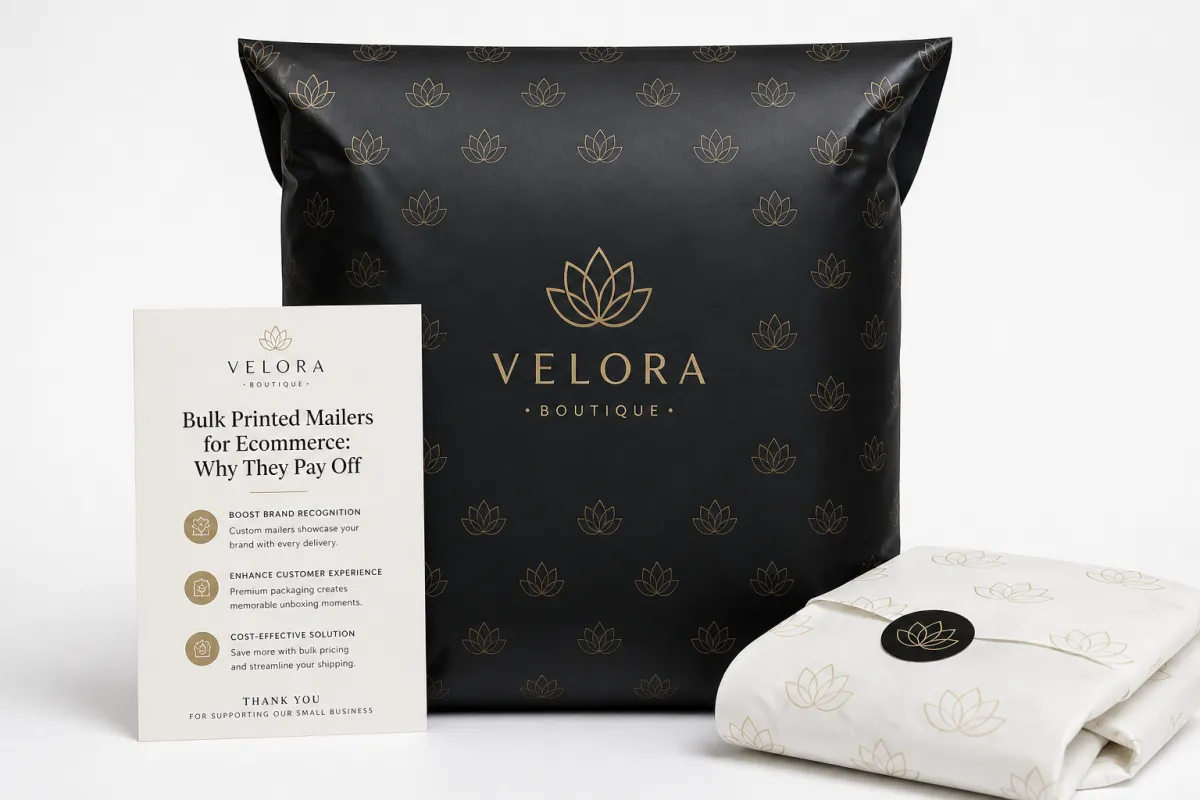
Bulk printed mailers for ecommerce earn their place by turning a routine shipping expense into a repeatable brand asset. A plain poly bag protects the product. A printed one protects the product and does some quiet marketing work on the table, in the bin, and at the doorstep. That can feel minor until order volume starts climbing. At a few hundred shipments, branding is a nice touch. At a few thousand, it becomes part of the customer’s first physical contact with the brand. The mailer is not trying to replace a full unboxing experience, but it does establish a tone before the package is even opened.
In day-to-day operations, bulk printed mailers for ecommerce also cut down on reorder friction. When the artwork, size, and stock are already locked in, the team does not need to scramble for emergency packaging every time inventory spikes. Delays in packaging usually show up later as delays in fulfillment, and that kind of delay rarely stays small. A brand that ships on time usually buys packaging on time. Not glamorous, but true. The other benefit is consistency. Mixed plain and printed stock creates a patchwork look at the packing table that makes a warehouse feel more improvised than it should.
Bulk printed mailers for ecommerce work especially well for brands that live on speed and repeat order flow: apparel labels, beauty kits, accessory sellers, subscription boxes, and promotional packs. These categories usually do not need rigid structural protection, yet they still need packaging that is light, moisture resistant, and strong enough to survive sorting, stacking, and courier handling. If the product already sits in a retail-ready pouch or carton, the mailer just adds a clean outer shell around it. That is where margin often hides. Extra material belongs on products that actually need extra material.
The return shows up in three places. The unit cost drops as the order grows. Packing moves faster because the mailer is light and easy to seal. The appearance stays consistent across SKUs, which is harder to maintain with a mix of box sizes. Bulk printed mailers for ecommerce do not fix a weak fulfillment process, but they do remove a lot of unnecessary drag from the system. If your current packaging adds time, weight, or brand inconsistency, this is one of the easiest places to tighten the operation without turning the pack line into a puzzle.
A mailer that looks great and splits on the conveyor is just expensive confetti.
Product Details That Matter
Bulk printed mailers for ecommerce come in a few main constructions, and the right choice depends on the product, the shipping lane, and the experience you want the customer to have. Poly mailers are usually the lowest-cost option and the most moisture resistant. Kraft mailers bring a more paper-forward, natural look. Padded mailers add cushioning for lighter items that still need a bit of shock protection. That split sounds simple, but a surprising number of buyers still choose by appearance first and fit second. The result is predictable: attractive packaging that does not match the real shipment.
Structure matters as much as the face print. The closure has to hold under repeated handling, not just during the first press at the packing table. Tear resistance matters when parcels get dragged, tossed, or compressed in transit. Print placement matters because a logo too close to a seam can distort after the package is sealed. Bulk printed mailers for ecommerce should also be checked for how they behave once filled. If the mailer balloons or wrinkles badly around the product, the print can look cheap even when the artwork is strong. Visual appeal and practical performance should work together, not compete for attention.
Real brand value comes from cutting out unnecessary steps. Bulk printed mailers for ecommerce can remove the need for separate outer labels, decorative sleeves, or heavy inserts in simple order types. That helps brands shipping repeat purchases or low-fragility goods. The mailer already carries identity. Customers do not need three layers of packaging to understand who sent the order. For many ecommerce sellers, the smartest package is the one that looks intentional without adding labor, extra material, or another item on the shelf that has to be managed.
Soft, light, and non-fragile products usually make the case for bulk printed mailers for ecommerce very quickly. Sharp edges, glass, liquid risk, and premium display expectations still point some products toward boxes. That is not a failure of mailers; it is a reminder that the package has to match the job. Packaging teams get into trouble when they try to force one format to do everything. It never does. The better approach is to define the shipping job first, then select the package that gets the work done with the least waste and the fewest surprises.
Bulk Printed Mailers for Ecommerce: Specifications to Check Before Ordering
Start with material before you start with print. Bulk printed mailers for ecommerce often use LDPE or PE film for poly builds because the material is cost effective, moisture resistant, and easy to print. A common strength range sits around 1.5 to 3 mil, with 2 mil serving as a familiar middle ground for apparel and other soft goods. Kraft paper mailers appeal to brands that want a more natural presentation, usually in the 60 to 100 GSM range depending on the construction. Padded mailers sit between those two worlds, adding cushioning without turning the package into a full carton. The stock should match the product and the handling conditions, not the mood board.
Size deserves more attention than it usually gets. Bulk printed mailers for ecommerce need to fit the finished item plus any insert, fold, or retail pouch without forcing the seal to work too hard. Check the finished dimensions, seal width, gusset needs, and total thickness once the product is inside. A mailer that is too tight can stress the seam and make the print look uneven. A mailer that is too large wastes film and freight. The best fit usually leaves just enough room for loading without making the product drift around like it packed for a move it did not ask for.
Print specifications are where buyers either keep costs under control or pay more than they meant to. Bulk printed mailers for ecommerce can be produced with one-color printing, multi-color printing, or full CMYK graphics. Outside-only print is the most common and the least expensive. Inside print adds a nice surprise for the customer, but it also adds cost and production complexity. Pantone matching matters when brand color accuracy cannot drift, while CMYK is often enough for detailed artwork or smaller production runs. Quote comparisons only mean something when the print area, number of colors, and coverage are identical. A cheaper quote with half the artwork is not a real comparison.
Performance details matter even when the artwork looks polished. Bulk printed mailers for ecommerce should have a closure that holds under pressure, a surface that resists scuffing, and enough puncture resistance for the route the package will travel. If the mailer needs tamper evidence, a tear strip, or stronger opacity, ask for it before production starts. For paper-based options, FSC chain-of-custody matters if your brand makes sourcing claims; FSC explains the certification clearly. For packaging performance and transit testing, resources from packaging.org help when you want information beyond a sales pitch. In my experience, the specs that get glossed over in the first quote are usually the specs that cause the loudest problems later.
- Film thickness: Typical poly mailers run about 1.5 to 3 mil, depending on product weight and handling risk.
- Paper stock: Kraft options usually fall in the 60 to 100 GSM range for common ecommerce use.
- Seal width: A wider seal improves closure confidence, especially on heavier soft goods.
- Print coverage: Full-coverage graphics raise cost faster than one-color logos.
- Compliance: Ask about recycling claims, adhesive type, and transit test data before approving production.
Bulk Printed Mailers for Ecommerce: Pricing, MOQ, and Cost Drivers
Pricing for bulk printed mailers for ecommerce depends on more than the substrate. Material type, size, number of colors, print coverage, finish, order volume, and freight all shape the final number. Poly film usually costs less than kraft or padded builds. Larger sizes use more raw material and cost more to move. Full-wrap printing takes longer to run and consumes more ink or setup time. Fancy finishes can look appealing, but they also add cost that many brands never recover. A lot of buyers request a quote, then act surprised when the price changes after they share the real artwork. That is not the supplier being difficult. That is manufacturing doing exactly what manufacturing does.
Minimum order quantity depends on the production method. For bulk printed mailers for ecommerce, digitally printed runs often begin around 500 to 1,000 units, which makes them a good fit for smaller launches or product tests. Traditional production methods, especially when plate or setup costs are involved, usually start making more sense at 2,500 units and up. Higher volumes push the per-piece cost down because the setup cost gets spread across more units. Storage is the tradeoff. Cheap packaging is not cheap if it sits in the corner for half a year because the order was sized on hope instead of demand. Cash flow and warehouse space count as real costs, even if they do not appear first on the quote.
| Mailer Type | Best For | Typical MOQ | Typical Unit Cost at 5,000 | Notes |
|---|---|---|---|---|
| Poly mailers | Apparel, accessories, lightweight soft goods | 500-1,000 digitally; 2,500+ for larger print runs | $0.16-$0.34 | Lowest cost, strong moisture resistance, fast pack-out |
| Kraft mailers | Natural-looking brands, paper-forward presentation | 500-1,000 digitally; 2,500+ for economical production | $0.22-$0.48 | Good shelf appeal, slightly higher material and print cost |
| Padded mailers | Light items that need extra cushioning | 1,000-2,500 depending on construction | $0.30-$0.65 | More protection, more material, usually the priciest of the three |
Quoted pricing should always be judged by landed cost per unit rather than factory price alone. Freight changes the math. So do print coverage, seal quality, and thickness. A quote that looks 8% lower on paper can become more expensive once shipping is added or once the film turns out to be thinner than spec. If one offer seems unusually cheap, check whether the supplier quietly reduced the size, trimmed the print area, switched to lighter stock, or padded the timeline with a slower shipping method. Buyers sometimes celebrate the smallest number on the page and pay for that mistake later in reorders, returns, or a fulfillment team that never quite warms up to the packaging.
A simple rule helps keep the comparison honest: ask for at least three quantity tiers and see what happens to the unit price at each one. Bulk printed mailers for ecommerce often show the biggest savings between the first and second volume break. After that, the curve usually flattens. That matters because it tells you whether ordering extra stock is a smart move or just a way to fill valuable warehouse space with optimism. If the order is tied to a launch or seasonal push, let demand shape the quantity, not wishful thinking. Wishful thinking does not pay for storage.
Process and Timeline
The buying process for bulk printed mailers for ecommerce should begin with the details that actually affect pricing and fit: finished size, material, quantity, artwork files, print colors, target ship date, and destination. Vague requests produce vague quotes. That wastes time for both sides. A clear specification gives the supplier enough information to price the correct build and catch problems early. It also helps to know whether the design is a one-color logo, a full-color graphic, or a simple brand mark. The closer the brief feels to a real order, the less likely the quote will fall apart later in the process.
Proofing is one of the most common places where delays start, so it should sit inside the timeline rather than outside it. For bulk printed mailers for ecommerce, the usual sequence is a dieline or digital proof first, followed by a check of the logo placement, print colors, seam zones, and any copy near the edges. One to three business days for proofing is common when the artwork is ready. Revisions add time. That is normal. What creates trouble is pushing production forward before the proof has been reviewed carefully. That is how a box of mailers ends up technically correct and still wrong in the hand.
Production often takes 10 to 20 business days after proof approval, depending on the print method, volume, and finish. Freight sits on top of that. Sea shipping, domestic trucking, and expedited air all behave differently, and the right choice depends on budget and urgency. Bulk printed mailers for ecommerce tied to launches or subscription cycles should be ordered early enough to hold safety stock. If timing gets tight, a small reorder cushion is still better than hoping for a miracle after the warehouse has already committed to the next wave of orders.
Delay points deserve attention. Artwork revisions, custom coatings, material shortages, and seasonal demand can stretch a normal schedule quickly. Bulk printed mailers for ecommerce also move more slowly when the spec is unusual, since every unusual requirement adds coordination. The planning rule is simple: if the mailers are tied to a launch, place the order before the launch schedule turns into a hard deadline. That sounds obvious, yet it is where a lot of brands stumble. The campaign gets weeks of planning and the packaging gets a separate calendar, which is usually a bad sign.
- Send a complete brief: Size, quantity, print colors, finish, and shipping destination.
- Review the proof: Check seam placement, color callouts, and artwork scale before approval.
- Confirm production timing: Ask for the build window and freight estimate together.
- Keep a safety buffer: Order early enough to avoid emergency freight or stock gaps.
Why Choose Us for Bulk Printed Mailers
Working with a packaging partner that understands bulk printed mailers for ecommerce means you get more than a quote and a shipping estimate. You get help matching the package format to the fulfillment process. That matters because ecommerce packaging has to move fast, stack neatly, stay consistent, and survive transit without drama. A supplier that only talks about decoration may miss the operational part entirely. A supplier that handles volume orders usually asks the questions that matter first: how the mailers will be packed, whether the product is fragile, what the launch date looks like, and how much storage space the warehouse can actually spare. Those questions save money. Decorative language does not.
The most useful support is practical. For bulk printed mailers for ecommerce, that usually means quote comparisons, artwork checks, sample approval, material guidance, and reorder consistency. A buyer should not have to guess whether the seal is strong enough or whether the color will stay steady on the next production run. It also helps when the supplier can explain the tradeoff between lower cost and stronger performance without pretending every option is equally good. They are not. Some options are simply safer, cleaner, and easier to ship at scale. Pretending otherwise is how people end up buying the same packaging twice.
There is value in working with a team that also handles broader packaging programs. If you need more than mailers, start with our Custom Packaging Products page, compare options against Custom Poly Mailers, and review our Wholesale Programs if you are buying across product lines. That makes it easier to align mailers, cartons, and inserts without treating every order like its own little research project. Bulk printed mailers for ecommerce work best when they fit inside a larger packaging system, not when they are treated as a last-minute add-on.
Honesty matters here. Bulk printed mailers for ecommerce are not the right answer in every scenario, and the cheapest supplier is rarely the best one. What usually wins is the mix of usable material, dependable print quality, consistent sizing, and reliable availability when order volume jumps. A mailer that looks good but scuffs easily, tears at the seam, or arrives late is a poor purchase wearing a savings costume. Packaging buyers usually learn that the hard way. Better to be direct before the freight bill shows up.
Next Steps for Your First Bulk Order
Before requesting a quote for bulk printed mailers for ecommerce, gather the information that actually affects pricing and fit: finished product dimensions, estimated monthly ship volume, target quantity tiers, artwork files, print colors, material preference, and shipping destination. If the artwork is still in progress, send the cleanest draft you have and call out the missing pieces clearly. That lets the quoting team work from reality instead of guessing. The more exact the input, the cleaner the quote. Packaging quotes are calculations, not magic tricks, and better inputs usually mean fewer surprises later.
A useful comparison set includes at least two or three volume levels. For bulk printed mailers for ecommerce, that shows where the price drops and whether the storage burden starts to feel annoying. A lot of buyers only ask for one quantity, then wonder why they missed a better break. Ask for a small run, a mid run, and the next meaningful step up. That gives you a clearer view of cash outlay, unit cost, and warehouse space in one place. It is a much better way to buy than picking a volume because it feels comfortable.
If the design is going into a new product line or a new fulfillment center, request a sample or short test run before committing to a large order. Bulk printed mailers for ecommerce can look perfect in a render and still behave differently once real product weight, seal pressure, and courier handling enter the picture. A small test reveals fit issues, print issues, and handling friction before they become expensive inventory. That is not hesitation. It is careful buying. Brands that do this well usually spend less over time because they avoid awkward reorders and slow-moving stock.
Bulk printed mailers for ecommerce work best when the order is planned like an operating tool, not a decorative extra. Send the specs, ask for tiered pricing, compare the landed cost, and check the sample before locking the full run. That is the shortest route to packaging that supports the business instead of sitting on a shelf looking polished. Simple, steady, and practical. If you are ordering this quarter, lock the size, material, and print coverage first; everything else gets easier once those three decisions are set.
Frequently Asked Questions
What is the minimum order for bulk printed mailers for ecommerce?
Minimums vary by material and print method, but bulk printed mailers for ecommerce often start around 500 to 1,000 units for digitally printed runs. Higher-volume production methods usually need a larger order to spread setup costs efficiently. If you are testing a new design, ask for tiered pricing so you can see where the break-even point lands before you commit.
Are bulk printed mailers for ecommerce cheaper than custom boxes?
Usually yes for light, non-fragile goods. Bulk printed mailers for ecommerce use less material, pack faster, and typically ship with lower dimensional weight than cartons. Boxes still win when the product needs more protection, structure, or a premium unboxing with inserts. The right comparison is total landed cost, not just packaging price.
Which material should I choose for bulk printed mailers for ecommerce?
Choose poly if you want the lowest cost and strong moisture resistance. Choose kraft paper if your brand wants a more natural look and the product does not need plastic-level protection. Choose padded mailers when the item is light but still needs extra cushioning. Bulk printed mailers for ecommerce work best when the material matches the actual shipping risk, not just the design board.
How long do custom printed mailers take to produce?
Proofing usually takes 1 to 3 business days if your artwork is ready. Standard production often takes 10 to 20 business days after approval, depending on the print method and quantity. Then add shipping time. Bulk printed mailers for ecommerce should be ordered with enough buffer to handle revision cycles, freight timing, and peak-season demand.
What do you need for a quote on bulk printed mailers for ecommerce?
Provide finished size, estimated quantity, print colors, material preference, and shipping destination. Send vector artwork if you have it, plus any Pantone references or brand color notes. If the design is not final, a draft file is still useful as long as you label the missing details. For bulk printed mailers for ecommerce, better input means a better quote, and a better quote usually means fewer headaches later.


