Buyer Fit Snapshot
| Best fit | Poly Mailers for Ecommerce Brands projects where brand print, material claims, artwork control, MOQ, and repeat-order consistency need to be specified before quoting. |
|---|---|
| Quote inputs | Share finished size, material target, print colors, finish, packing count, annual reorder estimate, ship-to region, and any compliance wording. |
| Proofing check | Approve dieline scale, logo placement, barcode or warning zones, color tolerance, closure strength, and carton packing before bulk production. |
| Main risk | Vague material claims, crowded artwork, missing packing details, or unclear freight terms can make a low unit price expensive after revisions. |
Fast answer: Poly Mailers for Ecommerce Brands: Film, Print, MOQ, and Carton Packing should be specified like a repeatable production item. The safest quote records material, print method, finish, artwork proof, packing count, and reorder notes in one written spec.
Production checks before approval
Compare the actual filled-product size with the drawing, then confirm tolerance on folds, seals, hang holes, label areas, and retail display edges. Reserve space for logos, QR codes, warning copy, and material claims before decorative graphics fill the panel.
Quote comparison points
Review material grade, print process, finish, sampling route, tooling charges, carton quantity, and freight assumptions side by side. A quote is only useful when the supplier can repeat the same color, closure quality, and packing count on the next order.
Poly Mailers for Ecommerce Brands: Smart Shipping Guide
A lot of brands obsess over the box and forget the bag. For soft goods and flat items, poly mailers for ecommerce brands usually decide the real shipping cost, the speed at the packing table, and the first impression your customer gets before they even touch the product. If you ship tees, socks, swimwear, accessories, or small beauty items, the difference between a padded carton and a well-chosen mailer shows up fast in carrier bills, labor minutes, and how the parcel moves through the sortation network.
Poly mailers for ecommerce brands deserve more attention than they usually get. The right bag protects against moisture, dirt, and scuffing while staying light enough to avoid extra dimensional weight. The wrong one wrinkles product, splits at the seal, or makes the brand feel rushed before the customer even opens the parcel. That is a bad trade. Simple as that.
And yes, the bag can be boring. That does not make it unimportant. I have seen brands pour weeks into the outer box and then ship their best-selling tee in a flimsy mailer that feels like it was chosen in a hurry. Customers notice. Fulfillment teams notice first.
What Poly Mailers for Ecommerce Brands Actually Do
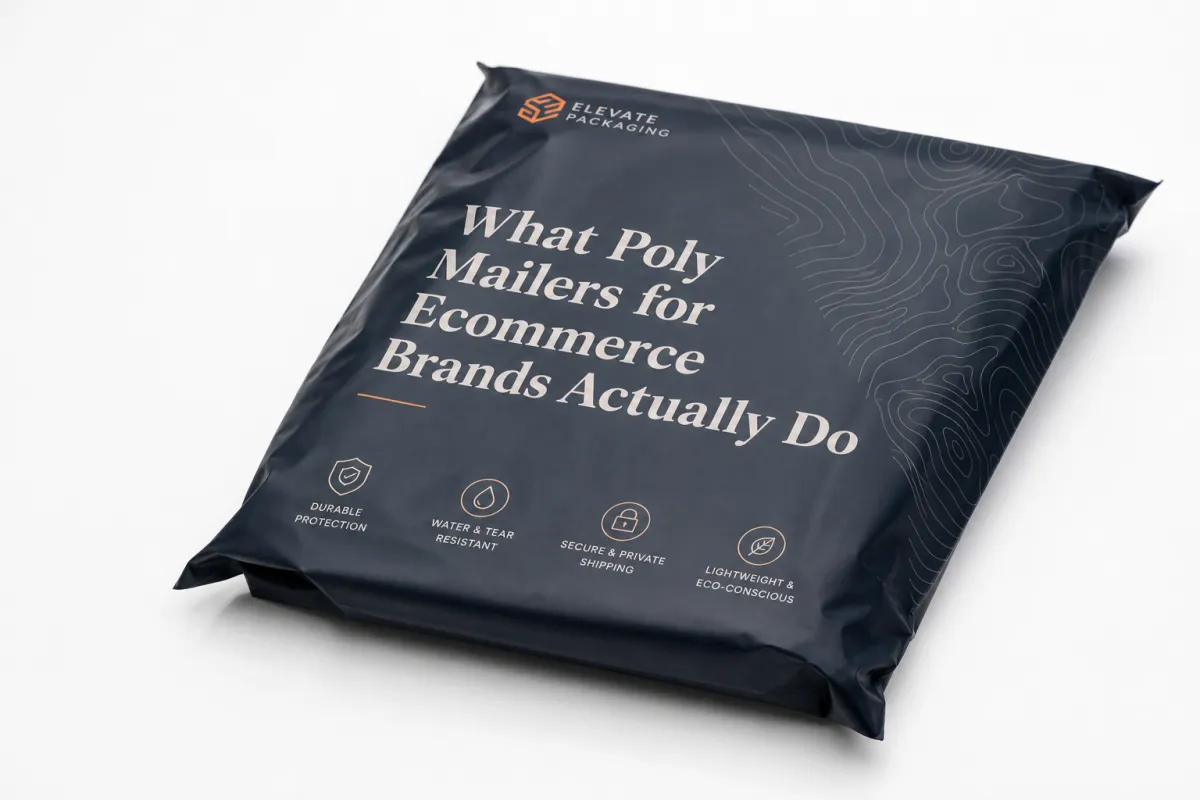
Poly mailers for ecommerce brands are lightweight shipping pouches made from plastic film, usually polyethylene or a co-extruded blend built for parcel movement. In plain English, they let a soft item travel with as little extra weight and bulk as possible while still staying protected from everyday shipping mess. That is why they show up so often in apparel, accessories, and low-fragility ecommerce programs.
For a lot of small items, the mailer matters more than the box ever will. Every ounce and every inch can change the carrier bill. A carton may look sturdier, but it adds board weight, air space, and more room for dimensional weight charges. By contrast, poly mailers for ecommerce brands keep the shipment flat, which usually means faster packing and fewer surprises on the invoice.
They work best for products that can tolerate a little flex in transit:
- Apparel like tees, leggings, loungewear, swimwear, and soft outerwear
- Socks, undergarments, and other small textile goods
- Accessories like hats, scarves, belts, and similar low-crush-risk products
- Beauty samples, flat kits, and promotional inserts
- Printed inserts, brochures, or bundles that do not need rigid edge protection
They are not the answer for everything. Breakables, rigid cosmetic jars, products with sharp corners, and anything that needs serious crush resistance usually belongs in a carton with proper cushioning. If the item can be damaged by bending, compression, or puncture, poly mailers for ecommerce brands may still work as an outer layer, but rarely as the only layer.
The real question is pretty simple: does the product need a hard shell, or does it need a clean, secure, moisture-resistant envelope? If it is the second category, poly mailers for ecommerce brands often make sense right away. If the answer is fuzzy, test both a mailer and a carton on the same SKU and compare damage, pack time, and shipping cost. Guessing is how brands waste money while feeling clever about it.
A mailer that saves two cents but adds thirty seconds at pack-out is usually not the cheaper option once labor and rework are counted.
If you are still mapping out the rest of the shipping lineup, it helps to compare the mailer choice against other Custom Packaging Products so your shipping system works as one unit instead of a pile of disconnected parts.
How Poly Mailers for Ecommerce Brands Work in the Shipping Flow
The shipping flow is where poly mailers for ecommerce brands earn their keep. A picker pulls the item, a packer folds or stacks it, the product slides into the mailer, the adhesive strip closes, and the label goes on a flat, easy-to-handle parcel. Nothing dramatic. Just fewer steps than building a carton, taping seams, filling voids, and wrestling a heavier package off the table.
The biggest operational win is touch reduction. A carton usually needs bottom tape, top tape, maybe a void-fill decision, and sometimes a second pass if the size feels off. With poly mailers for ecommerce brands, the packer can often finish the order in one motion. That matters if your operation is pushing hundreds or thousands of small orders a day. Ten saved seconds per order adds up fast. Labor has a way of doing that.
The protection is modest, but useful. The film resists light moisture and grime, and the seal keeps the parcel closed while it moves through the carrier network. A good mailer has enough stiffness to avoid feeling flimsy, but enough flexibility to conform to the product without wasting space. That flat profile helps parcels stack neatly in gaylords, sort bins, and delivery bags, which is one reason carriers tend to move them efficiently.
Dimensional weight is another reason these mailers matter. Carriers often price parcels by whichever is greater, actual weight or dimensional weight, and extra dead air can create a bill that feels wildly out of proportion to the product inside. A flatter shipment built from poly mailers for ecommerce brands usually gives you a better shot at staying in a favorable rate tier, especially for lightweight goods that do not deserve a box.
Branded mailers also shape the unboxing experience without adding much labor. A clean logo, a consistent color, or a sharp print pattern can turn a plain shipping envelope into something that feels intentional. That does not mean the packaging should yell for attention. It means the mailer can carry enough identity to look thought through while still doing the practical job of moving product quickly.
For teams that want a transit benchmark, the ISTA testing standards are a solid reference point. A simple pilot can borrow from that mindset: close the mailer, label it, stack it, shake it, drop it from a modest height, and watch how the seal, seams, and printed surface behave. The point is not perfect simulation. The point is to catch weak spots before customers do.
Poly mailers for ecommerce brands also fit easily into a clean receiving and replenishment routine. They store flat, take up little shelf space, and can often be counted in bundles instead of bulky cartons. That is a relief for smaller fulfillment areas where floor space is already tight and every square foot needs to pull its weight.
That part gets overlooked because packaging teams tend to think in outputs, not handling time. But when a box arrives bulky, it eats room before it ever touches a product. A flat stack of mailers does not. That difference can save a tiny warehouse from becoming a cluttered mess by week three.
Cost and Pricing Factors for Poly Mailers for Ecommerce Brands
The cost picture for poly mailers for ecommerce brands is bigger than the piece price on a quote. Film thickness, finished size, closure type, print coverage, number of colors, opacity, and whether the bag is stock or custom all change what you pay. A thicker film with a stronger seal and a large custom print area will cost more than a plain stock mailer. The real question is whether that extra cost lowers total shipping expense or just makes the invoice prettier.
Unit price changes with order volume too. A 1,000-piece run and a 10,000-piece run are rarely priced the same way because setup, film conversion, and print prep are spread across more or fewer units. Landed cost matters more. That includes freight, warehousing space, handling, spoilage, and the cost of a damaged parcel or replacement shipment. For growing brands, those hidden pieces usually matter more than a few cents on the unit.
Here is a practical comparison buyers often use when they evaluate poly mailers for ecommerce brands against other shipping formats:
| Option | Typical Use | Approx. Unit Cost at 5,000 pcs | Strengths | Watchouts |
|---|---|---|---|---|
| Stock clear or white poly mailer | Basic apparel and soft goods | $0.10-$0.18 | Lowest cost, fast to source, simple packing | Minimal branding, limited differentiation |
| Custom printed poly mailer | Branded ecommerce shipments | $0.16-$0.32 | Brand visibility, stronger presentation, consistent unboxing | Artwork setup, lead time, higher minimums |
| Premium gauge custom mailer | Heavier soft goods or higher damage risk | $0.22-$0.40 | Better puncture resistance and seal confidence | Higher cost and potentially more material use |
| Paper padded mailer | Low-fragility items with paper-based branding goals | $0.18-$0.35 | Paper feel, familiar consumer perception | More bulk, usually higher shipping cost than flat film |
These are not universal numbers. They are the kind of ranges a buyer might use as a working benchmark for planning. Actual pricing depends on dimensions, print area, material gauge, and freight lane. Still, the pattern is hard to miss: poly mailers for ecommerce brands often win on total economics even when the decorated version costs more than the plain one.
The trick is to compare the mailer against the full shipping equation, not just the purchase price. If a box costs less per unit but adds more postage, more labor, and more shelf space, it may end up being the expensive choice. That is why experienced teams track a target cost per shipped order instead of a target mailer price alone. A mailer that costs $0.08 more but saves $0.30 in freight and 12 seconds of labor is usually a good trade.
For brands scaling fast, I like a simple budget model with three numbers: unit cost, average freight impact, and damage or replacement allowance. Put those side by side and the answer gets a lot clearer. In many programs, poly mailers for ecommerce brands are not the cheapest packaging item in the room, but they are the item that lowers the overall cost of shipping the order.
If you need a place to compare mailer formats and build a packaging lineup, the dedicated Custom Poly Mailers page is a useful starting point, especially if you are trying to line up size, print, and finish before requesting quotes.
For sustainability-minded sourcing, ask for recycled-content documentation, note whether the material is part of a store collection program, and avoid vague recycling claims. The EPA’s guidance on plastic film recovery is useful background here: EPA recycling guidance. Check what your local market actually accepts, because film recycling is messy and not every community handles it the same way.
One more practical note: poly mailers for ecommerce brands can look inexpensive at first glance, but the budget changes quickly if the bag is undersized and creates rework, or if the print is too light and needs a second pass. Those are the details that separate a clean run from a frustrating one.
The cheapest quote is not always the cheapest outcome. That sounds obvious, but teams still get trapped by it. A bag that saves a fraction of a cent and causes packing headaches is not a win. It is just a small problem wearing a discount tag.
Step-by-Step Process and Timeline for Launching Poly Mailers for Ecommerce Brands
The cleanest way to launch poly mailers for ecommerce brands is to start with a requirements audit. Measure your top SKUs in their packed state, not just flat on a table. That means folds, inner wraps, tissue, inserts, and anything else the item carries during shipment. A product that is 10 inches wide flat may behave more like 11.5 or 12 inches once it is bagged. That difference matters when you choose the finished mailer size.
Next, split the products that truly belong in a mailer from the ones that do not. Soft goods with little crush sensitivity are obvious candidates, but items with sharp hardware, rigid containers, or delicate finishes may need another format. This is also the stage where a team decides whether poly mailers for ecommerce brands are being used for one hero SKU or for a wider assortment of shipments.
- Review your top-selling SKUs and their actual packed dimensions.
- Identify the items that can ship flat without extra void fill.
- Choose one or two candidate mailer sizes, not five.
- Prepare artwork or branding elements with edge-safe placement.
- Request physical samples and test closure, feel, and opacity.
- Run a pilot with real packing staff and real order flow.
- Refine your packing standard before placing the full order.
A realistic timeline usually moves in stages. Size selection and artwork setup may take a few days if approvals are quick. Proofing and sampling often add another week, especially if you want to compare two film gauges or two print layouts. Once the sample is approved, production and transit can take a few more weeks depending on the sourcing lane. For many buyers, a simple custom run lands in roughly 3-5 weeks from proof approval to receipt, though custom film, special finishes, or freight delays can push that longer.
Sampling deserves more respect than it usually gets. A screen preview cannot tell you how slick the bag feels, whether the adhesive strip stays closed under pressure, or whether the print looks too dark on the chosen film. A physical sample tells you if the mailer feels premium, flimsy, or just right. It also shows whether poly mailers for ecommerce brands are going to help packers move quickly or slow them down with awkward handling.
That sample review should include a few practical checks:
- Open and close the seal several times to test closure reliability
- Rub the printed surface to see if the ink scuffs or scratches
- Pack the most common SKU and judge the fit from a packer’s angle
- Stack 10 to 20 finished parcels and see whether they stay stable
- Run a short transit test using the same route your orders actually take
For transit testing, I prefer a small pilot that borrows from common ISTA thinking rather than a purely visual review. The goal is to watch what happens when the parcel gets compressed, dropped, or handled repeatedly. If you want a deeper test framework later, compare the bag’s performance against standard procedures at the ISTA organization. Even a light version of that mindset catches weak seams and weak seals before scale magnifies the problem.
After the pilot, adjust the packing instructions. Maybe the product needs a folded insert to keep the silhouette clean. Maybe the bag size is correct but the stock count at the station is too small. Maybe the team needs a better sequence for applying labels so the adhesive area stays flat. These little changes matter, because poly mailers for ecommerce brands reward consistency. A mailer that works beautifully in one station can turn into a mess in a rushed line if the process is not written down.
And honestly, the process is usually where brands either win or waste time. The material itself is only half the story. The other half is whether your team can use it without improvising every ten minutes.
Key Factors to Compare Before You Buy Poly Mailers for Ecommerce Brands
Before You Buy poly mailers for ecommerce brands, compare the dimensions carefully. The right mailer should fit the product without so much slack that the parcel slides around, but it also should not be so tight that the seal is under stress. An overstuffed mailer wrinkles the product and looks rushed. An oversized one feels loose and can create a sloppy presentation. Good sizing is a balance between fit, appearance, and packing speed.
Thickness is the next variable. Film gauge, usually described in mils or microns depending on the market, affects puncture resistance, seam behavior, and how confident the package feels in hand. Thicker is not automatically better. A film that is too heavy for the product may add unnecessary cost and stiffness, while a film that is too light may split at the edge seam or tear near a corner. The better question is whether the gauge matches the product profile and the carrier path.
Do not look at seal quality in isolation. A strong film still needs a dependable closure system, and a dependable closure still needs a well-made seam. Tear resistance, adhesive strength, and opacity work together. If the seal is weak, the best film in the world will not save the shipment. If the film is strong but the print area is poorly planned, the package can still feel cheap. That is why poly mailers for ecommerce brands should be evaluated as a system, not as one line item on a quote sheet.
Printing and surface finish deserve their own conversation. A simple one-color logo can look sharp on a matte white bag, while a more premium pattern may need deeper ink coverage or a different finish to hold detail. Too much ink on a low-grade film can make the print look muddy. Too little contrast can make the branding disappear. The visual approach should support the brand story without turning the mailer into a design science project.
- Fit: enough room for a clean seal without excess movement
- Film: gauge, puncture resistance, and overall hand feel
- Closure: adhesive quality, strip width, and seal confidence
- Print: color count, edge safety, and logo legibility
- Finish: gloss, matte, or satin appearance
- Documentation: material claims and recycled-content evidence
If sustainability matters to your audience, ask for clear documentation rather than broad claims. Some poly mailers for ecommerce brands use recycled content, and some are designed to support store collection programs for clean film. That is a useful conversation, but it should be precise. Customers can tell the difference between a packaging team that understands the material stream and one that is just repeating vague eco language.
There is also a sourcing angle here. If your broader packaging line includes cartons, tissue, labels, or inserts, the whole system should feel coherent. A shipping bag with a polished print and a mismatched insert can look less refined than a simpler package with everything aligned. That is why teams often review Case Studies to see how other brands balanced protection, speed, and presentation across the full order experience.
One practical rule I use often: if two mailers look similar on paper, order samples and force the decision with your hands. Poly mailers for ecommerce brands reveal a lot through touch, especially when one bag opens cleanly and another clings, wrinkles, or feels too soft for confidence. The right physical feel can save you from a quote that looked fine but behaved poorly in the packing room.
If a sample makes your packers hesitate, pay attention. Hesitation is data. A bag that slows down one person will usually slow down everyone once the order line gets busy.
Common Mistakes Ecommerce Brands Make with Poly Mailers
The most common mistake with poly mailers for ecommerce brands is undersizing. A bag that is too small forces the product to bend too sharply, stresses the seam, and makes the finished parcel look overstuffed. Even if the shipping label sticks fine, the package can arrive looking like it was forced into place. That is not the impression most brands want to send, especially if they are trying to look careful and considered.
Another frequent error is buying the lowest-cost option without testing adhesive strength, puncture resistance, and print durability. A cheap bag can be fine for very light products, but price alone does not tell you how the film behaves after it is rubbed, stacked, dropped, or squeezed. A few samples and a short pilot save more money than a bad full run ever will. That is especially true for poly mailers for ecommerce brands moving through high-volume fulfillment.
Skipping transit testing is a risk I see a lot. A mailer may look excellent on the packing table and still fail once it is mixed into real carrier handling. Seams can creep, adhesive can loosen, and the surface can scuff under friction. A pilot should include real labels, real staff, and a few rough-handling checks. If the parcel survives your own station but not the sortation path, the design is not ready yet.
Artwork mistakes are another easy way to weaken the package. Logos placed too close to the edge can cut off on the trim line, and text that depends on delicate color contrast may disappear on a dark or reflective film. If the branding is not legible, the package loses one of its main jobs. Poly mailers for ecommerce brands should look intentional from three feet away and still be clear in a mailbox or on a doorstep.
- Choosing a size by guesswork instead of measured packed dimensions
- Ignoring seal quality because the film itself seems strong
- Using a print layout that is too busy for the film surface
- Forgetting to train packers on the exact bag and fold sequence
- Ordering in volume before the pilot confirms the fit and feel
There is also a documentation mistake that shows up more than people expect: vague sustainability claims with no backup. If a buyer asks whether a mailer contains recycled content or belongs in a store collection stream, the supplier should answer clearly. That does not mean every poly mailers for ecommerce brands program needs to be branded as eco-forward. It does mean the claims should be accurate and the instructions should match the material reality.
A final trap is treating all SKUs as if they need the same packaging. A broad catalog usually includes a few items that fit mailers beautifully and a few that do not. A smart program sorts those out instead of forcing one generic answer across every product. That is where the savings appear, because poly mailers for ecommerce brands work best as a focused solution for the right item group, not as a universal answer for every order.
There is a kind of laziness that hides behind standardization. One size for everything sounds efficient until the returns, repacks, and customer complaints show up. Then it is just expensive.
Actionable Next Steps for Poly Mailers for Ecommerce Brands
If you are ready to move, start by auditing your top-selling SKUs and separating the products that can ship safely in a mailer from the ones that need a box. Measure the products in their packed state, not just as loose items, and build a shortlist of two or three mailer sizes that match real order data. That step cuts out a lot of guesswork and gives poly mailers for ecommerce brands a much better shot at working on the first try.
Then request samples from at least two options. Test seal strength, scuff resistance, print clarity, and packing speed with the people who actually prepare orders. If the team feels rushed, the packaging will show it. If the bag is hard to open or the adhesive is awkward, someone will notice on the first busy day. It is better to catch those issues in sampling than in a live shipment window.
Compare landed cost, not only unit price, and set a reorder point that gives you enough lead time to avoid emergency purchases. A good program tracks inventory on hand, average weekly usage, and the number of business days needed for replenishment. That keeps the shipping line stable and reduces the pressure that leads to rushed decisions. For poly mailers for ecommerce brands, that kind of planning is often the difference between a smooth quarter and a scramble.
Document the packing standard. Write down which product goes into which mailer, whether an insert is required, where the seal should land, and how the label should be placed. Then review damage rates, customer feedback, and pack-out time after launch. Small changes matter. A slightly different fold can improve appearance. A different bag width can reduce seam stress. A stronger adhesive strip can remove a whole category of returns or repacks.
Here is a simple launch checklist you can use:
- Measure packed product dimensions for the top SKUs
- Choose candidate bag sizes with a clean seal margin
- Request physical samples and compare at least two films
- Run a short pilot with real packing staff
- Check transit performance using a few rough-handling tests
- Confirm print readability and edge-safe artwork placement
- Set reorder levels based on usage and lead time
For brands that want a more polished rollout, compare packaging components as a family rather than as separate purchases. The mailer, insert, label placement, and outer presentation should all support the same customer promise. If you need to broaden the mix, the broader line of Custom Packaging Products can help you keep that system consistent while still Choosing the Right format for each SKU.
At a practical level, poly mailers for ecommerce brands work best when they are treated as a working packaging tool, not a branding afterthought. That means measuring the SKU, sampling the bag, testing the seal, and checking the full cost of the shipped order. Do those four things and the decision gets much easier.
FAQ
Are Poly Mailers only for clothing brands?
No. Apparel is the obvious fit, but poly mailers for ecommerce brands also work well for flat beauty items, soft accessories, printed kits, and other low-crush products. If the item can be shipped without rigid edge protection, it is probably worth testing in a mailer.
Do poly mailers protect against water?
They resist light moisture and general grime, but they are not waterproof armor. If a parcel will face wet weather, rough handling, or extra transit exposure, consider the product itself and the seal quality together. A mailer helps. It does not make bad logistics disappear.
Are Custom Printed Mailers always worth it?
Not always. Custom print helps presentation and brand recall, but it only makes sense if the total shipping cost still works and the design is easy to produce. For smaller runs or early-stage brands, stock mailers can be the smarter move until volume justifies custom production.
Can poly mailers be recycled?
Sometimes, but recycling options depend on local collection programs and the actual film used. Ask for material documentation and do not assume curbside pickup accepts it. Film recycling is inconsistent, which is annoying, but that is the reality right now.
How do I know if I chose the right size?
The right size closes cleanly, keeps the product flat, and avoids forcing the seal. If the bag wrinkles the item or stretches at the edge, it is too small. If the shipment slides around or looks loose, it is too big. Sample both ends and pick the one that packs fastest without hurting the product.
The shortest path is the best one here: measure the packed SKU, request two mailer samples, run a small pilot with real staff, and pick the option that wins on fit, seal strength, and total shipped cost. That is the decision that actually matters for poly mailers for ecommerce brands.


