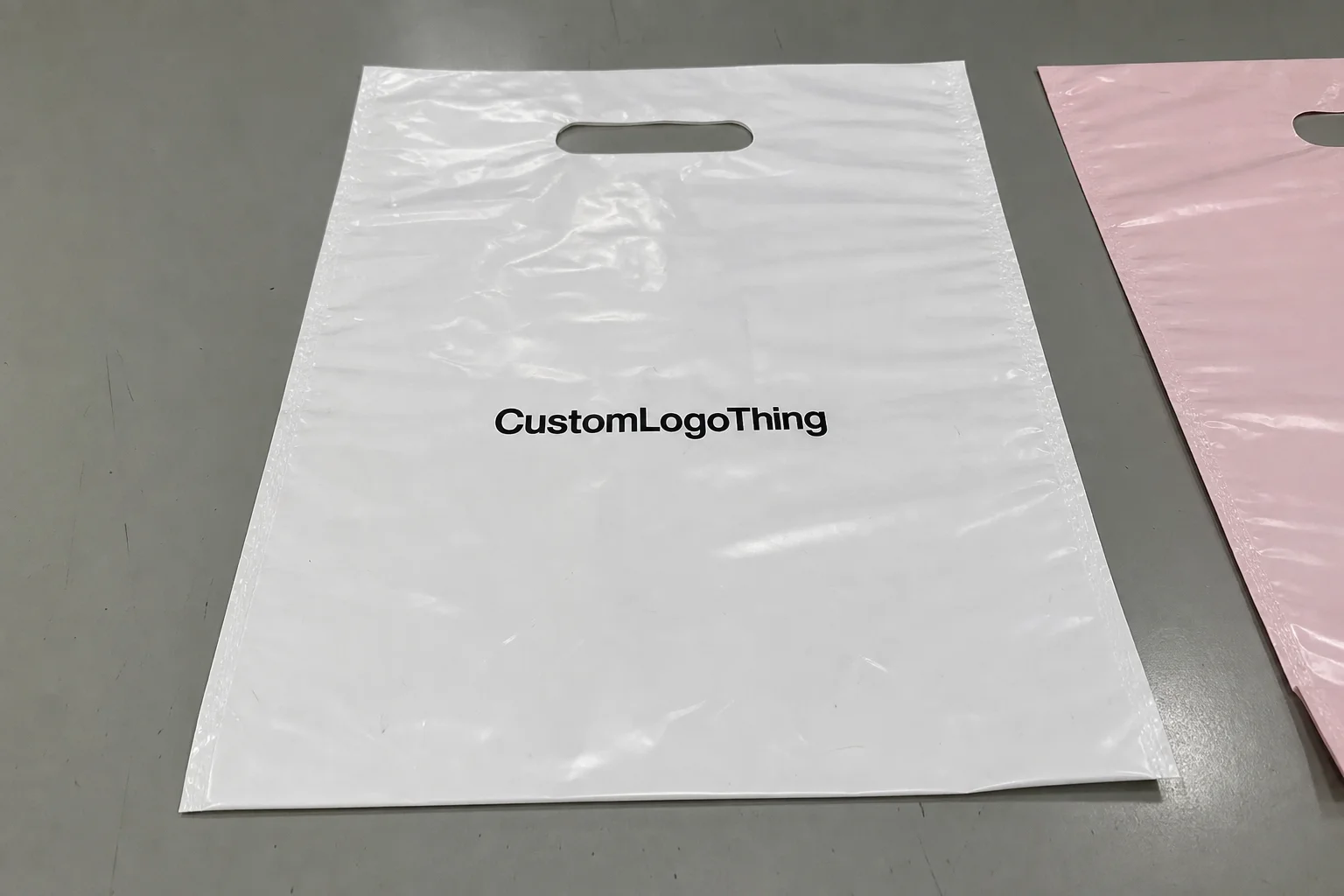
Buying Custom Plastic Bags wholesale is not just a unit-cost decision. The right bag affects load performance, print quality, storage, reorder timing, and how polished the purchase feels when it leaves the counter.
For retailers, pharmacies, bakeries, event teams, and brands already managing Custom Packaging Products, bags should be specified with the same discipline as labels, inserts, and cartons. The decisions that matter most are material, gauge, handle style, size, print method, case pack, and lead time.
This guide focuses on the buyer issues that change outcomes: specs, MOQ, cost drivers, decoration limits, production timing, and inspection points.
Custom Plastic Bags Wholesale Solves More Than Packaging

Bags are often treated like a last-minute commodity, but they create visible consequences. A clean, sturdy bag makes even a small purchase feel more intentional. A cloudy, weak bag with poor print does the opposite.
Common uses include:
- Retail carryout: apparel, cosmetics, books, shoes, gifts
- Trade shows and events: brochures, samples, handouts, merch kits
- Food-related secondary packaging: bakery boxes, sealed drinks, takeaway containers
- Product repackaging: accessories, spare parts, bundled items
- Healthcare and pharmacy: lightweight transport with store branding
- Seasonal promotions: pop-ups, limited runs, event-specific packaging
Bulk ordering usually improves unit cost, print consistency, and planning. Setup charges are spread over more pieces, color variation is easier to control within one run, and store teams are less likely to mix leftover bags from different vendors.
The bag also needs to match the rest of the packaging system. If your tissue, carton, and label look coordinated but the carry bag feels underbuilt, the final impression breaks quickly. Many brands roll bags into broader Wholesale Programs to keep quantities, lead times, and brand standards aligned.
Practical rule: if customers regularly leave with the bag visible, it is not just a supply item. It is branded packaging with real load requirements.
Custom Plastic Bags Wholesale: Choose the Right Bag Style, Material, and Print Method
Style should match both product weight and brand position.
Common bag types include:
- Die-cut handle bags: flat, economical, common for apparel and lighter retail items
- Patch handle bags: reinforced at the handle for heavier boxed purchases
- Soft loop handle bags: more premium feel, common in boutiques
- T-shirt bags: efficient, low-cost choice for grocery, convenience, and takeout
- Drawstring bags: useful for event kits and promotional use
- Zip lock bags: practical for parts, samples, kits, and internal organization
- Fold-over merchandise bags: fast packaging for small or flat retail goods
Material choices also change feel and performance:
- LDPE: softer feel, more flexible, often used for patch handle and higher-end retail bags
- HDPE: crisp feel, strong for its weight, common for t-shirt bags and economical carryout
- PP: useful where greater clarity is important
- Recycled-content films: available in some constructions, though print behavior and tear strength can vary
Gauge is where many cost cuts create problems. Typical retail carry bags often fall around 1.25 to 2.5 mil, depending on material and load. Soft loop boutique bags often run heavier. HDPE t-shirt bags can be thinner because the construction distributes weight differently.
Choose thickness for the heaviest realistic use, not the average sale. A folded shirt, a boxed candle, brochures, and glass skincare each stress the bag differently. Rigid corners increase puncture risk. Multiple items increase handle and seal stress.
Print method should fit both run size and artwork:
- Flexographic printing: common for larger runs and spot-color art
- Gravure or similar high-volume methods: stronger image quality and color consistency on big orders
- Digital or specialty short-run options: sometimes available, depending on construction
Film is less forgiving than paperboard. Fine lines can break, small reverse text can fill in, and gradients may print poorly unless the process supports them. Dark stock may also require a white underprint or higher-opacity ink to keep the logo readable.
Specifications That Actually Affect Performance and Brand Perception
If you want an accurate quote, send complete specs. At minimum, include:
- Width
- Gusset, if applicable
- Height
- Thickness or gauge
- Handle type
- Seal style
- Material
- Print colors
- One-side or two-side print
- Finish: gloss, matte, frosted, clear, opaque, or colored stock
Size planning starts with the product
Start with the largest item likely to go inside, then account for quantity and orientation. A jewelry box may fit a 6 x 9 inch bag. A folded shirt often needs something closer to 9 x 12 or 10 x 13 inches. Takeaway containers usually need more gusset depth. Shoe boxes and stacked cartons need a sturdier merchandise bag.
Also account for puncture points. Paperboard edges, clamshells, and bundled products stress film more than soft goods do. If customers often combine multiple boxed items in one bag, size and gauge need to reflect that.
Handles and seals are performance points
Many failures start at the handle. Die-cut handles are fine for lighter use, but heavier loads benefit from reinforcement. Patch handles distribute stress better. Soft loop handles improve comfort and presentation, but they also increase cost.
Seal quality matters just as much. A bag can look acceptable and still split if side seals or bottom seals are too weak for the contents. For boxed or rigid products, seal strength should be treated as a key inspection point.
Finish changes how the bag reads
Gloss tends to look brighter and more promotional. Matte can feel more refined but may show scuffs sooner. Frosted film is common in boutiques because it softens visibility without fully hiding the product. Clear works well for kits and accessories. Opaque color can strengthen branding but may change print contrast and cost.
Sustainability and compliance need precise language
Recycled content, downgauging, reusability, and recyclability are not the same claim. A bag may contain recycled resin and still not be accepted in local curbside programs. Some eco-positioned films also print differently or tear sooner than standard film.
The EPA recycling guidance is a useful baseline, but local rules govern what can be collected or distributed. If you print an environmental claim on the bag, it needs to match the actual material and the market where the bag will be used.
Compliance can also affect warning labels, food-contact confirmation, and local carryout-bag restrictions. For broader packaging-system testing, organizations such as ISTA may be relevant.
One operational tip: standardize where possible. Two or three core sizes usually work better than many near-duplicate SKUs, reducing storage issues and reorder mistakes.
Pricing, MOQ, and Unit Cost: What Moves the Quote Up or Down
Bag pricing mainly follows size, thickness, material, handle construction, print colors, print coverage, quantity, and freight. Larger dimensions use more resin. Heavier gauge uses more resin again. Reinforced handles and two-side print add cost.
Typical minimums depend on style and print method:
- Stock-size, one-color printed bags: often around 1,000 to 5,000 pieces
- Fully custom printed retail bags: commonly 5,000 to 10,000 or more
- Soft loop or patch handle bags: often higher because construction is more involved
- Specialty films or sizes: usually raise minimums
Typical market ranges:
| Bag Type | Typical Quantity | Common Print Level | Approx. Unit Range |
|---|---|---|---|
| HDPE t-shirt bag | 5,000-10,000 | 1-2 spot colors | $0.04-$0.10 each |
| Die-cut merchandise bag | 5,000 | 1-2 spot colors | $0.08-$0.18 each |
| Patch handle LDPE bag | 5,000 | 1-3 spot colors | $0.14-$0.28 each |
| Soft loop boutique bag | 3,000-5,000 | 2-4 colors | $0.22-$0.55 each |
| Zip lock custom print bag | 5,000+ | 1-4 colors | $0.06-$0.20 each |
These are broad estimates, not fixed quotes. Resin costs, freight, print coverage, and timing all move pricing. A one-color corner logo is not priced like dark flood printing on both sides.
In many cases, the best value comes from improving structure rather than decoration. Moving from a flimsy film to a sturdier one often changes perceived quality more than adding another ink color.
Freight and storage also matter. Bags are light but bulky, so carton count and warehouse space can become a hidden cost. A low unit price is less attractive if the order is difficult to store or handle.
A useful quote should show:
- Exact dimensions
- Material and thickness
- Handle type
- Print colors and print sides
- Plate or setup charges
- Proofing charges, if any
- Freight terms
- Quantity breaks
- Estimated cost per thousand
If storage allows, ordering several months of supply is often more efficient than frequent short runs, which add setup repetition, proofing time, and inbound freight.
Artwork Approval, Production Steps, and Lead Time Expectations
The standard process is straightforward:
- Inquiry with dimensions, style, quantity, and destination
- Specification review
- Quote with quantity tiers and freight terms
- Artwork submission
- Proofing and approval
- Sampling if fit, color, or strength needs validation
- Production
- Packing and shipping
Most delays happen before production starts: missing dimensions, poor artwork files, unresolved thickness decisions, or slow proof approval.
Lead times vary by customization level. Stock-size printed bags may ship in about 10 to 15 business days after final proof approval. Fully custom sizes, specialty handles, heavier-gauge boutique bags, or more complex printing often require 3 to 5 weeks before transit. Sampling, freight scheduling, and customs can add more time.
The important distinction is that production timing usually starts after final signoff, not after the initial inquiry.
What to send upfront for a faster quote
- Bag style
- Width x gusset x height
- Thickness or target feel
- Material preference, if known
- Estimated quantity
- Logo files in AI, EPS, or print-ready PDF
- Print colors and Pantone targets, if needed
- One-side or two-side print
- Delivery ZIP code
- Target in-hands date
If the bags need to match existing packaging, send references for cartons, labels, or other printed materials. That reduces guesswork on finish and color alignment.
Common Buying Mistakes That Lead to Weak Bags, Bad Print, or Wasted Budget
The most common mistake is choosing on unit price without confirming gauge, seal strength, and handle durability. A cheaper bag that tears under normal use is not a savings.
Another common issue is artwork that ignores the print surface. Tiny text, delicate outlines, low-contrast colors, and unsupported gradients may look fine on a screen and print poorly on film.
Over-customization is another budget leak. Too many near-unique sizes create fragmented inventory, inefficient carton storage, and uneven reorders. In most retail programs, a few well-chosen sizes work better than many specialized ones.
Under-ordering can also be expensive. Repeated small reorders often mean higher unit cost, repeated setup charges, and more freight events.
Storage is often overlooked. Excess heat, over-stacking, and long storage periods can affect appearance, handle shape, and printed surfaces. Ask about carton stacking limits and storage conditions if inventory will sit for months.
Finally, confirm compliance before ordering. Warning labels, food-contact claims, and local carryout-bag rules can trigger rework if they are checked too late.
Simple fixes: test samples with real products, keep artwork readable, compare quantity tiers, and specify for real handling conditions instead of best-case use.
How to Get the Right Quote Fast for Custom Plastic Bags Wholesale
To get a fast, usable quote for custom Plastic Bags Wholesale, send one complete request with:
- Bag style
- Dimensions
- Thickness
- Material, if known
- Print colors
- Quantity
- Shipping destination
- Deadline
Ask for at least two or three quantity breaks. Also ask how pricing changes if you move to a standard size, remove one print color, or print on one side only. Those are usually the fastest ways to reduce cost without weakening the bag.
If fit, comfort, or print appearance matters, request a stock or preproduction sample. That is the easiest way to catch narrow openings, cloudy film, uncomfortable handles, or poor print contrast before the run is approved.
Reordering should be based on usage data: average monthly consumption, plus production time, plus transit, plus a safety buffer. Suppliers should also be judged on quote clarity. If construction, print assumptions, and freight terms are vague, the order itself usually will be too.
The short version: define the application honestly, match the artwork to the print process, and Buy the Right quantity for actual usage. That produces a stronger bag, fewer surprises, and a better wholesale decision.
FAQ
What is the usual MOQ for custom plastic bags wholesale orders?
MOQ depends on style, size, film type, and print method. Stock-size bags with simple one-color printing can start around 1,000 to 5,000 pieces. Fully custom retail bags often begin closer to 5,000 or more, especially if the job includes specialty handles or multiple colors. Ask for several quantity tiers rather than a single minimum so you can compare the real cost jump.
How much do custom wholesale plastic bags cost per unit?
Unit cost is driven by size, thickness, material, handle construction, print coverage, and total quantity. Basic HDPE bags with light printing sit at the low end, while heavier LDPE boutique bags with reinforced or soft loop handles cost more. Freight can materially affect the total because bags ship in bulky cartons even though each piece is light.
What files do I need to order printed plastic bags in bulk?
Vector artwork is best, usually AI, EPS, or print-ready PDF. Include Pantone references if color matching matters, along with preferred print size and placement. Low-resolution screenshots and website images often slow proofing and produce weak results. If the art is not production-ready, expect a cleanup or redraw step.
How long does custom plastic bag wholesale production take?
Simple stock-size printed orders can sometimes move in 10 to 15 business days after final proof approval. Fully custom jobs, specialty constructions, and more complex print work often take 3 to 5 weeks before shipping. Sampling, freight transit, receiving delays, and customs can extend the total timeline, so the in-hands date should be planned from the end backward.
Can I get recyclable or recycled-content custom plastic bags wholesale?
Often yes, but availability depends on the bag type and required performance. Recycled content, reusable construction, and recyclable film are not identical claims, and they do not always behave the same in printing or load performance. Check local regulations first, then confirm the material still fits the actual use case rather than assuming every eco-positioned option will perform like standard film.