Buyer Fit Snapshot
| Best fit | Buy Premium Logo Foil Stickers for Branded Packaging projects where brand print, material claims, artwork control, MOQ, and repeat-order consistency need to be specified before quoting. |
|---|---|
| Quote inputs | Share finished size, material target, print colors, finish, packing count, annual reorder estimate, ship-to region, and any compliance wording. |
| Proofing check | Approve dieline scale, logo placement, barcode or warning zones, color tolerance, closure strength, and carton packing before bulk production. |
| Main risk | Vague material claims, crowded artwork, missing packing details, or unclear freight terms can make a low unit price expensive after revisions. |
Fast answer: Buy Premium Logo Foil Stickers for Branded Packaging should be specified like a repeatable production item. The safest quote records material, print method, finish, artwork proof, packing count, and reorder notes in one written spec.
Production checks before approval
Compare the actual filled-product size with the drawing, then confirm tolerance on folds, seals, hang holes, label areas, and retail display edges. Reserve space for logos, QR codes, warning copy, and material claims before decorative graphics fill the panel.
Quote comparison points
Review material grade, print process, finish, sampling route, tooling charges, carton quantity, and freight assumptions side by side. A quote is only useful when the supplier can repeat the same color, closure quality, and packing count on the next order.
Buy Premium Logo Foil Stickers for Branded Packaging
I still remember the first time a client in Singapore held a plain kraft mailer in one hand and the same mailer finished with a 38 mm gold seal in the other. She did not ask about the die line, the adhesive, or the foil layer, though I had a spec sheet ready with 50 micron BOPP and a permanent acrylic adhesive. She just looked up and said, "Why does this suddenly feel like a real product?" That reaction is the whole point. A small metallic detail can change how a package reads in seconds, and it does it without forcing anyone to rebuild the carton, redo the insert, or launch a six-week packaging project that takes over the calendar in April and May.
That is why brands buy premium logo foil stickers so often. The effect is immediate, the risk is low, and the result is easy to understand even for people who do not spend their day comparing press sheets under 5000K lights in a Shenzhen print room. I have seen that same shift happen for cosmetics in Los Angeles, coffee bags in Melbourne, candles in Austin, subscription boxes in Toronto, wedding favors in Dublin, and event kits in Dubai. A good foil sticker does not scream; it finishes the package. The shine catches the eye, the edge feels deliberate, and the brand looks like it cared about the last 20 mm of the experience. I am laying out the details buyers compare before they buy premium logo foil stickers, from finish selection and price structure to MOQ, proofing, and the press-side decisions that keep a job moving without the usual delays. A well-made metallic seal, a foil-stamped label, or a branded packaging seal can do that work with very little drama.
There is also a practical side to it that operations teams appreciate. If a brand wants a low-risk packaging upgrade, buy premium logo foil stickers and you can sharpen shelf presence, improve mailer appeal, and make the unboxing feel more considered in one move. I have seen teams spend three meetings debating a new carton structure, only to realize that a cleaner 42 mm seal on the existing box would have delivered the same visual payoff for about $0.15 per unit on a 5,000-piece run. That is usually the point where the finance lead stops talking and the operations lead starts nodding. I have been in those meetings, usually in a conference room with a cold coffee and a deadline set for the following Tuesday.
Why Brands Buy Premium Logo Foil Stickers
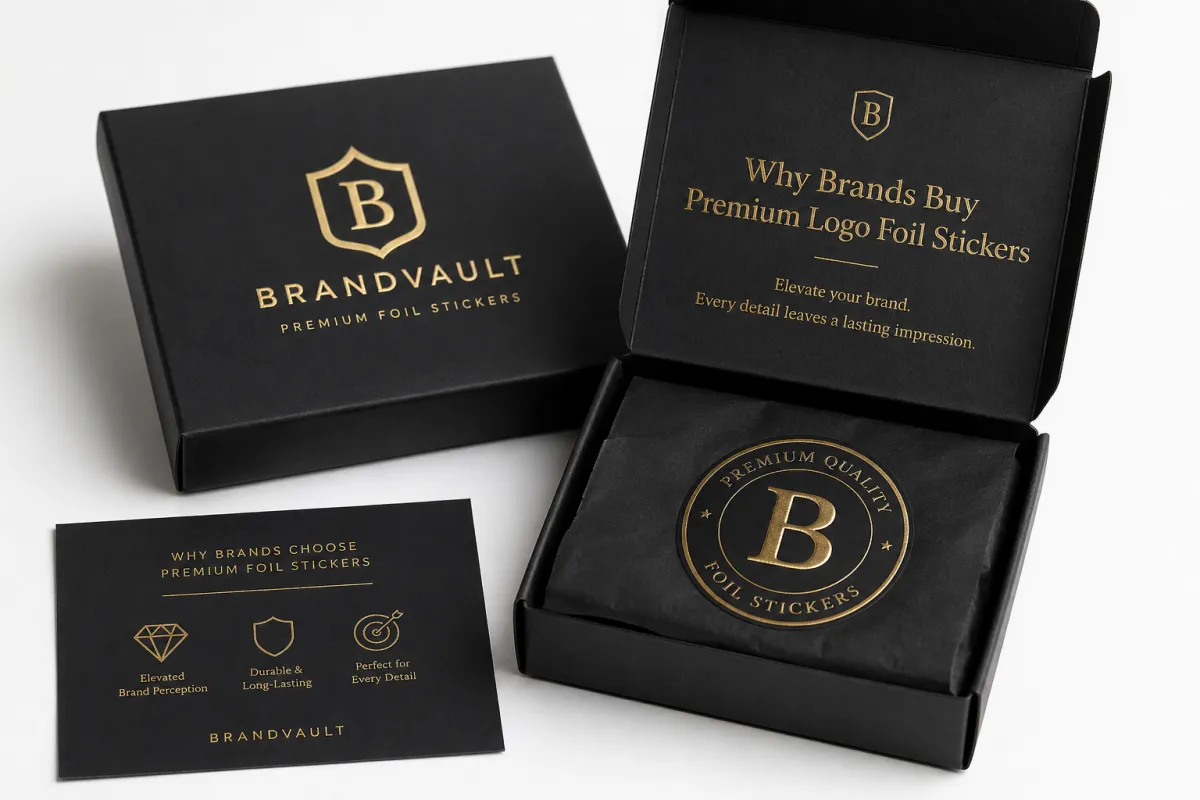
Most people underestimate foil until they hold two packages side by side on a table. The difference shows up immediately. A matte label can do the basic job, yet when you buy premium logo foil stickers, you add reflected light, a sharper contour, and a sense of precision that customers tend to read as better quality. That is not decoration for decoration's sake. It is visual shorthand, and packaging teams rely on it because the eye reacts quickly to contrast and brightness on a crowded shelf in Chicago or a busy desk in Berlin. A 35 mm gold mark on a black carton can do more work than a paragraph of marketing copy on the inside flap.
Speed matters just as much. A brand can buy premium logo foil stickers in a standard round size or a custom die-cut shape and update the package without changing cartons, pouches, inserts, or closures. I saw that play out in a tea buyer meeting in Hong Kong where the team had spent weeks circling a new folding carton structure. We tested a 45 mm silver seal on the existing box instead, using a 350gsm C1S artboard presentation card underneath for the shelf mockup. The seal cost a fraction of a redesign, and the marketing group signed off the same day because the package finally looked intentional rather than patched together before a Friday print deadline.
The logic is straightforward. Brands buy premium logo foil stickers because the risk stays low, the order size can remain manageable, and the visual payoff arrives fast. If a launch needs to feel more polished, foil gets you there. If a subscription box needs a stronger first impression, a metallic logo seal does the work. If an event kit has five inserts and one outer mailer, the seal becomes the brand cue people remember. That is why they show up on thank-you cards, sealed tissue, coffee pouches, PR kits, cosmetic jars, and holiday mailers so often, especially in runs of 1,000 to 10,000 pieces where the packaging budget has to stretch across a full campaign.
One mistake I see often is the assumption that foil belongs only to luxury brands with very deep packaging budgets. In practice, small businesses buy premium logo foil stickers because they want a sharper look without paying for new tooling. A candle maker in Portland I worked with had a 1,200-piece monthly run and no interest in new carton investment. We moved her from flat paper seals to gold foil seals on a 50 mm circle, and the repeat orders improved because customers photographed the unboxing more often. That was one of those rare moments where a simple packaging decision made the sales team happy and the production team less frustrated. A small change, a real commercial result.
"We thought the foil seal was just decoration until we put it on the box. Then the product looked like it belonged in a higher price band," a subscription-box founder in Brisbane told me after her first 2,500-piece run.
That is the pattern I see most often: brands buy premium logo foil stickers to make the package feel finished rather than flashy. A good foil sticker signals that the brand paid attention to the final detail, and in packaging, that is often the detail people remember after the product is gone and the box sits on a desk for another week.
- Best-fit uses: subscription boxes, cosmetics, coffee bags, candles, event kits, mailers, tissue seals, and thank-you cards.
- Brand effect: stronger contrast, higher perceived value, cleaner closure, and more consistent unboxing photos.
- Operational benefit: no carton retooling, no dieline overhaul, and easier test runs for new campaigns.
Premium Logo Foil Stickers: Product Details and Finishes
Clients usually ask what changes the final look, and I start with the stack-up. A premium logo foil sticker is typically built from face stock, adhesive, foil layer, and in some cases a topcoat. Each layer affects shine, handling, and how the label sits on the surface. If the base is too slick, the foil may look crisp but not stable. If the adhesive is too weak, the edge can lift after shipping from Guangzhou to Dallas. When you buy premium logo foil stickers, those details matter more than the polished language on the quote sheet, which can sound persuasive until the first carton arrives and reality gets involved.
I once stood on a press floor in Shenzhen while an operator rejected a run because foil registration drifted by 0.6 mm on a 42 mm logo. That sounds tiny, yet on a circular seal it changes the entire read of the brand mark. He was right to stop the job. If the foil kisses the text unevenly, the label looks inconsistent the moment it is in hand. That is why I tell buyers to ask about alignment tolerances before they buy premium logo foil stickers, especially when the logo uses thin strokes, a narrow monogram, or a serif font with fine terminals.
Format matters too. Sheet-fed stickers work well for hand application, roll-fed labels suit faster packing lines, and custom die-cut shapes can give a brand a more distinctive silhouette. Round and square labels are usually the most economical, while ovals and custom contour cuts often require extra tooling. If you want to buy premium logo foil stickers for a small team packing 100 to 300 orders a day in a warehouse in Atlanta or Leeds, the application method can matter more than the finish itself. I have watched people obsess over gold versus silver while ignoring whether the labels will actually apply cleanly on their line, which is a very expensive way to discover you picked the wrong format.
Finish selection has more range than many first-time buyers expect. Gold still sells because it reads as warm and premium. Silver feels cleaner and more technical. Holographic foil can work for campaigns that need energy, but it does not belong on every product line. I have also seen matte black or soft-touch backgrounds paired with foil accents, and that combination can be strong because the contrast is controlled rather than loud. If your goal is to buy premium logo foil stickers for a candle line, a deep matte base with a 30 mm foil logo can outperform a fully reflective surface. My own opinion: restraint usually looks more expensive than shouting, even if the shiny option is tempting in the sample book.
There is one detail buyers forget often: the artwork has to fit the finish. Thin lines, tiny serifs, and dense copy can disappear if the foil area is too small. I usually advise customers to keep the core logo simple, preserve clean clear space, and ask for a proof that shows exactly where the foil sits. That matters even more if you buy premium logo foil stickers for jar lids, mailers, or retail bags, where the sticker may be seen at an angle rather than straight on. On a 28 mm lid label, for example, a line weight below 0.25 pt can disappear after foil stamping.
For brands that want consistency across a larger packaging system, I often pair foil seals with matching collateral such as Custom Labels & Tags. A foil seal on the box and a matching hang tag or neck label makes a collection look planned rather than stitched together at the last minute. That kind of coordination is one reason experienced buyers buy premium logo foil stickers as part of a packaging set instead of treating them as a stand-alone embellishment. It also helps when the brand is shipping from a regional warehouse in Suzhou or Rotterdam and needs every component to read the same way on camera.
- Common shapes: round, square, oval, rectangle, and custom die-cut.
- Common finishes: gold, silver, holographic, matte base with foil accents, gloss with metallic detail.
- Application formats: sheets for hand use, rolls for faster packing, singles for test kits and promotions.
Specifications for Premium Logo Foil Stickers
Specifications decide whether a sticker looks premium in the carton or tired on arrival. Size, foil coverage, substrate type, adhesive strength, and die-cut complexity all influence the quote and the final result. When buyers ask me how to buy premium logo foil stickers wisely, I start with the application surface. A 30 mm seal on a tissue wrap serves a different purpose than a 90 mm label on a shipping box. The first is about closure and presentation. The second has to stay readable across more distance and more handling, especially if the box leaves a fulfillment center in Detroit and spends three days in transit.
Material choice is the biggest practical lever. Paper stock works well for dry, indoor packaging and gives a natural feel that suits candles, tea, and stationery. BOPP holds up better when moisture, oil, or frequent handling is part of the journey. Vinyl can help in tougher environments, though it is not always the first choice for elegant packaging. If you buy premium logo foil stickers for a cosmetic jar that may be touched repeatedly, I would usually test a synthetic stock before approving a paper version. I have seen too many nice-looking labels get crushed by reality after one week on a shelf in humid weather in Miami.
Adhesive selection is just as important. Permanent adhesive is the standard for most seals because the goal is to stay put once the customer applies the sticker. Removable or repositionable adhesive can help with event kits, sample packs, or temporary campaigns, yet those options need testing because they can trade some tack for easier removal. I have seen buyers buy premium logo foil stickers with the wrong adhesive for textured kraft mailers, and the edge lift showed up after the first shipping cycle. That was a lesson they did not want twice, and neither did their warehouse team in Nottingham.
Exact dimensions change the appearance more than most people expect. Smaller stickers lower cost, but they can compress the logo and lose detail. Larger labels give the foil more room to breathe, yet they can overpower delicate packaging. A 42 mm round seal often lands in a useful middle range for box closures, while a 70 mm version makes more sense for outer mailers or larger jar lids. If you plan to buy premium logo foil stickers, measure the panel, lid, or flap first and choose the size around the object rather than around a guess. I have had to say "maybe" to too many jobs that started with a guess and ended with a stack of unloved samples in the corner of a studio.
For a cleaner approval process, I ask buyers to send vector art, exact size, finish preference, and any cutline notes before we price the job. File quality matters. A flattened JPG with fuzzy edges can slow proofs, while a vector AI, EPS, or PDF file lets the production team map the die line more accurately. Buyers who buy premium logo foil stickers with proper artwork in hand usually move through proofing faster and avoid the kind of revision cycle that burns a week without improving the label. A clean PDF with outlined fonts is usually enough to keep the prepress team in Dongguan moving without extra questions.
If the package will ship through parcel carriers, I also think about transit testing. The ISTA testing framework is a useful reference when labels need to survive vibration, temperature swings, and repeated handling. For paper sourcing, the FSC chain-of-custody system matters when procurement wants a cleaner sustainability story. Those are not decorative details. They help buyers buy premium logo foil stickers with fewer surprises after the first run, especially on routes that pass through summer warehouses in Phoenix or winter freight lanes in Minneapolis.
- Spec fields to confirm: width, height, shape, foil coverage, adhesive type, face stock, and cutline complexity.
- Artwork files: AI, EPS, PDF, or another vector format with outlines and embedded fonts.
- Surface match: flat carton, coated mailer, textured kraft, glass jar, or flexible pouch.
Pricing, MOQ, and What Changes the Quote
Price is where the conversation gets practical. A buyer can buy premium logo foil stickers for a modest run or a larger seasonal order, but the quote shifts with quantity, size, shape, foil coverage, and substrate. In many cases, setup cost is what makes small runs look expensive on a unit basis. Once the run gets larger, that same setup is spread across more pieces, and the price per sticker drops. That is normal, and it is why I ask for pricing at several quantities instead of a single number on a call that ends in four minutes.
Here is a simple comparison based on common packaging jobs I have seen from factories in Shenzhen and Xiamen. These numbers are illustrative, not universal, because artwork complexity, freight route, packaging method, and current material pricing can all shift them. Still, they give buyers a useful frame. A 5,000-piece order of a 50 mm round gold foil sticker on paper stock might land around $0.15 per unit. The same size in 50 micron BOPP with a roll format may move closer to $0.22 per unit. A custom die-cut holographic label can reach $0.29 per unit or more, especially if the logo needs extra prepress work. If you only need 1,000 test pieces, the unit cost may climb to $0.40 or higher because the setup gets spread thin. I know that is not the number anyone hopes to hear, but packaging math rarely cares about hopes.
| Option | Typical Quantity | Indicative Unit Price | Best Use | Notes |
|---|---|---|---|---|
| Standard round gold foil on paper | 5,000 pieces | $0.15/unit | Boxes, tissue seals, cards | Strong value for dry indoor packaging |
| Roll-fed BOPP foil label | 5,000 pieces | $0.22/unit | Faster packing lines, flexible pouches | Better for moisture and handling |
| Custom die-cut holographic label | 5,000 pieces | $0.29/unit | Launches, limited editions, PR kits | Extra tooling and proofing may apply |
| Small test run | 1,000 pieces | $0.40/unit | Sampling, placement tests, buyer approval | Useful for first-time buyers |
MOQ is not just a factory rule. It reflects the way production setup is priced. If the press has to be adjusted for a new foil color, a custom die line, or a complex shape, that setup needs to be recovered across the run. That is why a standard shape usually costs less than a contour cut and why a reorder is often cheaper than the first job. Buyers who want to buy premium logo foil stickers for a test campaign often start with 1,000 to 2,000 pieces, then scale to 5,000 or 10,000 once the packaging is approved and the line is running cleanly.
There are extra charges buyers should ask about before they sign off. Rush service can add cost. Artwork cleanup can add cost. Proof revisions can add cost if the file is not ready. Shipping across multiple destinations can also create a surprise if it is not listed in the quote. I tell clients to compare at least three quantities, confirm whether the quote includes prepress and proofing, and ask what a reorder will cost. If you are going to buy premium logo foil stickers more than once, reorder pricing matters as much as the first invoice, especially when the second run is going to a warehouse in Manchester or San Diego.
One of the cleanest ways to control spend is to keep the design simple. A single-color foil logo on a standard shape usually prices better than a full-coverage custom cut with tight internal cutouts. That does not mean the cheaper option is always the right one. It means the buyer should know where the money goes. When brands buy premium logo foil stickers with that level of clarity, they are usually happier with both the quote and the final pack. I have seen a 60 mm custom star shape cost 18 percent more than a 60 mm circle purely because of die complexity and handling time at the plant in Dongguan.
How Do You Buy Premium Logo Foil Stickers Without Costly Revisions?
The order process should feel direct. Send artwork. Confirm size and finish. Review the proof. Approve the quote. Move into production. That is the clean version, and in a well-run job it usually stays close to that sequence. The real question most buyers ask is how long it takes to buy premium logo foil stickers and have them in hand after approval. My answer depends on shape, stock, and proof speed, but there are reliable ranges that work for most factories in Shenzhen, Ningbo, or Guangzhou.
For straightforward orders, I usually see 12 to 15 business days from proof approval to production completion on a 5,000-piece standard shape. Custom die-cuts or specialty foil builds can stretch to 15 to 18 business days because the die line, press setup, and finishing checks need more attention. Shipping adds more time, of course. A domestic parcel may take 3 to 5 business days. Air freight can move faster, though it is not always the cheaper path. Buyers who buy premium logo foil stickers for a launch date should separate production time from transit time in the planning sheet so nobody is surprised when a truck, a plane, or a customs hold has its own opinion about timing.
Proof delays are the hidden bottleneck. I have watched a job sit for four days because a client could not confirm whether the logo should be 48 mm or 52 mm wide. That is a small change on paper and a large change on the final product. The most efficient buyers buy premium logo foil stickers with the exact surface dimension, finish preference, shipping address, and logo file already prepared. That saves everyone time, and it keeps the quote from changing after the production slot is reserved. It also helps when the factory is booked out of order on a Monday morning in Guangdong.
I also recommend a simple approval checklist. The proof should show the die line, the foil placement, the final size, and any color limitations. The customer should approve the file once, not in fragments. On a busy account, I have seen proofing go from one day to five because different people were editing different parts of the same label. One manager wanted more shine. Another wanted a smaller mark. The operations team wanted an earlier ship date. That is how a straightforward order turns into a delay. If you buy premium logo foil stickers as part of a launch, assign one decision-maker and keep the file chain tight.
There is also a real difference between first order and reorder. The first order takes longer because the art has to be checked, the die line has to be confirmed, and the print team has to validate how the foil behaves on the chosen stock. Reorders are faster if the specification stays the same. That is one reason brands buy premium logo foil stickers from a supplier they can return to. Once the file, cut, and finish are locked, the next run becomes much easier to schedule and often lands in the same 12 to 15 business day window from proof approval if the spec stays unchanged.
On a project for a coffee roaster, I remember the buyer wanting the labels in time for a farmers market launch in Seattle. We worked backward from the event date, built in 2 days for proofing, 13 business days for production, and 4 days for transit. That left only a 1-day margin. The order made it, but barely. The lesson was simple: if you buy premium logo foil stickers for a fixed launch, you need the artwork finalized before the clock starts, not after the quote arrives. I still think about that job whenever a client says, "We probably have plenty of time." Usually, we do not.
- Step 1: Send vector artwork, target size, quantity, and finish.
- Step 2: Review the proof for die line, foil placement, and readability.
- Step 3: Approve the quote and confirm shipping details.
- Step 4: Production, quality check, packing, and carrier dispatch.
Why Choose Us for Premium Logo Foil Stickers
Buyers do not need another vague promise. They need a supplier that understands packaging pressure points. That means cleaner proofing, tighter foil consistency, better adhesive matching, and realistic timelines. When a team decides to buy premium logo foil stickers, the value is not just the sticker itself. It is the support that keeps the order from stalling because the logo was resized incorrectly or the wrong adhesive was matched to a coated surface. That kind of mistake is avoidable, which is why it feels especially annoying when it shows up in a 2,000-piece run on a Wednesday afternoon.
In my experience, the Best Packaging Suppliers act like technical partners. They ask about the substrate before quoting. They ask whether the label is sealing tissue, closing a mailer, or sitting on a jar lid. They ask how the pack ships. Those questions save money. Custom Logo Things earns attention when it approaches the order that way, because experienced buyers buy premium logo foil stickers from a team that can spot production risks before the first proof is issued. A supplier that knows the difference between a coated pouch from Xiamen and a textured kraft carton from Leeds is already ahead of the curve.
Quality control is where trust gets built. I want to know that the material was checked before printing, that alignment was inspected after finishing, and that the labels were packed so the edges stay clean in transit. A foil seal can look perfect in a photo and still arrive with curl if the packing is careless. I have seen that happen on a 3,000-piece order packed too tightly in warm weather. The print looked fine. The corners did not. Buyers who buy premium logo foil stickers should ask how the pieces are packed, not just how they are printed. A clean carton liner and a modest stack height can make a real difference.
Service matters too, especially on the first order. A startup testing a new visual system needs fast quote feedback and clear proof support. A seasonal brand scaling a holiday campaign needs reliable reorder consistency. An agency handling five clients needs one supplier that can keep the specs straight across several projects. If you buy premium logo foil stickers and the supplier cannot manage those differences, the price alone will not save the job. I would rather pay slightly more for a cleaner process than chase a cheaper quote through three rounds of corrections and one missed ship date.
There is also a sourcing angle that many procurement teams now ask about. Some buyers want FSC-aligned paper options. Others want a more durable synthetic stock. Others need a label that matches a retail compliance checklist. The right supplier will answer those questions without drama and without overpromising. That is the difference between a label vendor and a packaging partner. It is also why many teams buy premium logo foil stickers from specialists rather than a general print shop that treats foil as an add-on.
On a recent client call, a marketing manager told me her previous supplier had beautiful samples but poor reorder behavior. The first batch was excellent. The second batch drifted in size by 1.5 mm and the team had to adjust the hand-applied placement guide. That kind of inconsistency burns time. It also eats confidence. If you want to buy premium logo foil stickers for repeat use, consistency across runs matters more than a pretty sample board, especially when the labels are being used on retail runs in New York and Amsterdam at the same time.
If the packaging plan includes matching components, I usually suggest ordering the seal and the tag together. A foil logo on the package and a matching printed companion piece creates a stronger brand system than a single isolated embellishment. That is where our Custom Labels & Tags offering can fit into the broader pack. When brands buy premium logo foil stickers and tie them to the rest of the presentation, the result looks intentional, not assembled at the last minute. It also reduces the number of color surprises across a 6-piece launch set.
- What experienced buyers value: faster quoting, file review, sample support, and honest production guidance.
- What protects quality: alignment checks, material inspection, packing controls, and reorder documentation.
- Best-fit customers: startups, scaling DTC brands, agencies, and seasonal programs.
Next Steps to Order Premium Logo Foil Stickers
If you are ready to buy premium logo foil stickers, the best next move is to gather the essentials before you request a quote. Send the logo file in vector format, the target size in millimeters, the foil color you want, the quantity range, and the surface where the sticker will be applied. That one email removes a lot of the back-and-forth that usually slows a new project. A buyer who comes prepared usually gets a faster and more accurate response, often within one business day if the artwork is ready and the size is already confirmed.
Do not compare price alone. Compare quote structure, proofing support, material quality, and reorder consistency. I have seen brands save $40 on the first order only to lose a day in production because the low quote did not include cleanup work. That is not a real saving. If you plan to buy premium logo foil stickers more than once, ask how the second run will be handled, what the minimum reorder quantity looks like, and whether the supplier keeps the approved spec on file. A good reorder sheet should list the foil color, adhesive, size, and final approval date without anyone hunting through email threads.
Internally, the approval path should stay simple. One person should confirm the artwork. One person should approve the budget. One person should verify shipping details and timing. Three decision-makers are fine. Seven are not. A foil label order does not need a committee; it needs clarity. When teams buy premium logo foil stickers with a clean sign-off chain, they avoid the kind of last-minute correction that adds a week to the launch and forces the warehouse to work a Saturday shift.
If you want the first inquiry to move quickly, include these details: file type, quantity target, application surface, desired foil color, and deadline. Add one or two reference photos if the packaging surface is textured or curved. That helps a lot on jars, pouches, or coated mailers where adhesion can vary. The more precise the setup, the easier it is to buy premium logo foil stickers without revision cycles that eat into the schedule. A photo of the actual 72 mm jar lid, for example, tells the production team more than a paragraph describing "roughly medium-sized."
Here is my blunt advice after too many packaging meetings to count: the right supplier should make you feel informed, not trapped. They should tell you what the sticker can do, what it cannot do, and what the timeline really looks like. If the packaging goal is a cleaner unboxing, a sharper shelf signal, or a better seal on a seasonal kit, then buy premium logo foil stickers with a clear spec and a realistic deadline. That is how you get a result that looks premium without turning the order into a guessing game.
When you are ready to buy premium logo foil stickers, send the artwork, lock the size, confirm the finish, and ask for a proof. That is the shortest route to a label that looks good in the hand and performs well in the pack. If the goal is a branded package that feels considered from the first touch, buy premium logo foil stickers now and treat the seal as part of the product experience, not an afterthought. A 42 mm gold seal on a kraft mailer can do a lot of heavy lifting for a brand in a single afternoon, and the cleanest jobs are the ones where the size is measured first, the material is tested on the actual surface, and the proof is approved before the press slot is booked.
What should I check before I buy premium logo foil stickers?
Check the logo file first. A vector file in AI, EPS, or PDF format gives the production team cleaner edges and makes the die line more accurate. Then measure the application surface in millimeters so the size fits the box, lid, or mailer. I also recommend confirming MOQ, foil color, adhesive type, and proof turnaround before you approve the order, because those details affect both cost and schedule. For a first order, I like to see the size, material, and quantity written in one line, such as 5,000 pieces, 50 mm round, gold foil, paper stock.
Are premium logo foil stickers waterproof or oil-resistant?
Not all of them are. Performance depends on the face stock and the adhesive, so paper, BOPP, and vinyl behave differently. If the label may face moisture, oils, or frequent handling, ask for a synthetic stock and a compatible adhesive rather than assuming standard paper will hold up. If you plan to buy premium logo foil stickers for jars, pouches, or bathroom products, test the material against the real packaging surface before production starts. A 50 micron BOPP label with permanent adhesive usually performs better on a humid shelf than a coated paper seal.
Can I buy premium logo foil stickers in a small test quantity?
Yes, many suppliers can support a small test run, especially if you choose a standard shape and a common foil finish. Expect the unit cost to be higher on a short run because setup expenses are spread across fewer pieces. A test order is useful for validating size, adhesion, placement, and shelf look Before You Buy premium logo foil stickers at scale. A 1,000-piece sample run is often enough to see whether a 38 mm or 42 mm seal looks better on the final carton.
How long does it take to receive premium logo foil stickers after approval?
The clock usually starts after proof approval, not after the first quote. For a straightforward order, I often see 12 to 15 business days for production, with custom die-cuts or specialty finishes taking a bit longer. Shipping is separate. Ask for production time and transit time on the same quote so you can plan a launch without guessing how long it takes to buy premium logo foil stickers and receive them. A domestic shipment may add 3 to 5 business days, while air freight can shorten that depending on the route.
Can premium logo foil stickers be used on curved or textured packaging?
Yes, but they need testing. Smooth, clean surfaces give the adhesive the best chance to bond well, while curved or textured packaging can make edge lift more likely. If you want to buy premium logo foil stickers for jars, tubs, or rough kraft surfaces, request a sample application or an adhesion check before you commit to full production. A 60 mm label on a curved jar from a plant in Dongguan can behave very differently from the same size on a flat mailer.