Buyer Fit Snapshot
| Best fit | Biodegradable Packaging with Logo projects where brand print, material claims, artwork control, MOQ, and repeat-order consistency need to be specified before quoting. |
|---|---|
| Quote inputs | Share finished size, material target, print colors, finish, packing count, annual reorder estimate, ship-to region, and any compliance wording. |
| Proofing check | Approve dieline scale, logo placement, barcode or warning zones, color tolerance, closure strength, and carton packing before bulk production. |
| Main risk | Vague material claims, crowded artwork, missing packing details, or unclear freight terms can make a low unit price expensive after revisions. |
Fast answer: Biodegradable Packaging with Logo: Production Review should be specified like a repeatable production item. The safest quote records material, print method, finish, artwork proof, packing count, and reorder notes in one written spec.
Production checks before approval
Compare the actual filled-product size with the drawing, then confirm tolerance on folds, seals, hang holes, label areas, and retail display edges. Reserve space for logos, QR codes, warning copy, and material claims before decorative graphics fill the panel.
Quote comparison points
Review material grade, print process, finish, sampling route, tooling charges, carton quantity, and freight assumptions side by side. A quote is only useful when the supplier can repeat the same color, closure quality, and packing count on the next order.
The first time I held a compostable mailer over a steam line at 58 C in a plant outside Suzhou, it did not vanish in some magical puff of virtue; it softened, creased, and still kept the logo sharp enough to read at arm's length. I remember laughing a little, because that was the exact moment I realized biodegradable packaging with logo only matters when it survives the abuse first, whether that means a 3-meter conveyor drop in Jiangsu or a 14-day warehouse hold in Hamburg. The pack has to make it through shipping, stacking, handling, and warehouse chaos before it earns its place in a disposal stream that actually matches the material.
I have heard the same confusion in a corrugated plant in Guangdong, in a buyer meeting over espresso in Chicago's Fulton Market, and in a sourcing call where a vendor proudly cut $0.02 from the unit price after removing a plastic window and switching to water-based inks. Honestly, I think that is the sort of thing people should say more often: the savings were not magic, they were just the result of not making the pack harder to recycle or compost. Biodegradable packaging with logo is never just a print order. It lives at the crossing point of material science, packaging structure, retail display, and brand credibility, and one weak choice can drag the whole project sideways in a hurry.
What Biodegradable Packaging With Logo Really Means
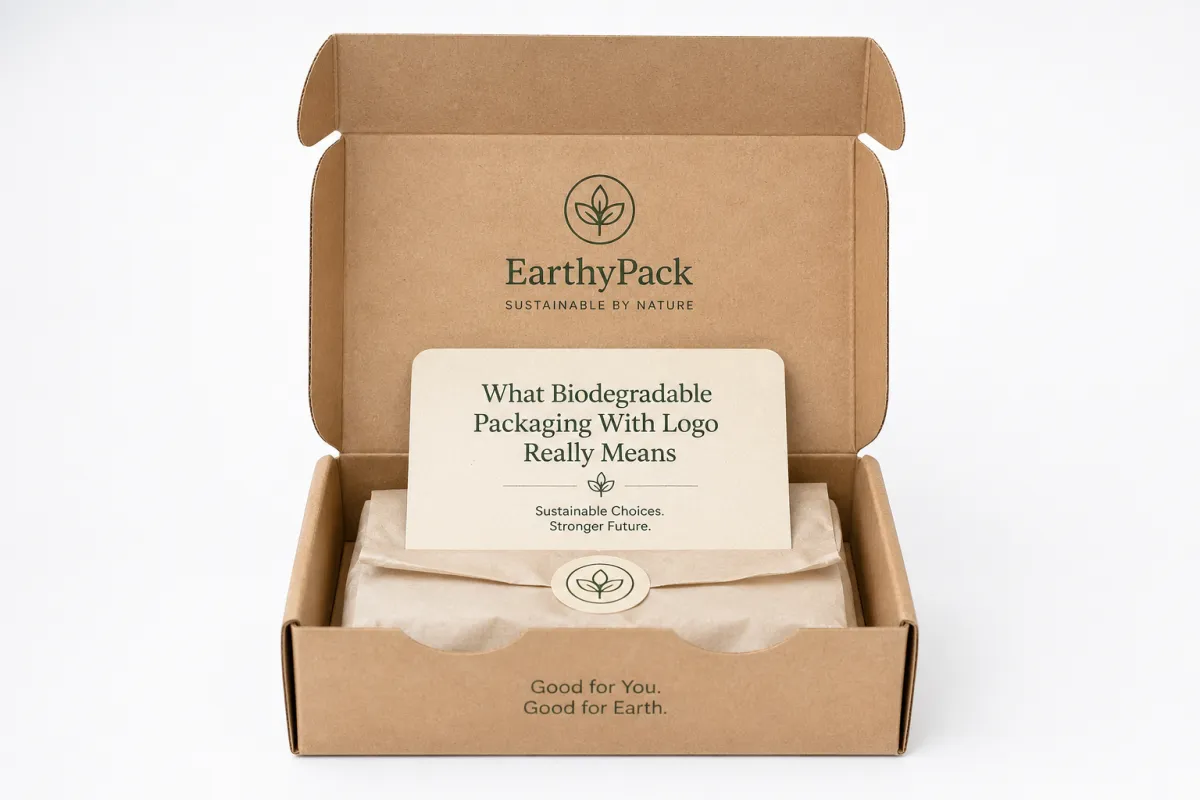
Biodegradable packaging with logo refers to packaging made from a substrate that can be broken down by natural biological activity over time, then marked with a brand symbol, wordmark, or graphic without changing the material into something else entirely. That sounds neat on a slide deck, but the real picture is more exact. A kraft paper mailer printed with a single-color logo behaves very differently from a PLA-lined pouch with a flood coat, a foil accent, and a pressure-sensitive label. One may fit the waste stream cleanly; the other can complicate it fast, which is the sort of detail that makes procurement teams sigh into their spreadsheets while checking the drawing against a 350gsm C1S artboard spec.
People often use biodegradable, compostable, and recyclable as though they mean the same thing, but the differences matter in the real world from Portland, Oregon to Rotterdam. Biodegradable packaging with logo can break down over time, compostable packaging is designed to break down under defined conditions and leave no toxic residue, and recyclable packaging should return to a recovery stream if local collection systems accept it. I have watched a buyer assume "eco-friendly" covered all three, then learn that the county accepted paper recycling but refused a multilayer film with a leaf icon printed on the front. The icon did nothing to change the structure, which is one of those truths that sounds rude only because it is true.
The logo matters because every layer carries consequences: substrate, ink, coating, adhesive, and finish. Water-based flexographic ink on kraft paper is a very different decision from solvent-heavy ink on a laminated film, especially in a run coming out of Dongguan where line speed can hit 120 meters per minute. The same goes for varnish. A light aqueous coating can protect a print run, while a plastic laminate can block the very end-of-life behavior the brand wants to claim. If you are sourcing biodegradable packaging with logo, you are buying a system, not a blank surface, and the system has to make sense from the first press pass all the way to disposal.
"We thought the logo was the last step. It turned out to be the first compliance question." A procurement lead said that during a 14,000-piece pilot run in a plant near Shenzhen, and the line stuck with me because it captures how these jobs either succeed or unravel.
Many brands still overpay for the wrong thing. They ask for biodegradable packaging with logo, yet what they really want is a pack that looks premium, ships safely, and tells the customer exactly how to dispose of it. Those are not the same brief. The first is a material request. The second is packaging design, logistics planning, and compliance work rolled into one, and if you skip that distinction you usually end up paying twice, first for the wrong structure and then for a remake that arrives six weeks later. I have seen it happen more than once, and it never gets less annoying.
How Biodegradable Packaging Breaks Down After Use
Biodegradable packaging with logo breaks down through biological activity driven by oxygen, moisture, heat, and microbes. In an industrial composting facility in northern Italy or the Pacific Northwest, temperatures may sit around 50-60 C, moisture remains relatively high, and microorganisms work faster than they do in a backyard pile. In a dry warehouse in Phoenix, the same material can sit unchanged for months. The disposal environment is not a side detail; it shapes the result from the start, which is why I get twitchy when a spec sheet skips the end-of-life story entirely.
The timeline can run from weeks to months, and sometimes longer if the material is dense or the print coverage is heavy. A thin paper sleeve with minimal ink can behave very differently from a molded-fiber tray with a high-coverage design across the face, especially if the tray is 2.5 mm thick and carries a water-resistant coating. I once watched a tray pass transit testing and then fail a composting review because the designer had chosen a finish that looked elegant under showroom lights but resisted the wet conditions needed for breakdown. That was not a cosmetic misstep. It was a material decision wearing a pretty jacket.
Buyers should ask for proof instead of language that sounds promising. If a supplier says a pack is biodegradable, ask which standard supports that claim. ASTM D6400, EN 13432, and similar protocols say far more than "eco" copy ever will. For disposal guidance, the EPA's composting basics at EPA composting guidance are a useful reference, because end-of-life instructions need to match the local waste stream rather than the marketing deck. I wish more brands would treat that as non-negotiable instead of optional fine print, especially when the order is shipping from a factory in Suzhou or Yantian and the customer is in Toronto.
Printing layers can slow breakdown if they are too thick, too dense, or paired with a coating that will not participate in composting. Heavy ink coverage, metallic effects, and plastic labels can leave residues or make a package harder to process. That does not mean branded packaging is the problem. It means biodegradable packaging with logo has to be designed with the print method in mind from the start, not added after the material choice has already been locked. Waiting until the end and then trying to make it green is how expensive mistakes get polite names.
The practical lesson is simple: biodegradable packaging with logo should be judged as a finished system, not as a substrate alone. If a supplier cannot explain the disposal environment, the material stack, and the test standard in one clear response, I would pause the order and ask for documentation. A polished mockup is not the same thing as a verified claim, no matter how nice the render looks in a pitch deck or how clean the sample feels at the booth in Milan.
Choosing the Right Biodegradable Packaging With Logo Materials
The best material for biodegradable packaging with logo depends on what you are packing, how it travels, and where it ends up. For dry retail goods, kraft paper can work well because it prints cleanly, folds sharply, and carries a clear brand mark without needing a heavy coating. For food service inserts or protective trays, molded fiber and bagasse often make more sense because they offer structure and a natural look that matches the disposal story. For certain sealed items, PLA blends may fit, but only when the supplier can show exactly how the pack should be discarded and what conditions are required, such as 58 C industrial composting for a 90-day test window. Otherwise, it is just a fancy-looking headache.
I usually ask three questions before I look at artwork: how much moisture will the pack face, how many miles will it travel, and what disposal route is likely in the customer’s region? Those answers change the recommendation every time. A subscription box moving 2,000 miles in corrugated board from Los Angeles to Atlanta needs different engineering than a local bakery sleeve sitting on a counter for six hours in Austin. Biodegradable packaging with logo is not one product category; it is a family of choices, and the right one is usually the least dramatic one that still does the job.
Best fits by use case
For Custom Printed Boxes, corrugated cardboard remains practical when the board is FSC-certified, the print coverage is controlled, and the finish stays light. A one-color logo on kraft paperboard is often easier to dispose of cleanly than a full-wrap glossy design printed across a 300 mm by 200 mm carton. For retail packaging, a minimalist logo on an uncoated surface can look more premium than a crowded print layout because the texture does some of the visual work. I have seen buyers spend $2,400 on artwork and only $1,700 on structure for a 5,000-piece run, even though the structure was what the customer held in their hand for 12 seconds. That has always struck me as backwards.
For food-contact applications, bagasse and molded fiber often win because they provide shape, stiffness, and a material story that feels believable in the hand. For dry goods and apparel, kraft paper mailers can be efficient, especially if the brand wants a tactile presentation with less shine and a 120 gsm to 150 gsm basis weight. I would not choose a material because it photographs well on a white backdrop in Brooklyn. I would choose it because it can survive the route, print the logo cleanly, and still support the end-of-life claim. A nice-looking failure is still a failure.
One practical filter helps more than most buyers expect: choose the material only after you define the product, distribution route, disposal path, and brand message. Skip any one of those four, and biodegradable packaging with logo can look right while behaving wrong. That is why I often tell clients to start with a sample set before scaling, and why many teams eventually review Custom Packaging Products after they settle the substrate and closure style. It is much easier to argue about aesthetics once the functional pieces are already behaving on a bench in the warehouse.
- Molded fiber works well for trays, inserts, and food packaging with low-sheen branding.
- Kraft paper suits mailers, sleeves, and light ecommerce shipments with simple logo placement.
- Bagasse handles clamshells and foodservice packs that need shape and stiffness.
- PLA blends may fit certain film-style packs, but disposal instructions must be very clear.
If you are torn between appearance and sustainability, choose the option that can survive shipping first, then refine the visual layer. A logo that lands crooked on a fragile surface is not a branding success. It is a production problem wearing a nicer font, usually after a 1,500-unit test run and a late-night signoff in Shenzhen. I have had to say that out loud in more than one meeting, usually after someone had fallen in love with a mockup that had absolutely no relationship to reality. That part is kinda funny once the pressure is off, but in the moment it can derail a launch.
What Biodegradable Packaging With Logo Costs
Pricing for biodegradable packaging with logo depends on material type, print method, color count, size, structure complexity, certifications, and order volume. A one-color kraft mailer at 5,000 units can land around $0.18 to $0.29 per unit, while a molded-fiber tray with custom tooling may sit closer to $0.24 to $0.38. Add a second print pass, die-cut windows, or special handling, and the quote moves quickly. That is why one supplier’s "cheap" number can become expensive once the details are on the table. I have seen bargain quotes do a complete face-plant as soon as actual specs arrived, especially when the final dieline called for a 280 mm by 380 mm flat size instead of the 240 mm by 320 mm the buyer first mentioned.
Smaller runs cost more per unit because setup costs do not shrink much. Plate charges, dieline work, proofing, and sample production can easily add $75 to $250 before the first finished piece ships. I have seen a buyer compare a 1,000-unit order with a 10,000-unit order and assume the large order was unnecessary, only to discover the unit cost dropped by more than 40 percent once setup fees were spread across the run. That math matters, even if everyone in the room would rather talk about color matching than arithmetic, and the difference can be even sharper if the line runs out of a plant in Dongguan or Ningbo where freight and loading schedules shift by the hour.
There are hidden costs too. Sampling can take 3 to 5 business days. Proof revisions can add another 2 days. Shipping for specialty substrates may cost more because the supplier has to protect moisture-sensitive stock with poly bags, desiccant packs, or export cartons lined to 350gsm C1S artboard standards. FSC paperwork, ASTM references, or transit verification can also add time even when they do not add much direct cost. I always tell clients that biodegradable packaging with logo is cheaper when the spec sheet is clear on day one. If the spec sheet is vague, the calendar starts bleeding immediately.
| Material / Format | Typical Use | Print Style | Indicative Cost at 5,000 Units | Notes |
|---|---|---|---|---|
| Kraft paper mailer | Apparel, inserts, light ecommerce shipments | 1-2 color flexo or digital | $0.18-$0.29/unit | Good for simple logo branding and low coating use |
| Molded fiber tray | Food, protective inserts, premium unboxing | Deboss, ink stamp, or light print | $0.24-$0.38/unit | Works best with minimal surface treatment |
| Bagasse clamshell | Food service, takeout, prepared meals | Single-color mark or emboss | $0.31-$0.52/unit | Check heat tolerance and grease resistance |
| PLA film pouch | Dry goods, select retail packaging | Digital or flexographic print | $0.22-$0.41/unit | Disposal instructions must be explicit |
Those figures are directional, not universal, because a 120 mm by 200 mm pouch is not priced like a 280 mm by 380 mm mailer. Still, the table helps buyers compare one option against another. Ask each vendor for the same dimensions, closure style, print coverage, and claim language. If one quote includes a plastic window, a glossy laminate, or a higher-moisture barrier, the comparison is already distorted. I have seen a $0.03 difference on paper turn into a $0.21 mistake after a design change and a compliance review. That kind of surprise is exactly what makes sourcing feel like a contact sport, especially when the factory floor is in Guangzhou and the buyer is trying to hold a launch date in New York.
The cheapest option often costs more later if it fails shelf life, damages the product, or confuses the waste stream. One client saved $1,400 on a small pilot, then paid for 420 replacement units after the first batch warped during a humid warehouse hold at 72 percent relative humidity. That is why I look at total landed cost, not just the per-unit number. Biodegradable packaging with logo should reduce friction, not move it downstream where it becomes somebody else's problem.
How the Biodegradable Packaging With Logo Process Works
The process starts with the brief, not the artwork. A good brief names the product, dimensions, fill weight, storage conditions, shipping route, target volume, and disposal expectations. Once that is clear, the supplier can suggest the right substrate, the right print method, and the right structure. Without those details, biodegradable packaging with logo becomes a guessing exercise, and guessing gets expensive quickly once a custom die or print plate enters the job. I would rather receive a slightly messy brief than a beautiful one that leaves out the important parts, especially if the shipment is headed to warehouses in Dallas and Vancouver.
Here is the sequence I prefer: concept design, material selection, artwork prep, sampling, proof approval, production, then shipping. If the product is fragile or moisture-sensitive, I add a simple transit test before full production. That can be as basic as a 24-hour humidity check or as formal as ISTA 3A transit testing. If you want a trusted overview of transport standards, the ISTA site at ISTA testing standards is useful because packaging has to work in the real world, not just in renderings. Pretty PDFs do not protect a product from a bumpy truck on the route from Ningbo to Berlin.
Typical timeline
For a straightforward run, sample production can take 3 to 5 business days, artwork proofing another 2 to 4, and full production 12 to 15 business days from proof approval. Custom tooling, complex folds, or certification review can add a week or more. I have seen a client rush a launch by 10 days and lose all that time because the first proof placed the logo too close to a fold line by 4 mm. That kind of error is avoidable if the dieline gets checked early. The funny part is that everyone notices the problem immediately once the sample arrives, which is exactly one week too late.
The approval checkpoints that save the most money are the ones people are tempted to skip. First, verify the dieline. Second, review the proof at full scale, not just on a laptop screen. Third, confirm the ink, adhesive, and coating with the substrate supplier. Fourth, ask for written confirmation on the disposal claim. If a vendor says biodegradable packaging with logo can be composted in a certain stream, ask for the exact condition, the standard, and the test result. Three minutes of skepticism can save three weeks of rework. I would even say it saves a bit of dignity, which is hard to price until you have to explain a bad batch to finance over a 9 a.m. call.
Clear communication speeds things up more than most teams expect. When the brand sends vector artwork, Pantone targets, size specs, and target quantities on the first email, the project moves faster by at least one revision cycle. I once watched a supplier shave two days off a project because the client delivered a complete spec sheet and a clean logo file on the first pass. That is uncommon, which is why it stands out. If you need a starting point, many buyers begin by reviewing Custom Packaging Products before they send a brief. It gives everyone the same mental picture before the quotes start flying.
Plan your launch calendar around the slowest part of the chain, not the fastest. If marketing wants samples for a trade show in London and operations needs stock in the warehouse seven days later, the packaging schedule will win that argument every time. Biodegradable packaging with logo works best when the packaging calendar is treated like a production calendar, not a design sprint. I know that sounds obvious, but judging by how often it gets ignored, it still deserves to be said out loud.
Common Mistakes to Avoid With Biodegradable Logo Packaging
The biggest mistake is greenwashing language. "Eco-friendly" is vague, and vague claims invite skepticism from buyers who have seen too many brands borrow the color green and call it a strategy. If you are using biodegradable packaging with logo, name the material, the disposal route, and the certification or test method. A customer who sees a clear claim is far more likely to trust it than one who sees a leaf icon and a vague promise. I have seen shoppers inspect the back panel with more care than some brands give their own spec sheets, especially on a 500-unit seasonal run where each carton matters.
Another error is choosing a finish that works against the sustainability story. Metallic foil, heavy lamination, plastic-based gloss, and oversized coating coverage can all undermine the point. I once sat in a supplier negotiation in Manila where a brand wanted a matte black pouch with silver foil because the mockup looked expensive. The supplier was right to push back: the foil would complicate the material story, and the final pack would no longer match the disposal guidance the team planned to print on the back panel. That is not a small detail; that is the whole argument.
Logistics mistakes are just as costly. A package that breaks down too quickly can fail in humid storage, while one that is too protected can resist decomposition longer than intended. Long-haul shipping across 1,500 miles, a 70 percent humidity warehouse, and a 3-week inventory hold are not theoretical problems; they are Tuesday problems in places like Miami, Houston, and Singapore. Biodegradable packaging with logo has to survive the route before it can succeed after use, and the route is rarely as gentle as the brand deck imagines.
Another common issue is assuming every supplier understands the standards equally well. They do not. Some can talk clearly about FSC chain of custody and source fiber; others can only repeat what is printed on a sample board. If the sourcing story matters to your brand, ask for documentation from a credible authority such as FSC certification standards and check that the paperwork matches the actual substrate, not a brochure claim. A logo on the carton does not magically certify the carton. Would that it did, especially when the board came off a line in Qingdao or Weihai.
Finally, do not leave artwork approvals until the last minute. Rushed proofing pushes teams into accepting a compromised finish, a slightly off-center logo, or a closure style that was never right for the product. I have seen this happen on a 9,000-unit run where a one-day delay in proof review turned into a production compromise nobody liked. The fix was not expensive, but the stress was real, and nobody was in a mood for celebratory coffee afterward. Biodegradable packaging with logo rewards patience more than panic.
What should you check before ordering biodegradable packaging with logo?
Before you place the order, check five things: the exact material, the print method, the disposal route, the certification or test standard, and the real-world handling conditions. If any one of those is vague, the project can drift into avoidable rework. Biodegradable packaging with logo performs best when the supplier can explain the substrate stack, the ink system, and the end-of-life claim in the same conversation, without hand-waving or marketing gloss. That is the kind of answer that usually separates a real production partner from a pretty sample board.
I also like to verify whether the pack will see heat, humidity, or long storage before it reaches the customer. A carton that looks perfect in a studio can behave very differently after 48 hours in a humid warehouse or a week in transit. Ask for sample photos, written specs, and a clear lead time in business days, then compare them against the actual launch schedule. A clean checklist saves more money than a rushed decision ever will, and it gives biodegradable packaging with logo a real chance to do its job instead of just looking the part.
Expert Tips and Next Steps for Biodegradable Packaging With Logo
My best advice is to start with one hero SKU and one packaging format. Test the print, the structure, and the disposal path on a single item before you expand the program. That sounds conservative, yet it saves money. A brand that proves one mailer at 3,000 units has better data than a brand that launches four formats at once and spends a month guessing which one caused the problem. Biodegradable packaging with logo gets easier after the first successful run, because real samples remove a lot of wishful thinking, especially when the first test pack has to survive a 48-hour freight move from Suzhou to Incheon.
Always order samples with real artwork, not blanks alone. Blank samples tell you about structure and feel, but they do not tell you how the logo reads across a fold, whether the ink spreads on kraft paper, or how the brand color behaves on molded fiber. I have seen a beige sample look elegant, then the printed version land too dark because the brand had not accounted for absorbency. That is a design issue, not a material failure, and it is much easier to fix before production becomes a full-scale reality with 8,000 units already scheduled.
A one-page spec sheet is worth more than a long email thread. Include the product type, target market, order volume, print colors, exact dimensions, disposal claim, required certification, and acceptable timeline. If you are still narrowing suppliers, it helps to compare Custom Packaging Products after the spec is stable, because the right starting point trims several rounds of back-and-forth. I know the temptation is to keep the brief loose so options stay open, but loose briefs usually just create expensive ambiguity and a lot of unnecessary Zoom calls.
- Confirm the substrate and finish with a supplier who understands biodegradable packaging with logo.
- Verify the print method, ink type, and adhesive against the disposal claim.
- Ask for sample pricing, setup fees, and a lead time in business days.
- Compare at least three quotes using the same dieline and artwork coverage.
- Test the finished sample in real humidity, real handling, and real transit conditions.
When those five steps are complete, the decision becomes much easier. You are no longer choosing between "good" and "bad" packaging; you are choosing between two workable options and judging them on price, print quality, and waste stream fit. That is a better place to be than chasing a trendy finish that fails in shipping. If you want a package that supports product packaging, package branding, and a clear disposal story, biodegradable packaging with logo can do all three, provided the structure and the claim are actually related.
Request the samples, compare the claims side by side, and check the end-of-life path before you sign off. That is how I would buy biodegradable packaging with logo for a brand that cares about shelf presence and real sustainability, and it is still the simplest way I know to avoid an expensive mistake. I would also keep one eye on the clock and one eye on the proof, because packaging projects have a funny habit of getting brave right before they get expensive, especially once air freight from Shenzhen to Chicago enters the picture. The cleanest takeaway is the one I use on my own projects: pick the material for the route, not the render, and make the logo part of the disposal plan rather than an afterthought.
Is biodegradable packaging with logo the same as compostable packaging?
No. Biodegradable means the material can break down over time, while compostable usually requires specific conditions and must leave no harmful residue. A pack can be biodegradable packaging with logo and still not be suitable for a backyard compost pile, so ask where it is meant to break down and which standard supports the claim. I wish the labels were always this clear, but they usually are not, which is why the paperwork matters more than the leaf icon printed on a 500-piece sample.
Which logo printing methods work best on biodegradable packaging with logo?
Water-based inks and low-impact flexographic or digital methods are common because they print cleanly on many substrates without piling on heavy coatings. I always test adhesion, smudge resistance, and color accuracy on the exact material, because biodegradable packaging with logo can behave very differently on kraft paper, molded fiber, or PLA film. A logo that looks perfect on screen can still misbehave on press, which is a lesson the hard way teaches very well, especially on a 20,000-piece run with a 2-color lockup.
How much does biodegradable packaging with logo usually cost?
Cost depends on material choice, print complexity, order volume, and whether the packaging needs certifications or tooling. For example, a simple kraft mailer may run $0.18 to $0.29 per unit at 5,000 pieces, while molded fiber or bagasse can price higher. The best way to compare biodegradable packaging with logo is to request matching quotes with the same size, structure, and artwork coverage, because otherwise you are comparing different jobs and pretending they are the same.
How long does it take to produce biodegradable packaging with logo?
Simple projects can move quickly, but sampling, proofing, and approval often take longer than the print run itself. A realistic schedule is 3 to 5 business days for samples and 12 to 15 business days from proof approval for production, though custom structures can add time. Build a buffer into your launch plan so biodegradable packaging with logo does not hold up the rest of the rollout. Launches are stressful enough without discovering the cartons are still in transit from a factory in Ningbo.
What should I ask before ordering biodegradable packaging with logo?
Ask what the package is made from, how it should be disposed of, and which certifications or test results support the claim. Confirm minimum order quantities, moisture resistance, print limits, and whether samples can be made with your exact artwork. Also ask about lead times, shipping options, and revision policies, because biodegradable packaging with logo works best when the supplier can answer those questions clearly and in writing. If they start dodging simple questions, that is usually your answer right there.


