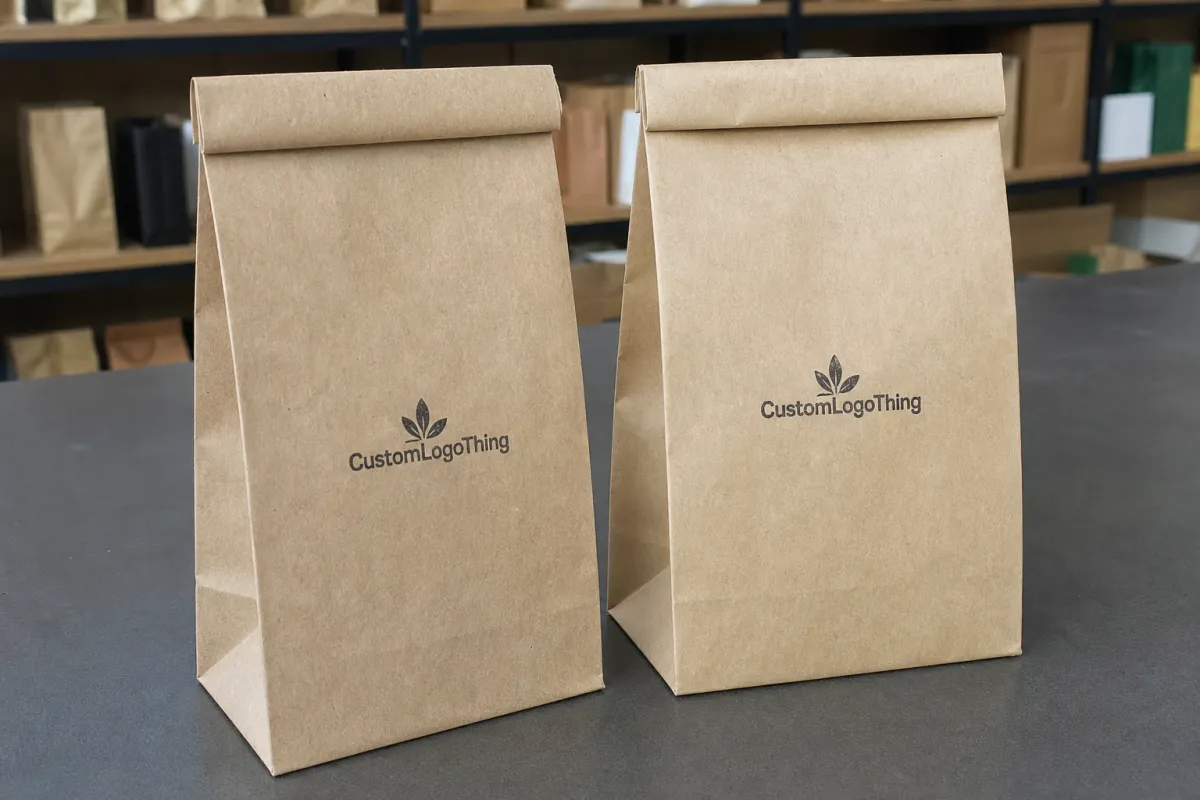
Buyer Fit Snapshot
| Best fit | Compare Kraft Paper vs Recycled Paper projects where brand print, material claims, artwork control, MOQ, and repeat-order consistency need to be specified before quoting. |
|---|---|
| Quote inputs | Share finished size, material target, print colors, finish, packing count, annual reorder estimate, ship-to region, and any compliance wording. |
| Proofing check | Approve dieline scale, logo placement, barcode or warning zones, color tolerance, closure strength, and carton packing before bulk production. |
| Main risk | Vague material claims, crowded artwork, missing packing details, or unclear freight terms can make a low unit price expensive after revisions. |
Fast answer: Compare Kraft Paper vs Recycled Paper: Production Spec, Color Control, and Delivery Risk should be specified like a repeatable production item. The safest quote records material, print method, finish, artwork proof, packing count, and reorder notes in one written spec.
Production checks before approval
Compare the actual filled-product size with the drawing, then confirm tolerance on folds, seals, hang holes, label areas, and retail display edges. Reserve space for logos, QR codes, warning copy, and material claims before decorative graphics fill the panel.
Quote comparison points
Review material grade, print process, finish, sampling route, tooling charges, carton quantity, and freight assumptions side by side. A quote is only useful when the supplier can repeat the same color, closure quality, and packing count on the next order.
The first time I had to Compare Kraft Paper vs Recycled paper for a subscription box client in Dongguan, the option that looked greener failed first in transit. I still remember the sample room smell—warm paper, fresh ink, and just enough optimism to make everyone a little reckless. The box looked better under the lights, sure. But the recycled sheet scuffed, softened, and split along the fold after three distribution cycles. The plain kraft option kept its shape for 18 days of parcel handling and arrived looking cleaner at the customer’s door, which was not what the marketing team expected. They were not thrilled. I wasn’t either, frankly, especially after the third round of revisions and a 7:30 a.m. call with the Guangzhou supplier.
That was the first lesson: compare kraft paper vs recycled paper by performance, not by label. Recycled paper is not automatically weaker, and kraft paper is not automatically more sustainable. Fiber quality, basis weight, coating, and the converting process decide most of the outcome. In my experience, kraft usually wins on tear resistance and moisture tolerance, while recycled paper often wins on visible recycled-content messaging and lower demand for virgin fiber. The right answer depends on whether you are shipping, retailing, wrapping, or printing. If that sounds annoyingly specific, well, packaging is annoyingly specific—and a 120gsm sheet can behave very differently from a 150gsm sheet even before the first fold.
I’ve seen the same mistake on factory floors in Shenzhen and in a supplier meeting in Guangzhou: buyers ask for “eco paper” as if it were one product. It isn’t. If you compare kraft paper vs recycled paper for shipping mailers, retail bags, inserts, tissue, or food wrap, each use case rewards a different combination of stiffness, print surface, and durability. Below, I’ll break down the real differences, the price gaps I’ve seen quoted at scale, the production timeline, and the questions I ask before I approve a sample. I’ve spent enough time squinting at paper swatches under bad fluorescent lighting to know that the wrong sheet can ruin a good idea fast. If you want the short version, keep reading—and keep one eye on the gram weight and another on the adhesive spec.
Quick Answer: Compare Kraft Paper vs Recycled Paper
If you need the short answer, compare kraft paper vs recycled paper like this: kraft is usually the better structural paper, and recycled paper is often the better story-driven paper. Kraft tends to perform better in tear resistance, puncture resistance, and moisture exposure. Recycled paper often looks more explicitly sustainable, especially when buyers want to highlight post-consumer waste or recycled materials on the pack. For a typical 5,000-piece mailer order, a 120gsm virgin kraft sheet may land around $0.15 per unit, while a comparable recycled sheet may run $0.13 to $0.18 per unit depending on recycled-content percentage and print finish.
I’ve tested both on mailers, sleeves, and wrapped inserts. A 120gsm kraft wrap held a 2.5 kg product sample after 14 drop cycles with less edge fray than a 120gsm mixed recycled sheet. The recycled sheet printed cleaner in one-pass black-and-white branding, which mattered to the retailer. That is the real tension when you compare kraft paper vs recycled paper: strength versus narrative, consistency versus recycled-content credentials. Honestly, that tug-of-war shows up in almost every packaging meeting I’ve sat through, whether the project starts in Shanghai, Ho Chi Minh City, or a small fulfillment warehouse in Manchester.
Here’s the practical difference in plain language. Kraft paper usually uses longer fibers, which gives it a higher tear threshold and better handling in rough logistics. Recycled paper uses recovered fiber, sometimes from mixed streams, so its performance depends heavily on feedstock quality, de-inking, and re-pulping. If the material is sorted well, recycled paper can be surprisingly strong. If not, it can vary by lot. And yes, “vary by lot” is a polite way of saying “some shipments behave like a dream and others act like they were designed by chaos.” I’ve seen that difference show up on two rolls from the same mill, one shipped from Foshan and the other from Suzhou, with the same spec sheet and very different fold behavior.
One client in a regional cosmetics line sent me two prototype cartons: the recycled version had a lovely muted gray tone, but the flap cracked after repeated opening and closing. The kraft version looked less “clean” at first glance, yet it survived better under adhesive stress. That is why I tell buyers to compare kraft paper vs recycled paper by the actual packaging task, not by the marketing claim printed on the spec sheet. If the box needs to survive 8 to 12 touchpoints before the end customer sees it, the material has to work harder than the headline on the box.
Use case matters more than ideology. Shipping mailers reward strength. Retail bags reward hand feel and appearance. Inserts reward print consistency. Tissue wrap rewards softness and low scuffing. Food wrap may require grease resistance, and once coatings enter the picture, the difference between kraft and recycled stock gets blurred. A coated board or laminated paper may outperform both, but then recyclability changes too. Packaging is full of these little trade-offs, which is probably why I have more gray hairs than I should for someone who spends time talking about paper, edge crush, and glue-line performance.
Below is the lens I use:
- Shipping mailers and void fill: kraft usually wins.
- Retail inserts and sleeves: recycled paper often wins.
- Food wrap: it depends on coating, grease barrier, and compliance.
- Premium minimal branding: kraft gives a warmer natural look.
- Explicit sustainability messaging: recycled paper often reads more clearly.
That is the basic framework I use every time I compare kraft paper vs recycled paper for a buyer who wants fewer defects and fewer headaches. And fewer headaches is not a small thing when a launch date is staring you down and the freight booking to Los Angeles is already locked for Friday.
Top Options Compared: Compare Kraft Paper vs Recycled Paper
When people say “kraft” or “recycled,” they usually mean several different grades. That is where confusion starts. To compare kraft paper vs recycled paper properly, I split them into four buckets: unbleached kraft, recycled kraft, post-consumer recycled paper, and mixed-fiber paper. They all behave differently in converting, printing, and field use, and the difference becomes obvious once a 350gsm C1S artboard outer carton is paired with a lighter insert sheet inside.
| Paper type | Typical strengths | Typical weaknesses | Best use |
|---|---|---|---|
| Unbleached kraft | High tear resistance, good puncture performance, natural look | Less uniform surface, brown tone may not suit all branding | Mailers, wraps, protective packaging |
| Recycled kraft | Balanced appearance, recycled story, decent strength | May vary by fiber source and lot consistency | Bags, sleeves, inserts |
| Post-consumer recycled paper | Strong sustainability messaging, reduced virgin fiber demand | Potential print variation, sometimes lower stiffness | Retail print pieces, labels, promotional inserts |
| Mixed-fiber paper | Lower cost in some cases, flexible sourcing | Performance can be less predictable | Low-stress packaging, internal use |
The biggest mistake I see is treating “recycled” as one material. It is not. A 100% post-consumer waste sheet with a tight fiber specification behaves differently from a mixed recovered-content sheet. Kraft is not one thing either. I’ve approved 70gsm kraft that was surprisingly tough, and I’ve rejected 120gsm stock that looked strong but split too easily because the pulp quality was inconsistent. That one still annoys me, partly because the order was already scheduled for a facility in Xiamen and the replacement run added nine business days.
When I compare kraft paper vs recycled paper for strength metrics, I look at four practical indicators: puncture resistance, tensile strength, crease retention, and print surface consistency. Puncture resistance matters for sharp corners and product edges. Tensile strength matters when the pack is pulled or folded. Crease retention matters if the piece must hold a clean fold after machine scoring. Print surface consistency matters because bad surfaces make a premium brand look cheap by one shade of gray. It sounds dramatic, but one ugly print run can absolutely make a brand manager age five years in a week, especially if the spot color is off by 10 to 12 Delta E points.
Appearance matters too. Kraft tends to communicate rugged, natural, and premium-minimal. The brown tone is now almost a design language on its own. Recycled paper often signals “environmentally conscious” more explicitly, especially if the sheet has a visible fleck or matte texture. I’ve watched a brand team choose recycled materials for a mailer sleeve specifically because the speckled finish made their sustainability claim feel more credible. Another team rejected it immediately because the irregular fiber pattern made their logo look uneven under a spot varnish. Same category, wildly different reaction. Packaging people love consistency until consistency gets expensive, and a lot of that tension shows up during proof approval in Dongguan or Yiwu.
Moisture handling is the quieter difference. In a humid warehouse, kraft often holds up better because its longer fibers and denser web structure give it a little more resilience. That does not mean recycled paper fails in humidity. It means the margin for error is smaller. If you want to compare kraft paper vs recycled paper for chilled, damp, or high-handling environments, ask for Cobb values, wet strength treatment details, and coating information before you commit. A paper that passes a dry tabletop test in Vancouver may act differently in a 32°C distribution center in Bangkok.
Sustainability tradeoffs are real, and they are not one-directional. Recycled paper lowers dependence on virgin fiber and can reduce pressure on forest extraction. Kraft can still be recyclable, compostable, and biodegradable packaging when it is uncoated or lightly finished with compatible inks. But once you add plastic lamination, heavy barrier coatings, or aggressive adhesives, the environmental picture changes. That is why I always ask what happens after disposal, not just what happens in the mill. A paper that looks greener on the shelf but fails local recycling rules in Sydney is not automatically the better environmental choice.
For buyers who want third-party context, the EPA recycling guidance is a useful baseline, and I also check whether the paper supplier can document FSC certified sourcing via the Forest Stewardship Council. Those two references do not answer every question, but they stop a lot of vague claims before they get into a purchase order. Which is helpful, because “trust me, it’s eco-friendly” is not a document I can file anywhere, and neither is “our mill in Hebei says so” without chain-of-custody paperwork.
Detailed Reviews: Compare Kraft Paper vs Recycled Paper in Real Use
Here is where testing beats assumptions. I have put kraft paper and recycled paper through folding, scuffing, edge-wear, and short moisture exposure tests on actual sample runs, not just lab sheets. The results were rarely dramatic in a single metric, but they were very clear in combination. If you compare kraft paper vs recycled paper for real packaging, the winner often depends on whether the package must survive handling, look premium, or carry a strong sustainability message. On a 2,000-unit pilot in Kuala Lumpur, that difference showed up after the third carton, not the first.
Kraft paper in shipping and protective use
Kraft paper usually performs better in wrapping, void fill, and protective mailers because of its longer fibers and higher tear resistance. On a line test for one e-commerce client, a 90gsm kraft wrap survived repeated edge rubbing against corrugated cardboard inserts with only modest surface whitening. A recycled sheet of the same nominal weight started feathering along the fold after the second handling cycle. That difference seems small until you multiply it across 12,000 shipments and a return rate. Then it becomes very loud, very quickly, especially if the warehouse sits in Rotterdam with coastal humidity in the summer.
In another client meeting, a warehouse manager told me, “The paper that looks cheapest in the sample room often costs us the most at dispatch.” He was right. If a shipping pack tears, the savings disappear quickly. That is why I compare kraft paper vs recycled paper for shipping applications using real handling conditions, not just catalog claims. If the parcel rides a conveyor, gets corner impact, or sits in a damp depot, kraft usually has the edge. I wish that weren’t true sometimes, mostly because the prettier recycled sample is often the one everyone wants to love, and the ugly truth is usually the one with the lower complaint rate.
Recycled paper in retail and print-heavy applications
Recycled paper can be the smarter choice for inserts, sleeves, labels, and low-stress retail packaging where printability matters more than abrasion resistance. I’ve seen recycled materials take black ink well, especially on matte surfaces with controlled porosity. The result can look refined, not rough. A museum gift shop project used a recycled insert at 150gsm with a single-color print, and it looked intentional, not budget. The key was Choosing the Right sheet, not the “greenest” sheet, and the final run came out of a supplier facility in Suzhou in 11 business days.
That said, recycled paper can show more batch variation. If your brand depends on exact color matching across 5,000 units and another 5,000 three months later, variation matters. A mixed-fiber paper may shift slightly in shade, stiffness, or opacity from one lot to another. In premium packaging, that can become a problem. I once rejected a batch because the white point drifted enough to make a soft gray logo appear muddy under store lighting. The client noticed it immediately, and honestly, they should have. Nobody wants their “elevated” packaging to look like it had a rough night, especially not in a boutique in Paris where the shelves are lit like a jewelry case.
Look and feel as a business signal
Buyers sometimes underestimate how customers read paper. Texture, stiffness, and color are not cosmetic details. They are quality signals. Kraft paper often says “natural, sturdy, minimal.” Recycled paper often says “thoughtful, responsible, low-waste.” Neither signal is automatically better. It depends on the brand story. A premium candle label may benefit from recycled paper because it adds credibility to the sustainability claim. A tool brand or outdoor goods company may prefer kraft because it matches the rugged product promise, especially if the outer box is a 350gsm C1S artboard carton with a matte kraft insert.
When I compare kraft paper vs recycled Paper for Branding, I ask one simple question: which sheet supports the product truth? If the packaging says “refined,” but the paper feels rough and inconsistent, customers notice. If the packaging says “eco-conscious,” but the paper looks like standard stock with a green leaf icon, customers notice that too. One of those mismatches can kill trust faster than a bad slogan. And a bad slogan is already pretty efficient at ruining a launch, particularly when the packaging lands in New York and the social team sees the unboxing video before production signs off.
Consistency and defect risk
Consistency is where kraft often has an operational advantage. Recycled paper can be excellent, but only if the recovered fiber stream is controlled. If the feedstock mix changes, you can see variation in surface fibers, shade, and stiffness. For a customer matching brand colors across multiple SKUs, that is not a minor issue. It turns into rework, proofing delays, or outright rejects. If you need 10,000 inserts in the same off-white tone, a shift of even 3 to 5 percent in brightness can be enough to trigger a resample.
I’ve stood on a converting line while operators adjusted tension because the recycled sheet behaved differently from the sample batch. It happens. The sheet felt slightly softer, and the die-cut window dragged just enough to slow production by 6%. Not catastrophic, but enough to matter when you promised 10 business days and the retailer booked shelf space. That tiny delay can turn into a very unfun phone call, and I’ve had a few of those, usually after 4 p.m. on a Friday when the mill in Foshan is already closed for the day.
“The cheapest paper is the one that never comes back as a complaint.” That line came from a packaging buyer I worked with on a 40,000-unit retail launch, and it still holds up. Failure costs more than fiber.
So when you compare kraft paper vs recycled paper, do not stop at recycled content percentages. Inspect the real-sheet behavior: how it folds, how it rubs, how it prints, and how it survives after three or four touches. Packaging is a contact sport. Paper should be judged like one. A 120gsm sheet that looks fine in a catalog can still fail after a courier sortation run in Dallas or an airport transfer in Singapore.
Price Comparison: Compare Kraft Paper vs Recycled Paper Costs
Price is where buyers often oversimplify. They compare sheet price per ton, then act surprised when the finished package costs more than expected. To compare kraft paper vs recycled paper honestly, you need to separate raw material, converting, printing, finishing, and failure costs. The cheapest sheet is not always the cheapest final unit. I’ve watched a team celebrate a lower paper quote, then lose the savings to reprints and damaged goods. That celebration did not last long, especially after freight to Chicago and a second proof in the same week.
In basic sourcing terms, virgin kraft can sometimes be more expensive than standard recycled stock because of pulp cost and grade requirements. Recycled specialty grades can also carry a premium if you need a high post-consumer waste percentage, FSC certified paperwork, or a tight visual standard. The market does not reward slogans. It rewards specification control. On a 5,000-piece order, a difference of $0.02 per unit sounds trivial until it becomes $100 in raw material alone, before you count rejects or setup waste.
| Cost factor | Kraft paper | Recycled paper | Buyer impact |
|---|---|---|---|
| Raw sheet price | Often mid-range to higher for virgin grades | Can be lower or higher depending on recycled content | Depends on sourcing and mill availability |
| Printing | Usually predictable on unbleached surfaces | May need more proofing for color consistency | Impacts setup waste |
| Converting | Often stable in folding and die-cutting | Can vary with sheet softness and fiber mix | Impacts machine speed |
| Damage/replacement | Lower risk in rough handling | Higher or lower depending on grade | Can erase paper savings |
| Compliance paperwork | Standard for many applications | May require recycled-content proof or chain-of-custody docs | Adds admin time |
At one packaging negotiation in Ho Chi Minh City, a client insisted that recycled stock would save 12%. We ran the numbers again with print waste, operator time, and transit damage, and the total savings dropped to 4.1%. Then a humidity issue caused a second reprint, and the project actually went over budget. That is not rare. It happens whenever the buying team prices only the sheet, not the system. I’m not trying to be dramatic here; I’m trying to save people from expensive optimism, the kind that looks fine in a spreadsheet and terrible on a dock receipt.
Order size also changes everything. At 3,000 sheets, both kraft and recycled paper often carry higher per-unit costs because setup and freight dominate. At 50,000 sheets, the paper price matters more and the gap narrows. If you want to compare kraft paper vs recycled paper for a small test run, expect the “eco” story to cost a little more because short runs absorb more setup waste and minimum charges. A supplier in Dongguan may quote $0.21 per unit for 3,000 pieces and $0.15 per unit for 5,000 pieces simply because the press setup and die-cut charge get spread differently.
Hidden costs hide in coatings, adhesives, and compliance. Food wrap may require grease resistance. Cosmetics may require print finishes that survive handling. Shipping applications may need stronger glue lines or a higher basis weight. I’ve seen a plain recycled insert become 18% more expensive after a buyer added a soft-touch coating and a spot UV logo. That changed the recycling profile too, which defeated part of the point. That kind of thing makes me mutter at spec sheets, not gonna lie. A matte aqueous coat is one thing; a full PET lamination changes the disposal story entirely.
So what is the cheapest path? Usually the one with the fewest failures. If kraft reduces damage and recycled paper improves sell-through because it fits the brand story better, both can be cheaper in different ways. That is the financial reality behind compare kraft paper vs recycled paper. The best quote is the one that survives production, freight, and the customer’s first thirty seconds with the package.
Process and Timeline: Compare Kraft Paper vs Recycled Paper Production
The production path is different enough to matter. Kraft pulp processing typically produces stronger long fibers and more consistent web behavior. Recycled paper depends on collection, sorting, de-inking, re-pulping, and sometimes additional cleaning or blending. Those steps can make a recycled sheet feel good on paper and more variable on the line. Paper mills can make it sound tidy, but the real process is messier than the brochure version, especially if the mill is balancing mixed recovered fiber from several provinces in China or import bale streams from Europe.
If you compare kraft paper vs recycled paper by lead time, standard kraft is often faster to source because common grades are widely available. Recycled paper can take longer if the mill needs a specific recovered fiber blend or if the order requires a tight post-consumer content target. That does not mean recycled is slow by default. It means the more specific the claim, the more coordination it usually needs. If you want 80% post-consumer content plus a custom Pantone match, the schedule usually stops being casual.
On a recent project for a skincare brand, the first sample of recycled paper arrived in 9 business days, but the revised color-matched batch took 16 business days because the mill adjusted the recovered fiber mix. That extra week cost the client one selling window. The core paper was fine. The timing wasn’t. Timing is the silent villain in a lot of packaging projects, especially when a launch date in Singapore depends on three suppliers and a freight forwarder all agreeing on the same calendar.
Color and consistency checks also add time. Recycled fibers can create more visible variation, so proofing may need a second round. Kraft is usually easier in this respect, especially for brown, black, or minimalist layouts. If you want deep white coverage or a precise pastel tone, both materials can be tricky, but recycled stock often needs more attention. A brand asking for a soft sage print on 150gsm recycled paper may need two proofs and a light revision to the ink density before approval.
Here is the practical timeline I usually see for a custom paper packaging run:
- Sample request: 3-5 business days for stocked grades, 7-10 for specialty blends.
- Proof review: 2-4 business days, longer if the buyer wants color revisions.
- Material approval: 1-3 business days after final sample sign-off.
- Printing and converting: 7-12 business days for standard runs, longer for die-cuts or coatings.
- Freight and delivery: 3-8 business days depending on destination and shipping mode.
Delays usually come from specialty coatings, tight color matching, or custom die-cuts, not from the word “kraft” or “recycled” alone. I’ve watched a simple mailer take longer because of an odd glue pattern than because of the paper choice itself. If a supplier promises both speed and highly specific sustainability documentation, ask how they will manage the conversion schedule. Paper mills can move quickly, but paperwork and production rarely move at the same pace. In practice, a standard run might be 12-15 business days from proof approval, while a multi-step recycled specification can stretch to 18 business days if the mill has to lock a new fiber blend.
If your project involves corrugated cardboard alongside paper wraps or inserts, ask whether the paper choice interacts with the carton board surface. I have seen recycled inserts scuff a coated corrugated interior during shipment because the finish was slightly too dry. It was not a disaster. It was just a reminder that the package is a system, not a single sheet. The whole thing has to work together, which is maddening and kind of fascinating at the same time. A 350gsm C1S artboard sleeve with a 90gsm insert can either protect the product beautifully or create edge rub if the fit tolerance is off by just 1 to 2 mm.
How to Choose Between Kraft and Recycled Paper
The simplest decision framework is this: use the packaging job, not the paper label, as the starting point. When I compare kraft paper vs recycled paper with a buyer, I ask five questions: what is the product weight, how rough is handling, how visible is the package, how strong is the sustainability claim, and what is the budget per unit? If the answer includes a 2.5 kg product, a 600-meter courier route, and a tight launch window, the material choice gets clearer fast.
If rough handling or heavier products are involved, kraft usually earns the first look. If the package is more visible to the customer and the recycled-content story matters, recycled paper often deserves attention. That sounds obvious, but I’ve seen teams ignore it and pay for it later in reprints or returns. One brand team once spent six weeks debating a recycled sheet while the real issue was that the mailer flap was too short. You can imagine how well that went. They eventually fixed the flap by adding 8 mm to the spec, which mattered more than the paper origin.
Use kraft paper when:
- The package must survive shipping abrasion, corner impact, or folding stress.
- The product is medium to heavy, such as supplements, tools, or bundled goods.
- You want a natural, rugged, premium-minimal look.
- Moisture resistance and tear resistance matter more than a fully recycled story.
Use recycled paper when:
- Brand messaging needs visible recycled content or lower virgin fiber use.
- The application is light to medium duty, such as inserts, labels, or sleeves.
- Print-heavy layouts need a matte, controlled surface.
- You are building a sustainability narrative that customers will actually see.
Ask your supplier for sample sheets, basis weight specs, recycled-content documentation, and performance test data before you place an order. I like to see numbers, not adjectives. A sheet might be 90gsm, 120gsm, or 150gsm; those figures matter more than “premium” or “eco-friendly.” For more formal testing language, ISTA standards can help frame transit durability expectations. If you need a reference point, ISTA’s packaging test resources are a good place to start, especially if your route includes parcel hubs in Dallas, Frankfurt, or Tokyo.
Also check the weakest link. If the adhesive fails first, the fold splits first, or the print rubs off first, the paper grade is only one variable. I once reviewed a beautiful recycled sleeve that failed because the glue line was under-spec by 8mm. The sheet was not the problem. The structure was. I still think about that one whenever someone tells me “the paper is the issue” before they’ve checked the rest of the pack. A proper comparison should include board thickness, glue coverage, and the exact die-line tolerance.
So yes, compare kraft paper vs recycled paper carefully. But compare the full pack, too: sheet, glue, inks, coating, and actual handling conditions. That means looking at the product in hand, not just the PDF on your screen.
Our Recommendation: Best Use Cases After Testing
After testing both materials across mailers, wraps, sleeves, and retail inserts, my recommendation is straightforward. Choose kraft when durability and shipping performance matter most. Choose recycled paper when the brand story and content credentials matter most. That is the cleanest way to compare kraft paper vs recycled paper without overcomplicating the decision. It also lines up with what I’ve seen in facilities from Shenzhen to Hamburg: the best-performing material is the one matched to the job.
For e-commerce mailers, kraft usually wins because it takes abuse better. For food sleeves, the decision depends on barrier treatment and compliance. For tissue wrap, recycled paper can work well if the feel is soft enough and scuff resistance is acceptable. For shopping bags, both can work, but kraft often gives better handle strength. For promotional inserts, recycled paper often wins because print quality and environmental messaging matter more than impact resistance. If you are ordering 10,000 bags for a retail rollout, the difference between a 90gsm recycled bag and a 120gsm kraft bag can show up immediately in handle elongation after repeated lifting.
I also like hybrid approaches. They are often the smartest. Use recycled paper for visible inserts or outer graphics, then use kraft for structural layers, wrapping, or protective content. I’ve seen brands cut waste while improving shelf presence by pairing the two instead of forcing one material to do everything. That is usually where the best balance lives. Honestly, I think that approach gets ignored because people want a simple answer and packaging keeps refusing to be simple. A recycled insert inside a kraft mailer can deliver the signal and the strength at the same time, especially if the print area is limited to one or two inks.
Here is the testing checklist I use before any scale-up:
- Rub test: 20-30 manual rubs to check scuffing and ink transfer.
- Fold test: repeated fold/unfold cycles to inspect crease cracking.
- Weight test: confirm the sheet holds the intended product load.
- Moisture exposure: short humidity or light spray test, if relevant.
- Pilot run: at least 300-500 units before full production.
One final point from the factory floor: the “best” paper is often the one that keeps your schedule intact. I have seen a buyer spend two weeks debating recycled content while the real issue was a missed freight window. I have also seen a kraft pack save a launch because it held up in transit when the prettier option failed. Both outcomes can be true, and both can happen on the same project if the spec is loose enough.
If you need a practical rule, use this: compare kraft paper vs recycled paper against the product, the route to market, and the disposal claim. Then ask for samples, landed cost, and proof of compliance. If the paper will touch food, cosmetics, or regulated goods, verify the claim trail carefully and make sure the finishes do not sabotage recyclability. That is how you avoid a pretty mistake. A decent supplier should be able to quote a pilot of 300 pieces, a mid-volume run of 5,000 pieces at $0.15 per unit, and a full production timeline of 12-15 business days from proof approval if the spec is standard.
For many buyers, the right answer is not “one or the other” but “the one that fits the job.” And if I had to choose in a hurry, I would still compare kraft paper vs recycled paper by failure risk first, brand story second, and unit cost third. That order has saved more projects than any sustainability slogan ever has. It has also saved more than one launch in markets like Toronto, Melbourne, and Singapore, where late freight is a very expensive lesson.
FAQs
Is kraft paper or recycled paper better for packaging strength?
Kraft paper usually offers better tear resistance and puncture performance because of longer fibers. Recycled paper can still be strong enough for light to medium-duty applications if you specify the right basis weight, such as 120gsm or 150gsm. For shipping or protective wrapping, kraft is often the safer choice, especially on parcels traveling through rough sorting centers in Chicago or Amsterdam.
When should I compare kraft paper vs recycled paper for branding?
Compare them when the packaging is visible to customers and the paper surface affects brand perception. Kraft tends to signal natural, rugged, and premium-minimal branding. Recycled paper can reinforce sustainability messaging more directly if its texture and color fit the brand, particularly on inserts, sleeves, and outer labels with a 1- or 2-color print.
Does recycled paper always cost less than kraft paper?
No. Pricing depends on fiber source, recycled-content percentage, finishing, print requirements, and order size. Some recycled specialty grades cost more than standard kraft. The real comparison should include waste, damage, and reprint risk, not just sheet price. A 5,000-piece quote can shift by $0.03 to $0.07 per unit once coatings and freight are included.
Which paper is faster to produce: kraft or recycled?
Standard kraft is often easier to source quickly because it is widely available in common grades. Recycled paper can take longer if the order needs specific post-consumer content or tight color consistency. Custom coatings, die-cuts, and proofs can extend timelines for either option, and most standard runs still land around 12-15 business days from proof approval when the spec is already approved.
How do I verify sustainability claims when I compare kraft paper vs recycled paper?
Ask for recycled-content documentation, fiber-source details, and any relevant certifications, including FSC certified records if applicable. Check whether inks, coatings, and laminations affect recyclability. Verify that the paper choice matches local recycling infrastructure and your actual packaging format. If the supplier cannot state the mill location, the recycled-content percentage, and the finishing method in writing, keep asking questions.