Buyer Fit Snapshot
| Best fit | compare matte poly mailers for cosmetics for packaging buyers comparing material specs, print proof, MOQ, unit cost, freight, and repeat-order risk where brand print, material, artwork control, and repeat-order consistency matter. |
|---|---|
| Quote inputs | Share finished size, material target, print colors, finish, packing count, annual reorder estimate, and delivery region. |
| Proofing check | Approve dieline scale, logo placement, barcode or warning zones, color tolerance, and any recyclable or compostable wording before bulk production. |
| Main risk | Vague material claims, crowded artwork, or missing packing details can create delays even when the unit price looks attractive. |
Fast answer: Compare Matte Poly Mailers for Cosmetics: Film, Closure, Print, and Fulfillment should be specified like a repeatable production item. The safest quote includes material, print method, finish, artwork proof, carton packing, and reorder notes in one written spec.
What to confirm before approving the packaging proof
Check the product dimensions against the actual filled item, not only the sales mockup. Ask for tolerance on folds, seals, hang holes, label areas, and retail display edges. If the package carries a logo, QR code, warning copy, or legal claim, reserve that space before decorative graphics fill the panel.
How to compare quotes without losing quality
Compare board or film grade, print process, finish, sampling route, tooling charges, carton quantity, and freight assumptions side by side. A lower quote is only useful if the supplier can repeat the same color, closure quality, and packing count on the next order.
Compare Matte Poly Mailers for Cosmetics: Best Picks
To compare matte poly mailers for cosmetics properly, you have to look past the finish long enough to inspect the parts that actually keep orders intact: seal strength, puncture resistance, print quality, and the true cost per shipment. Matte does a nice job of making a beauty brand look polished fast. Fine. But if the adhesive fails or a square palette punches a corner through the film, the pretty part of the story is done before the box reaches the porch. I have seen plenty of mailers that looked premium on a sample sheet and then folded the second a rigid compact, pump bottle, or boxed skincare set went through normal transit.
The honest answer is simple: you should compare matte poly mailers for cosmetics by use case, not by appearance alone. Lightweight samples, subscription kits, and retail orders all stress packaging in different ways, and the best pick for one job can be a lousy fit for another. A thinner mailer may save money on a soft order. A heavier co-extruded bag may protect better around hard edges and sharp closures. If you are buying for a growing beauty line, the real decision sits between presentation, reliability, and landed cost. That is why this side-by-side look at compare matte poly mailers for cosmetics matters more than a glossy product overview.
Short version: if the order is flat and light, a standard matte mailer usually does the job. If the order includes boxed skincare, lip sets with rigid packaging, or glass components, a thicker premium bag usually earns its keep. If branding is the whole point, custom printed matte mailers can lift the first impression without forcing you into a carton for every shipment. I would rather see a cosmetics brand choose the mailer that protects the product and still looks intentional than one that wins on finish and loses in transit. That is the standard I use every time I compare matte poly mailers for cosmetics.
How do you compare matte poly mailers for cosmetics quickly?
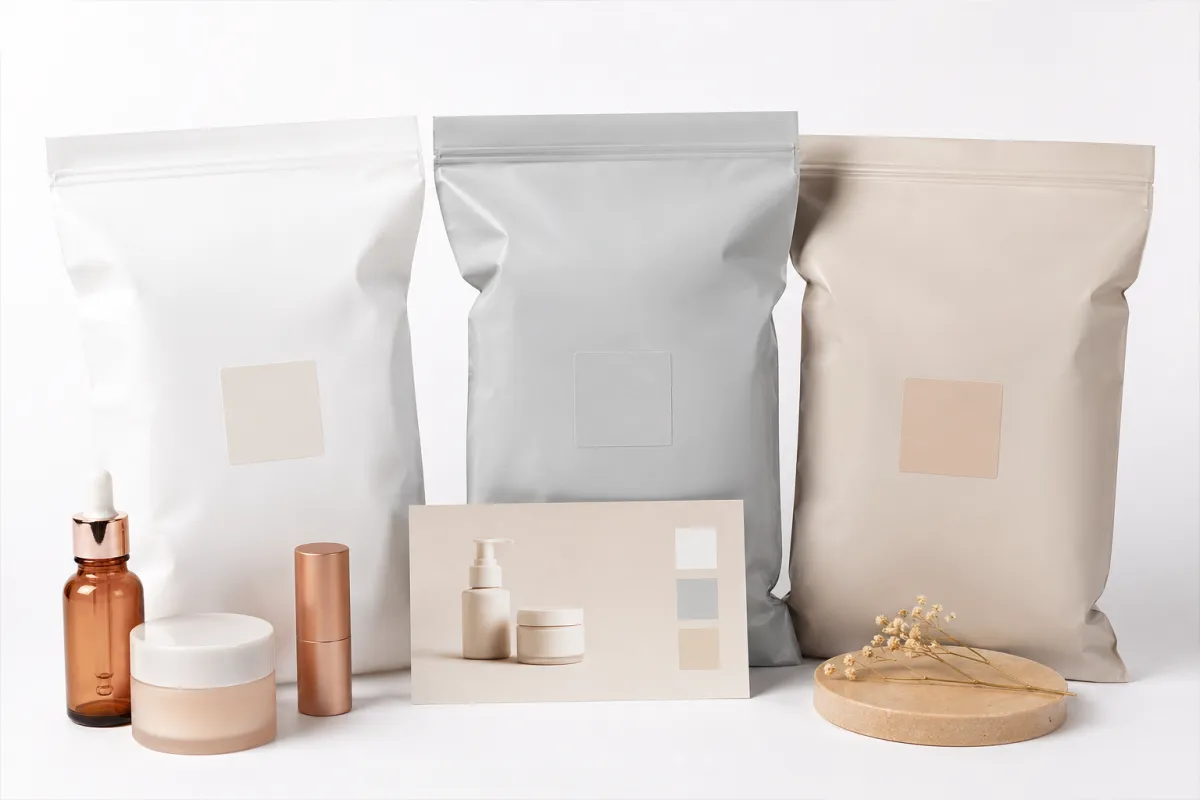
If you compare matte poly mailers for cosmetics by one feature only, you are probably going to buy the wrong one. The finish is what people notice first. The closure, gauge, and seam construction are the parts that keep a lipstick set, serum bundle, or compact from arriving with crushed corners or a split edge. From a buyer's point of view, the best matte mailer is the one that delivers a clean brand image and still survives conveyor belts, sorting bins, dock handling, and the occasional bad drop. Surface alone does not ship products.
For lightweight beauty samples, small sachet sets, or soft goods like headbands and cloth pouches, a standard 2.5 mil to 3 mil matte poly mailer is usually enough. It keeps the order neat, stays flexible, and does not add much to postage. For subscription kits and boxed skincare, I lean toward 3.5 mil to 4 mil because the extra body helps resist edge punctures and reduces the chance of the mailer bowing around the contents. If the order has hard corners, glass, or heavy inserts, a thicker co-extruded bag with a strong seal feels safer. That is the kind of practical split that matters when you compare matte poly mailers for cosmetics across real product types.
Closure style matters more than a lot of teams expect. A peel-and-seal strip speeds up packing, which is useful during launches or holiday rushes, but the adhesive has to be consistent or the whole advantage disappears. Some brands also want dual adhesive strips for returns or reuse, though I would only pay for that if the order flow truly needs it. A mailer that reopens too easily is a poor fit for cosmetics, especially when the package carries paper inserts, sample cards, or items that shift during transport. If you compare matte poly mailers for cosmetics without testing the closure under pressure, you miss one of the easiest failure points to catch early.
Here is the quick verdict by use case:
- Beauty samples and sachets: choose a lighter matte mailer with clean seal behavior and good opacity.
- Subscription kits: choose a medium-gauge mailer with better puncture resistance and a wider adhesive strip.
- Retail boxed orders: choose a thicker matte mailer or a co-extruded option that resists edge scuffing and splitting.
- Premium brand launches: choose a custom printed matte mailer that balances finish, ink coverage, and consistent quality.
A matte surface is not just about looks. It changes how the package handles fingerprints, light scuffs, and shelf presentation after packing. Glossy bags can look loud. Matte usually hides handling marks better and feels more controlled in the customer’s hand. Still, if the film is too thin, the finish can look cheap once the contents stretch the seams. That is why I keep coming back to the same idea: compare matte poly mailers for cosmetics as a full system, not as a surface treatment. Otherwise you are just buying a vibe. And vibes do not survive sorting hubs.
Top Options Compared: Matte Poly Mailers for Cosmetics
When I compare matte poly mailers for cosmetics, I usually sort them into four groups: standard matte mailers, thicker premium mailers, co-extruded matte mailers, and custom printed options. Each one can work. Each one solves a different problem. Standard bags are the easiest on the budget, premium mailers offer better body and puncture resistance, co-extruded mailers tend to feel tougher in the hand, and custom printed versions do the best job of turning the outer package into part of the brand story. The right choice depends on whether you care most about cost, performance, or presentation. Usually, you care about all three. That is the annoying part.
Standard matte poly mailers often use a lighter film and a simple peel-and-seal closure. They are common for flat beauty shipments, sample packs, and low-risk items that are already inside a secondary pouch or carton. The feel is clean, but not especially substantial. I would not use a light standard mailer for a glass bottle or a stacked set of hard compacts unless the inner packaging is doing most of the protection work. For a lot of DTC beauty brands, though, this category is the starting point when they compare matte poly mailers for cosmetics on a tight budget.
Thicker premium mailers are the next step up. A 3.5 mil to 4.5 mil film usually gives better resistance to corner pressure and a firmer hand feel that customers tend to read as more valuable. These are a better match for boxed skincare, multi-piece makeup sets, and product combinations that include rigid inserts. The bag does not collapse as easily, which helps the outer package keep a cleaner shape during handling. If you compare matte poly mailers for cosmetics with an eye on return damage, this is often where the smarter money goes.
Co-extruded matte mailers deserve real attention because the structure can improve toughness without making the bag feel bulky. The outer layer can be tuned for print quality and finish, while the inner layer contributes toughness and seal integrity. That matters for cosmetics orders that need both appearance and protection. I like these for brands that want the customer to feel a little more substance at opening, especially if the package travels through several handling points before delivery. If you compare matte poly mailers for cosmetics by transit tolerance, co-extruded construction often stands out.
Custom printed matte mailers are where branding and performance meet. A good print job on a matte surface can make a simple shipping bag look far more deliberate than a plain white poly mailer, especially when the logo is placed with restraint and the graphics are not overworked. Too much ink coverage can make a bag look flat or muddy, so the artwork has to suit the film and the finish. Beauty brands often want soft black, warm neutrals, or clean two-color layouts that feel premium without hiding the material. If you are shopping through Custom Poly Mailers, this is the route that usually gets the most brand mileage.
| Mailer Type | Typical Gauge | Best For | Approx. Unit Cost | Main Tradeoff |
|---|---|---|---|---|
| Standard matte mailer | 2.5-3 mil | Samples, sachets, soft goods | $0.12-$0.24 | Lower protection around hard edges |
| Premium thicker matte mailer | 3.5-4.5 mil | Boxed skincare, kits, mixed orders | $0.18-$0.35 | Higher cost than basic stock bags |
| Co-extruded matte mailer | 4-5 mil | Heavier kits, fragile outer packaging | $0.22-$0.42 | Usually needs better volume planning |
| Custom printed matte mailer | 3-4.5 mil | Brand launches, repeat DTC orders | $0.20-$0.50+ | Setup and print approval take longer |
Honestly, the finish is only one part of the story. A matte surface that looks beautiful in photos can still show pressure whitening on corners if the bag is too thin, and a great-looking printed bag can still fail if the seal is inconsistent. That is why I tell buyers to compare matte poly mailers for cosmetics using actual packed samples, not empty bags. A filled mailer tells you far more about the final shipment than a flat swatch ever will.
"A matte finish can sell the brand story, but seal integrity still decides whether a box arrives clean."
If you want broader packaging options around the mailer itself, the Custom Packaging Products page is a useful place to look at related cartons, inserts, and branded shipping pieces that can work together with the outer bag. For many beauty brands, the strongest result comes from matching the mailer to the rest of the pack, not treating it as an isolated purchase.
Detailed Reviews of the Best Matte Poly Mailers
To compare matte poly mailers for cosmetics in a way That Actually Helps a buyer, I look at the details that show up during packing and transit. The first is print quality. A matte film should hold logos cleanly, without the artwork looking blurry, chalky, or washed out. Fine text, subtle gradients, and small brand marks need enough contrast to stay readable after the bag is folded, stacked, and handled. If the print is too heavy, the mailer can lose the soft look that made the matte finish attractive in the first place. That balance matters more than many teams think.
The second detail is how the bag behaves around hard shapes. Cosmetics shipping is full of trouble spots: square compacts, rigid lipstick cases, dropper bottles, and outer cartons with sharp corners. A good mailer flexes around those shapes without creating stress points along the seams. A weaker bag may still look fine when it is empty, then show stretch lines or edge whitening once it is packed. That is why I recommend comparing filled test units instead of flat samples. If you compare matte poly mailers for cosmetics with the actual product inside, you get a much clearer answer.
The third detail is surface wear. Matte bags are usually better than glossy bags at hiding fingerprints, but they can still show rubbing if they are dragged across rough conveyor surfaces or stacked tightly in a shipper. Better films keep their finish longer and resist the dull patches that make the bag look tired on arrival. The stronger options often feel denser, not just darker. That extra density can be the difference between a package that arrives looking intentional and one that looks like it has already had a long day.
Here is the practical read on the categories:
- Standard matte mailers: best for low-risk cosmetic orders that are already in a box or pouch.
- Thicker premium mailers: best for mixed beauty kits, compact sets, and products with hard edges.
- Co-extruded matte mailers: best for brands that want more toughness without moving to a carton.
- Custom printed matte mailers: best for brands that want the shipping bag to reinforce identity.
One thing I check every time is seal behavior after the bag is packed, flexed, and set down a few times. A strip that looks strong in the catalog may lift slightly after the film is stretched around a box. That is not a cosmetic issue. It is a transit issue, and it shows up quickly on the receiving end. For that reason, the best mailers in this category are not just attractive; they stay shut. If you compare matte poly mailers for cosmetics and ignore the adhesive, you are missing the part that keeps the order intact.
For brands that ship through a real distribution path, it helps to think in transit tests instead of guesswork. The ISTA test methods are a strong reference point for packout and handling stress, and they are far more useful than a simple desk-side squeeze test. I do not expect a beauty startup to run a full lab program on day one, but I do expect them to borrow the same mindset: pack real product, shake it, flex it, and inspect it after the journey.
My honest take? A lot of beauty brands overspend on print and underspend on structure. That gives you a nice-looking mailer that fails a boring but essential job. The better approach is to compare matte poly mailers for cosmetics with equal weight on appearance and transport behavior, then choose the option that survives both. It does not have to be glamorous. It just has to work.
Price Comparison and Total Packing Cost
Price is the part everyone asks about first, but the lowest unit price is not always the cheapest choice. When you compare matte poly mailers for cosmetics, you should count the hidden costs too: labels, inner protection, damage replacement, packer time, and the cost of a brand impression that feels too thin or too cheap. A mailer that saves two cents but causes one percent more reships is not a bargain. For beauty brands, landed cost usually tells the truer story.
Stock matte mailers are usually the least expensive option because they do not require print setup. They work well for smaller brands testing a new product line or for teams that want to move fast without waiting on artwork approval. The price per unit is often attractive at low to mid quantities, but the branding is minimal unless you add labels or sleeves. That can still be a smart choice if the product is early-stage and the order volume is inconsistent. If you compare matte poly mailers for cosmetics before a launch, stock bags are often the least risky place to start.
Custom printed matte mailers add setup cost, proof time, and usually a higher unit price, but the economics improve as the order size rises. A small run might make the print premium feel hard to justify, while a larger reorder can make the branded bag look very reasonable once you divide the setup across thousands of units. I have seen brands pay more per piece up front and still save money overall because they eliminated extra labels, reduced packing time, and cut down on presentation fixes. That is one reason why the phrase compare matte poly mailers for cosmetics should always include brand labor, not just the bag price.
The quantity break matters a lot. Small runs are usually the most expensive per unit, mid-size runs often offer the best balance, and bulk pricing rewards brands that can forecast demand cleanly. If you are moving from a few hundred orders a month to a few thousand, the math starts to change quickly. At that point, a bag that looks a little pricier on paper may become the better buy because it speeds packing and reduces the need for secondary decoration. That is a subtle but important shift when you compare matte poly mailers for cosmetics at scale.
Here is a useful way to think about total packing cost:
- Mailer cost: the bag itself, stock or printed.
- Decoration cost: labels, stickers, or custom print setup.
- Protection cost: inserts, tissue, cartons, or bubble wrap where needed.
- Labor cost: how long each order takes to pack and seal.
- Risk cost: replacement shipments, damaged goods, and customer service time.
If you want a real-world range, a simple stock matte mailer might land around $0.12-$0.24 at modest quantities, a premium thicker bag might sit around $0.18-$0.35, and a custom printed version can run $0.20-$0.50 or more depending on size, ink coverage, and order volume. Those numbers only matter if you also look at how many seconds it takes to pack one order and how often the package has to be replaced because of transit wear. For cosmetics, one damaged compact can erase the savings from dozens of low-cost mailers.
There is also a sustainability angle to price that buyers forget. If a mailer is too light for the product, you may end up double-bagging, adding filler, or shipping replacements. That is wasteful in both materials and labor. If the packaging uses paper inserts or an outer carton, using FSC-certified material from a source like FSC can support a cleaner materials story, especially when the brand is trying to keep the whole package line consistent. Even then, the outer mailer still has to do its own job correctly. The pretty story only matters if the package arrives in one piece.
How to Choose the Right Matte Poly Mailer for Cosmetics
The easiest way to choose is to start with the product, then work outward. If you compare matte poly mailers for cosmetics by product type, the answer gets much clearer. Flat sample sets and soft items rarely need the same protection as a boxed serum kit or a rigid palette, and shipping distance can change the risk again. A local parcel route with low handling is not the same as a cross-country shipment with multiple transfer points. The mailer should match the trip, not just the SKU.
Thickness is the next decision. A lighter film can look fine with a flat load, but once the contents create hard edges, the bag needs enough body to resist puncture and seam strain. I like to test by packing the actual product, not an empty box, and then checking whether the film stretches cleanly or starts to bow, crease, or whiten. That one test tells you a lot. If the mailer feels too loose, it can fold awkwardly. If it feels too tight, the film may be working too hard. Either way, the goal is to compare matte poly mailers for cosmetics against the real load, not a hypothetical one.
Branding matters too, though I would not let branding override performance. A soft-touch matte look can feel excellent for premium skincare, especially if the artwork is restrained and the color palette is clean. A more utility-driven finish may suit a fast-moving brand that cares more about speed and repeatability than about a luxury cue. Both approaches can work. What does not work is a mailer that looks expensive but cannot keep up with the pack line. If you are deciding between a label-led setup and a fully printed outer bag, the best answer depends on order volume, artwork complexity, and how often the design changes.
Moisture, dust, and odor resistance deserve more attention than they get. Cosmetics often travel with creams, fragrance notes, sample cards, and folded literature, and the outer mailer is part of the first line of defense against the grime of transit and storage. A matte film should not feel flimsy or porous, and the seal should close cleanly enough that the customer does not get a musty or battered package. For products that can stain or leak, the outer mailer should be part of a layered package, not the only layer.
Handling and workflow are the last piece. A mailer that is awkward to store, hard to peel, or slow to close can create bottlenecks at the pack station. That matters during launches and subscription drops, when the staff needs predictable packing behavior more than anything else. If the mailer stacks well, tears cleanly from the adhesive, and opens without fighting the operator, it saves time. If it does none of those things, the savings disappear in labor. For teams comparing matte poly mailers for cosmetics across several sizes, I would always put pack line behavior in the test checklist.
A practical checklist helps:
- Product fit: does the mailer hold the item without over-stretching?
- Seal hold: does the adhesive stay closed after pressure and flexing?
- Surface behavior: does the matte finish hide scuffs, fingerprints, and rub marks?
- Shipping risk: will the order travel through low, medium, or high handling?
- Brand image: does the outer package support the price point of the product inside?
If you compare matte poly mailers for cosmetics using those five checks, the right option usually shows itself without a fight. The choice stops being theoretical and starts feeling like a production decision, which is where it belongs.
Process and Timeline: Sampling, Printing, and Launch
A clean buying process saves time later. I like to move from sample request to filled sample testing before any bulk order gets approved, because a flat swatch can hide almost all of the issues that matter. A good supplier will let you review material feel, finish, closure, print layout, and size fit before production begins. That step matters even more when you compare matte poly mailers for cosmetics across multiple sizes, because a bag that works for a serum box may be wrong for a compact kit or a mixed gift set.
Testing with actual cosmetics is the key. Empty cartons do not behave like a real order. A bottle of lotion shifts differently than a cardboard insert, and a palette with a hard edge creates pressure where a soft sample would not. I like to pack a few real units, seal them, and then do a basic stress check: shake them, flex the corners, press on the adhesive area, and inspect the package for whitening or seam creep. That is not fancy science, but it is close to what the package faces in normal handling. If you compare matte poly mailers for cosmetics without this step, you are asking the wrong object to answer the question.
For stock mailers, the timeline is usually straightforward. Once the quantity and size are confirmed, the order can move through packing and shipment quickly, and the main variable is transit time to your facility. Custom Printed Mailers take longer because artwork has to be checked, proofs have to be approved, and production needs a slot. Depending on the print complexity and quantity, that can add meaningful lead time. For a launch, I would not cut that timeline too close. Beauty brands that run seasonal campaigns or subscription drops need enough buffer to absorb proof changes, carrier delays, and a possible reorder.
Here is a simple planning range:
- Sample review: 2-5 business days after material selection, depending on stock availability.
- Proof approval: 1-3 days if artwork is already clean and sized correctly.
- Production: often 12-15 business days for custom print, sometimes faster for simple runs and sometimes longer for complex coverage.
- Transit and receiving: depends on lane and carrier, but it is smart to leave extra room for inspection and put-away.
The best way to lower launch risk is to run a small pilot. Send a few parcels through normal fulfillment, then inspect the arrivals for seal integrity, corner wear, and print rub. If the adhesive is holding, the matte surface is staying clean, and the package looks consistent after handling, you can scale with more confidence. If something looks off, the pilot gives you a chance to adjust before the larger order is locked in. That is much cheaper than discovering a weak point after a few hundred orders have already gone out.
At this stage, it helps to compare related pack pieces too. Sometimes a beauty brand does not need a different mailer as much as it needs a better insert, a more rigid inner box, or a stronger shipping label strategy. That is where the broader Custom Packaging Products catalog can help a team see how the outer mailer fits into the full packaging system instead of treating every item as a separate purchase. Good pack design is often a chain, and the weakest link usually shows up fast once you test it.
From a production standpoint, the most common mistake is ordering too late. If your brand runs a promotion, a holiday set, or a subscription wave, build in reorder lead time before stock gets tight. A packaging line waiting on mailers costs more than one that is planned correctly. And if you compare matte poly mailers for cosmetics with the calendar in mind, you are more likely to choose a size and finish that still makes sense after the campaign starts.
Our Recommendation and Next Steps
My recommendation is simple: match the mailer to the product, the shipping risk, and the image you want the customer to feel the moment the package lands in their hands. For lightweight samples and small beauty add-ons, a standard matte mailer is usually enough and keeps the cost down. For boxed skincare, gift sets, and orders with hard edges, a thicker premium or co-extruded bag is the safer choice. For brands that rely on unboxing as part of the sale, custom printed matte mailers are usually worth the extra planning because they turn the outer bag into part of the experience. That is the cleanest way to compare matte poly mailers for cosmetics without getting lost in surface details.
If the priority is premium branding, I would start with a custom printed matte option that uses restrained artwork, a strong adhesive, and enough film body to keep the package looking crisp after transit. If the priority is budget shipping, a stock matte mailer with a reliable seal is often the better first step, especially for sample-heavy orders. If the priority is heavier kits, I would step up the gauge and check whether a co-extruded structure can give more toughness without adding too much bulk. In every case, the better choice is the one that survives real handling while still supporting the brand story.
Here is the short action plan I would use:
- Order samples in the right sizes for your actual cosmetic products.
- Pack real units, not empty boxes.
- Test seal hold, corner pressure, and surface scuffing.
- Compare stock and custom pricing at your real order volume.
- Run a small shipping pilot before you commit to a bulk run.
That sequence is boring in the best way. It keeps the decision grounded in how the packaging behaves, not just how it looks on a screen. If you are weighing finish, print quality, and total cost, the right answer usually shows up once the package is full and the adhesive is closed. That is why I keep urging buyers to compare matte poly mailers for cosmetics with actual product and actual shipping conditions, because that is where the truth lives.
For teams that are ready to move beyond plain stock packaging, the next step is to review custom print options, request a sample that matches your product weight, and look at the pack line from start to finish. The best-looking bag is not always the best performer, and the cheapest bag is not always the least expensive choice once damage and labor are counted. If you compare matte poly mailers for cosmetics with that fuller picture in mind, you will usually land on the option that protects the product, supports the brand, and keeps operations predictable. That is the choice worth making.
What thickness should I choose when I compare matte poly mailers for cosmetics?
Use a lighter gauge for flat, low-fragility items like sample cards, sachets, and soft accessories. Choose a thicker mailer when the order includes boxes, jars, or rigid cosmetic packaging with hard edges. The better rule is to match thickness to puncture and stretch risk, not just to the product weight.
Are matte poly mailers good for shipping skincare and makeup products?
Yes, they work well when the product is already protected in a secondary carton, pouch, or insert system. They are especially useful for lightweight beauty orders that need a polished outer appearance without the cost of a full box. For liquid-heavy or fragile items, use an inner package that can handle the product safely before it goes into the mailer.
How much more do custom matte poly mailers for cosmetics usually cost?
Custom printing usually adds setup cost and a higher unit price than stock mailers. The premium becomes easier to justify as order volume rises and branding matters more to the sale. I would always compare total landed cost, including labels, labor, and replacement shipments, before deciding.
Can matte poly mailers protect glass jars and liquid cosmetics?
They can help with outer protection, but they should not be the only layer around fragile glass or leak-prone liquids. Use an inner box, padded wrap, or sealed bag for products that can crack, spill, or stain. Test one fully packed order before buying in bulk so you know how the package behaves in real handling.
How do I test a matte poly mailer before ordering in bulk?
Pack real products, seal the bag, and shake, flex, and corner-load it to mimic transit stress. Check whether the adhesive holds after pressure and whether the matte surface shows scuffs or fingerprints. Ship a few test parcels through normal carriers and inspect them on arrival before scaling up.


